

Common App Fees & Fee Waivers: What It Costs and How to Apply Free
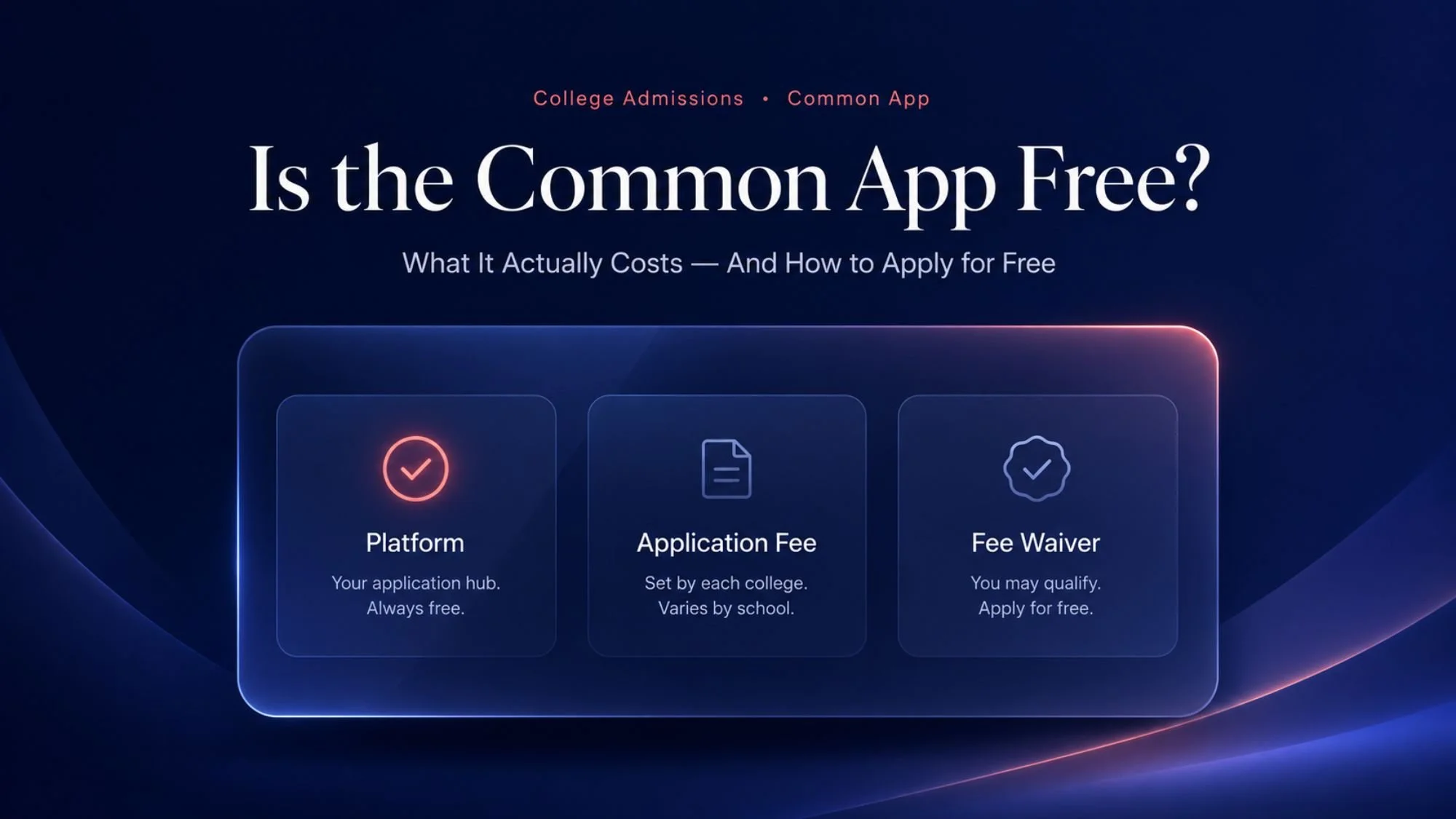
“Is the Common App free?” comes up in nearly every family meeting we sit down for at HYE Tutors, and the honest answer has two parts. The Common App platform itself doesn't cost you a cent. But once you're ready to submit to a specific college, that college charges its own fee — and that's the part that catches families off guard. We've walked dozens of first-generation and lower-income students through exactly this question, and no student we've worked with has ever been shut out of applying because of cost. In the next few minutes, you'll know exactly what things cost, what fee waivers cover, and whether you qualify to apply for free.
Is the Common App Free? Costs, Fees & What You Actually Pay
When families ask us this, we've learned to answer by separating the platform from the application. The platform is absolutely free — you can build an entire profile, write your essays, upload documents, everything. But when you hit “submit” for a specific college, that college charges you a fee. It's the difference between opening a door and walking through it.
The Common App Platform Is Free
Creating a Common App account costs $0, with no catch.
Writing and storing essays, building your profile, uploading transcripts, and requesting recommendations are all included at no cost.
You can browse college requirements and deadlines on the platform freely, before committing to apply anywhere.
For students who are first-generation applicants, this matters more than it might seem: you can start the entire process — research, essay drafts, building your list — without spending a dollar upfront.
Mentor Tip:
The Common App itself doesn't make money from you — the colleges do. Use the platform freely to explore and plan before you commit to applying anywhere.
Per-College Application Fees: What Each School Charges
Once you're ready to submit, each school sets and collects its own fee. Amounts vary, and they can change year to year, so always confirm the current number on the school's own admissions page before you submit.
| School Type | Typical Fee | Notes |
|---|---|---|
| Most public universities | $60–$85 | Often lower for in-state applicants |
| Ivy League & elite privates | $75–$90 | Fairly consistent across most selective schools |
| Large state university systems | $65–$95 | Pricing can vary by campus within a system |
| Smaller liberal arts colleges | $50–$80 | Frequently lower than large universities |
| Nearly half of Common App schools | $0 | No application fee at all — filterable on the platform |
You pay per school, not per platform — one Common App profile can go to as many member colleges as you choose, but each one bills separately. Apply to 10 schools at roughly $80 each, and you're looking at about $800 total. That math is exactly why fee waivers matter so much.
Mentor Tip:
A student applying to 15 schools without fee waivers could be looking at well over $1,000 in fees. That's a real number for any family, and it can be the deciding factor for families facing financial hardship — which is precisely why fee waivers exist.
What Happens If You Don't Pay the Fee?
If you submit an application without paying the fee or applying a waiver, the school does not receive it — it sits unsubmitted.
You'll typically get a payment reminder; the application stays in pending status until the fee is paid or a waiver is processed.
Schools don't hold incomplete applications indefinitely, so don't let a payment notice sit unanswered.
Pay the fee or apply for a waiver before your deadline — don't assume a reminder email can wait.
How to Get a Common App Fee Waiver
One of the most important conversations we have with families is about fee waivers. A fee waiver isn't charity — it's a recognition that college costs are high, and schools want talented students applying, not just well-funded ones. If you qualify, you deserve to use it.
Who Qualifies?
According to Common App's official fee waiver guidance, you generally qualify if any one of the following is true for you:
You currently receive, or are eligible for, free or reduced-price lunch at your high school.
You've received or are eligible for an SAT or ACT testing fee waiver.
Your family income falls within the USDA's income eligibility guidelines, or your family receives public assistance.
You participate in a college access program such as TRIO, Upward Bound, GEAR UP, or QuestBridge.
You live in federally subsidized housing, a foster home, or are experiencing homelessness — or are a ward of the state.
You are a veteran of the U.S. Armed Forces, or a parent/guardian is currently serving.
Mentor Tip:
We've never worked with a student who genuinely qualified for a fee waiver and didn't get one approved. If you're unsure, ask your counselor or the college's admissions office directly — never assume you don't qualify.
Three Ways to Apply for a Fee Waiver
1. Through the Common App platform. In the “Profile” section of your Common App account, look for the fee waiver question, answer honestly, and sign the request digitally. Your school counselor then certifies it, and once approved, the waiver applies automatically to every Common App school on your list.
2. Through your school counselor. Many high schools sponsor group fee waivers for eligible students. Ask directly — counselors expect this question and have helped other students through it many times before.
3. Through the college directly. Some schools run their own school-specific waiver, found under “Member Questions” once that college is added to your list. If a school doesn't offer one, you can also email the admissions office and explain your situation — many colleges will work with you case by case.
Fee Waiver Eligibility Checklist
☐ I currently receive, or have received, free or reduced-price lunch in high school
☐ I participate in TRIO, Upward Bound, GEAR UP, QuestBridge, or a similar college access program
☐ My family's income falls within USDA guidelines, or my family receives public assistance
☐ I am a foster youth, homeless youth, or ward of the state
☐ A parent or guardian is currently serving, or has served, in the U.S. military
☐ My school counselor has offered group fee waivers to eligible students
If you checked even one box, you very likely qualify — move on to the application steps above. If you're unsure, talk to your counselor or email the college's admissions office and ask directly.
FAQs
Q: Is the Common App completely free?
A: The platform is — account creation, essays, uploads, and recommendation requests all cost nothing. Each college you apply to charges its own fee, typically $75–$90, unless you qualify for a waiver.
Q: How much does it cost to apply through Common App?
A: It depends entirely on your school list. Five schools at roughly $80 each runs about $400 total without a waiver; with an approved fee waiver, that cost drops to $0 for every participating school.
Q: Can one fee waiver cover all my Common App schools?
A: Yes — an approved Common App fee waiver applies to every Common App member school on your list. Schools outside the Common App, like UC campuses or Coalition App schools, need their own separate waiver request.
Q: Is there an income limit for a fee waiver?
A: There's no single fixed number — it depends on USDA income guidelines, family size, and state. Common App doesn't ask for exact income; it asks about free/reduced lunch status and program participation as the main indicators.
Q: How long does approval take?
A: A request submitted through your Common App profile is typically reviewed within a few days once your counselor certifies it. Counselor-sponsored group waivers are often immediate. Apply early — September or October — to avoid bottlenecks near deadlines.
Once you understand costs and waivers, the natural next step is understanding what each application actually requires. Our guide on What is Common App? Everything You Need to Know walks through every section and document you'll need, and Which Colleges Use the Common App confirms whether your target schools are on the platform at all.
The One Rule That Matters Most
Here's the recap: the Common App platform is free. Applying to a specific school typically costs $75–$90, but fee waivers exist precisely to remove that barrier for students who qualify — and they're not a special favor. They're how the system is designed to work.
Don't let application costs keep you from applying to your reach schools. Requesting a fee waiver code takes about five minutes and can save a family hundreds of dollars. So — is the Common App free? The platform is. Your applications to specific schools have fees, but a waiver removes that barrier entirely if you qualify.
If you're unsure whether you qualify for a fee waiver, or you want help mapping your full application timeline and costs, our advisors at HYE Tutors can walk you through it step by step — no pressure, just clarity. Book a free 20-minute session anytime.
About the Author:
This guide was written by a college admissions mentor at HYE Tutors with over eight years of experience helping students navigate the application process, with a particular focus on first-generation and low-income student support. A graduate of USC, they've personally guided dozens of students through fee waiver applications and Common App submissions, and have supported students gaining admission to Ivy League, UC, and other top-tier institutions nationwide — regardless of what they could afford to pay in application fees.