

How to Format a College Essay: The Complete Guide for 2025 Applications
It's 11 p.m. You've just finished the hardest paragraph you've ever written. Your college essay is done — finally. And then a small, nagging question surfaces: wait, does my formatting even look right?
It's a moment we see constantly at HYE Tutors, and the answer matters more than most students expect. Knowing how to format a college essay correctly is one of those rare things in the application process that is entirely within your control — and entirely fixable in under an hour. The good news is that once you know the rules, you'll never second-guess them again.
As a team of college counselors and essay coaches with affiliations at Columbia, UCLA, and UC Berkeley — with over seven years of experience guiding students through Common App, Coalition App, UC Application, and QuestBridge cycles — we've watched brilliant essays lose impact simply because of formatting missteps that took ten minutes to fix. We've also watched students waste hours worrying about formatting when the solution was straightforward all along.
In this guide, you'll get the exact formatting specifications you need, platform-by-platform rules, a pre-submission checklist, and the most common mistakes to avoid. Parents will find this equally useful — consider bookmarking it for the weeks ahead.
“A college essay should be written in a 12-point standard font (Times New Roman, Arial, or Calibri), double-spaced, with 1-inch margins on all sides. The standard word limit is 650 words for the Common App. Do not include a title unless specifically requested. Use standard paragraph breaks, avoid headers or bullet points, and write in first person. Always review your essay inside the application portal before submitting — formatting often shifts when you paste.”
How to Format a College Essay — The Complete Guide
In seven years of working with college applicants, the most avoidable crisis we see is the paste problem: a student spends weeks perfecting their essay in Google Docs, then pastes it into the Common App portal on deadline night and watches the paragraphs collapse, the spacing shift, and the careful line breaks disappear. Let's make sure that never happens to you. Here's every formatting element you need to get right, one by one.
College Essay Font, Size, and Spacing Requirements
Students often ask us if there's a "best" font for a college essay. There is — and it's not as exciting as you might hope. The goal is readability and professionalism, not personality. Here are the non-negotiables:
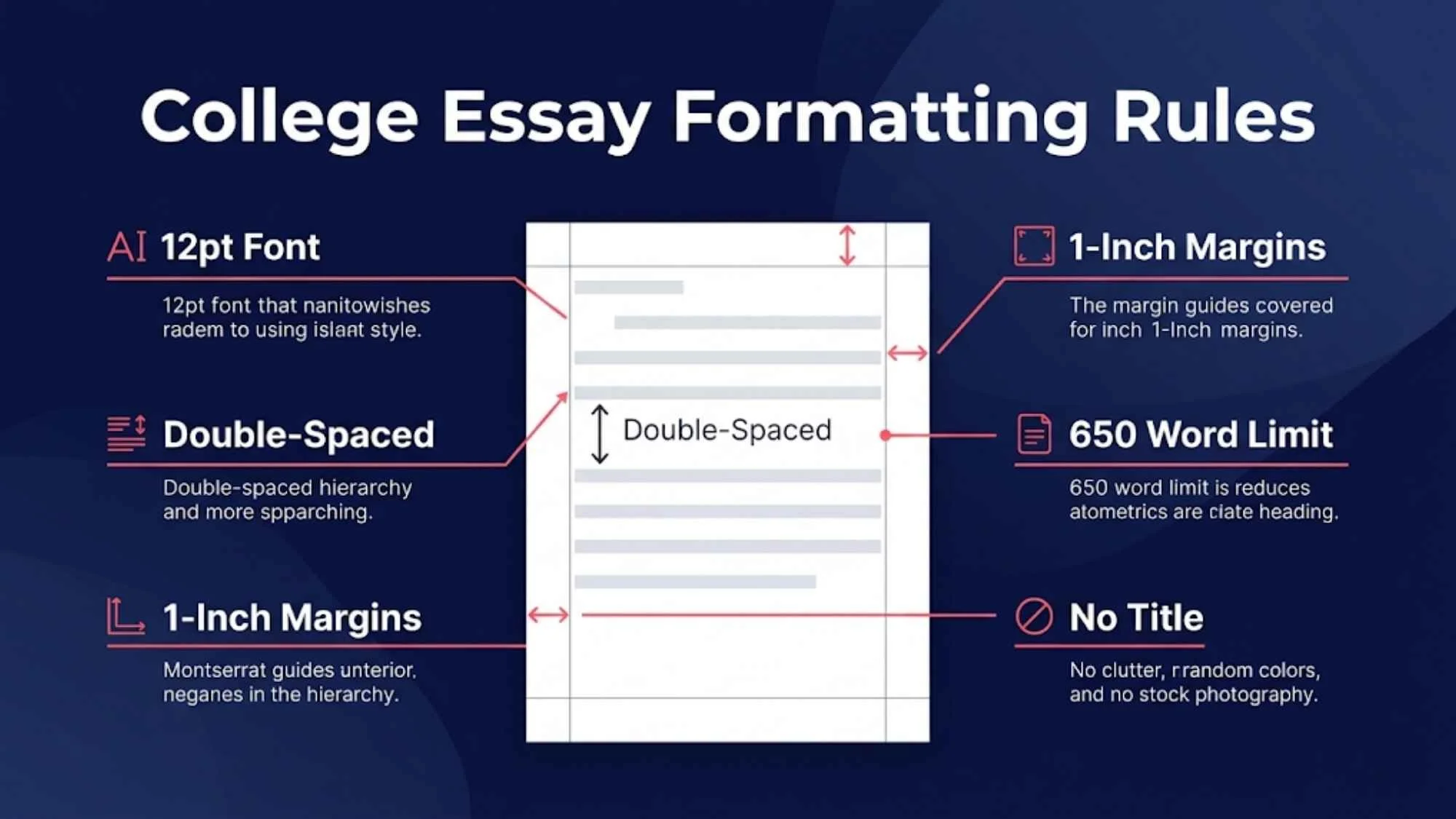
Font: Times New Roman, Arial, or Calibri. These are universally accepted across every application platform and every admissions office. When in doubt, Times New Roman is the safest choice.
Font size: 12-point. Do not go smaller to squeeze in extra content — admissions officers notice. Do not go larger to appear more substantial — they notice that too.
Line spacing: Double-spaced throughout the entire essay, including within paragraphs. Not 1.5. Not "Exactly 24pt." Double.
Paragraph spacing: Do not add extra blank lines between paragraphs beyond what double-spacing already provides. Uniformity is the goal.
Why does this matter? Admissions officers at competitive schools read hundreds — sometimes thousands — of essays in a cycle. Readable formatting is a silent signal that you understand professional norms. It removes friction between your words and their attention.
College Essay Margins and Page Layout
Margins are one of those formatting elements students assume are fine by default — and they usually are, as long as you've checked. Here's what correct looks like:
Standard margins: 1 inch on all four sides — top, bottom, left, and right. This is the default in Google Docs and Microsoft Word, but confirm it before you finalize.
Do not adjust margins to fit more content. Narrowing margins to squeeze in extra words is immediately noticeable and reads as a workaround, not craftsmanship.
Headers and footers: Generally unnecessary for college essays. Do not include your name, page numbers, or a running header unless a specific platform explicitly asks for it. Most don't.
Think of margins as white space that gives the reader's eye room to breathe. A crowded page — even with excellent content — creates subtle visual fatigue that works against you.
College Essay Word Count — How Long Should It Be?
Word count is one of the most searched questions about college essays, and for good reason — the rules vary by platform. Here's the breakdown:
Common App main essay: 650 words maximum. This is a hard cap — the portal will not let you submit more. The ideal target is 600–650 words.
Coalition App: 500–650 words recommended, depending on the prompt.
UC Application (University of California): 350 words per prompt; you answer 4 of 8 Personal Insight Questions.
Supplemental essays: Word limits vary significantly by school — anywhere from 50 to 650 words. Always verify each school's specific requirements on their admissions page.
Every year, students ask us whether they should use every single word available. Our answer is consistent: get within 50 words of the limit. Not over — ever. But never more than 10% under. An essay that's 400 words for a 650-word prompt signals either a lack of depth or a failure to take the prompt seriously. Use the space you're given.
Should a College Essay Have a Title?
The short answer: no. For the Common App main essay, a title is not expected, not required, and takes up word count you'd be better off spending on your actual story.
A few important nuances:
Some scholarship applications or individual school supplements may specifically request a title. Always follow the explicit instructions for that application.
If you feel strongly about including a title despite this advice, keep it to 5 words or fewer — and do not count it in your word limit.
College Essay Structure — Paragraphs, Openings, and Flow
Formatting isn't only visual — it includes how your essay is built internally. A well-structured essay guides the admissions reader through your story without them realizing they're being guided.
Here's the structure that works for a standard 650-word Common App essay:
Opening paragraph (1–3 sentences): Drop the reader directly into a scene, moment, or image. No throat-clearing. No "I have always believed..." The first line is the most important sentence in your essay.
Body paragraphs (2–4 paragraphs): Develop the story, reflection, or argument. Each paragraph should do one clear job and connect to the next.
Closing paragraph: Pull back from the story. What does it mean? What does it say about who you are — and who you're becoming? Connect, briefly, to your future.
A few structural rules that apply regardless of content:
No headers or bullet points inside the essay body. This is a personal narrative, not a resume or a report.
No more than 4–6 paragraphs for a 650-word essay. If you have more, they're probably too short to carry weight.
Transitions between paragraphs should feel natural. Avoid "Furthermore," "In conclusion," or "As a result" — these are essay conventions for a different kind of
Here's a quick comparison of strong vs. weak openings:
| Weak Opening | Strong Opening |
|---|---|
| "I have always been passionate about science." | "The beaker cracked at exactly the wrong moment." |
| "Webster's Dictionary defines leadership as..." | "My grandmother never finished high school. I thought about that every day of freshman year." |
| "Ever since I was young, I knew I was different." | "3:47 a.m. The app was still running. So was I." |
How to Format a College Essay in Google Docs vs. Microsoft Word
Most students draft in Google Docs or Microsoft Word before copying into the application portal. Here's how to make sure your settings are correct in each:
Google Docs: Go to File → Page Setup → set all margins to 1 inch. Then Format → Line & Paragraph Spacing → Double.
Microsoft Word: Go to the Layout tab → Margins → Normal (1 inch). Then Home → Line Spacing → 2.0.
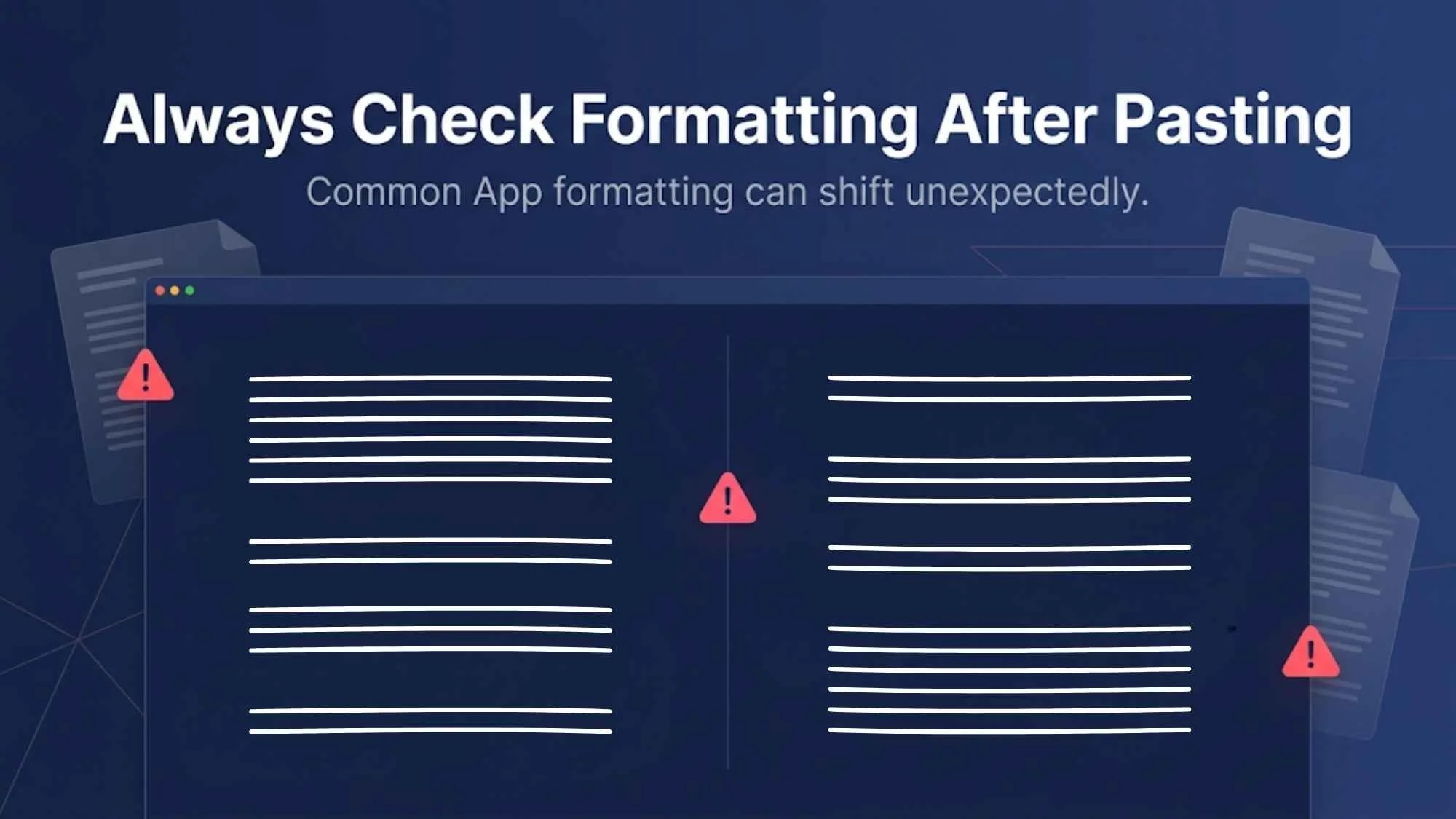
Because of this, we recommend that every student paste their essay into the Common App text editor at least two weeks before the deadline — not the night before. Every single time we do this exercise with students, something unexpected appears: a paragraph that fused, a dash that became a question mark, a line break that vanished. Give yourself time to fix it.
After pasting: re-read the entire essay inside the portal. Read it slowly. What you see in that text box is exactly what admissions officers will see.
Formatting Rules for Specific College Application Platforms
Applying to multiple schools means navigating multiple platforms. Here's what each major one requires:
Common App: 650-word limit, plain text box, formatting stripped on paste. The most widely used platform — nearly 1,000 colleges accept it.
Coalition App: Similar plain text interface; slightly different word ranges per prompt. Used by many selective schools alongside Common App.
UC Application: Eight Personal Insight Questions; you answer four. Each response is capped at 350 words. Formatting rules are the same — plain, direct prose.
QuestBridge: Has its own essay prompts and word limits, which update annually. Check their official site before each cycle.
Individual school portals: Schools like MIT and Georgetown have their own application systems. Always verify formatting requirements directly on the school’s admissions page before submitting.
College Essay Format Examples — What a Correctly Formatted Essay Looks Like
Rules are one thing. Seeing them in practice is another. Here's what a properly formatted 650-word college essay looks like before it goes into the application portal — and a sample opening paragraph to illustrate structure and tone.
Sample Essay Opening (Model — Not a Real Application Essay): 12pt Arial, double-spaced, no title, 1-inch margins.
Notice what this opening does: it drops into a specific moment, raises an immediate question (what were they fixing?), and ends with a reflection that gestures toward the larger theme without explaining it outright. That structure — scene, tension, meaning — is the engine of most successful personal statements.
| Pre-Submission Formatting Checklist |
|---|
| ☑ Font: Times New Roman, Arial, or Calibri — 12pt |
| ☑ Spacing: Double-spaced throughout (not 1.5, not "automatic") |
| ☑ Margins: 1 inch on all four sides — confirmed in page settings |
| ☑ Word count: Within 50 words of the platform's limit |
| ☑ No title (unless the platform specifically requests one) |
| ☑ No headers, bullet points, or bold text inside the essay body |
| ☑ Pasted into the application portal — reviewed for formatting changes |
| ☑ Read aloud once for flow, pacing, and any remaining errors |
| ☑ Supplemental essay limits checked and confirmed for each school |
Want an experienced tutor to review your essay's formatting and content before you submit? Book a session with HYE Tutors and we'll go through it together.
Common College Essay Formatting Mistakes to Avoid
After reviewing hundreds of essays across seven years of college counseling, the formatting mistakes we see are remarkably consistent — and almost always avoidable. Here they are:
❌ Going over the word limit. The Common App text box will cut your essay off at 650 words. Anything beyond that disappears — and you may not even realize it. Always confirm your final word count before pasting.
❌ Submitting significantly under the word limit. A 400-word essay for a 650-word prompt signals an incomplete effort. Admissions officers notice. Use the space available to you.
❌ Forgetting to review after pasting. The portal strips all formatting. Always re-read the essay inside the application before submission — not in your Word document.
❌ Using small or decorative fonts. 10pt font to squeeze in extra words. 14pt to look more substantial. Fancy fonts to stand out. None of these work. All of them read as workarounds.
❌ Including a title. It costs word count and rarely adds value. Your opening sentence is your title.
❌ Using bullet points or headers inside the essay. A college essay is a personal narrative, not a list. If it looks like a resume, it won't read like a story.
❌ Submitting a PDF when plain text is required. Some portals require plain text or specific file formats. Check the file type requirements before uploading anything.
❌ Treating supplemental essays as afterthoughts. Each school's supplement has its own word limit and formatting requirements. We've worked with students who polished their main essay for weeks and then dashed off supplements in an hour — that imbalance shows.
College Essay Format vs. College Essay Content — What Matters More?
Students sometimes ask us: if my essay is genuinely great, does formatting really matter? It's a fair question, and the honest answer is nuanced.
Content is king. Your story, your voice, your reflection — those are what get you admitted. A perfectly formatted essay with weak content won't move anyone. Formatting is not a substitute for a compelling personal statement.
But here's the thing: formatting is the frame around your content. A beautiful painting in a broken frame still looks careless. Admissions officers who read thousands of essays aren't consciously penalizing bad formatting — but poor formatting creates subtle friction that makes even strong writing harder to absorb.
We've worked with students whose essays contained genuinely moving stories, written in 10pt font, single-spaced, with no paragraph breaks. The story was there. The reader had to fight to find it. Don't make admissions officers work harder than they need to.
The practical takeaway: formatting should take less than an hour to get right. Once it's handled, put it out of your mind and return your full attention to the writing itself. That's where the real work — and the real reward — lives.
According to the Common App's own guidance for applicants, the essay is your opportunity to tell your story in your own voice. Formatting is what ensures that voice reaches the reader intact. And per the College Board's advice on the college application process, how you present your application reflects on your overall attention to detail.
Once your formatting is sorted, the real work begins. We've put together resources on analytical thinking and academic preparation throughout our blog — including guides for students applying to STEM programs, like our piece on the Pythagorean theorem and foundational math skills — that pair well with the application process for students who want to present a complete, polished academic profile.
FAQs
What font should I use for a college essay?
Use Times New Roman, Arial, or Calibri at 12-point size. These are universally accepted across all major application platforms. Standard fonts signal professionalism and ensure your essay renders correctly in every reader's environment — don't try to stand out with your typography.
Should a college essay be double-spaced?
Yes. Double-spacing is the standard for college essays across all platforms. This applies within every paragraph, not just between them. If you're submitting to a platform with a plain text box (like Common App), spacing may not carry over — confirm by reviewing your essay inside the portal after pasting.
How many paragraphs should a college essay have?
For a 650-word essay, aim for 4–6 paragraphs. There's no strict rule — structure should serve your story. A powerful three-paragraph essay beats a meandering six-paragraph one. What matters is that each paragraph earns its place and connects clearly to the next.
Can I use bold or italic text in a college essay?
Generally, no. Avoid bold and italic text inside the essay body — they're stripped when pasted into most application portals anyway, including Common App. More importantly, a well-written sentence doesn't need formatting for emphasis. If you find yourself reaching for bold, consider rewriting that sentence instead.
Does the Common App have a formatting template?
No downloadable template exists. The Common App uses a plain text box for the main essay. All formatting decisions — font, spacing, margins — are made in your word processor before pasting. Once pasted, the portal applies its own rendering. This is why reviewing your essay inside the portal before the deadline is non-negotiable.
What happens if my college essay is over 650 words?
The Common App text box enforces the 650-word cap strictly — if your essay exceeds the limit, the excess is cut off and will not be submitted. You may not be alerted clearly when this happens. Always confirm your word count in your word processor before pasting, and verify once more inside the portal.
Do supplemental essays have different formatting rules?
Yes. Each school sets its own word limits and formatting requirements for supplemental essays — these range from 50 to 650 words depending on the prompt and school. Never assume a supplemental follows the same rules as the Common App main essay. Check each school's admissions page directly and track requirements in a spreadsheet as you go.
Conclusion
You came to this guide stressed about formatting. You're leaving with the exact rules, a checklist, and a clear picture of what correct looks like. That's the goal.
Here's what to remember: 12-point standard font, double-spaced, 1-inch margins, within 50 words of the word limit, no title, and paste your essay into the portal early to check for formatting changes. That's it. That's how to format a college essay correctly, and it takes less time than you've probably already spent worrying about it.
In all our years of college essay coaching, we've never met a student who couldn't get formatting right once they knew the rules. The harder work — writing the essay itself, finding your story, shaping your voice — is where you'll spend your best energy. Formatting is the foundation. Now build something worth reading on top of it.
For more on crafting a strong application, Khan Academy's college admissions resources offer excellent free guidance on everything from test prep to application strategy.
If you'd like an experienced tutor to review both your formatting and essay content before submission, our team at HYE Tutors is ready. We've guided hundreds of students from first draft to final submission — and we'd love to help you get there too.
About the Author
This article was written and reviewed by college admissions coaches affiliated with Columbia University, UCLA, and UC Berkeley, with more than seven years of experience guiding students through every stage of the college application process — from brainstorming essay topics to final submission. Our tutors have worked with students applying to Ivy League schools, UC campuses, QuestBridge programs, and everything in between. At HYE Tutors, we believe every student deserves the same quality of guidance — clear, specific, and grounded in real application experience.