

What Is A Complex Sentence? Definition and Example
Understanding "what is a complex sentence" is one of the most valuable grammar skills you can develop. Complex sentences allow writers to express relationships between ideas — showing cause and effect, time sequences, conditions, and contrasts — all within a single, flowing sentence.
If you've ever felt confused by the difference between complex, compound, and compound-complex sentences, you're in good company. The terminology can feel overwhelming at first, but the concepts themselves are straightforward once you see how they work.
This guide will walk you through everything you need to know: what complex sentences are, how to build them, which signal words to look for, and how to punctuate them correctly. By the end, you'll be able to identify and create complex sentences with confidence.
“A complex sentence is a sentence that contains one independent clause and at least one dependent clause. The dependent clause cannot stand alone and often begins with words like “because,” “although,” or “when.” Example: Because it was raining, we stayed inside.”
What Is a Complex Sentence?
A complex sentence is a powerful tool in any writer's toolkit. Unlike simple sentences that express one idea, complex sentences let you show how ideas connect — which one depends on the other, which came first, or under what conditions something happens. This makes your writing more sophisticated and your meaning clearer.
Writers use complex sentences to add depth without adding length. Instead of writing two separate sentences, you combine them in a way that shows their relationship. The result is writing that flows naturally and keeps readers engaged.
Definition
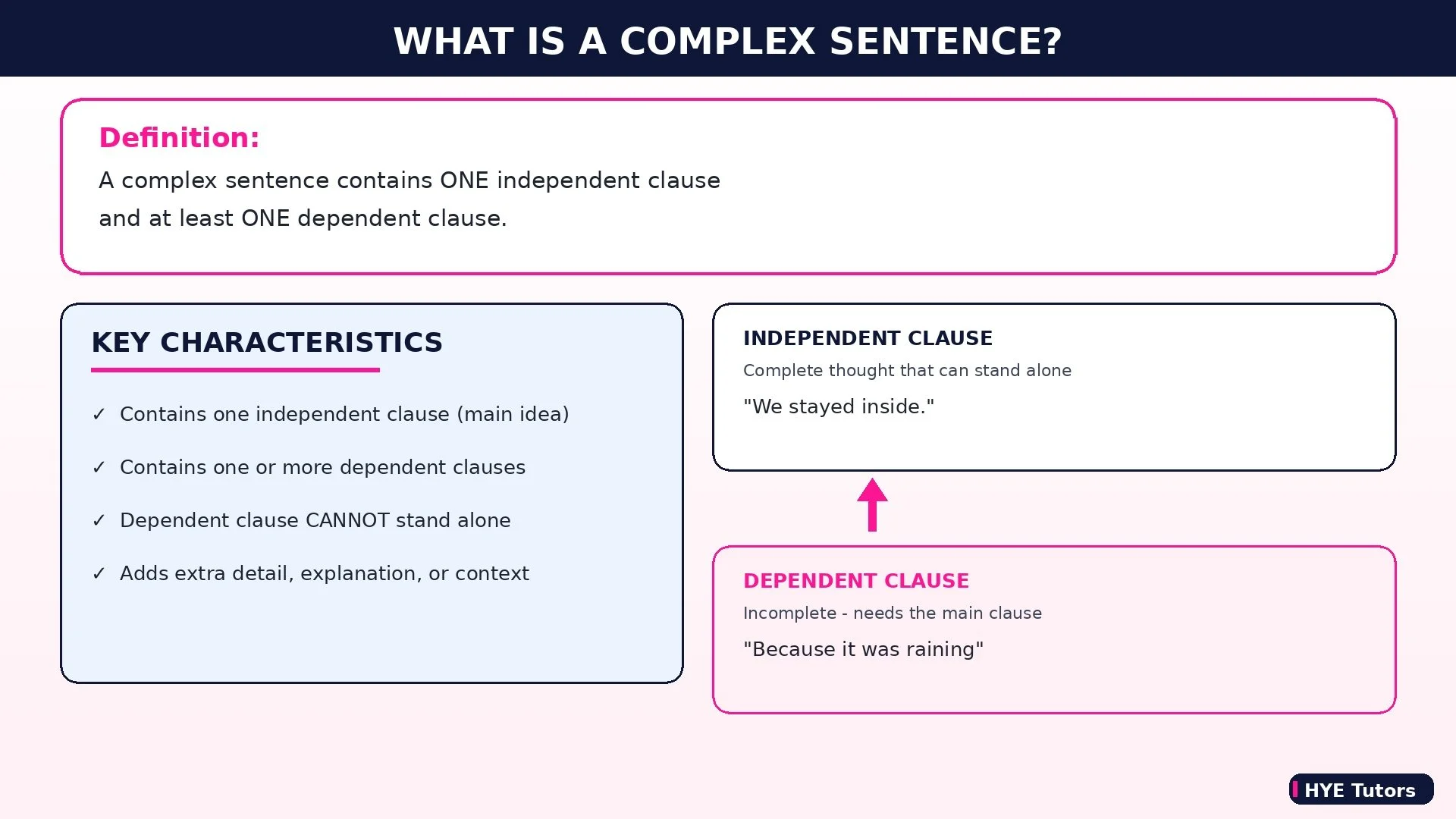
In plain English, a complex sentence contains one independent clause and at least one dependent clause. The independent clause expresses a complete thought and could stand alone as a sentence. The dependent clause adds extra information but cannot stand alone — it "depends" on the main clause to make sense.
The Purdue Online Writing Lab explains that recognizing these clause types is fundamental to understanding sentence structure in English.
Key characteristics of complex sentences:
• Contains one independent clause (the main idea)
• Contains one or more dependent clauses (supporting information)
• The dependent clause cannot stand alone as a complete sentence
• Adds extra detail, explanation, or context to the main idea
Structure
The structure of a complex sentence is flexible — you can place the dependent clause at the beginning, middle, or end of the sentence. This flexibility allows writers to emphasize different parts of their message and create varied sentence rhythms.
The basic structure includes:
• Independent clause: A complete idea with subject + verb that can stand alone
• Dependent clause: An incomplete idea that starts with a subordinating conjunction
• Connection: Joined by subordinating conjunctions like "because," "when," or "although"
• Word order matters: Clause placement affects comma usage
Example: "When the bell rang (dependent), the students rushed to lunch (independent)." The dependent clause "when the bell rang" cannot stand alone.
Subordinating Conjunctions (Signal Words)
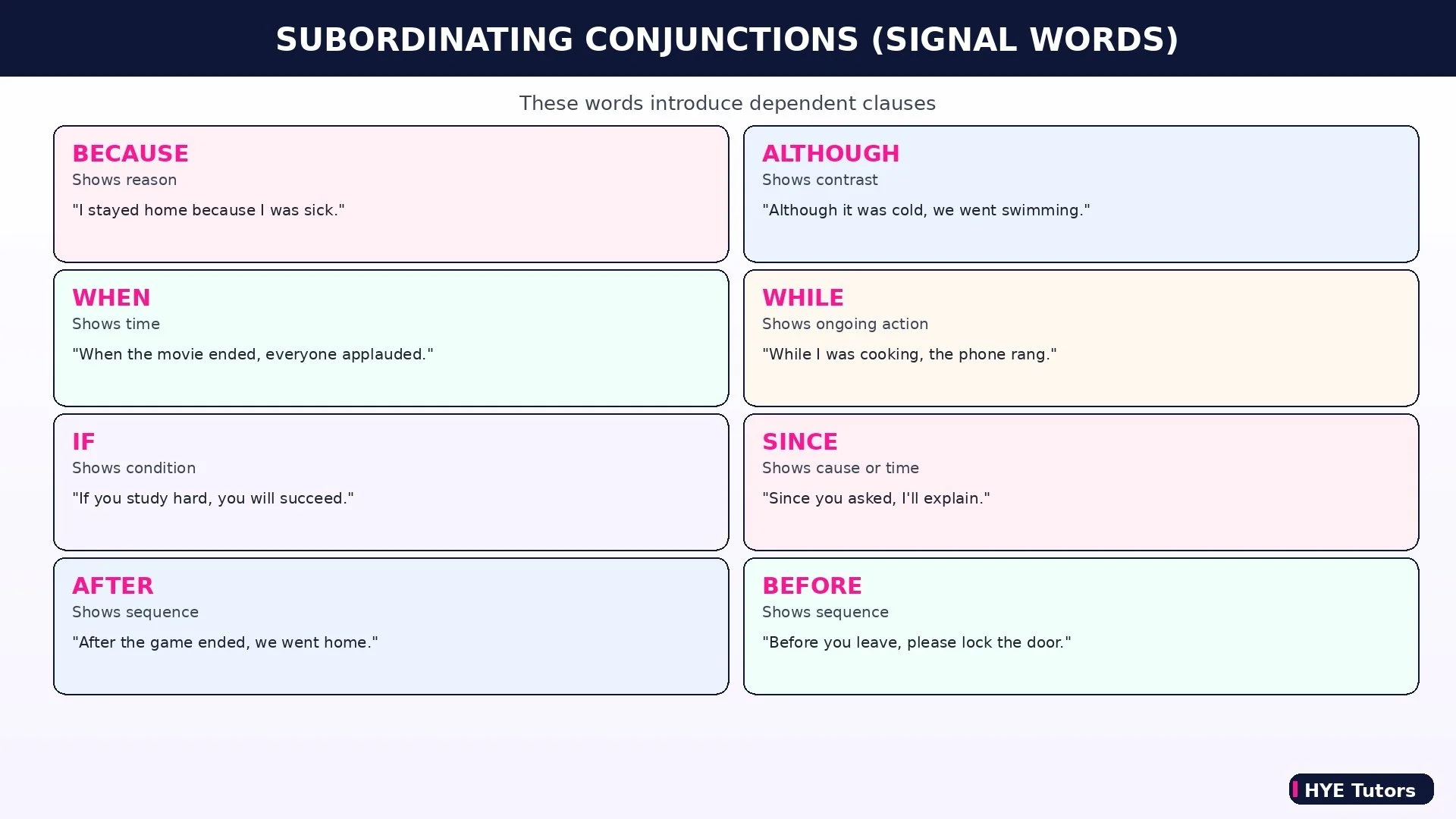
Subordinating conjunctions are the signal words that introduce dependent clauses. When you see one of these words at the beginning of a clause, that clause becomes dependent — it needs an independent clause to complete the thought. Learning these words helps you both identify and create complex sentences.
• Because: Shows reason ("I stayed home because I was sick.")
• Although/Though: Shows contrast ("Although it was cold, we went swimming.")
• When: Shows time ("When the movie ended, everyone applauded.")
• While: Shows ongoing action ("While I was cooking, the phone rang.")
• If: Shows condition ("If you study hard, you will succeed.")
• Since: Shows cause or time ("Since you asked, I'll explain.")
• After: Shows sequence ("After the game ended, we went home.")
• Before: Shows sequence ("Before you leave, please lock the door.")
Punctuation Rules
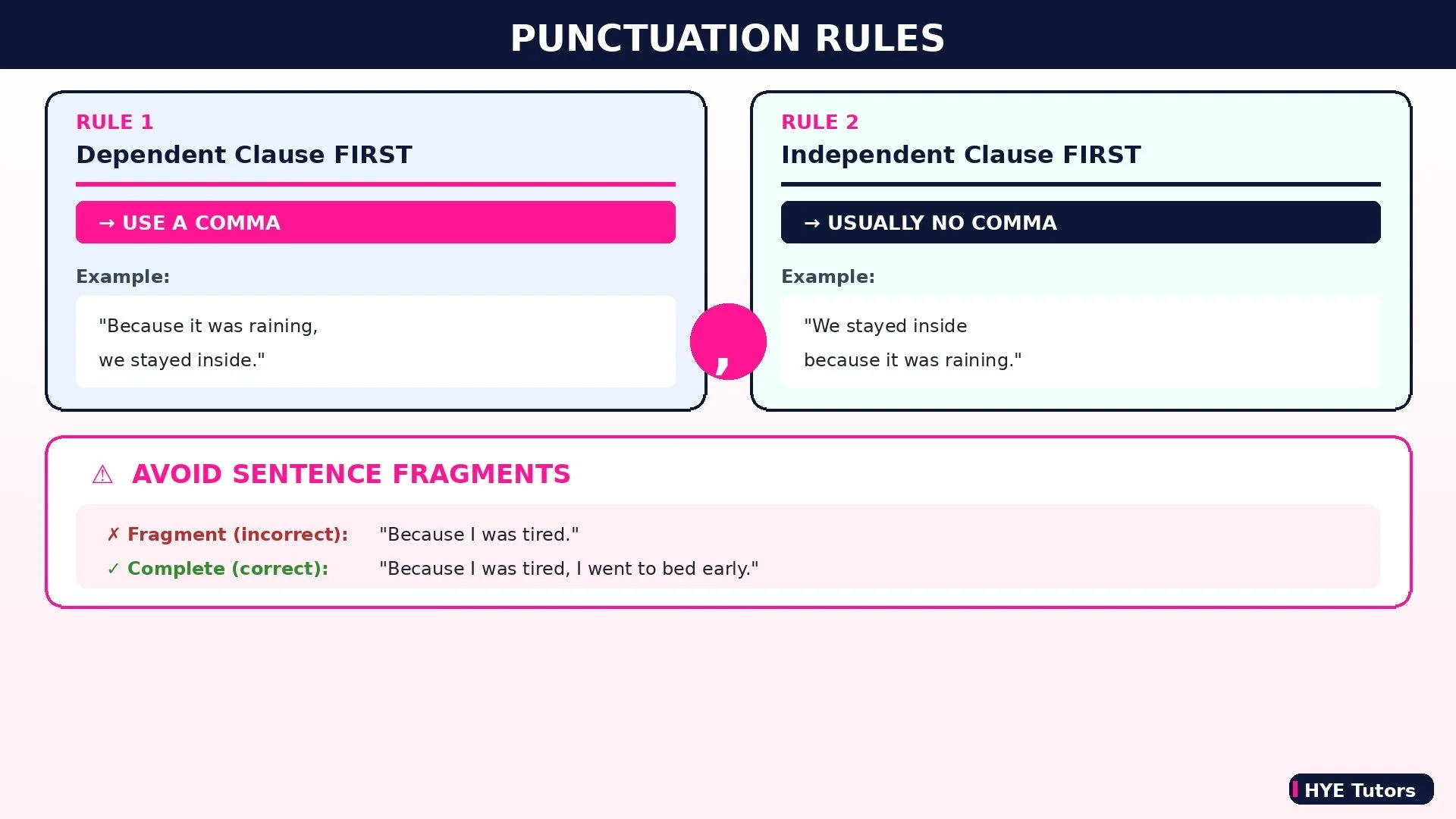
Punctuation in complex sentences follows a simple pattern, but it's where many writers make mistakes. The rule depends on which clause comes first. Once you understand this, you'll punctuate complex sentences correctly every time.
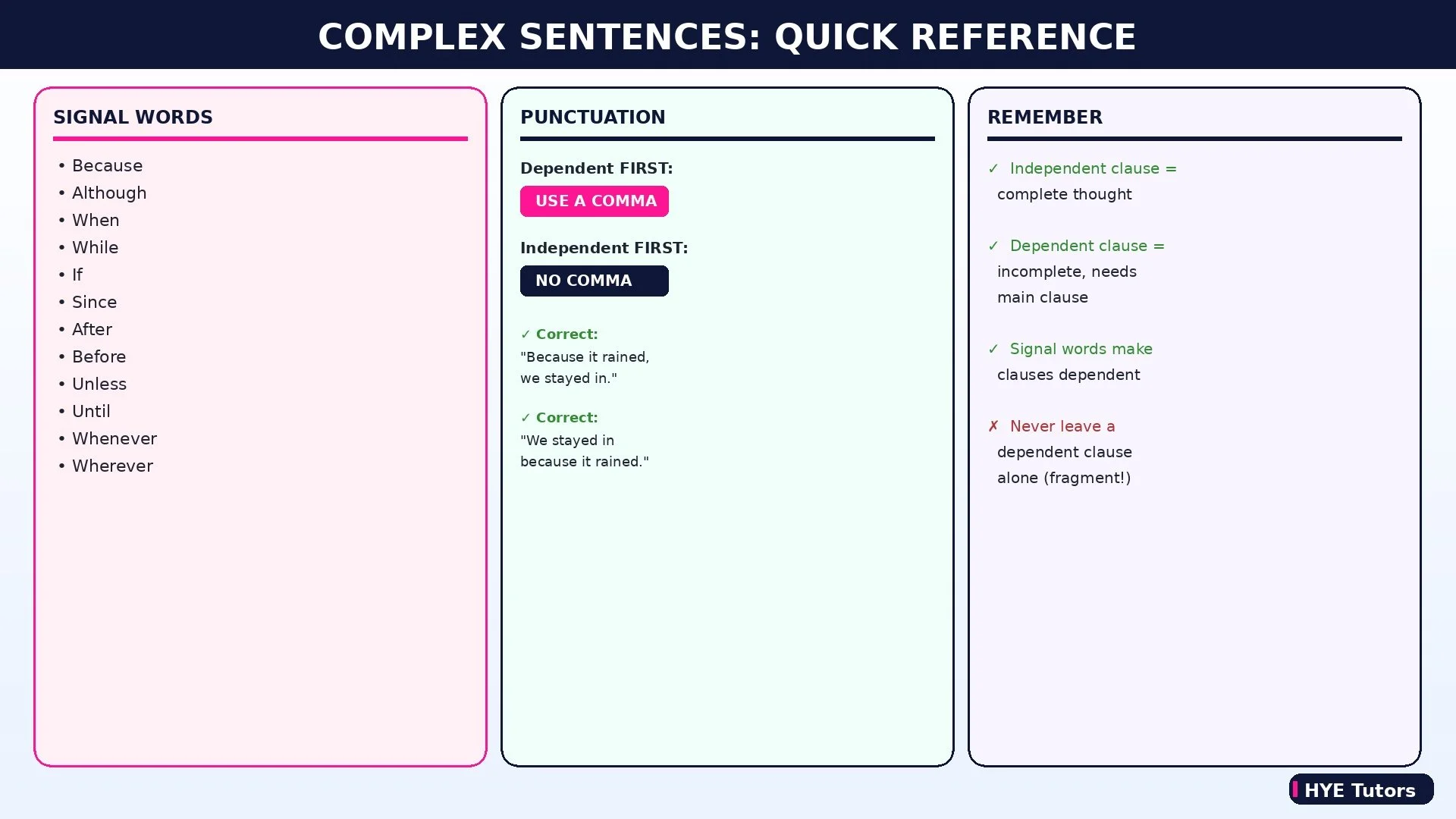
• Dependent clause first → use a comma: "Because it was raining, we stayed inside."
• Independent clause first → usually no comma: "We stayed inside because it was raining."
• Avoid sentence fragments: Never leave a dependent clause standing alone
• Check completeness: Every sentence needs at least one independent clause
Fragment (incorrect): "Because I was tired." → Complete (correct): "Because I was tired, I went to bed early."
Complex Sentence Examples
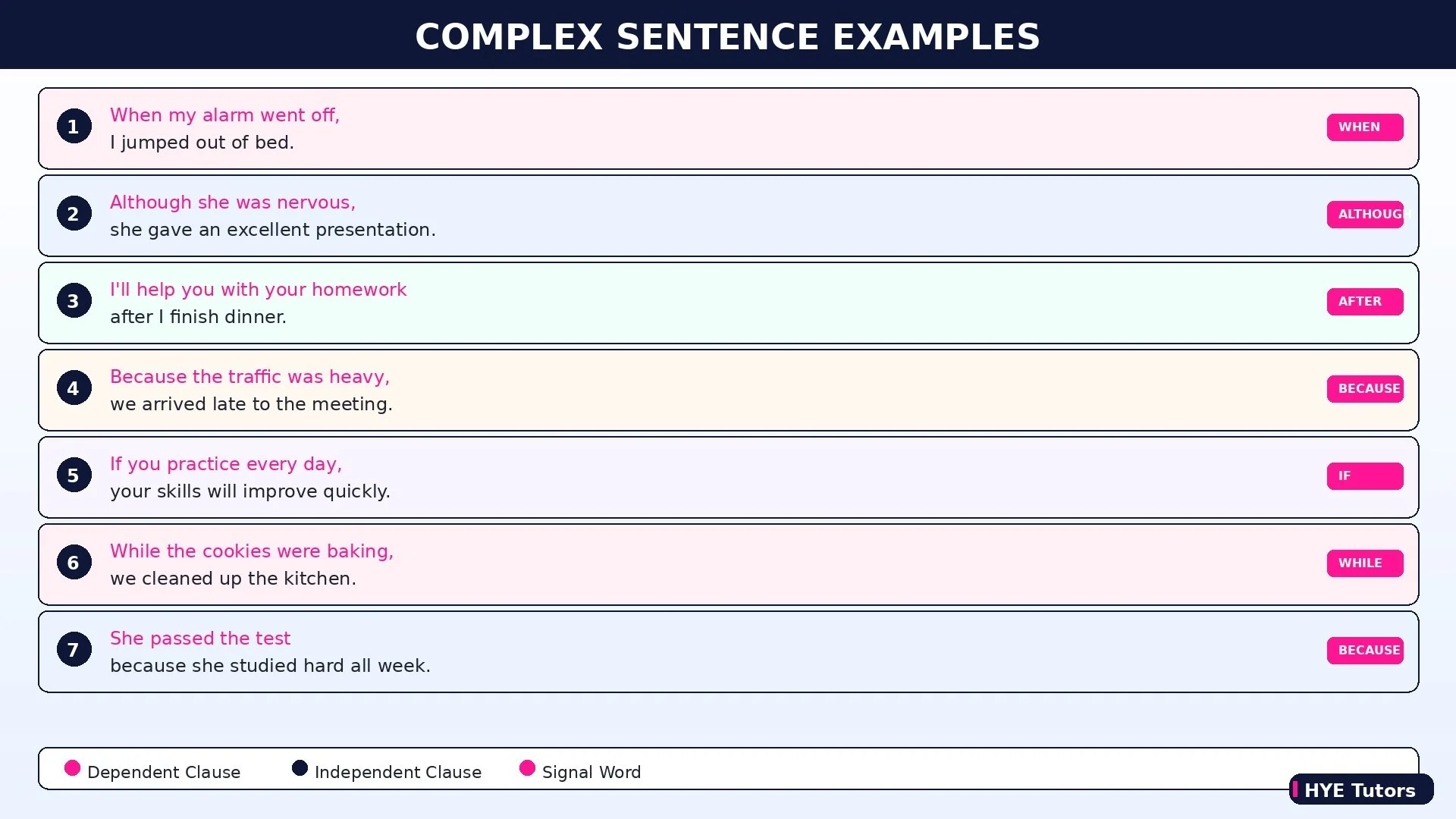
Seeing complex sentences in context makes them easier to understand and use. Here are examples from everyday situations that students and families encounter:
1. "When my alarm went off, I jumped out of bed."
2. "Although she was nervous, she gave an excellent presentation."
3. "I'll help you with your homework after I finish dinner."
4. "Because the traffic was heavy, we arrived late to the meeting."
5. "If you practice every day, your skills will improve quickly."
6. "While the cookies were baking, we cleaned up the kitchen."
7. "She passed the test because she studied hard all week."
Common Mistakes and How to Avoid Them
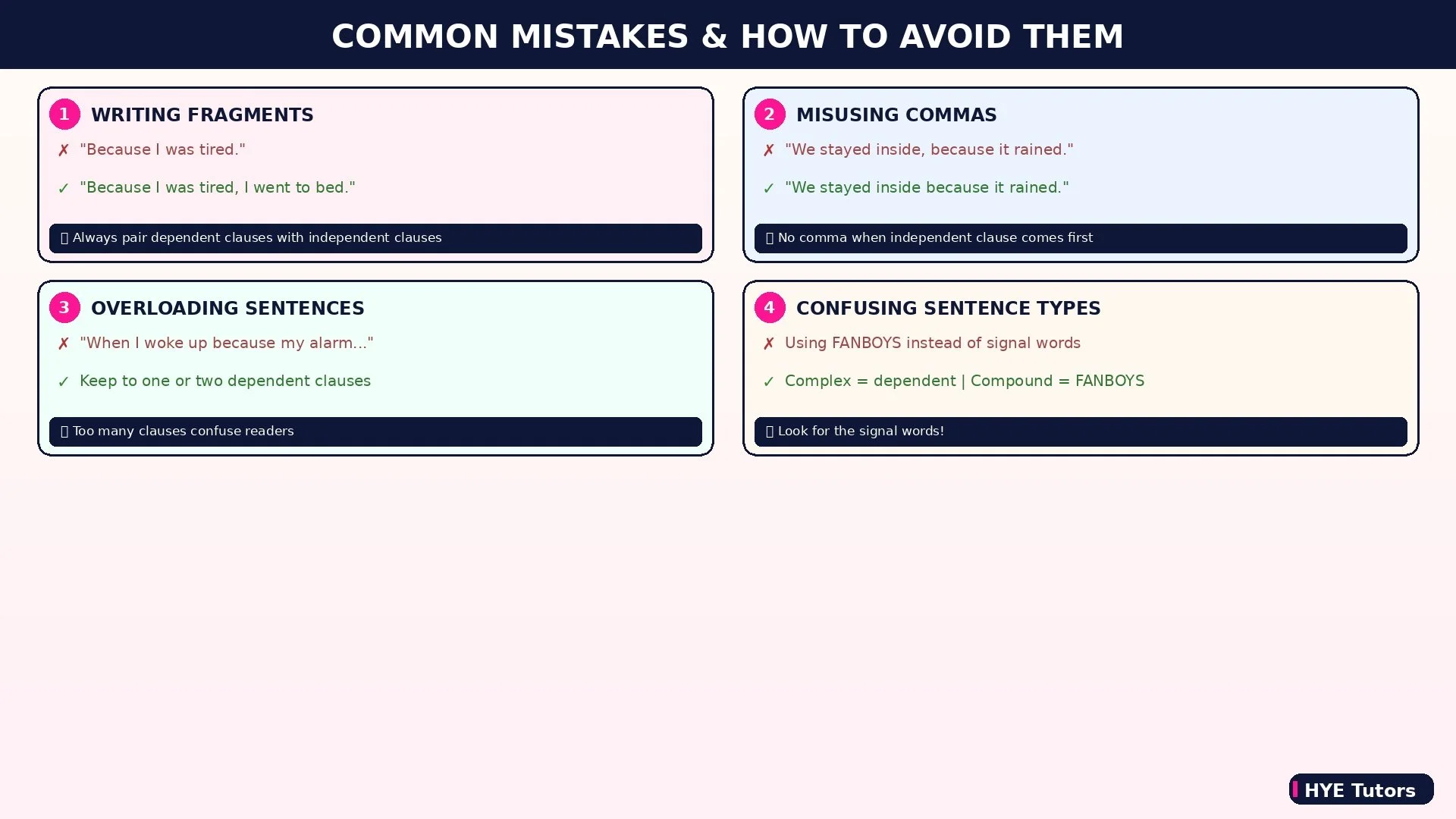
Even experienced writers sometimes stumble with complex sentences. Here are the most common errors and how to fix them. Think of these as coaching tips to strengthen your writing.
• Writing fragments: Leaving dependent clauses alone without an independent clause. Always pair them together.
• Misusing commas: Forgetting the comma when the dependent clause comes first, or adding one when it's not needed.
• Overloading sentences: Adding too many dependent clauses makes sentences confusing. Keep it to one or two.
• Confusing complex with compound: Remember: complex uses dependent clauses; compound uses independent clauses joined by FANBOYS.
What Is a Compound - Complex Sentence?
Once you understand complex sentences, the next level is the compound-complex sentence. A compound-complex sentence combines the features of both compound and complex sentences. It contains at least two independent clauses (like a compound sentence) plus at least one dependent clause (like a complex sentence).
Writers use compound-complex sentences when they need to express multiple related ideas along with additional context or conditions. According to the Cambridge Dictionary Grammar Guide, these sentences are common in formal and academic writing where precise relationships between ideas matter.
• Definition: Two or more independent clauses + one or more dependent clauses
• Why writers use them: To show multiple related ideas with added context in a single sentence
• Structure: Independent clause + coordinating conjunction + independent clause + dependent clause (order can vary)
Examples:
"Although the exam was difficult (dependent), she passed with a high score (independent), and she celebrated with her family (independent)."
"I finished my project (independent), and I submitted it early (independent) because I wanted feedback before the deadline (dependent)."
Simple vs Compound vs Complex vs Compound - Complex Sentences
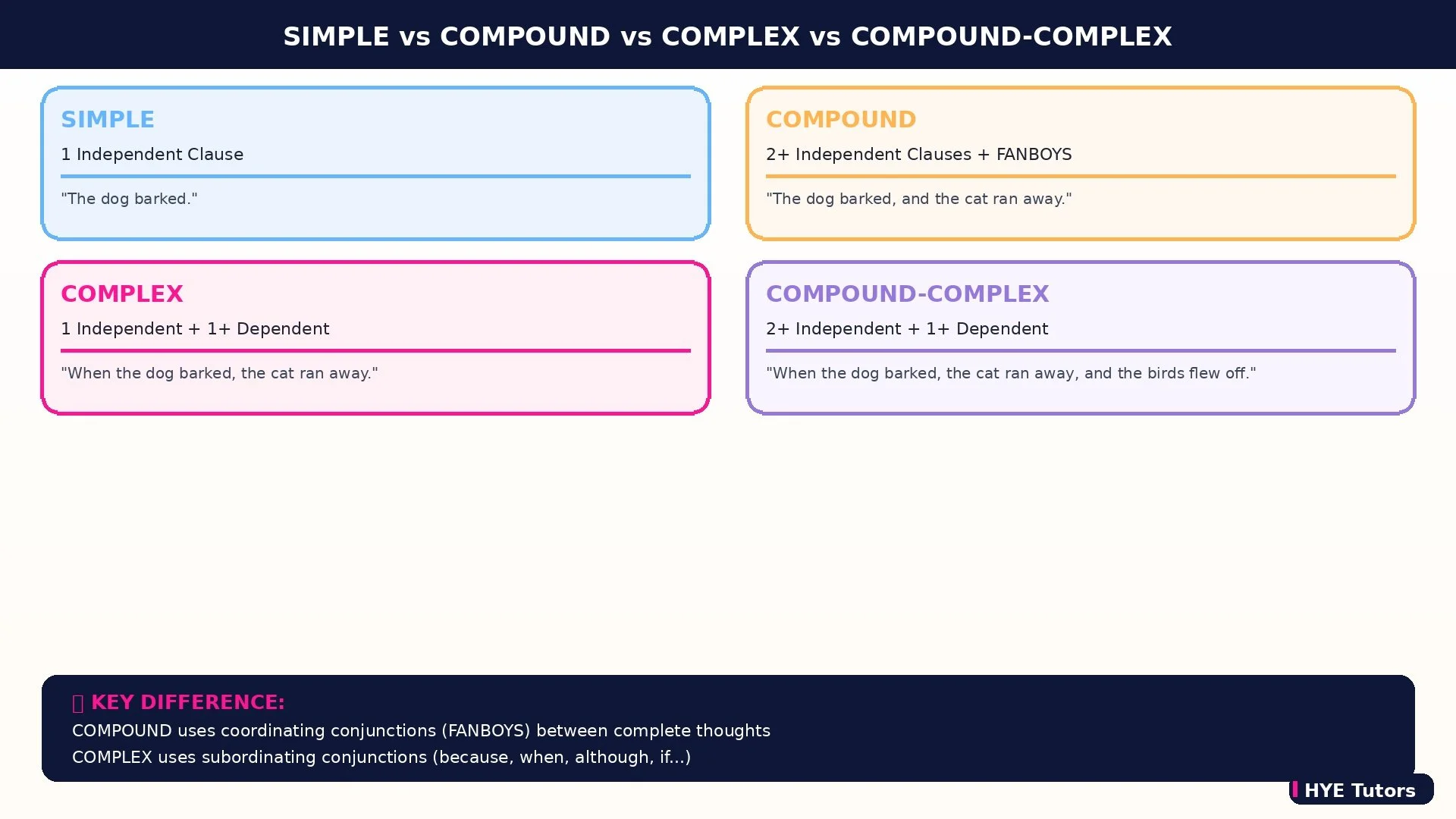
Many students search for the difference between compound and complex sentences or want to understand all four sentence types together. Here's a clear comparison to help you identify each type. Understanding these differences will improve both your reading comprehension and your writing.
• Simple sentence: One independent clause. Example: "The dog barked."
• Compound sentence: Two or more independent clauses joined by FANBOYS. Example: "The dog barked, and the cat ran away."
• Complex sentence: One independent clause + one or more dependent clauses. Example: "When the dog barked, the cat ran away."
• Compound-complex sentence: Two or more independent clauses + one or more dependent clauses. Example: "When the dog barked, the cat ran away, and the birds flew off."
The key difference between compound and complex sentences is the type of clauses they contain. Compound sentences join independent clauses (complete thoughts). Complex sentences combine an independent clause with a dependent clause (incomplete thought).
Quick tip: Look for subordinating conjunctions (because, when, although, if, since) to identify dependent clauses. Look for coordinating conjunctions (for, and, nor, but, or, yet, so) between complete thoughts to identify compound structures.
Conclusion
Now you have a complete answer to "what is a complex sentence" — it's a sentence that combines one independent clause with at least one dependent clause to add meaning, detail, and context to your writing. The dependent clause provides extra information while the independent clause delivers the main point.
Remember to watch for subordinating conjunctions like "because," "when," "although," and "if" — they signal dependent clauses. Place your comma after the dependent clause when it comes first, and you'll punctuate correctly every time.
Keep practicing with everyday writing, and complex sentences will soon feel natural. Your writing will become clearer, more connected, and more engaging. You've got this!