

What Is Atomic Number and Atomic Mass? — A Simple Guide
You're staring at the periodic table, and every single element tile has two numbers on it. One small, one with a decimal point. Which one is which — and why does it matter? That's exactly the moment that brings most students to this page, and it's a question I've answered in almost every first chemistry session I've run. So let's settle it for good: what is atomic number? By the end of this page, you'll know exactly what both numbers mean — and how to use them on a test.
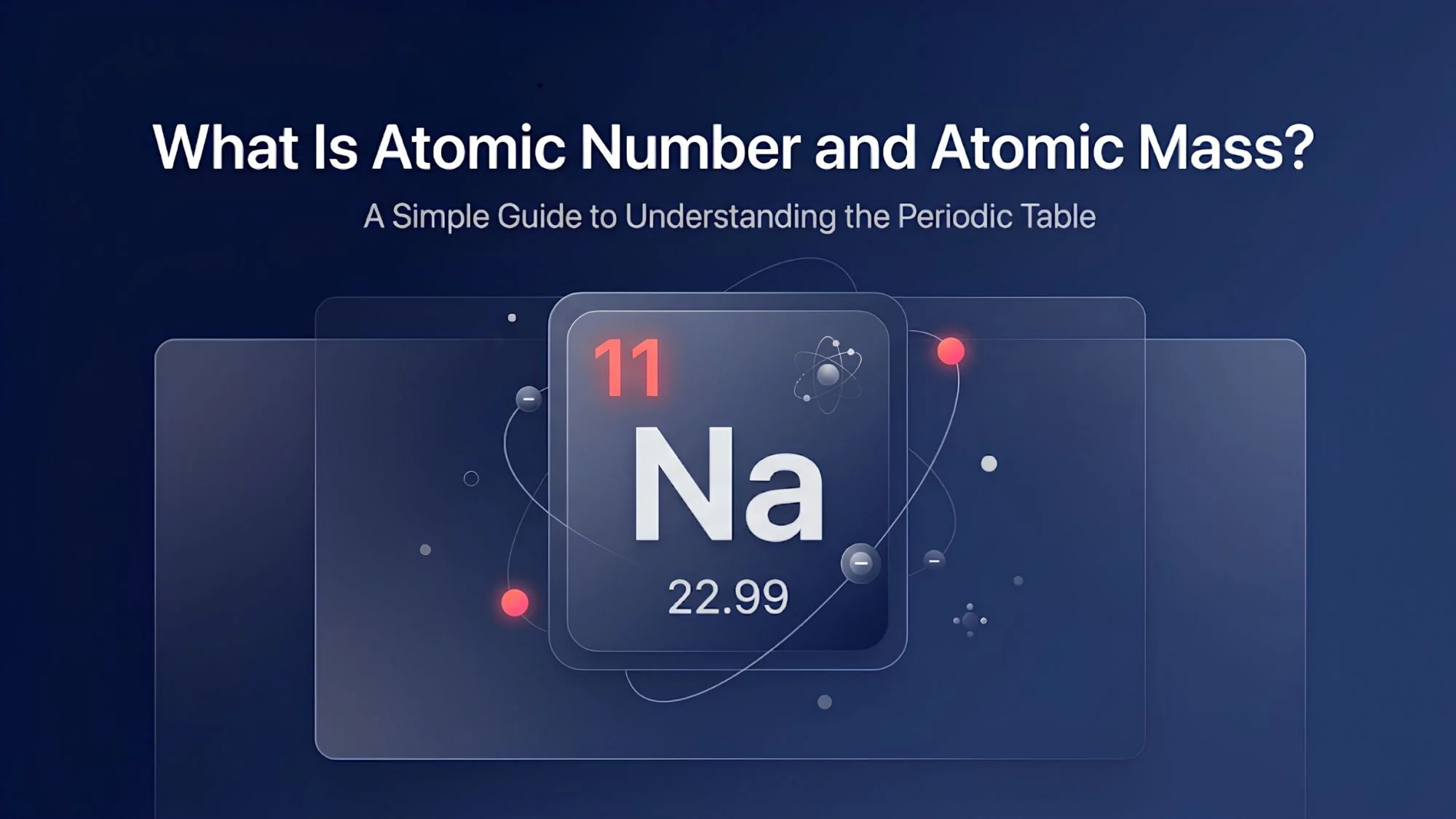
What Is Atomic Number and Atomic Mass?
The atomic number of an element is the number of protons in the nucleus of one atom of that element. It is unique to every element and determines its position on the periodic table. Atomic mass is the average mass of an atom in atomic mass units (amu), accounting for all naturally occurring isotopes. Atomic number is always a whole number; atomic mass is usually a decimal.
What Is Atomic Number?
Every element has an identity number, and that number is its atomic number. When a student asks me what is atomic number, I tell them: it's simply the count of protons sitting in the nucleus (the dense, positively charged core at the center of an atom). Change that number and you no longer have the same element — you have a completely different one.
In chemistry notation, atomic number is represented by the symbol Z. Every element on the periodic table has a unique atomic number — no two elements share one. That's what makes it such a reliable identifier. Carbon has 6 protons, so its atomic number is 6. Oxygen has 8 protons, so its atomic number is 8. Simple as that.
The periodic table itself is organized around this exact concept: elements are arranged in order of increasing atomic number, reading left to right and top to bottom. According to the Royal Society of Chemistry, this ordering — first proposed in modern form by Henry Moseley in 1913 — replaced the older system of ordering by atomic mass, because atomic number reflects an element's true chemical identity.
Here's a detail that trips up even strong students: in a neutral atom, the atomic number also equals the number of electrons. This comes up constantly on the SAT, ACT, and AP Chemistry exams, so flag it now. The most common mix-up I see in tutoring sessions is students confusing atomic number with mass number — a related but different value (we'll draw a clear line between the two further down this page).
What Does Atomic Number Tell You?
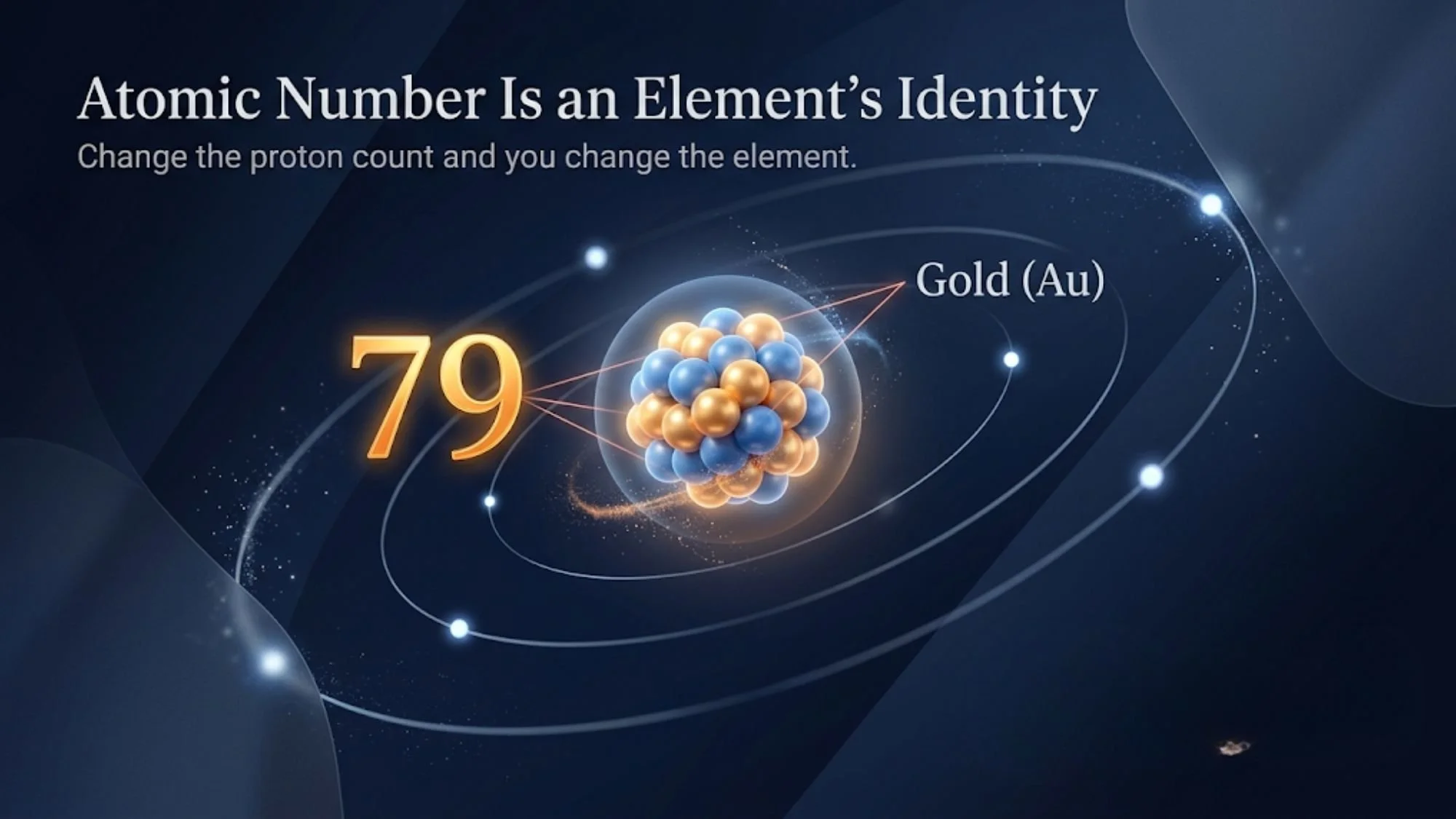
Atomic number is an element's permanent ID. It cannot change without changing the element itself. It tells you the proton count directly — and, in a neutral atom, the electron count too. Together, those numbers determine the element's chemical behavior and bonding properties.
When I see atomic number 79, I immediately know we're looking at gold — Au on the periodic table. That kind of instant recognition is exactly what makes exam questions fast.
What Is Atomic Mass?
Atomic mass is the weighted average mass of an atom, measured in atomic mass units (amu — a unit equal to roughly the mass of one proton or neutron). Its symbol is A. Unlike atomic number, atomic mass accounts for every naturally occurring isotope of an element — atoms of the same element with the same number of protons but a different number of neutrons.
That's also why atomic mass is usually a decimal rather than a clean whole number. Most elements exist in nature as a mix of isotopes with slightly different masses, and the periodic table shows the weighted average across that mix.
Here's where the real confusion starts: mass number is a whole number — it's the total of protons plus neutrons for one specific isotope. Atomic mass is an average across all of an element's isotopes as they occur in nature. Students always ask me why the periodic table shows 35.45 for chlorine instead of a round number. The answer is isotopes — chlorine exists in nature as a mix of Cl-35 and Cl-37 — and once they get that, atomic mass makes complete sense.
Atomic Number vs. Atomic Mass — What's the Difference?
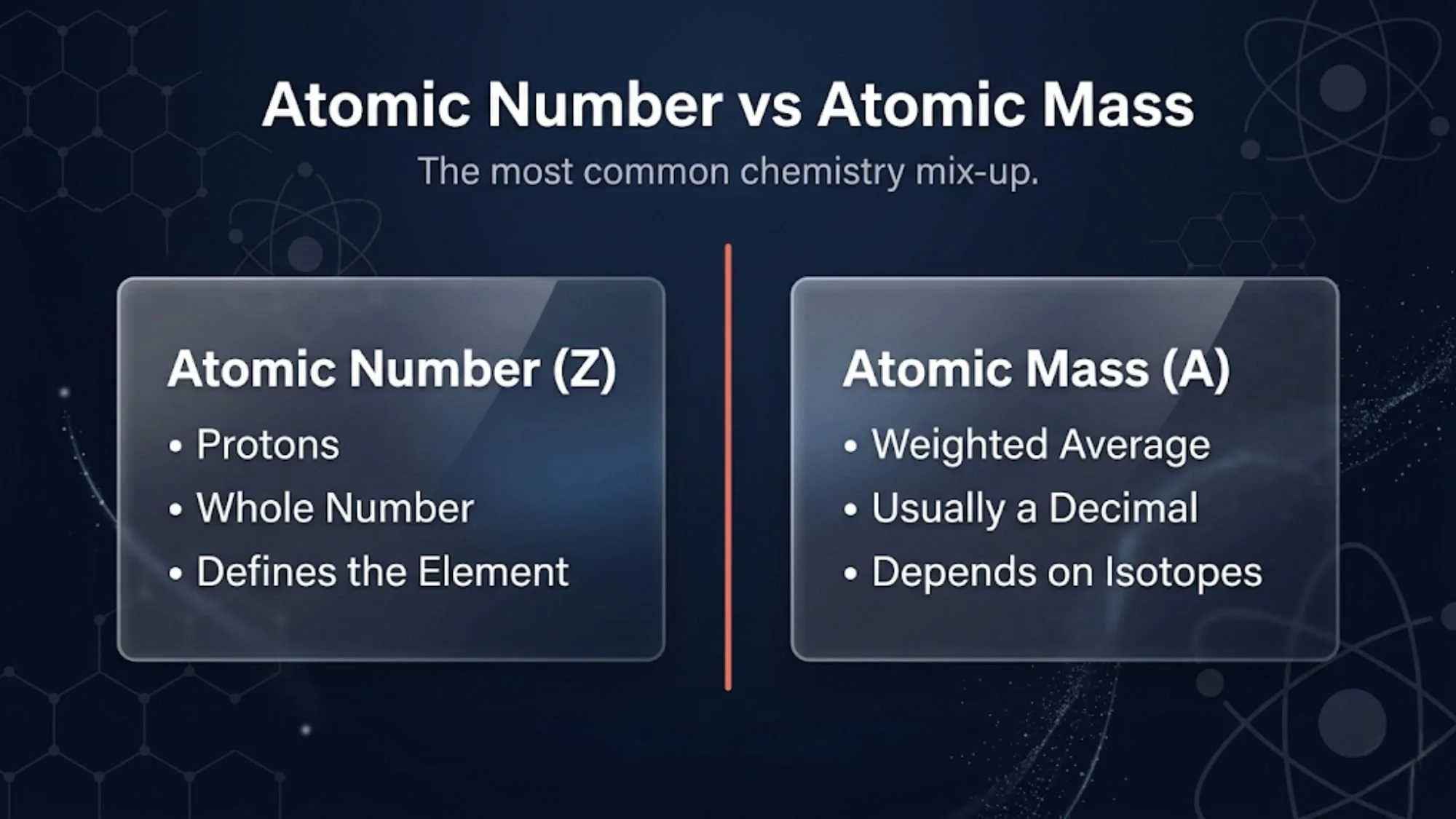
This is exactly what I draw on the whiteboard in the first five minutes when a student says they're confused. Once you see both properties side by side, the difference becomes obvious:
| Property | Atomic Number (Z) | Atomic Mass (A) |
|---|---|---|
| What it counts | Protons in nucleus | Weighted average of protons + neutrons |
| Always a whole number? | Yes | Usually a decimal |
| Unique to each element? | Yes — defines the element | No — can overlap |
| Where on the periodic table | Smaller number (top) | Larger number (bottom) |
| Symbol | Z | A |
Atomic number identifies which element you're looking at. Atomic mass tells you how heavy that element's atoms typically are. Keep that distinction in mind and the rest of this topic falls into place quickly.
How to Find Atomic Number and Atomic Mass on the Periodic Table
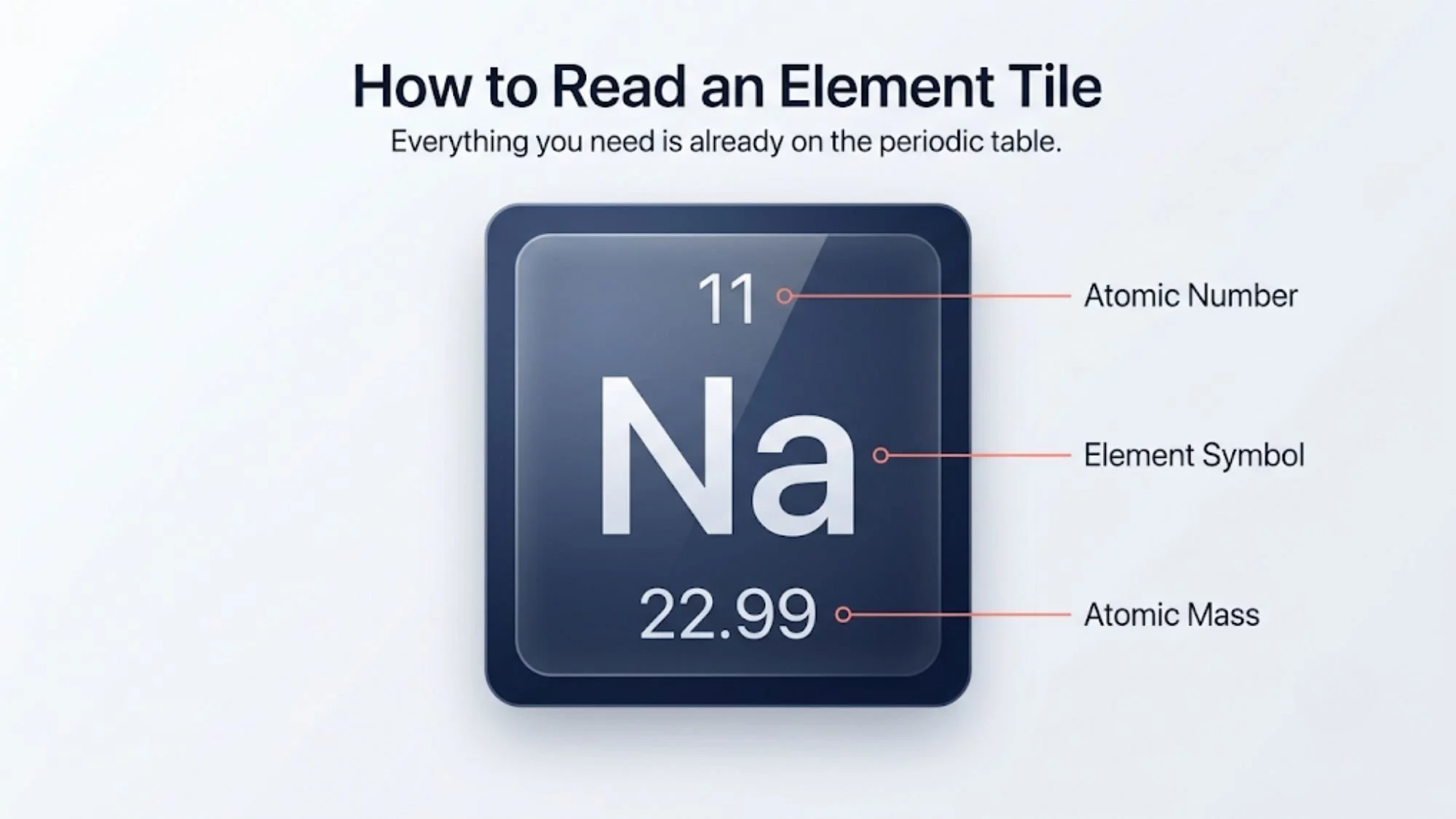
Students often have the periodic table right in front of them on exams — they just don't know which number is which. Here's how to read a single element tile:
The element symbol sits in the center of the tile
The smaller number above the symbol = atomic number
The larger number below the symbol (with a decimal) = atomic mass
Take sodium (Na) as an example: atomic number 11, atomic mass approximately 22.99. The labeled tile below shows exactly where to look.
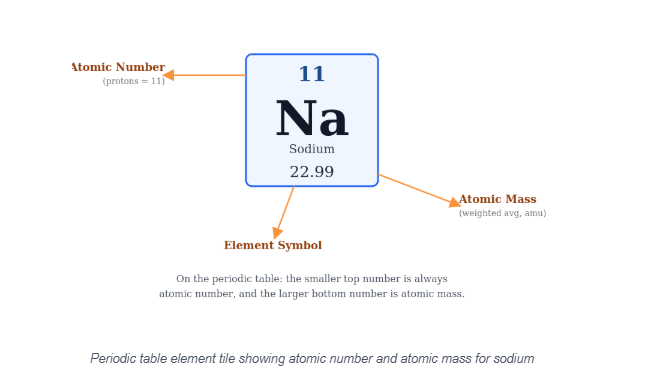
Exam tip: on the SAT and ACT, the periodic table is usually provided. Knowing that the top number is always atomic number will answer multiple questions on its own — no calculation required.
If you're curious about how the full table is organized, our article How Many Elements Are on the Periodic Table? walks through every section — from the lightest elements to the most recently confirmed ones.
Chemistry builds on itself — once atomic number clicks, topics like acid-base chemistry and buffer solutions start to make much more sense. Check out What Is Acid and Base in Chemistry? and What Is Buffer Solution in Chemistry? to keep building.
FAQs
Q: What is atomic number in simple terms?
A: Atomic number is the number of protons in the nucleus of an atom. Every element has its own unique atomic number, which is what makes it that specific element and no other.
Q: What is the difference between atomic number and atomic mass?
A: Atomic number counts only protons — it's a whole number unique to each element. Atomic mass is the weighted average of protons plus neutrons across all of an element's naturally occurring isotopes, so it's usually a decimal.
Q: Can two elements have the same atomic number?
A: No — atomic number uniquely defines each element. Isotopes of the same element share an atomic number but differ in mass number, since they have different numbers of neutrons.
Q: Why is atomic mass a decimal number?
A: Because most elements exist in nature as a mixture of isotopes with different masses. The periodic table shows the weighted average of that mixture, so the result is rarely a whole number.
Q: Is atomic number the same as the number of electrons?
A: Yes — but only in a neutral atom. In ions, electrons are gained or lost while atomic number stays fixed. For example, Na⁺ still has 11 protons but only 10 electrons.
Ready to see atomic number in action beyond the basics? Our guide on Galvanic Cell vs Electrolytic Cell shows how atomic structure shapes real electrochemical reactions — a natural next step for students heading into AP Chemistry.
Bringing It Together
Atomic number tells you what element you have — its proton count. Atomic mass tells you how heavy that element's atoms are, on average, across its isotopes. The students I've tutored who get these two concepts right always find the rest of chemistry easier — bonding, reactions, electrochemistry, all of it builds from here.
Once atomic number stops being a mystery, the periodic table stops feeling like a wall of numbers and starts working like the map it actually is.
Ready to go deeper — or get ahead before the next exam? Book a session with an HYE Tutors chemistry mentor and let's build on this foundation together.