

MCAT score percentiles explained
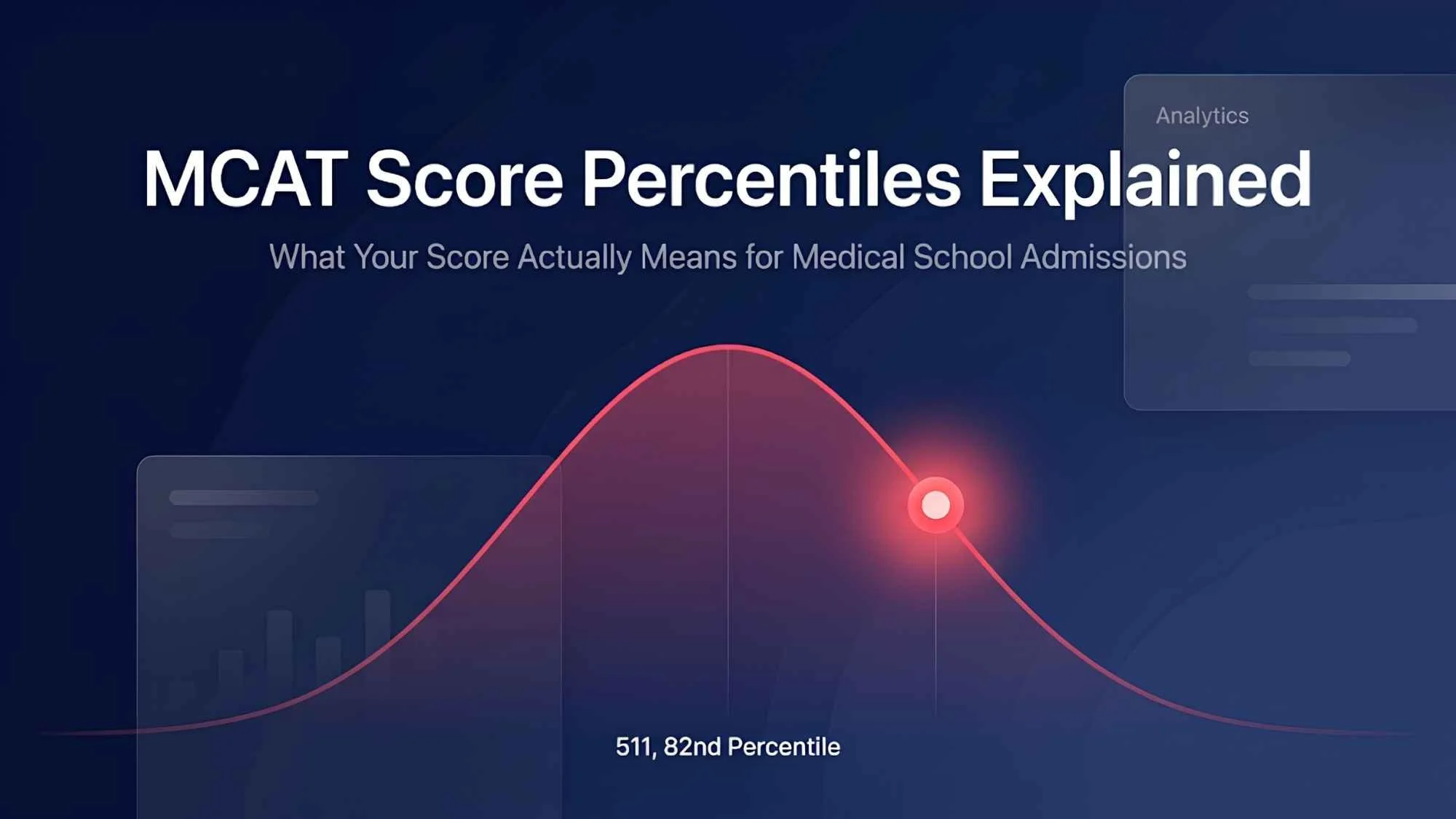
You open your score report. There's a number — say, 509 — and absolutely no instinct for whether that's great, fine, or a problem. That gap between seeing a score and understanding what it means is exactly where MCAT score percentiles come in.
I scored a 522 on my own MCAT and have spent over twelve years mentoring pre-med students through this exact moment of confusion. By the end of this guide, you'll know exactly where your score stands — and what to do next.
MCAT score percentiles show what percentage of test-takers you scored equal to or higher than. The total MCAT score ranges from 472–528, with 500 sitting near the 49th percentile. A score of 511 falls around the 82nd percentile. Most MD programs accept students averaging 511–518. Each section — C/P, CARS, B/B, P/S — is scored 118–132 with its own percentile, updated annually by the AAMC.
MCAT Score Percentiles — What the Numbers Actually Mean
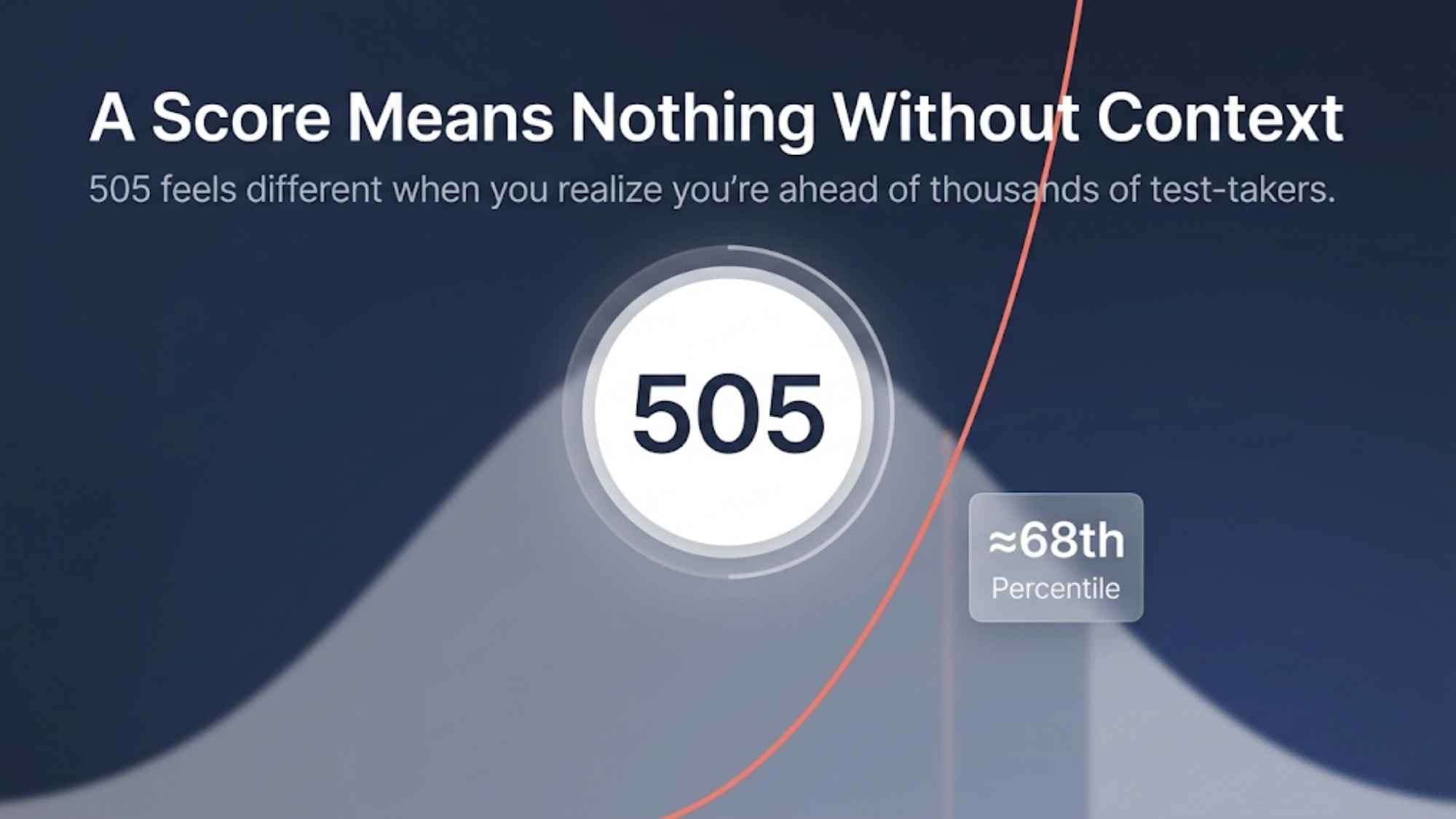
One of the first things I tell every student I mentor: your raw MCAT score is almost meaningless without its percentile context. A 505 feels discouraging until you realize it puts you ahead of roughly two-thirds of everyone who sat that exam.
Here's the structure. The MCAT scoring scale runs from 472 to 528, built from four sections, each scored 118 to 132:
Chemical and Physical Foundations of Biological Systems (C/P)
Critical Analysis and Reasoning Skills (CARS)
Biological and Biochemical Foundations of Living Systems (B/B)
Psychological, Social, and Biological Foundations of Behavior (P/S)
A percentile rank tells you the share of test-takers who scored equal to or below your score. If you're in the 84th percentile, you scored as well as or better than 84% of everyone who took the exam — not that you answered 84% of questions correctly. Those are two very different things, and mixing them up is one of the most common sources of score-day panic I see.
Here's the part most students don't expect: percentile tables aren't fixed. According to the AAMC's official percentile rankings, the tables are rebuilt every year using the most recent three years of test-takers. The same raw score can shift a point or two in percentile from one year to the next as the testing pool changes.
In twelve years mentoring pre-med students, I've watched plenty of them dismiss a 509 as a failure. Based on current AAMC data, that score sits around the 76th–77th percentile — ahead of roughly three-quarters of test-takers. Context changes everything.
| MCAT Score | Percentile Rank | Competitiveness |
|---|---|---|
| 528 | ~100th | Elite programs — only a few dozen test-takers reach this each year |
| 520–527 | 97th–99th | Top-10 MD programs become realistic |
| 515–519 | 91st–96th | Strong MD applicant at most programs |
| 511–514 | 82nd–89th | Competitive applicant; sits at or above the MD matriculant median |
| 506–510 | 68th–79th | Average MD applicant; very viable with a strong overall file |
| 500–505 | 49th–65th | Below the typical MD matriculant average; DO programs strongly viable |
| Below 500 | Below 49th | Significant challenge for MD programs; retake worth evaluating |
Section Scores Have Their Own Percentiles
Your total score is the headline, but each section carries its own percentile — and they don't move together. A 130 in CARS ranks very differently from a 130 in Biology, because the score distributions aren't identical across sections.
CARS, in particular, is historically the most compressed section — most test-takers cluster in a tight scoring range, which means small score gains there produce outsized percentile jumps. A score of 124–125 in CARS is right around the section average, while a 128 can place you near the 90th percentile for that section alone.
If you're still building toward your MCAT and want to understand the full test structure before diving into score strategy, our MCAT exam guide — everything you need to know covers exactly that — start there if any of the section names above are unfamiliar. And if your undergraduate major left certain sections feeling shakier than others, that's worth knowing well before test day, since pre-med coursework background often predicts which section needs the most attention.
What Is a Good MCAT Score for Medical School?

"Good" is relative — it depends on your target school type, program tier, and how your score pairs with your GPA.
At the broadest level: the average accepted score at MD programs sits around 511–512, while the average accepted score at DO programs is closer to 504–506. For the very top 10 MD programs — Harvard, Johns Hopkins, and similar — accepted averages typically run 519–523.
One of the most important things I've learned mentoring students out of Los Angeles and UCLA specifically: your MCAT score and GPA are evaluated together, not separately. A 509 with a 3.9 GPA reads very differently from a 509 with a 3.2. I've seen a 507 open doors at strong state schools when it was paired with solid research, a 3.85, and a compelling personal narrative.
For a full roadmap of what medical schools evaluate beyond your MCAT — GPA, clinical hours, letters of recommendation — our step-by-step guide to getting into medical school walks through the entire process.
Should You Retake the MCAT? A Percentile-Based Framework
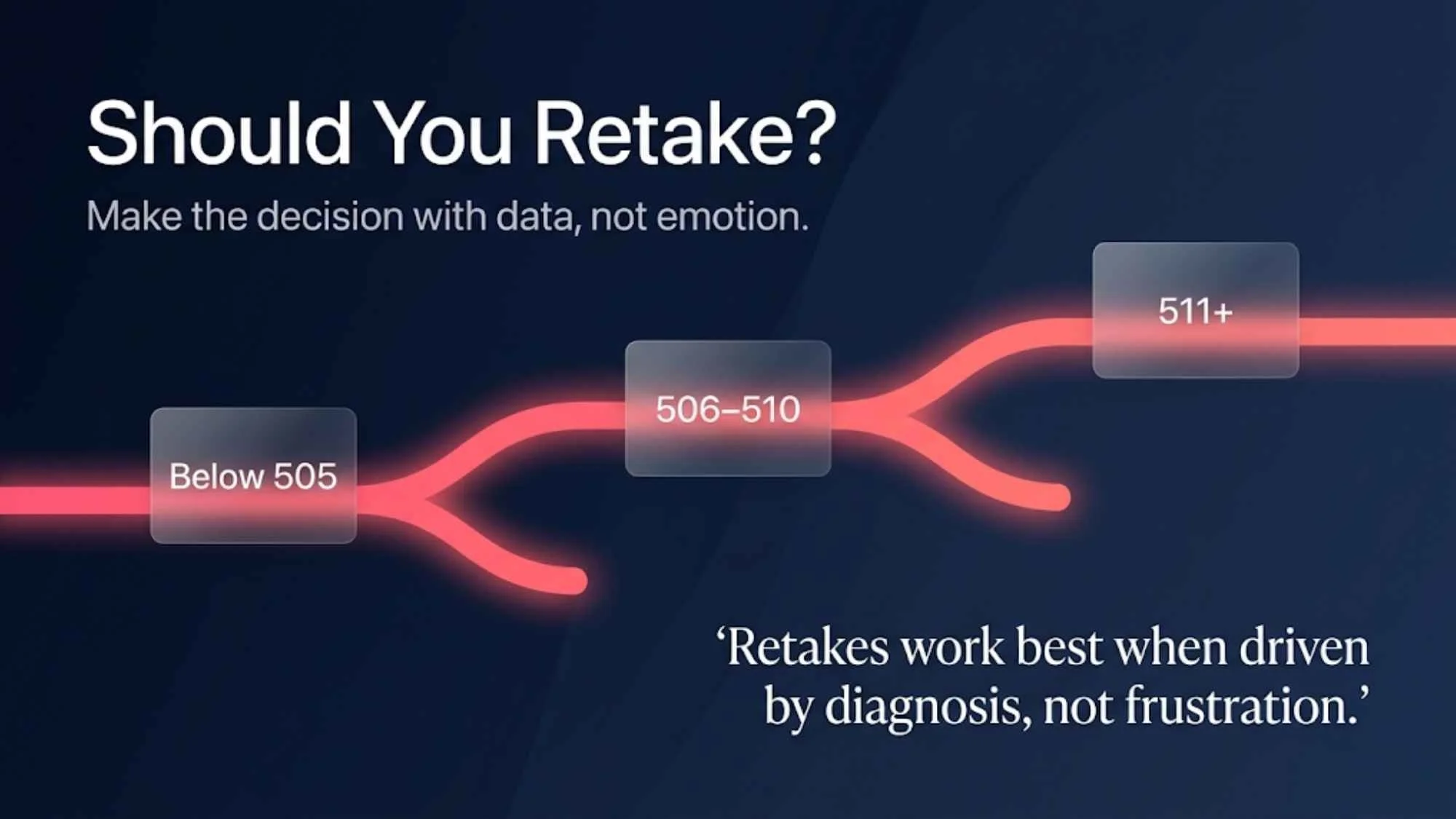
This is the question every student asks the moment their score posts. Here's the honest, framework-based answer.
General rule: if your score is more than three to four points below your target school's median accepted score, a retake is worth serious consideration. But a retake is only worthwhile with a genuine diagnosis of what went wrong — not just more study hours layered onto the same approach.
Every cycle, I have students retake without a real plan. They score within two points of their original — sometimes lower. Before retaking, identify the exact content areas and section strategies that broke down. That diagnostic is the first thing I do in any retake session.
Quick checklist:
Score below 505? Retake strongly recommended if you're targeting MD programs.
Score 506–510, targeting top-50 programs? Evaluate holistically with an advisor before deciding.
Score 511+? Retake risk often outweighs the benefit, unless you're specifically targeting elite programs.
If a retake is in your future, prep resources matter enormously. Our guide to the top MCAT prep books for 2026 breaks down exactly which books are worth your time — and which to skip.
FAQs
Q1: What MCAT score is the 90th percentile?
Around 515 — current AAMC data places it close to the 91st percentile. This shifts by a point or two each year, so confirm the exact figure against the most recent table before relying on it.
Q2: Is a 510 a good MCAT score?
Yes for most programs. A 510 sits in roughly the 78th–79th percentile and is competitive for many MD programs, particularly mid-tier and state schools, though it falls slightly below the MD matriculant median.
Q3: How are MCAT scores calculated?
Four sections are each scored 118–132 and summed for a total ranging from 472–528. A total score of 500 represents roughly the midpoint of all test-takers.
Q4: Do MCAT percentiles change every year?
Yes. The AAMC recalculates percentiles annually using the most recent three years of test-takers, so the same raw score can shift rank slightly year to year. Always check aamc.org for the current table.
Q5: What MCAT score do I need for Harvard Medical School?
Harvard's accepted average typically falls around 519–523. That score range alone isn't sufficient, though — Harvard reviews applications holistically, weighing GPA, research, and clinical experience alongside the MCAT.
Bottom Line on MCAT Score Percentiles
Your percentile rank, not your raw score, tells you where you actually stand.
The students I've watched match at their top-choice schools weren't always the ones with the highest scores. They were the ones who understood their numbers — both total and section-by-section — and made smart, unemotional decisions because of it.
Understanding MCAT score percentiles turns a confusing three-digit number into a real strategy. Know your percentile, know your target school's median, and build your plan from there.
And when your MCAT is behind you, your personal statement is next. Our guide on how to write a personal statement for medical school is the first thing I send every student the week after their exam.
About the Author
This article was written by a mentor affiliated with Columbia University and UC Berkeley who scored a 522 on the MCAT and has spent over twelve years mentoring pre-med students through score interpretation, retake decisions, and medical school strategy. Based in Los Angeles, our mentors specialize in turning raw MCAT numbers into clear, confident application plans.