

What Is a Good MCAT Score for Medical School?
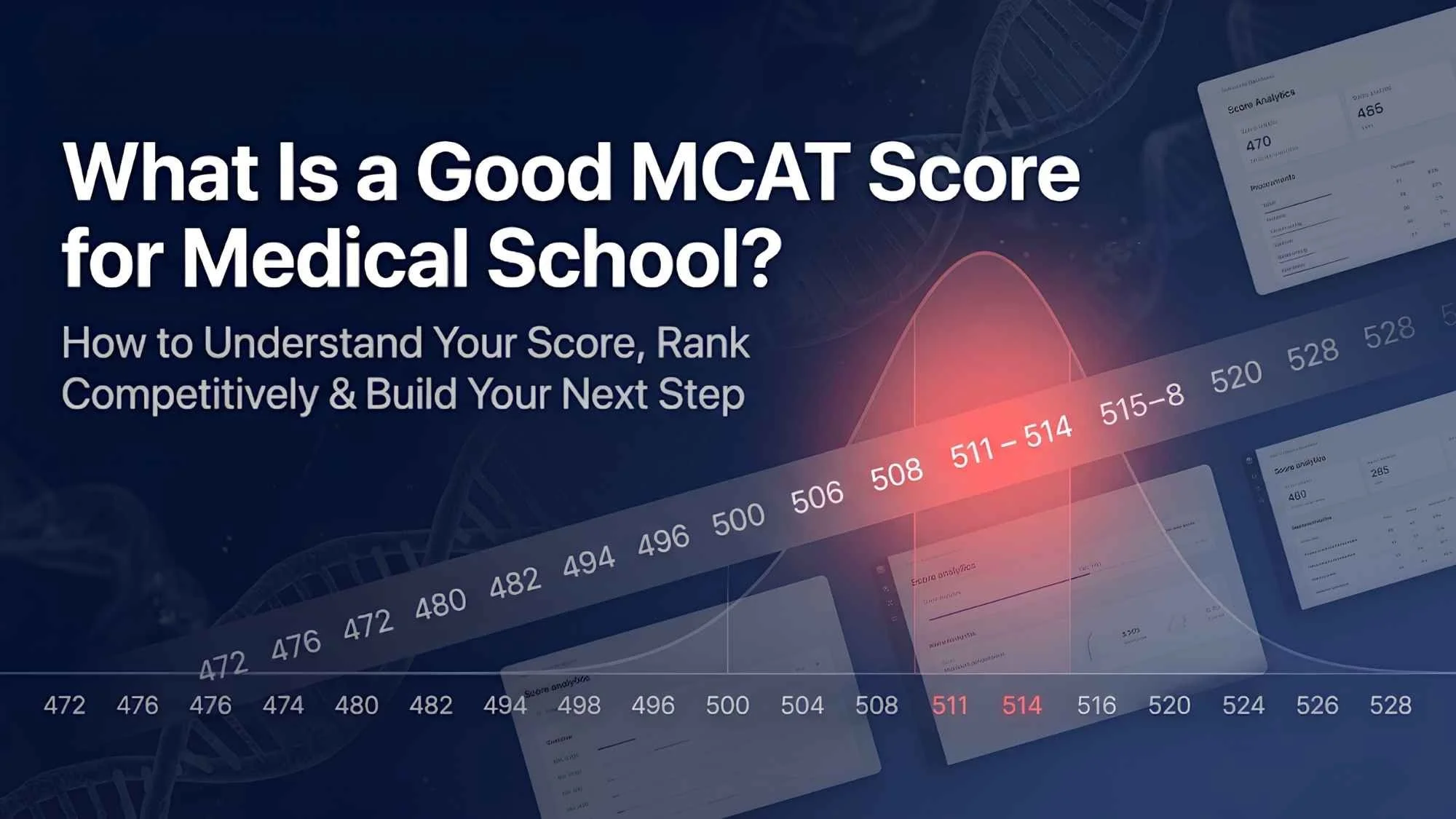
You just got your MCAT score back — or maybe you're staring at a target number on a medical school's website — and one question is running through your head: what is a good MCAT score, anyway? Is the number in front of you something to be proud of, something to worry about, or somewhere in between?
In four years of mentoring pre-med students (and with a 522 of my own on record), I've sat across from this exact moment more times than I can count. The honest answer is more useful than a single cutoff number — and by the end of this guide, you'll know exactly where your score stands, what it actually gets you, and what to do next.
“A score of 511–514 is considered competitive for most MD programs, placing you roughly in the top 10–20% of test-takers. A score of 515+ is strong for top-30 MD programs, and 517+ gives you a realistic shot at elite programs like Johns Hopkins or Harvard Medical School. The national average across all test-takers is around 500–501, while the average MD matriculant scores closer to 511–512.”
What Is a Good MCAT Score? Score Ranges Explained
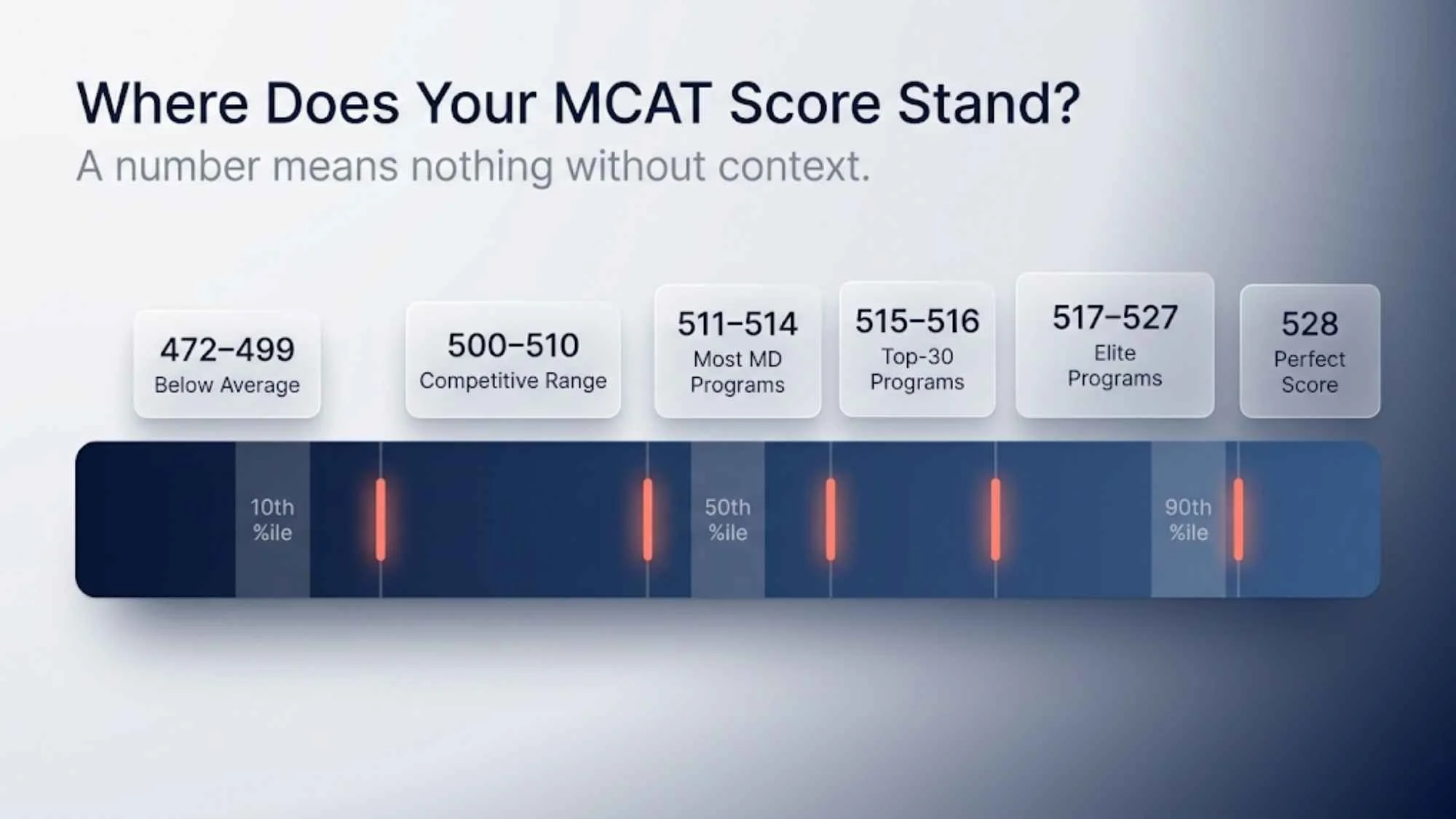
The first thing I tell every student who comes to me with their score: a number means nothing without context. Here's the context.
The MCAT is scored on a scale from 472 to 528, built from four sections — each scored 118 to 132 — that are added together for your total. According to the AAMC's official percentile rankings, here's how those totals translate into where you actually stand:
| MCAT Score | Percentile | What It Means |
|---|---|---|
| 528 (Perfect) | ~100th | Exceptional — opens any door, though only a handful of test-takers reach it each year. |
| 517–527 | 94th–99th | Elite programs become genuinely competitive. |
| 515–516 | 91st–92nd | Strong for top-30 MD programs. |
| 511–514 | ~82nd–89th | Competitive for most MD schools (511 is roughly the MD matriculant median). |
| 505–510 | ~65th–79th | Average range; DO programs viable, MD possible with a strong overall application. |
| Below 500 | Below ~50th | Retake strongly recommended for the MD track. |
A few things worth sitting with from that table. First, the national average — around 500–501 — is the average across everyone who takes the MCAT, including people who never apply to medical school. The average MD matriculant, by contrast, scores closer to 511–512. That gap matters: it tells you the bar for getting in is meaningfully higher than the bar for taking the test.
One pattern I've seen across four years of mentoring — students fixate on the total score and completely ignore section balance. Admissions committees see all four section scores, not just the total. A 514 with a 124 in CARS will raise more questions than a 511 that's evenly balanced across Biology, Chemistry/Physics, Psych/Soc, and CARS. If one section is dragging your total down, that's exactly where your prep time should go.
If you're still early in your MCAT journey and want the full picture — test structure, registration, what to expect on test day — our guide on the MCAT exam and everything you need to know is worth reading before you go further.
What Is a Good MCAT Score for Top Medical Schools?

This is the question behind the question. A score can be objectively strong and still not be enough for a specific school — context is everything.
At the very top of the range, Harvard Medical School's published admissions data shows an average MCAT around 520, with most matriculants falling somewhere between 515 and 525. Stanford sits close behind, with an average around 518. Schools like UCLA and Johns Hopkins, along with most other top-30 West Coast and Northeast programs, typically have medians of 515 or above — and the very highest-ranked programs (think UCSF, Columbia, NYU, WashU) often cluster in the 519–522 range.
Here's the distinction that matters most: a median is not a minimum. Admissions committees don't draw a hard line at one number and reject everyone below it. We've worked with students who got into UCLA with a 511, and students with a 517 who were turned away. MCAT score is one input — but being four or more points below a school's median means every other part of your application has to work that much harder to compensate.
And if MD programs feel out of reach right now, DO programs are a legitimate path, not a consolation prize — the average DO matriculant scores closer to 503, and many excellent physicians come through that route.
Should You Retake the MCAT?
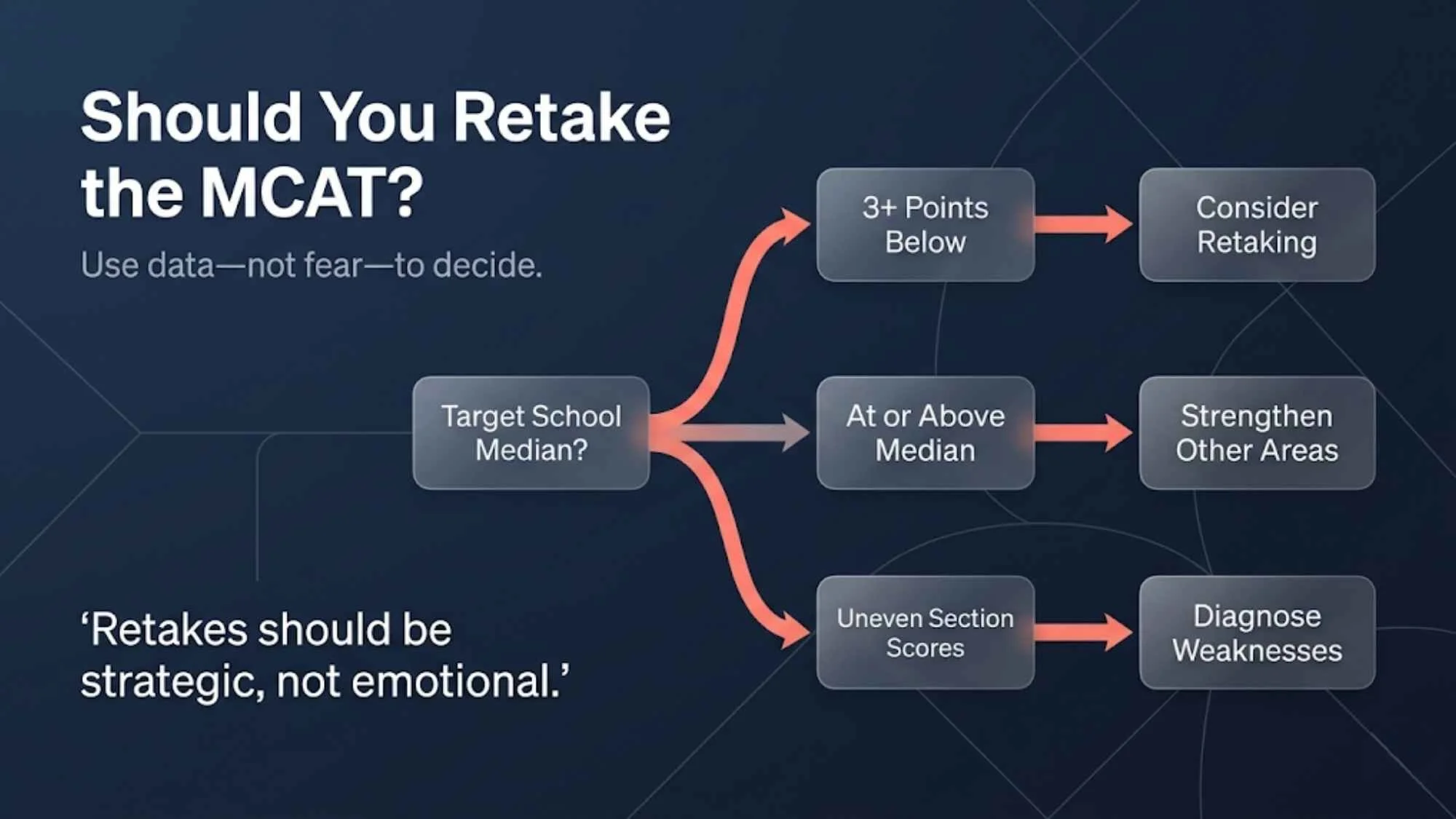
This is the question behind that question — and it deserves a direct answer.
Here's the threshold I give every student: if your score is more than three points below your target school's median, retaking is worth serious consideration. If your score is below 510 and your target is a top-50 MD program, you likely need to retake. That's not discouragement — that's math.
On the flip side, you generally shouldn't retake if your score is at or above your target school's median and the rest of your application — GPA, experiences, letters — is genuinely strong. And to be clear: multiple MCAT attempts are not automatically penalized. Admissions committees see the whole picture, including how you've grown.
If a retake is on the table, your study plan and prep materials matter more than almost anything else. Our breakdown of the top MCAT prep books for 2026 will save you from spending months on the wrong resource.
FAQs
Q1: What is a good MCAT score for MD schools?
A score of 511–514 is generally considered competitive for most MD programs, since it sits near or above the national MD matriculant average. A 515+ is considered strong and opens up a wider range of top-30 programs.
Q2: What MCAT score do I need for Harvard Medical School?
Harvard's matriculants average roughly 519–523. That said, no single score guarantees admission — Harvard reviews applications holistically, and MCAT score is just one factor alongside GPA, research, and clinical experience.
Q3: Is a 510 a good MCAT score?
Yes — a 510 puts you in roughly the top 20–25% of test-takers and is competitive for many MD programs, especially mid-tier and state schools. Whether it's "good enough" still depends heavily on your specific target schools.
Q4: How many times can you retake the MCAT?
Per AAMC policy, you can take the MCAT up to three times in one year, four times across two years, and seven times in a lifetime. Always confirm current rules directly with the AAMC before registering.
Q5: What is the average MCAT score?
The average score across all test-takers is around 500–501. But for context, the average MD matriculant scores closer to 511–512 — a meaningful gap between who takes the test and who gets in.
Your MCAT score is one chapter in a longer story. If you're thinking about what comes before and after it, our step-by-step guide to getting into medical school maps the entire journey — from pre-med planning to acceptance.
The Bottom Line
A good MCAT score is relative to your target school — knowing your specific number matters far more than knowing the national average.
If there's one thing four years of mentoring has taught me, it's this: the students I've seen succeed weren't always the highest scorers. They were the ones who understood exactly where their number stood, built a realistic plan around it, and executed that plan without second-guessing every step.
So when someone asks what is a good MCAT score, the honest answer is: the one that gets you into the program that's right for you. Know your number, know your target, and build from there.
About the Author
This article was written by a mentor affiliated with Columbia University and UC Berkeley, who scored a 522 on the MCAT and has spent over four years helping pre-med students interpret their scores, plan retakes, and build competitive medical school applications. Our mentors specialize in MCAT prep, score strategy, and pre-med advising for students applying across the full range of MD and DO programs.