

MCAT Study Schedule: A Week-by-Week 4-Month Plan
I still remember the moment I opened my first MCAT prep book and felt completely paralyzed. Seven textbooks, four content areas, 500-some days' worth of material — and no idea where to start. If you've ever stared at a pile of prep resources and felt your stomach drop, I've been there. After scoring 522 on the MCAT (Medical College Admission Test) myself and spending the past 12 years mentoring pre-med students at HYE Tutors, I can tell you that the students who succeed aren't the ones who panic-study hardest. They're the ones who follow a clear, sequenced plan. By the end of this article, you'll have a concrete, week-by-week 4-month MCAT study schedule ready to execute — no fluff, no filler, just exactly what works.
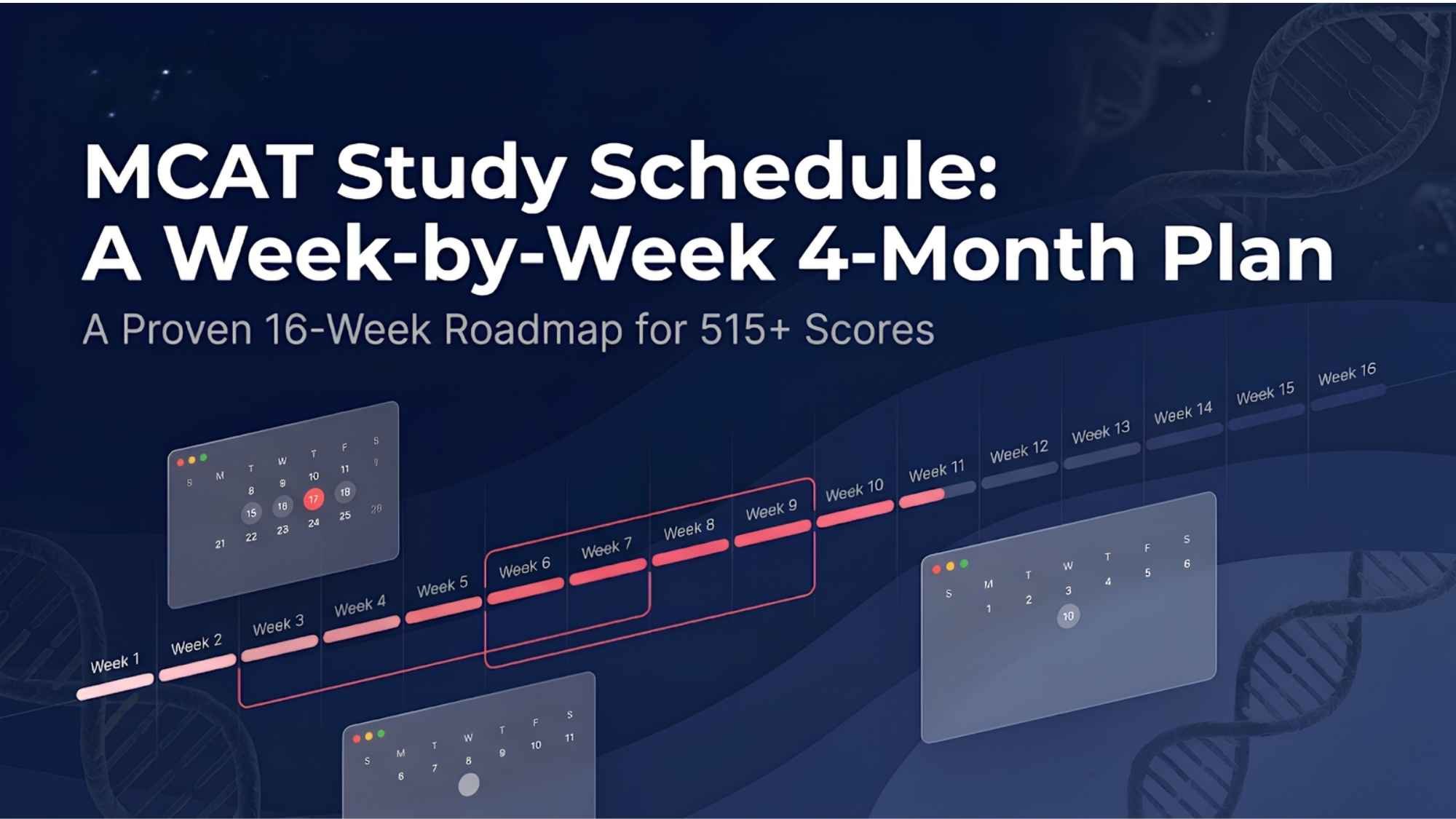
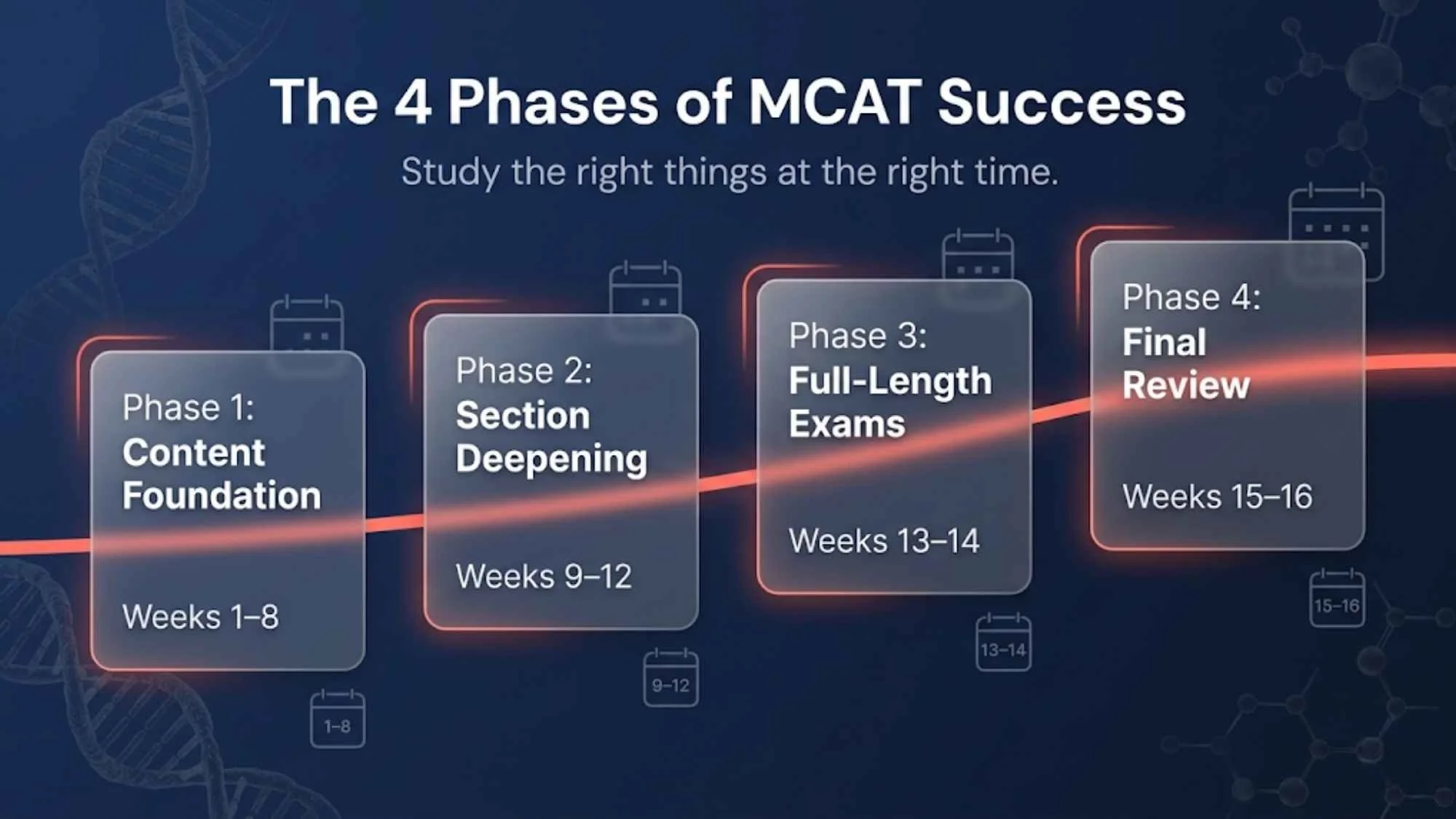
“A 4-month MCAT study schedule divides prep into four phases: content review (weeks 1–8), section-specific deepening (weeks 9–12), full-length practice tests (weeks 13–14), and final review (weeks 15–16). Study 6 days per week, 6–8 hours per day. Prioritize your weakest sections early, integrate AAMC (Association of American Medical Colleges) Official materials from week 9 onward, and never skip rest days — recovery drives retention.”
The 4-Month MCAT Study Schedule — Week by Week
In 12 years of mentoring pre-med students, the ones who hit 515+ weren't the ones who studied the most hours — they were the ones who studied the right things at the right time. This schedule is built around that principle. According to AAMC data, most successful test-takers invest between 300–350 hours of total prep time. This plan distributes those hours strategically across four distinct phases.
Quick Phase Overview
| Phase | Weeks | Focus | Daily Hours |
|---|---|---|---|
| Phase 1 — Content Foundation | 1–8 | Full content review by section | 6–7 hrs |
| Phase 2 — Section Deepening | 9–12 | Weak sections + passage practice | 7–8 hrs |
| Phase 3 — Full-Length Tests | 13–14 | Timed FL exams + review | 8 hrs |
| Phase 4 — Final Review | 15–16 | High-yield content + AAMC polish | 6 hrs |
Phase 1 — Weeks 1–8: Content Review Foundation
This is where you build the foundation. The mistake I made on my first serious MCAT prep attempt — and the mistake we see constantly at HYE Tutors — is treating every subject equally. Biology and Biochemistry carry the heaviest content weight on the MCAT; start there and front-load your time accordingly. Here's your week-by-week subject map:
Weeks 1–2: Biology and Biochemistry (B/B — Biological and Biochemical Foundations) — heaviest content weight on the MCAT; prioritize these first
Weeks 3–4: General and Organic Chemistry — lay the groundwork for the C/P (Chemical and Physical Foundations) section
Weeks 5–6: Physics and Math fundamentals — round out the C/P section content
Weeks 7–8: Psychology and Sociology (P/S — Psychological, Social, and Biological Foundations of Behavior) — plus daily CARS (Critical Analysis and Reasoning Skills) practice begins in Week 1
One thing I tell every student I mentor: CARS is not a content subject. You don't review it — you practice it daily, the way an athlete drills footwork. Research published in Academic Medicine consistently shows that reasoning skills like those tested in CARS develop through repeated practice, not passive review. Start two CARS passages on Day 1 and never stop.
09:00–09:15 AM Break
09:15–11:15 AM Biochemistry: amino acids and protein structure
11:15 AM–12:00 PM Active recall flashcards (Anki or handwritten)
12:00–01:00 PM Lunch + rest
01:00–02:00 PM 2 CARS passages + timed review
02:00–04:00 PM Biology continued (cell biology, genetics)
04:00–05:00 PM Error log review + notes consolidation
Phase 2 — Weeks 9–12: Section Deepening and Passage Practice
By now you know the content. Phase 2 is about applying it under real test conditions — and confronting whatever weaknesses Phase 1 revealed. This is also when you introduce AAMC Official materials for the first time: the AAMC Question Packs, AAMC Section Bank, and AAMC Official Full-Lengths (available at aamc.org). Third-party materials have their place in Phase 1, but nothing replicates the real test like AAMC's own question library.
Take your first diagnostic full-length practice test at the start of Week 9 — this benchmarks where you are and tells you which 1–2 subsections need the most attention in this phase
Increase CARS practice to 3–4 passages per day
Begin working through the AAMC Question Packs by section and the AAMC Section Bank for targeted passage-based practice
Dedicate your two highest-intensity study days per week to your identified weak subsections
Every year we work with students who discover in Week 12 that P/S was their real problem — not chemistry. Don't let that be you. The diagnostic at Week 9 is the single most valuable data point in this entire schedule. Trust what it tells you.
If you're still deciding whether your prep book lineup is right for this phase, our guide
Top 5 Best MCAT Prep Books 2026 breaks down exactly which books pair with each phase of this schedule.
Phase 3 — Weeks 13–14: Full-Length Exam Practice
This is the highest-intensity block of the schedule — and the one most students misuse. The point of a full-length practice test is not simply to take it. The review is the work. A study on deliberate practice in medical education from the National Institutes of Health underscores exactly this: performance improves most not from repetition, but from reviewed repetition — understanding every error before moving on.
Take one full-length exam every 2–3 days — no more than 3–4 total in this block
Spend equal or more time reviewing each exam than taking it — every wrong answer gets an entry in your error log
Never take two full-lengths back-to-back — recovery and analysis is the work
Prioritize AAMC Official Full-Length Exams 1–4 in this block — these are the most accurate predictors of your real score
I scored a 519 on my first official practice test, then spent 6 hours reviewing it. That review session taught me more about my own test-taking patterns than the two weeks before it. Every HYE Tutors student who's broken 515 has said something similar.
Phase 4 — Weeks 15–16: Final Review and Test-Day Prep
Wind down the intensity. This phase is not about learning new content — it's about consolidating what you already know and building the confidence to perform under pressure. Students who try to cram new material in Week 16 almost always underperform relative to their practice scores.
No new content — high-yield flashcard review only (biochemistry pathways, P/S theory, physics equations)
Take one final full-length practice exam in Week 15; review it immediately and thoroughly
Week 16: light review only — 1 CARS passage per day, a clean sleep schedule, and attention to nutrition and hydration protocols
The week before test day, I tell every student the same thing: "Your score is already in there. Your job now is to not get in the way of it."
- Confirm test center location and travel route
- Pack approved ID and any required test materials
- Set consistent sleep/wake times 7 days before exam
- Prep healthy meals and snacks for test day
- Do 1 light CARS passage each morning — no full-length exams
- Review your personal error log (not new material)
- Contact HYE Tutors if you have last-minute questions
Before your MCAT date, your personal statement is the next crucial milestone. Our guide How to Write a Personal Statement for Medical School is the first resource I send students the week after their exam.
How to Adjust This MCAT Study Schedule for Your Situation
Not every student starts from the same baseline — and a schedule that ignores your starting point is just noise. The students I worry about most at HYE Tutors are the ones who follow a generic schedule without running a diagnostic first. Always begin with a full-length diagnostic; it changes everything. Here's how to adapt based on your situation:
Full-time student: This 4-month schedule fits as written. Protect your weekends as study days and guard your one rest day per week — non-negotiable.
Working part-time: Extend to 5–6 months. Compress Phase 1 to 10 weeks instead of 8, and reduce daily hours to 4–5 on workdays, making up volume on weekends.
Retaking the MCAT: Skip bulk Phase 1 content review. Use your previous score report and diagnostic results to go straight into Phase 2 with targeted review of your specific weak subsections.
Under 10 weeks remaining: Compress Phases 1–2 into 6 weeks using high-yield-only materials. This is high-risk and not recommended for first-time test takers — mentorship is strongly advised.
Not sure how to adapt this schedule to your test date and starting score? Book a free session with an HYE Tutors MCAT mentor and we'll build your personalized plan together.

FAQs
If you're still exploring whether the MCAT is right for your path, our deep-dive MCAT Exam: Everything You Need to Know covers eligibility, scoring, and registration — a strong read before committing to any schedule.
Q: How many months should I study for the MCAT?
A: Three to six months, depending on your baseline. Four months is the most common effective window for first-time test takers — it's long enough to cover all four sections without burning out. Fewer than 10 weeks is high-risk for most students; there simply isn't enough time to build the reasoning skills CARS and B/B require.
Q: How many hours per day should I study for the MCAT?
A: Six to eight hours per day, six days per week during peak phases. Quality matters far more than raw hours. A focused 6-hour session with active recall and error review will outperform an unfocused 10-hour marathon every time.
Q: When should I start taking MCAT practice tests?
A: Take a diagnostic full-length at the very start of prep to establish your baseline. Structured full-lengths begin in Week 9 (Phase 2). Reserve the official AAMC Full-Lengths for Weeks 13–16, when you're closest to test conditions and your score will be most predictive.
Q: Can I study for the MCAT in 2 months?
A: It's possible for retakers who already have a strong content foundation and a clear sense of their weak areas. For first-time test takers, two months is not recommended — the risk of burnout and significant content gaps is high. If you're working with a compressed timeline, book a free session with one of our mentors before you start.
Q: What is the hardest section on the MCAT to prepare for?
A: CARS — and it's not close. Unlike the science sections, CARS resists content-based study entirely. You can't memorize your way to a good CARS score. It requires daily passage practice from Day 1, building the reasoning and reading speed that only comes with consistent repetition. Most students who underperform on test day underestimated CARS prep. Don't be one of them.
For a complete overview of the pre-med path, our guide How to Get into Medical School: Step-by-Step Guidebook covers every milestone from GPA strategy to MCAT timelines — worth reading before your test date.
Your Next Step
A strong MCAT study schedule isn't about logging the most hours — it's about sequencing the right work at the right time. The students I've seen at HYE Tutors break 515 consistently shared one thing in common: they followed a plan, not a panic. They treated CARS like an athlete treats footwork. They used AAMC Official materials where it mattered most. And they reviewed their practice tests harder than they took them.
Every student who has walked into an HYE Tutors session overwhelmed has walked out with a schedule that made sense for them. That's what personalized mentorship does. Your MCAT study schedule should fit your starting score, your test date, and your life — not a generic template.
If you're ready for a personalized MCAT study schedule built around your exact situation, book your free consultation with an HYE Tutors mentor today. Let's build your plan.