

What Is a Dilation in Math?
Picture a coordinate grid with two triangles on it — one small, one large, but clearly the same shape. A student will usually ask the same question: "How did one turn into the other?" The answer is dilation — and what a dilation in math really means is simpler than most students expect.
Dilation is one of the four major geometric transformations, alongside translation, rotation, and reflection — and it's the one most directly connected to real life. If you've already read our guides on rotation and translation, you're already halfway to understanding the full picture of how shapes move and change.
As someone who has tutored geometry and standardized test prep for over five years, I can tell you dilation is one of the topics that looks intimidating on a worksheet and feels completely natural once it's drawn out. By the end of this guide, you'll know exactly what a dilation is, how to perform one step by step, and where it shows up on exams.
Dilation in Math:
A dilation in math is a transformation that resizes a figure — either enlarging or shrinking it — by a scale factor, from a fixed point called the center of dilation. The shape's proportions stay the same; only its size changes. Dilation is one of the four main geometric transformations, and it produces figures that are similar, not congruent, to the original.
What Is a Dilation in Math?
In my years of tutoring geometry, I've found that dilation is the transformation students fear most on paper — but understand fastest once I draw it. Let's do that together.
At its core, a dilation is a transformation that produces a figure similar to the original by scaling it from a fixed center point. There are two outcomes:
Enlargement — the figure gets bigger (scale factor greater than 1)
Reduction — the figure gets smaller (scale factor between 0 and 1)
As with the other transformations in this series, the original figure is called the pre-image, and the result is the image. With dilation, the shape, angle measures, and proportions of the figure are all preserved — only the size changes.
Here's the detail that trips students up: unlike rotation, reflection, and translation — which are all isometries (they preserve distance) — dilation does not preserve distance. The whole point of a dilation is that distances change — proportionally, by the scale factor.
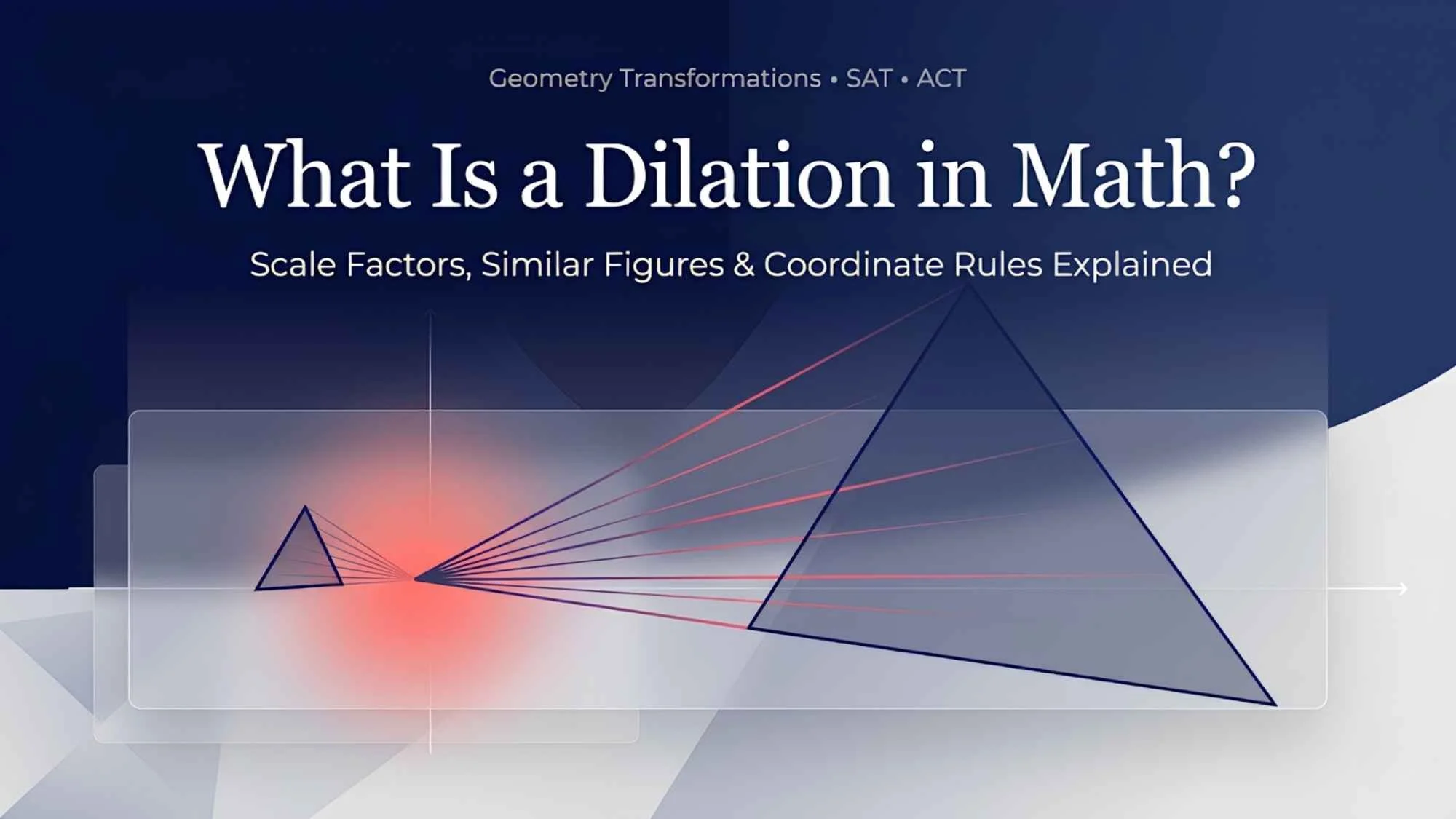
Picture a small triangle near the bottom-left of a coordinate grid, with arrows stretching out from a single point to each of its corners, landing on a much larger triangle. That's a dilation in motion — and once a student sees that picture, the formula stops being abstract.
Dilation Definition in Math — Key Terms to Know
Before anything else makes sense, lock in these two terms:
Center of Dilation: the fixed point from which every point of the figure is scaled. It can be inside the figure, outside it, or anywhere else on the plane — it depends entirely on the problem.
Scale Factor (k): the ratio that determines how much the figure is enlarged or reduced.
Here's how scale factor breaks down in practice:
k > 1 → enlargement (the image is bigger)
0 < k < 1 → reduction (the image is smaller)
k = 1 → the image is identical to the pre-image (no change)
k < 0 → a dilation combined with a 180° rotation. This shows up occasionally in advanced problems, but we won't go deep on it here — just know it exists.
Exam Tip: On most middle and high school exams, the scale factor will be positive. If you see a negative scale factor, flag it — that's an advanced variation, and it's worth a second look before you answer.
How Does a Dilation Work? The Scale Factor Formula
The core relationship behind every dilation is this: the image's distance from the center equals the scale factor times the pre-image's distance from the center. That's the entire idea — everything else is just applying it.
On a coordinate grid, when the center of dilation is the origin, the formula is:
(x, y) → (kx, ky)
I always tell my students: "Multiply every coordinate by k. That's it." Once they see it applied to an actual point, the formula stops feeling like a rule and starts feeling like common sense.
Let's walk through it. Say a triangle has a vertex at (2, 3), and we're applying a scale factor of k = 2, centered at the origin. We multiply both coordinates by 2: (2 × 2, 3 × 2) = (4, 6). That's the new vertex location in the image. Every other vertex of the triangle follows the exact same rule.
| Pre-Image Vertex (x, y) | Image Vertex (kx, ky), k = 2 |
|---|---|
| (2, 3) | (4, 6) |
| (1, −1) | (2, −2) |
| (0, 4) | (0, 8) |
I had a student who kept multiplying only the x-coordinate by k and leaving the y-coordinate unchanged — a mistake I now pre-empt in every first session on dilation. Both coordinates get multiplied. Always.
Dilation on a Coordinate Plane — Step-by-Step
Many students search specifically for how to perform a dilation on a graph. Here's the process, broken into steps:
Identify the center of dilation and the scale factor (k) given in the problem
Write down the coordinates of each vertex of the pre-image
Multiply each x- and y-coordinate by the scale factor k
Plot the new coordinates — this is your image
Check your work: are the two figures similar? Do the sides stay proportional?
Nine times out of ten in a classroom exam, the center of dilation is the origin (0, 0). Learn that case cold first — then tackle problems with other centers once it's automatic.
If you want to see how shapes continue to interact across a plane after transformations like this — including how dilated shapes can still tile a surface — our guide on tessellations is a natural next stop.
Center of Dilation — What It Is and Why It Matters

A lot of students understand scale factor just fine but get fuzzy on what the center of dilation actually does. Here's the clearest way to think about it: the center of dilation is the anchor point — every other point in the figure moves away from it (enlargement) or toward it (reduction).
When the center is the origin, the process is simple — multiply every coordinate by k, as we covered above. But when the center is not the origin, there's an extra step: you shift the figure so the center becomes the origin, scale by k, then shift back to the original position.
For example, if the center of dilation is (1, 1) and a vertex is at (3, 4) with a scale factor of k = 2: first subtract the center to get (2, 3), multiply by k to get (4, 6), then add the center back to get (5, 7). That's the new vertex location.
I describe the center of dilation like a flashlight. The light source is the center — and depending on how close the object is to the light, the shadow it casts gets bigger or smaller. The shadow's shape never changes — only its size, based on distance from the light.
Types of Dilation in Math — Enlargement vs. Reduction
This distinction comes up constantly, and it's simple once you frame it the right way:
| Type | Scale Factor | What Happens |
|---|---|---|
| Enlargement | k > 1 | Image is larger than the pre-image |
| Reduction | 0 < k < 1 | Image is smaller than the pre-image |
| No Change | k = 1 | Image is identical to the pre-image |
Think of it like adjusting the zoom on your phone's camera: enlargement is zooming in — everything gets bigger but keeps its proportions. Reduction is zooming out — everything gets smaller, same proportions. Either way, the result is a similar figure — same shape, different size.
One more note for the curious: a negative scale factor produces a dilation combined with a 180° rotation. It's a real variation that exists in more advanced problems, but for the vast majority of middle and high school work, you won't need to apply it.
Dilation vs. Other Math Transformations — What's the Difference?
Students frequently lump all four transformations together. Here's the side-by-side comparison that clears it up:
| Transformation | Changes Size? | Changes Shape? | Congruent Result? |
|---|---|---|---|
| Translation | No | No | Yes |
| Rotation | No | No | Yes |
| Reflection | No | No | Yes |
| Dilation | Yes | No | No (Similar) |
The key distinction: translation, rotation, and reflection are rigid motions (isometries) — they preserve both size and shape, producing congruent figures. Dilation is not a rigid motion. It preserves shape but changes size, which means it produces similar figures rather than congruent ones.
Real-Life Examples of Dilation in Math
One of my favorite things to tell students: dilation isn't invented for math class. It's borrowed from the real world — you've been looking at dilations your whole life without naming them.
Photography and zoom lenses — zooming in or out scales the entire image from a center point, exactly like a coordinate dilation.
Maps and blueprints — a scale of 1:100 means every real-world measurement has been dilated down by a factor of 1/100. Architects and engineers rely on this daily.
Screen resolution and image resizing — stretching or shrinking a digital image on your phone or computer is a dilation in action.
Microscopes — enlarging a tiny object by a known scale factor so it's visible to the human eye.
Architecture and model building — scale models of buildings, bridges, and cities use precise dilation to represent real structures at a manageable size.
Whenever a student tells me dilation feels pointless, I pull out a map and ask them to find the scale. They get it immediately — every measurement on that map has already been dilated for them.
Dilation in Math on Exams — What Students Need to Know
In my tutoring experience, dilation questions are almost guaranteed on state geometry assessments and the SAT — and they reward students who understand the concept, not just the formula.
Common Core Geometry (8th grade & high school): dilation is an explicit standard. Students are expected to understand similarity and scale factor as foundational concepts.
SAT Math: similar triangles and scale factor problems show up regularly. A solid grasp of dilation builds the intuition needed to solve them quickly.
ACT Math: proportion and similarity questions are common, and dilation is the concept underneath nearly all of them.
State Geometry Exams: dilation and similarity proofs are standard. Students need to be able to identify the scale factor directly from a graph.
Dilation also pairs naturally with other foundational geometry concepts — including the Pythagorean Theorem, which often shows up in the same similarity and proportion problems once side lengths are involved.
FAQs
Q1: What is a dilation in math in simple terms?
A dilation is like using the zoom feature on a photo. The picture (shape) stays exactly the same — just bigger or smaller — and everything stretches or shrinks from one fixed point.
Q2: What is the scale factor in a dilation?
The scale factor is the number that tells you how much a figure grows or shrinks. A scale factor of 3 means every side of the new figure is three times the length of the original. A scale factor of 1/2 means every side is cut in half.
Q3: Does dilation change the shape of a figure?
No. Dilation preserves the shape and all angle measures — the figure stays similar to the original. Only the size changes, scaled up or down by the scale factor.
Q4: What is the center of dilation?
The center of dilation is the fixed point from which the entire figure is scaled. Every point in the image lies along a line drawn from this center through the corresponding point in the pre-image.
Q5: Is a dilation a rigid transformation?
No. Rigid transformations — rotation, reflection, and translation — preserve size and shape, producing congruent figures. Dilation changes size, so it is not rigid; it produces similar figures instead.
Q6: What happens when the scale factor is less than 1?
The image becomes smaller than the pre-image — this is called a reduction. For example, a scale factor of 0.5 means the image is exactly half the size of the original in every dimension.
Q7: How do you find the scale factor of a dilation?
Divide the length of any side of the image by the length of the corresponding side of the pre-image: k = image length ÷ pre-image length. The result is your scale factor.
Putting It All Together
Here's the core of it: a dilation is a size transformation — it works by applying a scale factor from a center of dilation, and it produces a similar figure — same shape, same angles, different size.
Dilation is genuinely one of the most visual and intuitive topics in geometry once you see it properly — and once you've drawn a few yourself, the formula (x, y) → (kx, ky) stops being something to memorize and starts being something you understand.
Students who understand dilation deeply — not just the formula — consistently handle similarity proofs and proportion problems with ease on exams. Understanding what a dilation in math actually is gives you a genuine advantage in geometry, and it builds the foundation for similarity, trigonometry, and beyond.
For more practice, Khan Academy's dilation lessons walk through several worked examples, and CK-12's geometry resources offer additional practice problems with solutions.
About the Author:
This article was written by a tutor affiliated with Columbia University and UCLA, with over five years of one-on-one experience in geometry, Common Core math, and standardized test prep for the SAT and ACT. Our tutors work with students across 8th-grade geometry, high school geometry, and state assessment curricula — helping students move past memorized formulas toward genuine understanding. At HYE Tutors, we believe every student can master geometry when it's taught the right way.