

What Is Symmetry in Math? Lines, Rotational & Point Symmetry
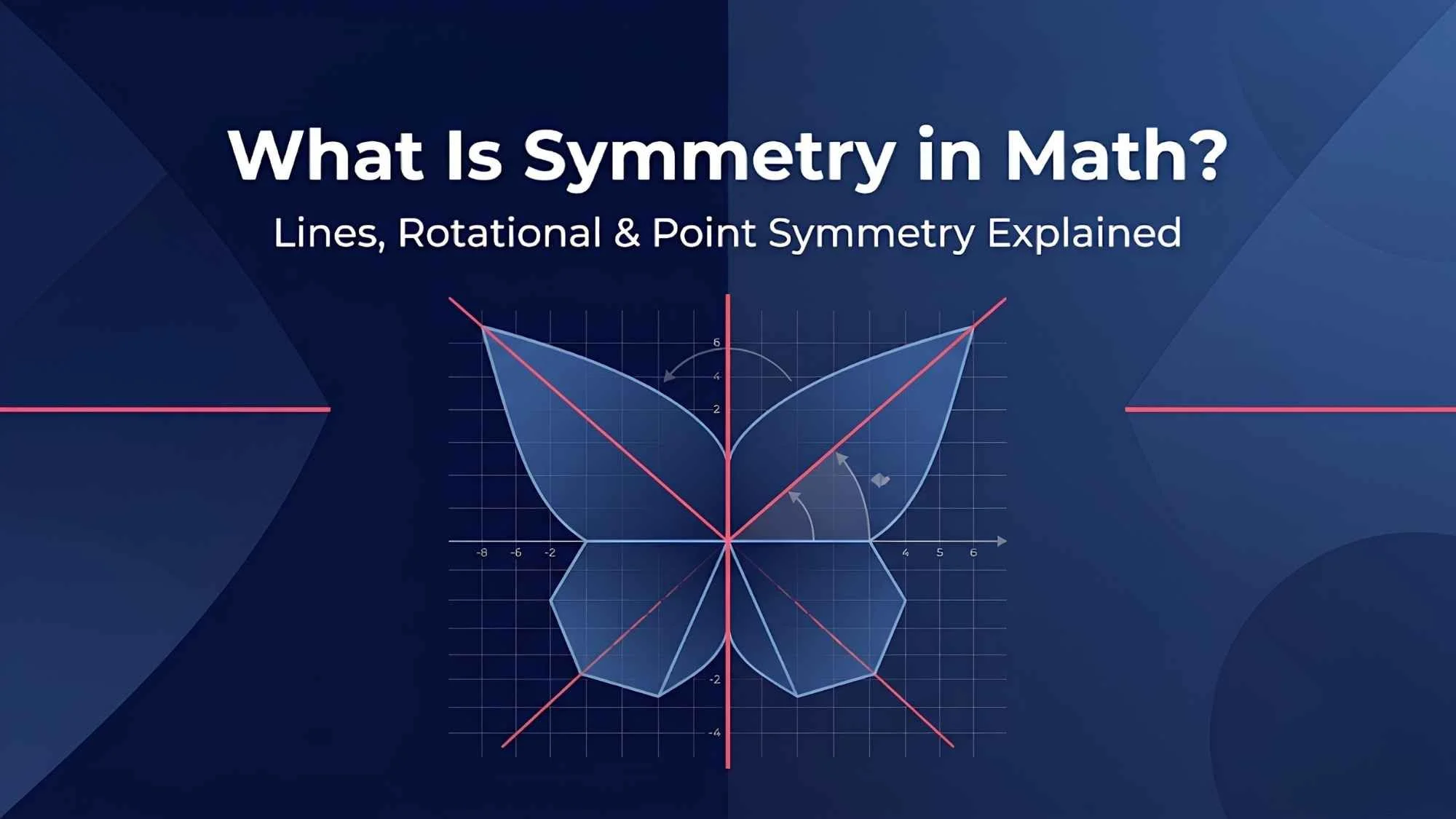
Fold a piece of paper in half. If both sides line up perfectly — every edge, every corner — you've just performed the world's simplest symmetry test. It's the same thing that makes a butterfly's wings so striking, a snowflake so mesmerizing, and the Taj Mahal so satisfying to look at. But what is symmetry in math, exactly? And why does it matter beyond art class?
Symmetry is not just an aesthetic quality — it is a precise mathematical concept that students encounter from early elementary school all the way through standardized testing. I've been tutoring math across grade levels for over eight years, working with students from 4th grade through SAT and ACT prep, and I'll tell you honestly: symmetry questions trip up more students than you'd expect. Not because the concept is hard, but because the different types of symmetry aren't always clearly explained in textbooks.
By the end of this guide, you'll have a complete, clear understanding of what symmetry means in math, the three main types (line, rotational, and point), how to find and count lines of symmetry, and exactly what to expect on your next exam.
Symmetry in Math
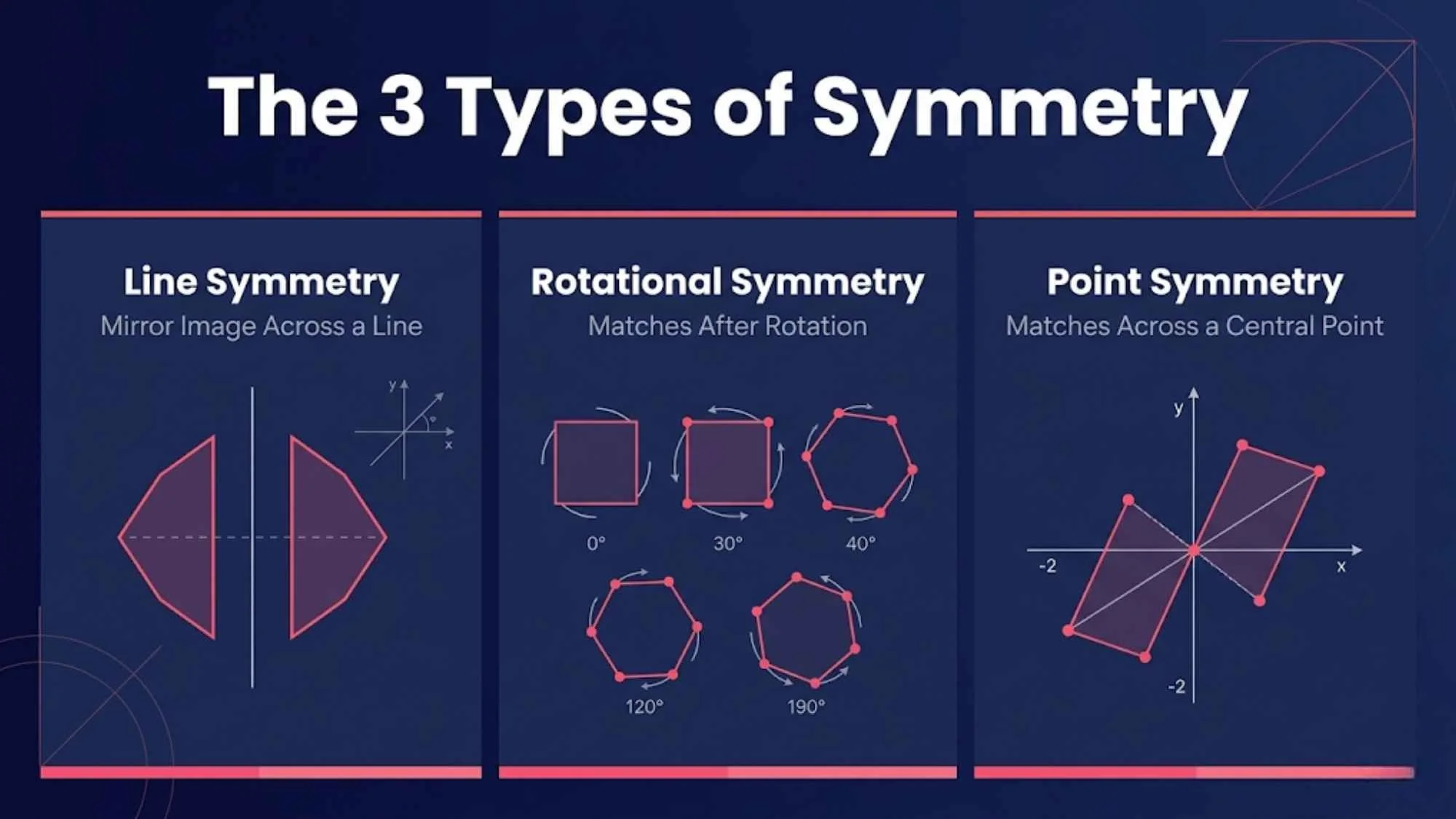
Symmetry in math means a shape or figure looks identical on both sides of a dividing point, line, or axis after being folded, rotated, or reflected. A shape is symmetrical when one part is a mirror image of the other.
The 03 main types of symmetry in math are
Line symmetry (reflective symmetry),
Rotational symmetry, and
Point symmetry.
What Is Symmetry in Math?
I always start symmetry lessons with a folded paper cutout. I'll hand a student a square piece of paper and ask them to fold it so both halves match exactly. The moment they see the edges align perfectly, the definition clicks — and it sticks for good.
So here's the formal version: a figure has symmetry when it can be divided so that one part is the mirror image of the other. The dividing line is called the line of symmetry (also called the axis of symmetry). Symmetry is about perfect balance and exact correspondence — not just 'looks similar,' but mathematically identical.
We've worked with students who initially thought a slightly lopsided drawing was symmetric because it 'looked about right.' That intuition matters — but in math, symmetry demands precision. If you flipped one half over the dividing line, it would land exactly on top of the other half. Not approximately. Exactly.
Simple examples of symmetric shapes: a square, a circle, an equilateral triangle, a rectangle, and the capital letter A. Non-examples are just as instructive: a scalene triangle has no symmetry at all, and the letter F has none either.
One of my go-to questions for students: "Does the letter H have symmetry?" Almost every student finds one line of symmetry at first — the vertical one. Then they look again and realize H has two lines: one vertical, one horizontal. It's a small moment, but it teaches students to look systematically rather than settling for the first answer.
Symmetry also shows up across mathematical domains. It's central to geometry — but also connects to algebra (the axis of symmetry of a parabola), coordinate geometry, and even number patterns. According to Khan Academy's geometry curriculum, understanding symmetry and transformations forms one of the cornerstones of geometric reasoning from middle school onward.
Symmetry is also central to tessellations — the way shapes tile a plane without gaps or overlaps. We explore that connection in our guide on tessellations in math.
Symmetry in math comes in three main types — and knowing each one is what separates students who guess from students who score.
Line Symmetry in Math (Reflective Symmetry)
Line symmetry is the type students encounter first, and it's the most intuitive. A shape has line symmetry when a straight line divides it into two halves that are exact mirror images of each other. This is also called reflective symmetry or bilateral symmetry.
The key question on exams: how many lines of symmetry does a given shape have? Here's a quick reference: a square has 4 (horizontal, vertical, and both diagonals); a rectangle has 2 (horizontal and vertical only — not diagonal); a circle has infinitely many; an equilateral triangle has 3.
Real-world examples include butterfly wings, the human face (approximately), and capital letters like M, A, T, and W. You see it in architecture, in logos, and in nature constantly.
Rotational Symmetry in Math
This is where students most often get tripped up — and where a single clear explanation makes all the difference. A shape has rotational symmetry if it looks identical after being rotated less than 360° around its center point.
The key term here is order of symmetry — the number of times a shape matches its original appearance during one full 360° rotation. A square rotated 90° looks exactly the same, and this happens 4 times in a full rotation, so it has rotational symmetry of order 4. An equilateral triangle has order 3 (matching every 120°). A shape with order 1 has no rotational symmetry — it only matches itself at the full 360° return.
I tell students: spin the shape in your mind. If it ever looks identical before you've completed the full circle — that's rotational symmetry. Pinwheels, starfish, snowflakes, and most regular polygons all have it.
To understand rotational symmetry deeply, it helps to have a solid grip on what rotation means in geometry — check out our guide on rotations in math for the full picture.
Point Symmetry in Math
Point symmetry is the least familiar type for most K-8 students, but it's worth knowing — especially as students move into coordinate geometry. A figure has point symmetry when every part of it has a matching part the same distance from a central point, but in the opposite direction.
It's also called origin symmetry in coordinate geometry. The test: for every point (x, y) on the figure, the point (−x, −y) is also on the figure. Think of the letter S, the letter Z, or a regular hexagon. They all have point symmetry — spin them 180° around their center, and they look exactly the same.
Lines of Symmetry — How to Find and Count Them
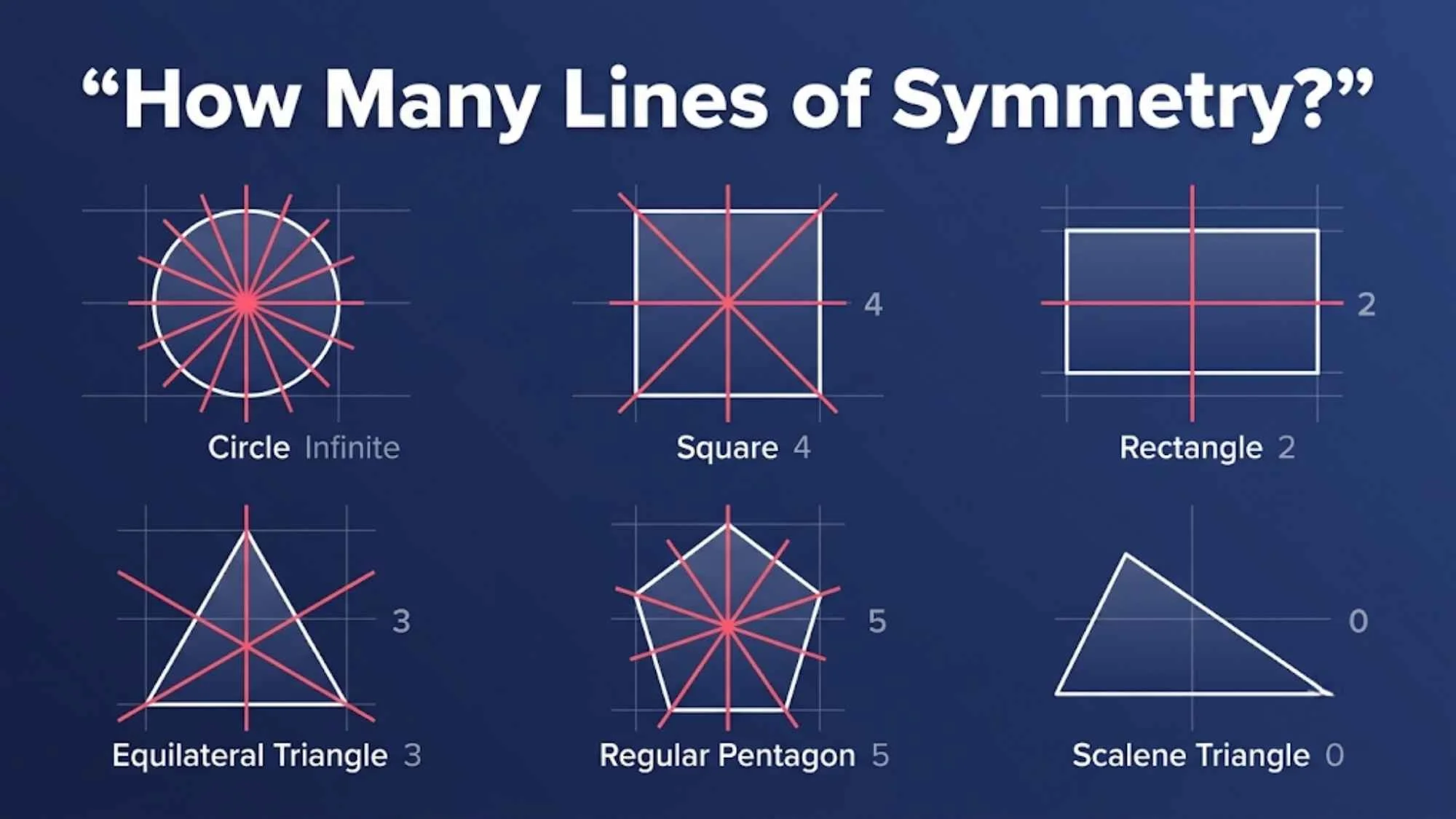
Finding lines of symmetry is one of the most commonly tested geometry skills from grades 3 through 8. Here's the reliable method we teach every student at HYE Tutors.
The Fold Test: Mentally (or physically) fold the shape along a potential line of symmetry. If both halves align perfectly — every edge, every corner — that fold line is a line of symmetry. If anything is off, it isn't.
Work systematically: check the vertical fold first, then horizontal, then both diagonals. Don't skip steps. A common mistake we see all the time: students find the vertical line of symmetry in a rectangle and stop there, missing the horizontal one completely.
Here's the quick reference table to memorize:
| Shape | Lines of Symmetry |
|---|---|
| Circle | Infinite |
| Square | 4 |
| Rectangle | 2 |
| Equilateral Triangle | 3 |
| Regular Pentagon | 5 |
| Scalene Triangle | 0 |
| Letter H | 2 |
| Letter A | 1 |
| Letter F | 0 |
Symmetry, translation, and rotation are all part of the same family of geometric transformations. If you want the full picture, our guide on translation in math is a natural next step.
Symmetry in Real Life — Where Students See It
One thing I've found after years of tutoring: students who connect abstract concepts to the physical world retain them far longer. So let's make symmetry real.
In nature: Butterfly wings (line symmetry), snowflakes (rotational symmetry of order 6), starfish (rotational symmetry of order 5), and leaves (approximate bilateral symmetry). The natural world is full of mathematical precision — even when we don't label it that way.
In architecture: The Taj Mahal, the Eiffel Tower's base, gothic cathedral windows, and bridge designs all leverage symmetry for both aesthetics and structural stability.
In art and design: Mandalas are perhaps the purest example of rotational symmetry in human-made objects. Logos, quilts, and Islamic geometric art also use symmetry extensively.
In the alphabet: Letters with line symmetry include A, H, I, M, O, T, U, V, W, X, and Y. Letters with no line symmetry: F, G, J, N, P, Q, R, S, Z. (S and Z, interestingly, have point symmetry instead.)
I always ask students: find three symmetric objects in this room right now. They always can — and that's the point. Once you see symmetry, you can't unsee it.
Symmetry also appears in another famous mathematical relationship found throughout nature: the Golden Ratio. We explore that in our guide on the Golden Ratio in math and nature.
Symmetry on Math Exams — What Students Need to Know
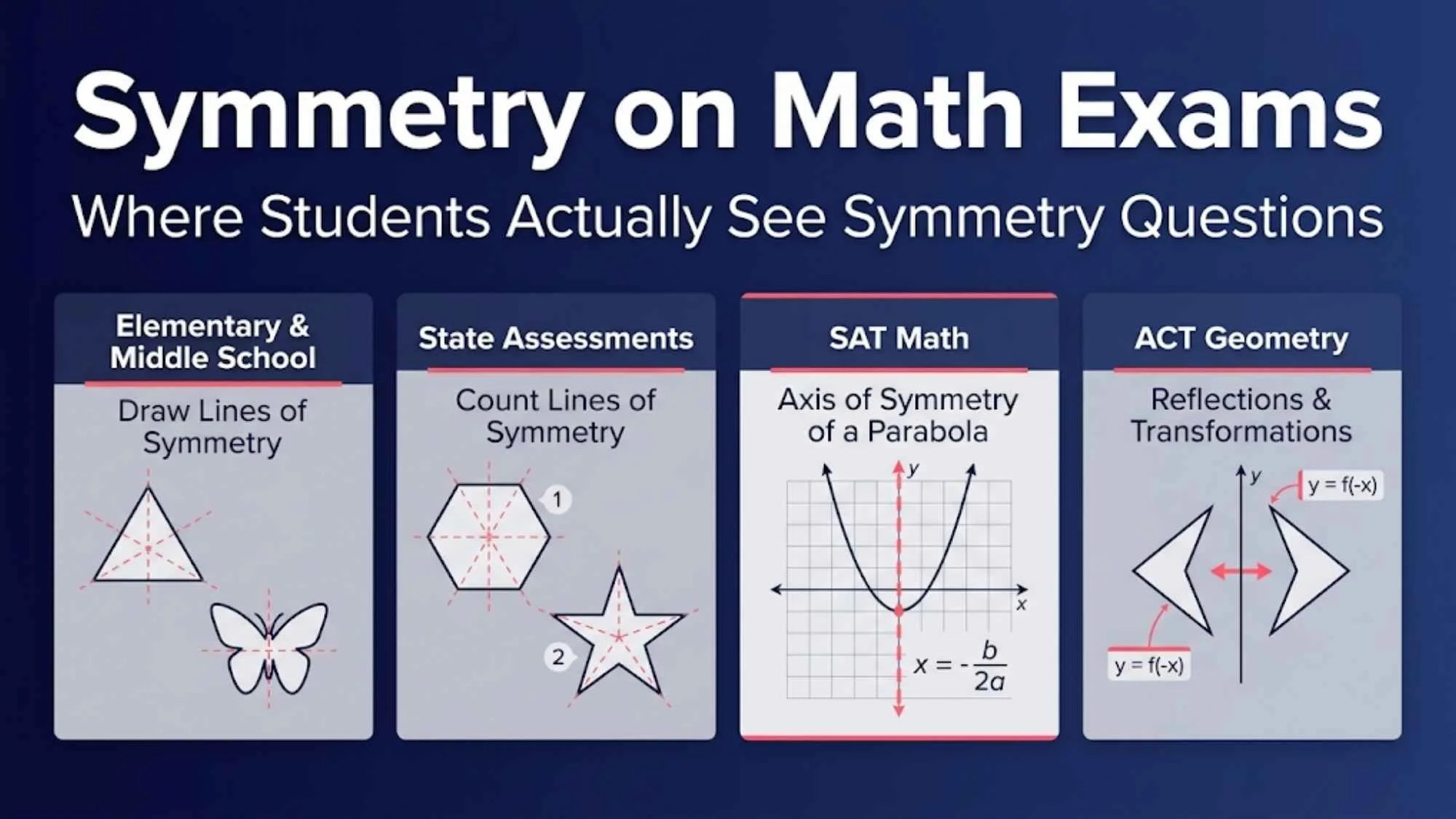
In my tutoring experience across standardized tests, symmetry questions are among the most consistently rewarding for students to study. They're visual, logical, and learnable — students who prepare for them almost always get them right.
Common Core Math (K–8): Drawing and identifying lines of symmetry is explicitly tested starting in 4th grade (CCSS 4.G.3). Students are asked to identify symmetric figures and draw lines of symmetry. According to the Common Core State Standards Initiative, this standard builds directly into geometric transformation work in later grades.
SAT Math: Symmetry appears in coordinate geometry — most prominently as the axis of symmetry of a parabola. If you see a quadratic equation in the form y = ax² + bx + c, the axis of symmetry is the vertical line x = −b/2a. This is symmetry applied to algebra, and it's heavily tested.
ACT Math: Rotational symmetry and reflections appear in the geometry sections. Students who can mentally rotate or reflect a shape are significantly faster on these questions than students who work purely algebraically.
State assessments (grades 3–8): Expect questions like 'How many lines of symmetry does this shape have?' and 'Which of these figures is symmetric?' Drawn diagrams are common — practice identifying symmetry visually, not just by formula.
Geometry is highly interconnected. Just as the Pythagorean theorem is non-negotiable for coordinate geometry, understanding symmetry is essential for the spatial reasoning sections of every major standardized test. Students who visualize geometric relationships — rather than just memorizing formulas — consistently score higher.
FAQs
Q1: What is symmetry in math in simple words?
A shape has symmetry in math when you can fold it along a line and both halves match up perfectly — like a butterfly or a square. That fold line is called the line of symmetry. If the two halves line up exactly, the shape is symmetrical.
Q2: What are the 3 types of symmetry in math?
The three types are:
(1) Line symmetry — a line divides the shape into two mirror-image halves;
(2) Rotational symmetry — the shape looks identical after being rotated less than 360°; and
(3) Point symmetry — every point on the figure has a matching point the same distance from a central point, but in the opposite direction.
Q3: How many lines of symmetry does a circle have?
A circle has infinite lines of symmetry. Any straight line drawn through the center of a circle divides it into two perfect mirror halves — and you can draw infinitely many such lines through a single point. This is a favorite exam question precisely because the answer surprises students.
Q4: Does a rectangle have symmetry?
Yes — a rectangle has 2 lines of symmetry: one horizontal and one vertical. Here's a common misconception worth calling out directly: a rectangle does not have diagonal lines of symmetry. If you fold a rectangle along a diagonal, the corners don't align. A square — which is a special rectangle — does have diagonal symmetry, but a non-square rectangle doesn't.
Q5: What is the difference between line symmetry and rotational symmetry?
Line symmetry is about folding — a line divides the shape so that one half is the mirror image of the other. Rotational symmetry is about spinning — the shape looks identical after being rotated less than 360°. Many shapes have both: a square has 4 lines of symmetry and rotational symmetry of order 4. But some shapes have one without the other — for example, the letter Z has point symmetry but no line symmetry.
Q6: What is an axis of symmetry?
The axis of symmetry is the line that divides a shape into two perfect mirror halves. In basic geometry, it's synonymous with the line of symmetry. In algebra, the term appears specifically for parabolas: the axis of symmetry is the vertical line that passes through the vertex of the parabola, given by the formula x = −b/2a for any parabola in the form y = ax² + bx + c.
Conclusion
Symmetry in math is, at its core, about balance and mirror-image correspondence — across a line, around a point, or through rotation. It's one of those concepts that feels simple once it clicks, but requires clear explanation to get there.
The three types — line symmetry, rotational symmetry, and point symmetry — each show up differently on exams. Knowing all three, and being able to apply them quickly to shapes and coordinate geometry problems, is a real advantage. Students who visualize symmetry rather than just memorize its definition answer geometry questions faster and with far more confidence.
Understanding what symmetry is in math opens doors across geometry, algebra, and standardized testing. It's a concept that rewards the students who take the time to really internalize it — and we've seen it happen again and again in our tutoring sessions.
Want personalized practice on symmetry or any geometry topic? Our expert tutors at HYE Tutors are ready to help. Book your free session → at hyetutors.com.
About the Author:
This article was written by a tutor affiliated with Columbia University and UCLA, with over 8 years of experience teaching math from 4th grade through SAT, ACT, and state standardized test preparation. Having worked with hundreds of students across New York, Los Angeles, and online, the author specializes in making foundational math concepts — like symmetry, geometry, and algebraic reasoning — genuinely stick. All guides on HYE Tutors are written by real educators with real classroom and tutoring experience.
External Sources
Britannica — Symmetry in Mathematics and Science