

What Is a Reflection in Math? (Transformations Series)
Imagine you're looking at a coordinate plane and you see a triangle on one side of a line — then its perfect mirror twin appears on the other side. You might wonder: is that really math? It is — and it has precise rules. This is what a reflection in math is all about.
As geometry tutors who have prepped students for the SAT, ACT, and state geometry exams for over seven years, we've seen this moment happen again and again in sessions: a student squints at a transformed shape on a graph and intuitively knows something was flipped, but doesn't yet have the language — or the coordinate rules — to describe it precisely. That's exactly what this guide will give you.
Reflections are one of the four core geometric transformations — alongside translations, rotations, and dilations. By the end of this article, you'll know exactly what a reflection is, how to reflect any point or shape across the most common lines, and how to apply those rules confidently on any exam.
Reflection in Math
A reflection in math is a geometric transformation that flips a shape or point across a line called the line of reflection, producing a mirror image. The original figure and its reflection are congruent — same size and shape — but appear reversed. The line of reflection acts like a mirror. Common lines of reflection include the x-axis, y-axis, and the line y = x.
What Is a Reflection in Math?
In my geometry sessions, I always start reflections with a simple fold test: if you fold the paper along the line of reflection, both shapes land exactly on top of each other. Every student gets it immediately — and it's not a trick. It's the geometric truth of what a reflection does.
Reflections are one of the most visual and intuitive topics in all of geometry. Once a student sees the diagram, the concept clicks. The difficulty comes later, when the diagram is gone and the student has to apply coordinate rules from memory under exam pressure. That's where we'll make sure you're prepared.
According to Khan Academy's geometry curriculum, transformations — including reflections — form the backbone of high school geometry and appear extensively on standardized tests. Let's break it down.
Reflection in Math Definition — What Does It Mean to Reflect a Shape?
In plain English: a reflection flips a figure across a line, creating a mirror image. The formal definition says the same thing more precisely: every point in the reflected image is the same distance from the line of reflection as its corresponding point in the original figure — just on the opposite side.
Here's what you need to lock in:
The line the shape flips across is called the line of reflection (also called the mirror line)
The original shape is called the pre-image; the flipped result is the image
Both figures are congruent — same size, same shape — only orientation changes
Every point in the image is equidistant from the line of reflection as its matching pre-image point
Reassurance: if you've ever folded a piece of paper and traced a shape onto the other side — you've performed a reflection. Math is Fun describes it exactly this way, and we couldn't agree more.
What Is the Line of Reflection?
The line of reflection is the key term students miss — and the one most likely to cost points on a test. Think of it as the mirror itself.
Everything hinges on this line:
Every point and its reflected image are equal distances from this line — on opposite sides
The line of reflection is the perpendicular bisector of the segment connecting each original point to its image
It can be the x-axis, y-axis, y = x, y = −x, or any custom line specified in the problem
We always tell students: "If the question gives you a line, that line is the mirror. Fold the shape across it — where does each point land?" That mental model has saved more students on geometry exams than any formula we've taught.
Properties of Reflections in Math
These properties are tested directly on the SAT, ACT, and Common Core state exams. Know them cold:
The image is congruent to the pre-image — same size, same shape
The orientation is reversed — like a mirror, left becomes right
The line of reflection is the perpendicular bisector of the segment joining each point to its image
A reflection is an isometry — it preserves distances and angle measures
Reflection Rules — How to Reflect Points Across Common Lines
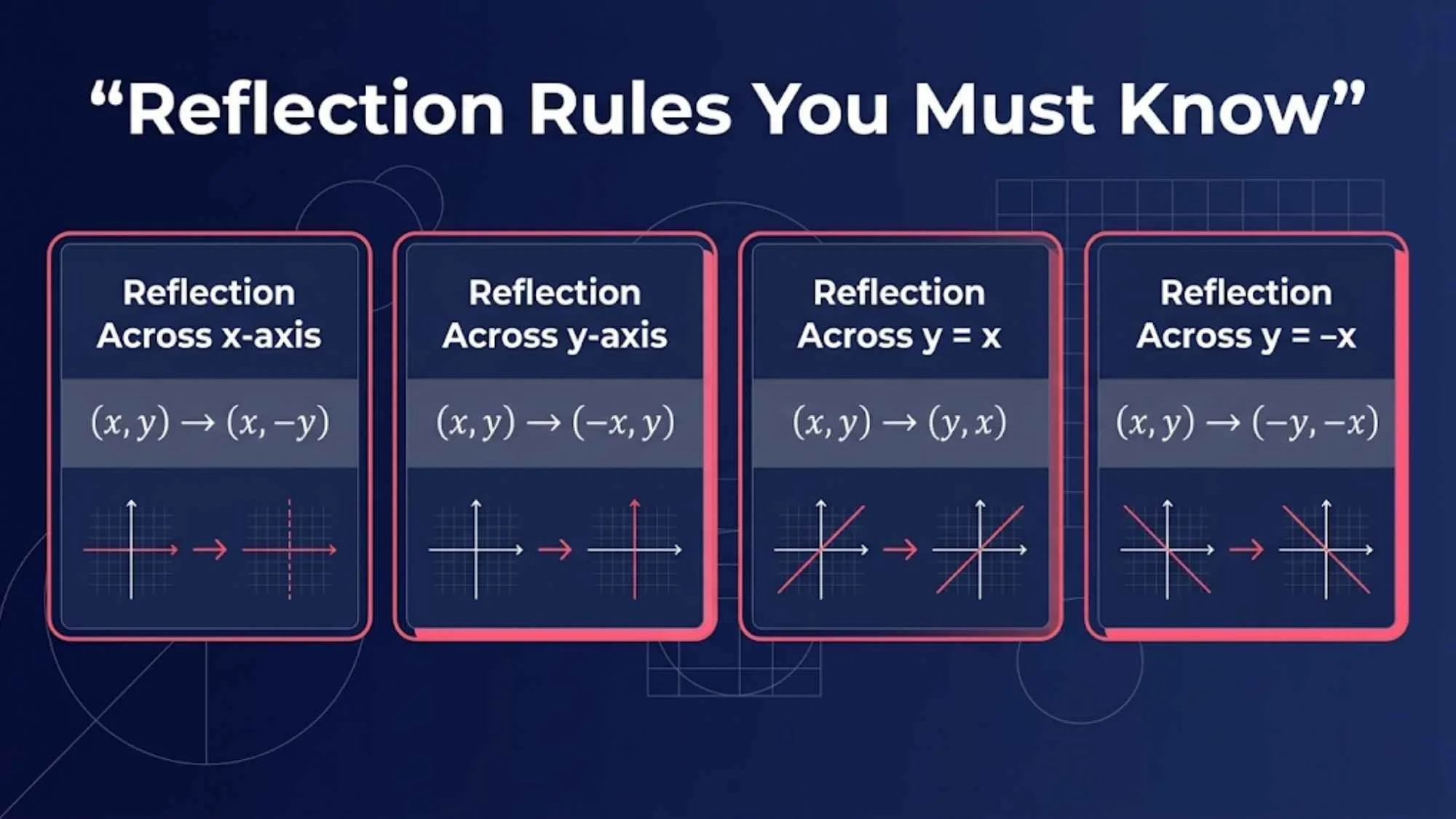
This is the section we drill with every student before a geometry test. Memorize these four rules and you can handle almost any reflection question you'll see on a standardized exam.
We've worked with students who could perfectly describe what a reflection is conceptually — but froze when asked to find the coordinates of a reflected point. The fix is always the same: learn the rules, practice with examples, and never try to "visualize" your way to a coordinate answer under test pressure.
| Line of Reflection | Rule | Example |
|---|---|---|
| x-axis | (x, y) → (x, −y) | (3, 4) → (3, −4) |
| y-axis | (x, y) → (−x, y) | (3, −2) → (−3, −2) |
| y = x | (x, y) → (y, x) | (2, 5) → (5, 2) |
| y = −x | (x, y) → (−y, −x) | (3, 1) → (−1, −3) |
Let's walk through each rule:
Reflect Over the x-axis: (x, y) → (x, −y)
The x-coordinate stays the same. The y-coordinate flips its sign.
Example: Reflect (3, 4) over the x-axis → (3, −4)
Reflect Over the y-axis: (x, y) → (−x, y)
The y-coordinate stays the same. The x-coordinate flips its sign.
Example: Reflect (3, −2) over the y-axis → (−3, −2)
Reflect Over y = x: (x, y) → (y, x)
The x and y coordinates swap positions.
Example: Reflect (2, 5) over y = x → (5, 2)
Reflect Over y = −x: (x, y) → (−y, −x)
Swap the coordinates, then negate both. This one trips students up — the double operation (swap AND negate) is easy to forget.
Example: Reflect (3, 1) over y = −x → (−1, −3)
For deeper practice with these rules, Khan Academy's transformation exercises are excellent — and free. We recommend them to every student we work with.
Reflection vs. Other Transformations — What's the Difference?
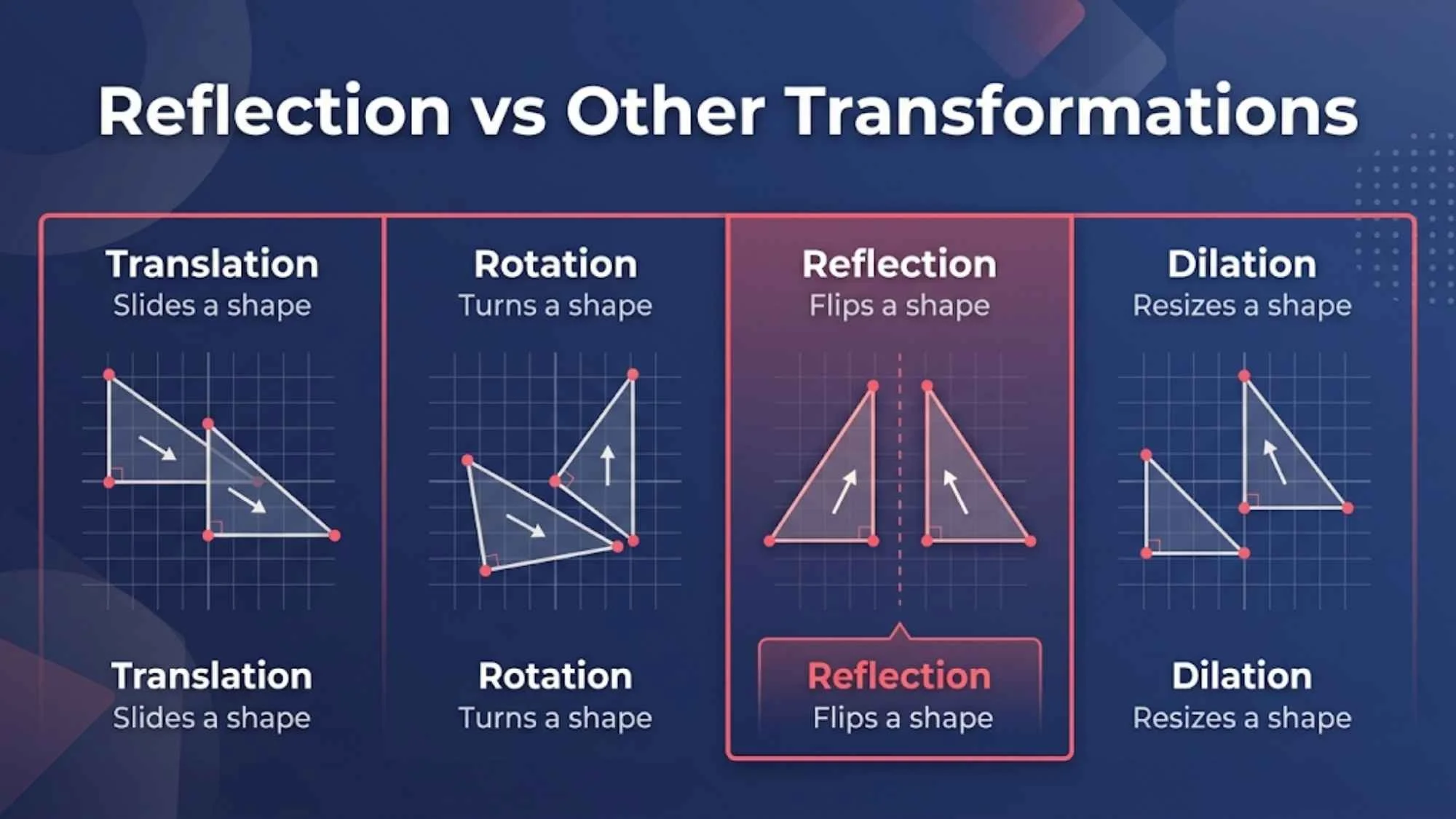
Students frequently confuse reflections with rotations and translations. Here's the quick breakdown:
| Transformation | What It Does | Orientation | Congruent? |
|---|---|---|---|
| Translation | Slides a shape | Preserved | Yes |
| Rotation | Turns around a point | Preserved | Yes |
| Reflection | Flips across a line | Reversed* | Yes |
| Dilation | Resizes a shape | Preserved | Only if scale = 1 |
* Only reflections reverse orientation. That's the key distinction. If you've read our guides on rotation and translation in the Transformations Series, you'll notice that reflections behave differently in one critical way: a rotation turns, a translation slides — but only a reflection flips. The shape ends up as a true mirror image.
Here's how we teach the quick-check in our sessions: "If the shape looks like it was flipped through a mirror — reflection. If it slid — translation. If it turned — rotation." That single mental check solves most multiple-choice problems.
One more thing curious students love: two reflections in sequence can produce a rotation. Reflect a shape over one line, then over another line that intersects the first — the result is a rotation by twice the angle between the lines. It's a beautiful connection that shows up in advanced geometry and in MIT OpenCourseWare's geometry materials.
Real-Life Examples of Reflections in Math
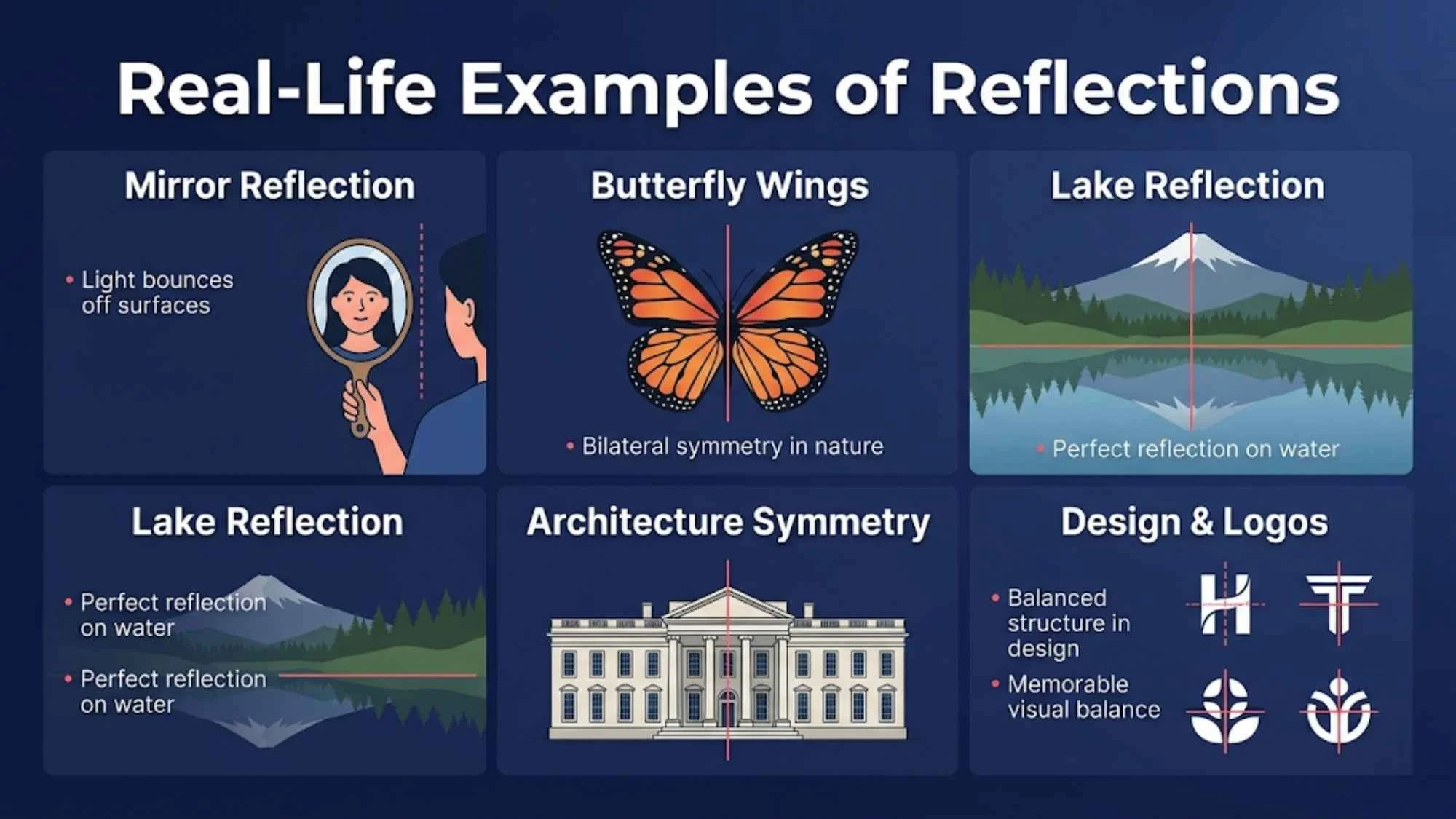
One of our favorite things to tell students: you already understand reflections intuitively. Math just gives you the rules to describe what your eyes already see.
A mirror — the most direct analogy. Your reflection in a mirror is equidistant from the glass as you are, on the opposite side.
Butterfly wings — bilateral symmetry in nature is a perfect reflection. The left wing is the mirror image of the right, with the body acting as the line of reflection.
A still lake — the reflection of trees or mountains in calm water follows the exact same geometric rules as a coordinate reflection.
Architecture — symmetrical building facades, from the Taj Mahal to modern skyscrapers, are designed using reflective symmetry.
Design and art — logos, fonts, and patterns frequently use mirror symmetry. The letters A, M, T, U, V, and W are all reflections of themselves across a vertical axis.
Computer graphics and game design — reflections are foundational to how rendering engines create mirror effects, water surfaces, and symmetric character models. If you're interested in game development, you're already working with geometric reflections.
FAQs
Q1: What is a reflection in math in simple terms?
A reflection is a flip. Take a shape, place a mirror line on your coordinate plane, and flip the shape over that line — the result is its mirror image, perfectly congruent to the original but reversed. If you've ever folded a piece of paper and traced a shape, you've done it.
Q2: What is the line of reflection?
The line of reflection is the mirror line — the line a shape flips across. Every point in the original figure and its corresponding reflected point are exactly equal distances from this line, on opposite sides.
Q3: Does a reflection change the size of a shape?
No. A reflection is an isometry — it preserves size, shape, and angle measures. Only the orientation changes. This is a common exam question: the answer is always no, reflections do not resize.
Q4: What is the rule for reflecting over the y-axis?
The rule is: (x, y) → (−x, y). The x-coordinate becomes its opposite; the y-coordinate stays the same. Example: (5, 3) reflected over the y-axis becomes (−5, 3).
Q5: What is the difference between a reflection and a rotation in math?
A reflection flips a shape across a line; a rotation turns a shape around a fixed point. Both preserve size and shape — but only a reflection reverses orientation. On a multiple-choice exam, check whether the shape appears mirrored (reflection) or simply turned (rotation).
Q6: Is a reflection the same as a flip?
Yes — "flip" is the informal, everyday word for reflection. Both describe the exact same transformation. Most middle school curricula introduce the concept as a flip before formalizing it as a reflection in high school geometry.
Putting It All Together
A reflection flips a shape across a line of reflection, producing a congruent mirror image — and there are exact coordinate rules for every common line you'll encounter on an exam. Once you draw it, it clicks. Once you memorize the four coordinate rules, you can handle almost any reflection problem you'll face in a geometry class or on a standardized test.
Students who master the coordinate rules for reflections find the entire transformations unit much easier — it builds the foundation for understanding symmetry across geometry, and those symmetry concepts extend into trigonometry (see our guide on sines and cosines) and far beyond. For further reading, we also recommend Math is Fun's geometry section as a clean visual reference.
Want to explore the rest of the series? Check out our guides on rotation, translation, and tessellations — each one connects naturally to reflections and rounds out your understanding of geometric transformations.
About the Author:
This article was written by a tutor affiliated with Columbia University and UC Berkeley, with over seven years of one-on-one experience in geometry, pre-algebra, and test prep for the SAT, ACT, and state geometry exams. Our tutors have worked with students across Common Core, Regents, and AP curricula — and are passionate about making abstract concepts genuinely click. At HYE Tutors, we believe every student can master geometry when it's taught the right way.