

ACT Math Prep: Formulas and Concepts You Need to Know
Picture this: you flip to question 34 on the ACT Math section. You recognize the shape, you remember the concept vaguely from sophomore geometry — but the formula? Gone. That moment of blank-page panic is one of the most fixable problems in all of ACT Math prep, and it's exactly what this guide is here to solve.
After eight years of ACT Math prep tutoring — working with students in Los Angeles, from Westwood to Pasadena, and virtually across the country — I've watched this same pattern play out hundreds of times. A student comes to me convinced they're "not a math person." Six weeks later, after we've gone through the right formulas and strategies, they're walking into test day with confidence. The ACT Math section is not about natural talent. It's about knowing exactly what the test expects.
The ACT Math section covers 60 questions in 60 minutes across six content domains. No formula sheet is provided. By the end of this guide, you'll have a clear, organized reference of every formula and concept that consistently appears on the exam — organized by topic, explained in plain English, with tips from real test prep experience.
What Is ACT Math Prep?
ACT Math prep focuses on six content areas: Pre-Algebra, Elementary Algebra, Intermediate Algebra, Coordinate Geometry, Plane Geometry, and Trigonometry. The test is 60 questions in 60 minutes. Effective preparation means mastering core formulas — including the quadratic formula, slope, area, the Pythagorean theorem, and basic trig ratios — and practicing under timed conditions. No formulas are provided on test day, so memorization and application are essential.
What Does ACT Math Actually Test?
Before you can prep efficiently, you need to understand the structure of what you're preparing for. The first thing I tell every new ACT student: this is a reasoning test disguised as a math test. The formulas are the key that unlocks it.
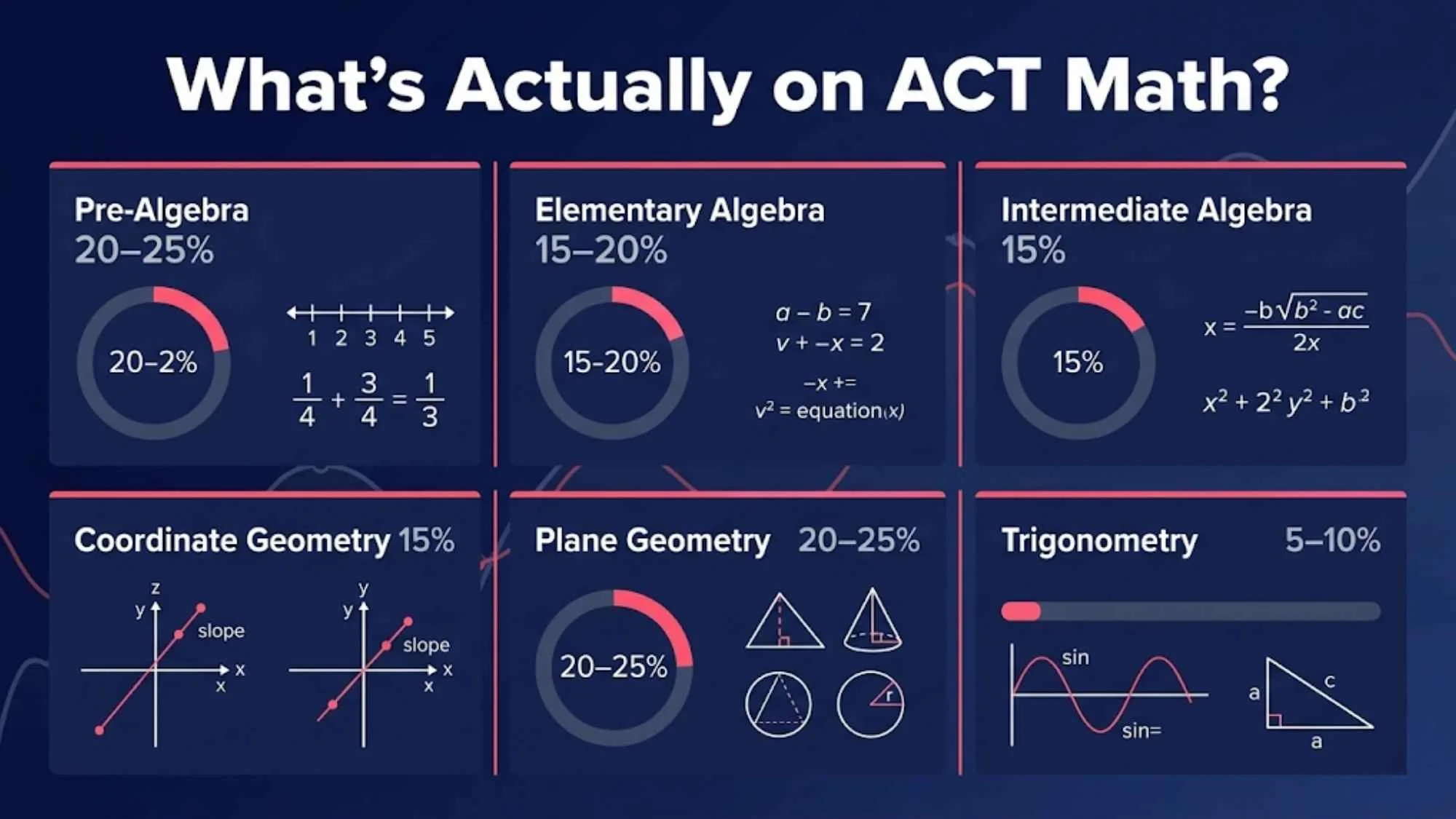
Here's the breakdown of the six content domains and their approximate share of the 60 questions:
Pre-Algebra (~20–25%): fractions, decimals, percentages, ratios, basic statistics
Elementary Algebra (~15–20%): solving equations, inequalities, basic expressions
Intermediate Algebra (~15%): quadratics, systems of equations, functions
Coordinate Geometry (~15%): slope, distance, midpoint, graphing lines and parabolas
Plane Geometry (~20–25%): angles, triangles, circles, polygons, area, volume
Trigonometry (~5–10%): SOH-CAH-TOA, the unit circle, trig identities
A few important logistics: no formula sheet is provided — every formula must be in your head. Calculators are permitted (the TI-84 Plus is the standard recommendation), though calculators with CAS or tablet-style devices are not allowed. Scoring runs on a 1–36 scale, with a national average of approximately 20. A 28+ is competitive for most four-year colleges; a 33+ places you in the top 5%.
Topics like the Pythagorean theorem, which we've broken down in detail in our dedicated HYE Tutors guide, appear consistently in the Plane Geometry section and are among the highest-yield formulas to know cold.
ACT Math Formulas You Must Memorize (By Topic)
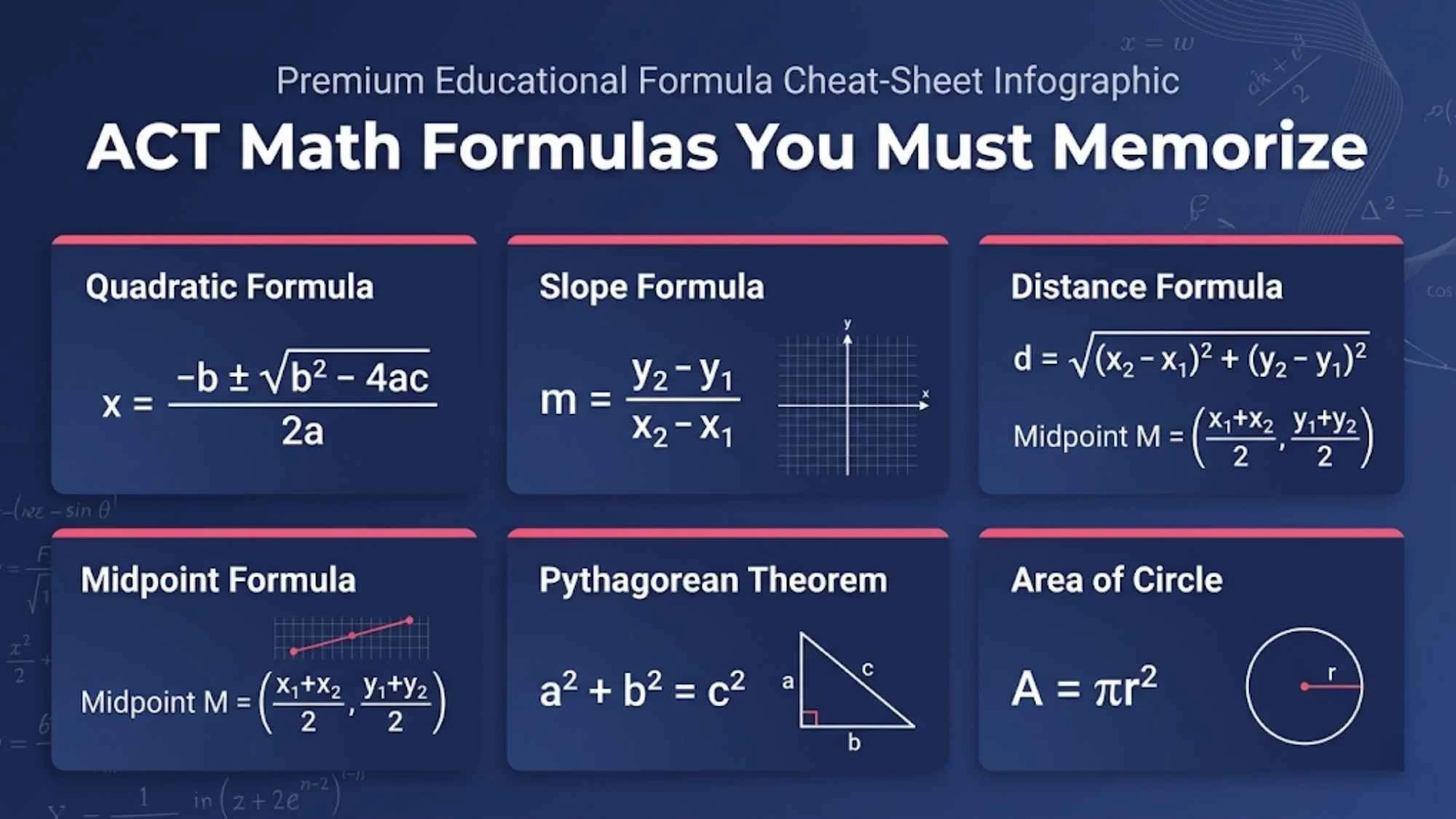
In eight years of ACT Math prep, I've tracked which formulas come up again and again on official practice tests. What follows isn't a list of everything in a textbook — it's the shortlist that actually shows up on test day. Each formula is paired with a plain-English explanation and a note on how the ACT tends to test it.
Algebra Formulas for ACT Math
Algebra underpins roughly 30–40% of the test, spread across Elementary Algebra, Intermediate Algebra, and Coordinate Geometry. These are the formulas I drill with every student in the first two sessions.
| Formula | What It Means / When to Use It |
|---|---|
| x = [-b ± √(b² − 4ac)] / 2a | Quadratic Formula — use when factoring won't work cleanly (non-integer roots). Know it cold. |
| (a + b)(a − b) = a² − b² | Difference of Squares — speeds up factoring; the ACT uses it in disguised forms. |
| m = (y₂ − y₁) / (x₂ − x₁) | Slope Formula — rise over run. Mixing up Δy and Δx is the most common algebra error. |
| y = mx + b | Slope-Intercept Form — b is the y-intercept; m is the slope. |
| Ax + By = C | Standard Form of a Line — useful for finding intercepts quickly. |
| d = √[(x₂ − x₁)² + (y₂ − y₁)²] | Distance Formula — derived from the Pythagorean theorem; used in coordinate geometry. |
| M = [(x₁ + x₂)/2, (y₁ + y₂)/2] | Midpoint Formula — average the x-values, average the y-values. |
When your students review the quadratic formula, it helps to understand what the constants a, b, and c represent — our HYE Tutors article on what a constant in math means is a useful companion read for students who want to reinforce the concept.
Geometry Formulas for ACT Math
Plane Geometry is one of the heaviest sections on the ACT, accounting for roughly a quarter of all questions. Organize your studying by shape — and don't skip the Pythagorean triples.
| Formula | What It Means / When to Use It |
|---|---|
| A = l × w | Area of Rectangle — foundational; appears in composite shape problems. |
| A = ½bh | Area of Triangle — the ½ is the most commonly forgotten part. |
| A = πr² | Area of Circle — r is radius, not diameter. |
| A = ½(b₁ + b₂)h | Area of Trapezoid — average the two bases, multiply by height. |
| C = 2πr | Circumference of Circle — also written as C = πd. |
| P = 2l + 2w | Perimeter of Rectangle. |
| V = lwh | Volume of Rectangular Prism. |
| V = πr²h | Volume of Cylinder — the ACT tests this occasionally; worth knowing. |
| a² + b² = c² | Pythagorean Theorem — c is always the hypotenuse. |
| (n − 2) × 180° | Sum of Interior Angles of a Polygon — n is the number of sides. |
At HYE Tutors, we've covered the Pythagorean theorem in depth across several guides — including how to find the hypotenuse and how to solve common variations. Those are worth reviewing before test day. We've also published companion reads on how to calculate the area of a rectangle and what volume in math means — useful for students who want to reinforce the geometry fundamentals.
One of the most useful time-saving tricks in geometry: Pythagorean triples. The most common ones on the ACT are:
3-4-5 (and multiples: 6-8-10, 9-12-15)
5-12-13
8-15-17
Trigonometry Formulas for ACT Math
Trigonometry Formulas:
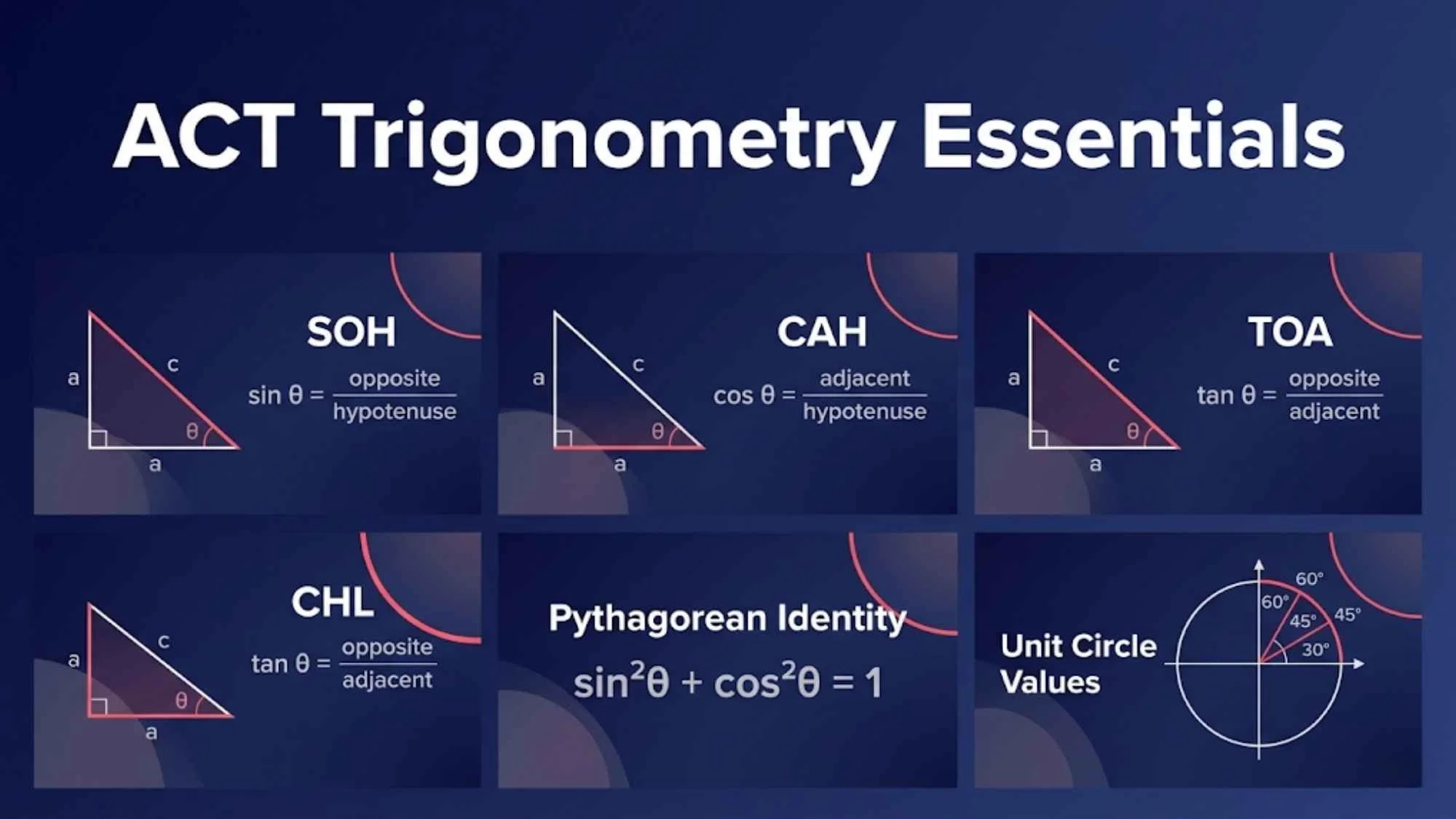
Trig is only 5–10% of the test, but students abandon it entirely — and that's a mistake. A handful of formulas, learned well, can earn you 3–5 extra points. I've never had a student who learned just SOH-CAH-TOA and the Pythagorean identity walk away with zero trig points.
| Formula | What It Means / When to Use It |
|---|---|
| sin θ = opposite / hypotenuse | SOH — the sine of an angle equals the opposite side over the hypotenuse. |
| cos θ = adjacent / hypotenuse | CAH — cosine is adjacent over hypotenuse. |
| tan θ = opposite / adjacent | TOA — tangent is opposite over adjacent. |
| sin²θ + cos²θ = 1 | Pythagorean Identity — the most tested trig identity on the ACT. |
| sin 30° = ½, cos 30° = √3/2 | Key unit circle values at 30°. |
| sin 45° = cos 45° = √2/2 | Key unit circle values at 45°. |
| sin 60° = √3/2, cos 60° = ½ | Key unit circle values at 60°. |
| Law of Sines: a/sin A = b/sin B | Higher-level — useful for non-right triangles. |
| Law of Cosines: c² = a² + b² − 2ab cos C | Higher-level — when you have two sides and the included angle. |
For deeper practice on trig, our HYE Tutors articles on what sines and cosines are and the Law of Sines and Law of Cosines are the right next steps — especially if you're aiming for a 30 or above.
Number Properties and Pre-Algebra Formulas
Pre-Algebra sounds easy, which is exactly why it catches students off guard. Careless errors here — especially in order of operations — are among the most common score-killers I see. Don't skip this section.
| Formula | What It Means / When to Use It |
|---|---|
| PEMDAS | Parentheses → Exponents → Multiply/Divide → Add/Subtract. Always follow this order. |
| Part = Percent × Whole | Percent formula — rearrange for any unknown (percent, part, or whole). |
| I = P × r × t | Simple Interest — Principal × rate × time. |
| A = P(1 + r/n)(nt) | Compound Interest — know when to use this instead of simple interest. |
| Mean = Sum ÷ Count | Average formula — one of the most consistently tested pre-algebra concepts. |
| Median | Middle value when data is arranged in order. |
| Mode | Most frequently occurring value in a data set. |
| Range = Max − Min | Difference between the largest and smallest values. |
For students who want to strengthen their foundation here, our HYE Tutors guides on what PEMDAS means, mean, median, mode, and range, and factors in math are the right starting points.
Key ACT Math Concepts Beyond the Formulas
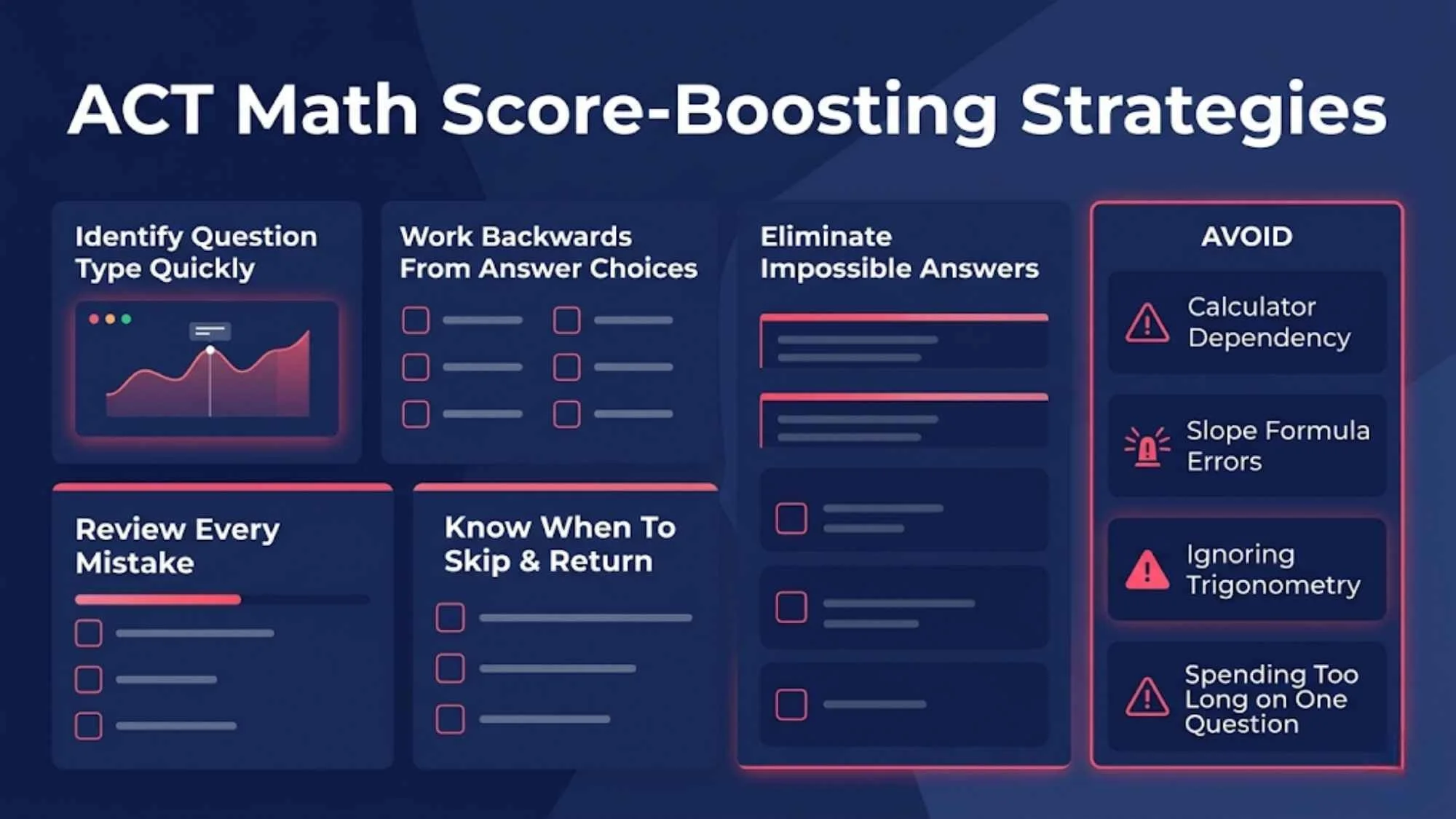
Formulas are tools. Concepts are the understanding of when and how to use them. One of the most valuable things I teach ACT students isn't a formula — it's to read the question twice and identify the question type before writing anything. That habit alone has moved students up two to three points.
Here are the reasoning patterns the ACT tests most consistently:
Identify question type quickly: word problem vs. pure computation vs. graph interpretation. The approach changes with the question type.
Work backwards from answer choices: plugging in answer choices is one of the most powerful ACT-specific strategies, especially on algebra questions with clean numbers.
Eliminate unreasonable answers: a negative area is impossible. An angle over 180° in a triangle is impossible. Geometry and word problems are full of these traps.
Understand relationship types: the ACT regularly asks you to distinguish linear, quadratic, and exponential relationships from a table or graph.
Read graphs and tables accurately: data interpretation questions appear in nearly every test. Practice reading axes, scales, and legends precisely.
Know when to use a calculator vs. mental math: calculator dependency on simple arithmetic slows students down significantly. Practice both.
Functions: understand f(x) notation, how to evaluate a function at a point, and how composition of functions works (f(g(x))).
Matrices: basic matrix addition and multiplication appear occasionally — low frequency but worth a quick review for higher scorers.
For coordinate geometry questions involving transformations, our HYE Tutors articles on what translation in math means and what a rotation in math is can help you visualize these problems more confidently.
The ACT's official prep resources also offer free practice tests — always an excellent baseline before you start your structured prep.
ACT Math Prep Strategy: How to Study, Not Just What to Study
We've worked with students at HYE Tutors who showed up with all the right formulas memorized — and still scored in the low 20s because they didn't have a structured approach to studying. Knowing what to study and knowing how to study are two different things. Here's the framework I use with every student:
Step 1: Establish your baseline.
Take a full-length official ACT practice test before you do anything else. Don't study before this — you want an honest picture of where you are. The ACT's official website and Khan Academy both offer free practice tests.
Step 2: Identify your weak domains.
If your Plane Geometry score is the lowest, that's where your prep time goes first. Students who study everything equally waste prep time on areas they've already mastered.
Step 3: Structure your weekly sessions.
A realistic and effective schedule looks like 3–4 sessions per week, 45–60 minutes each. One formula topic per session. One timed practice section per week (all 60 questions, 60 minutes, no stopping).
Step 4: Memorize formulas systematically.
Flashcard one topic per day. Quiz yourself without looking. The goal isn't to recite the formula — it's to recognize the problem type and immediately know which formula applies.
Step 5: Review every wrong answer.
Not just the score — the reasoning behind each mistake. Was it a formula error? A misread question? A time management issue? The students I've seen improve the most are the ones who reviewed every single mistake, not just retook the test.
Score-target guidance:
Targeting 20–25: ensure Pre-Algebra and Elementary Algebra are essentially error-free. These are the highest-volume domains and have the most immediate impact.
Targeting 28+: move into Intermediate Algebra and Coordinate Geometry. Work on time management — these questions take longer.
Targeting 30+: add Trigonometry. Even 4–5 trig questions answered correctly can push you over the 30 threshold.
If you're not sure where your prep gaps are, our team at HYE Tutors — graduates of Harvard, Columbia, UCLA, and UC Berkeley — can run a diagnostic session to show you exactly where to focus. Book a free session here.
Khan Academy also offers free, well-structured ACT Math practice by topic — an excellent supplement to your formula work.
Common ACT Math Mistakes (And How to Avoid Them)
In eight years of test prep tutoring, I've catalogued every mistake I've seen students make. These aren't random errors — they're patterns, and patterns are fixable.
Forgetting to label units in geometry. This leads to wrong formula choice — especially when mixing up radius and diameter in circle problems.
Misreading 'least' vs. 'greatest' in min/max questions. Read the question twice. Circling these words helps.
Confusing the slope formula. Mixing up Δy and Δx is the most common algebra error I see. Write the formula before plugging in.
Skipping trig entirely. Even one trig question correctly answered shifts your score. Don't leave free points on the table.
Not checking whether the answer is reasonable. A negative area. An angle greater than 360°. A population of 2.5 people. The ACT plants these traps.
Spending too long on a hard question. There is no guessing penalty on the ACT. If you've spent more than 90 seconds on a single question, circle it, move on, and return at the end.
Calculator dependency on simple arithmetic. Reaching for a calculator on 3 × 4 costs seconds that compound. Practice mental math on basic operations.
FAQs
Q: What math is on the ACT?
The ACT Math section covers six content domains: Pre-Algebra, Elementary Algebra, Intermediate Algebra, Coordinate Geometry, Plane Geometry, and Trigonometry. The test is 60 questions in 60 minutes, with no formula sheet provided. Topics range from basic percentages and ratios to quadratic equations, geometric proofs, and trigonometric identities.
Q: How do I start ACT Math prep?
Start by taking a full official ACT practice test to establish your baseline score. Then identify which of the six content domains scored lowest — that's where your prep time should go first. Free resources include the ACT's official prep site and Khan Academy's ACT Math module.
Q: What formulas does the ACT give you?
None. The ACT does not provide a formula sheet of any kind. Every formula — from the quadratic formula to the area of a trapezoid to SOH-CAH-TOA — must be memorized before test day. This is one of the most important things to know about the ACT Math section.
Q: How long should I study for ACT Math?
For most students, 6–8 weeks is a solid prep window. A minimum of 3–4 hours per week is realistic for meaningful improvement. Students starting below a 20 may benefit from 10–12 weeks. Students closer to 28 targeting 33+ often need intensive, targeted work on Intermediate Algebra and Trigonometry.
Q: Is ACT Math harder than SAT Math?
They test different things. ACT Math covers more topics — including trigonometry — but gives less time per question (1 minute on ACT vs. roughly 1.25 minutes on SAT). SAT Math has a no-calculator section; ACT Math allows calculators throughout. Neither is universally harder — it depends on the student's strengths.
Q: What is a good ACT Math score?
The national average is approximately 20. A score of 24+ is generally considered above average. Most competitive four-year colleges look for 28+. A 33+ places you in the top 5% of test takers nationally.
Q: Can I use a calculator on ACT Math?
Yes — most scientific and graphing calculators are permitted. The TI-84 Plus is the standard recommendation. Calculators with CAS (Computer Algebra Systems), tablet-style devices, and laptops are not allowed. Check the ACT's current calculator policy before test day, as it is updated periodically.
You're More Prepared Than You Think
ACT Math doesn't test how smart you are — it tests how prepared you are. Six content domains. No formula sheet. Sixty questions in sixty minutes. That's the whole equation.
In eight years of ACT Math prep, the students who improve the most are never the ones who studied the hardest. They're the ones who studied most strategically — who knew their formulas cold, who identified their weak domains early, and who reviewed every single mistake instead of just retaking tests and hoping for different results.
Whether you're starting at an 18 and working toward a 25, or you're at a 28 and chasing a 33, the formulas and concepts in this guide are the right foundation. Bookmark this page. Come back to it. Use the HYE Tutors companion articles to go deeper on any topic that's still shaky.
When you're ready to take your ACT Math prep further with a personalized plan, our tutors at HYE Tutors — graduates of Harvard, Columbia, UCLA, and UC Berkeley — have helped students across Los Angeles and beyond reach their target scores. Book your free diagnostic session today.
About the Author
This article was written by a HYE Tutors instructor and graduate of Columbia University, with additional teaching experience at UC Berkeley, UCLA, and Harvard-affiliated programs. With over 8 years of one-on-one and group ACT/SAT Math tutoring, our instructors have helped students across Los Angeles improve by an average of 4–6 points on ACT Math. We track score improvements with every student — because results are the only metric that matters.