

What Is Pi (π) in Math? Definition, Value & Real-Life Uses
Most students first encounter what pi is in math the same way — staring at the π button on a calculator and typing 3.14 into a formula without quite knowing why. They get the right answer, move on, and never question it. As someone who has coached students through geometry, pre-calculus, and standardized test prep for over eight years, I can tell you that this is one of the most common gaps I see — and one of the easiest to close. Pi is not just a button to press. It is one of the most elegant and far-reaching constants in all of mathematics. It shows up in geometry, physics, engineering, music, GPS technology, and even space exploration. By the end of this guide, you will know what pi is, where it comes from, its value, why it never ends, and exactly how it appears across the math you are already studying.
Pi (π)
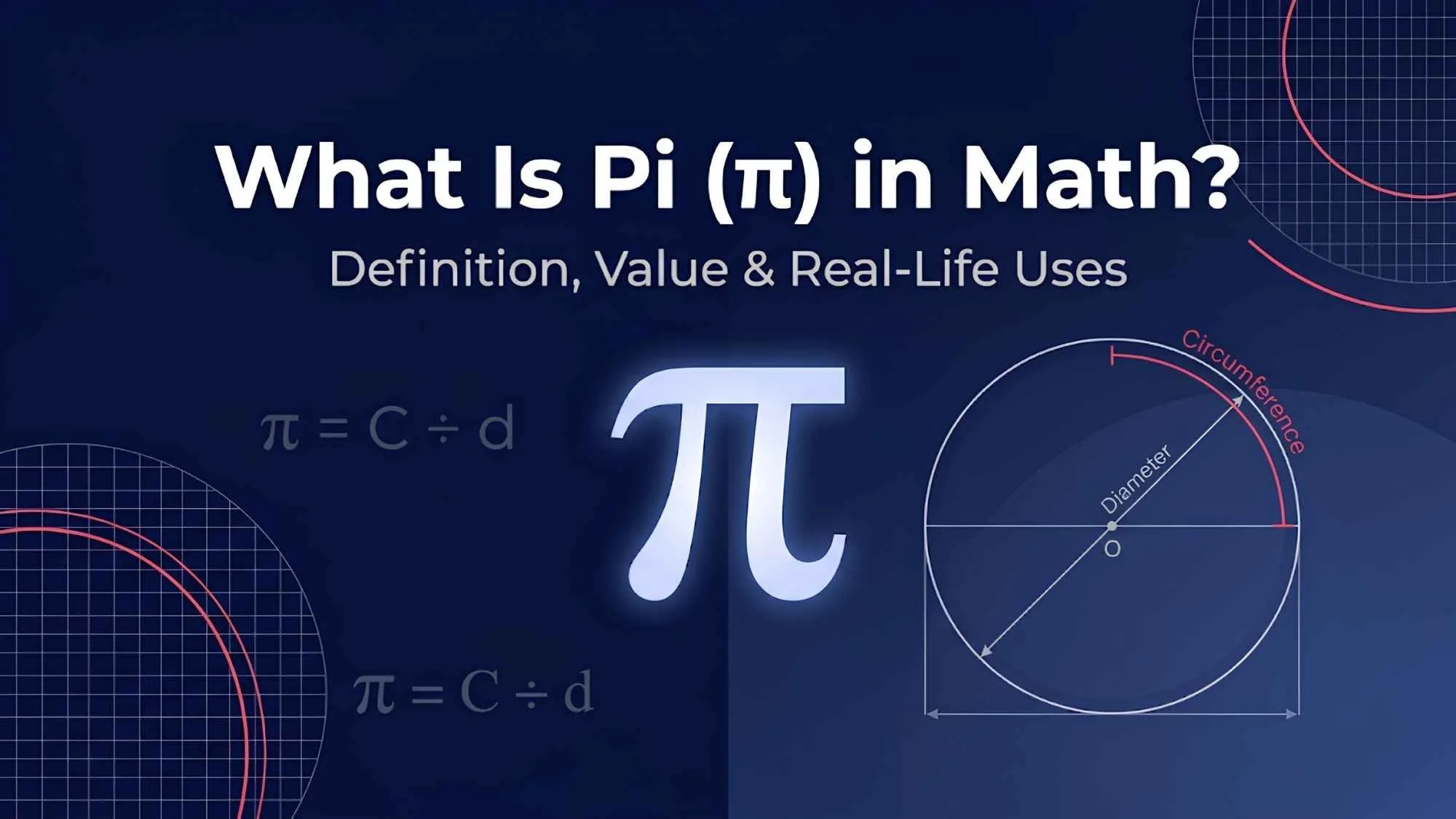
Pi (π) is a mathematical constant representing the ratio of a circle's circumference to its diameter. Its value is approximately 3.14159 and it never ends or repeats, making it an irrational number. Pi appears in geometry, physics, engineering, and countless real-world applications wherever circles or curves are involved.
What Is Pi (π) in Math?
In my eight years of tutoring, I have found that students who understand where pi actually comes from — not just its decimal — answer geometry and trigonometry questions with far more confidence. So let us start at the very beginning. Grab any circular object. A coin, a clock, a wheel — it does not matter what size. Measure the distance around the outside (that's the circumference) and then measure the distance straight across the middle (that's the diameter). Now divide the circumference by the diameter. No matter which circle you chose — a pizza or a planet — you will always get the same number: approximately 3.14159. That number is pi.
Pi Definition — What Does π Mean in Math?
In plain English: pi is the ratio of a circle's circumference to its diameter. Mathematically, this is written as:
π = C ÷ d
Where C is circumference and d is diameter. This ratio is constant — it does not matter if the circle is the size of a button or the size of a stadium. The symbol π itself is the Greek letter "pi" (pronounced like the dessert), adopted in mathematics in the early 18th century. And for most classroom and exam problems, you will either use 3.14 or the π button on your calculator — both are perfectly fine.
What Is the Exact Value of Pi?
Here is a question students ask constantly: what is the exact value of pi? The honest answer: there is no exact decimal. Pi is an irrational number — its decimal expansion never ends and never settles into a repeating pattern. The value 3.14159265358979… continues forever with no repetition. According to Guinness World Records, pi has been calculated to over 100 trillion decimal places — and no pattern has ever been found.
Here is what to use in practice:
3.14 — everyday calculations and most classroom problems
3.14159 — higher-precision work and most standardized exams
22/7 — a quick fraction approximation (useful but not exact)
Who Discovered Pi and Where Does It Come From?
Pi has a longer history than almost any other number in mathematics. The Babylonians and Egyptians were approximating it as far back as 1900 BCE — the ancient Egyptians used a value of roughly 3.16, remarkably close. The Greek mathematician Archimedes of Syracuse (around 250 BCE) took the first rigorous scientific approach: he inscribed and circumscribed polygons around a circle, progressively increasing the number of sides until he could sandwich pi between two closing values. It was elegant problem-solving that would hold up by modern standards. The symbol π was introduced by Welsh mathematician William Jones in 1706 and popularized by the great Swiss mathematician Leonhard Euler — the same Euler behind Euler's number. Students who have read our guide on Euler's number (e) in math often have a "wait, him again?" moment here — which is exactly right. Euler touched almost everything.
Is Pi a Rational or Irrational Number?
This appears on exams more than you would expect, so let's be direct: pi is irrational. It cannot be expressed as a fraction p/q where both p and q are whole numbers. It is also transcendental — meaning it is not the solution to any polynomial equation with rational coefficients — though that detail rarely appears before college-level math.
The most common misconception: 22/7 is not pi. It is a rational approximation that is close enough for quick calculations, but pi itself is not a fraction. I once had a student who used 22/7 for every pi problem because a teacher told him it was "good enough" — it cost him on a multi-step area question on his SAT practice test when the accumulated rounding error put him outside the answer choices. Use the π button.
Pi Formulas — Where Does π Appear in Math?
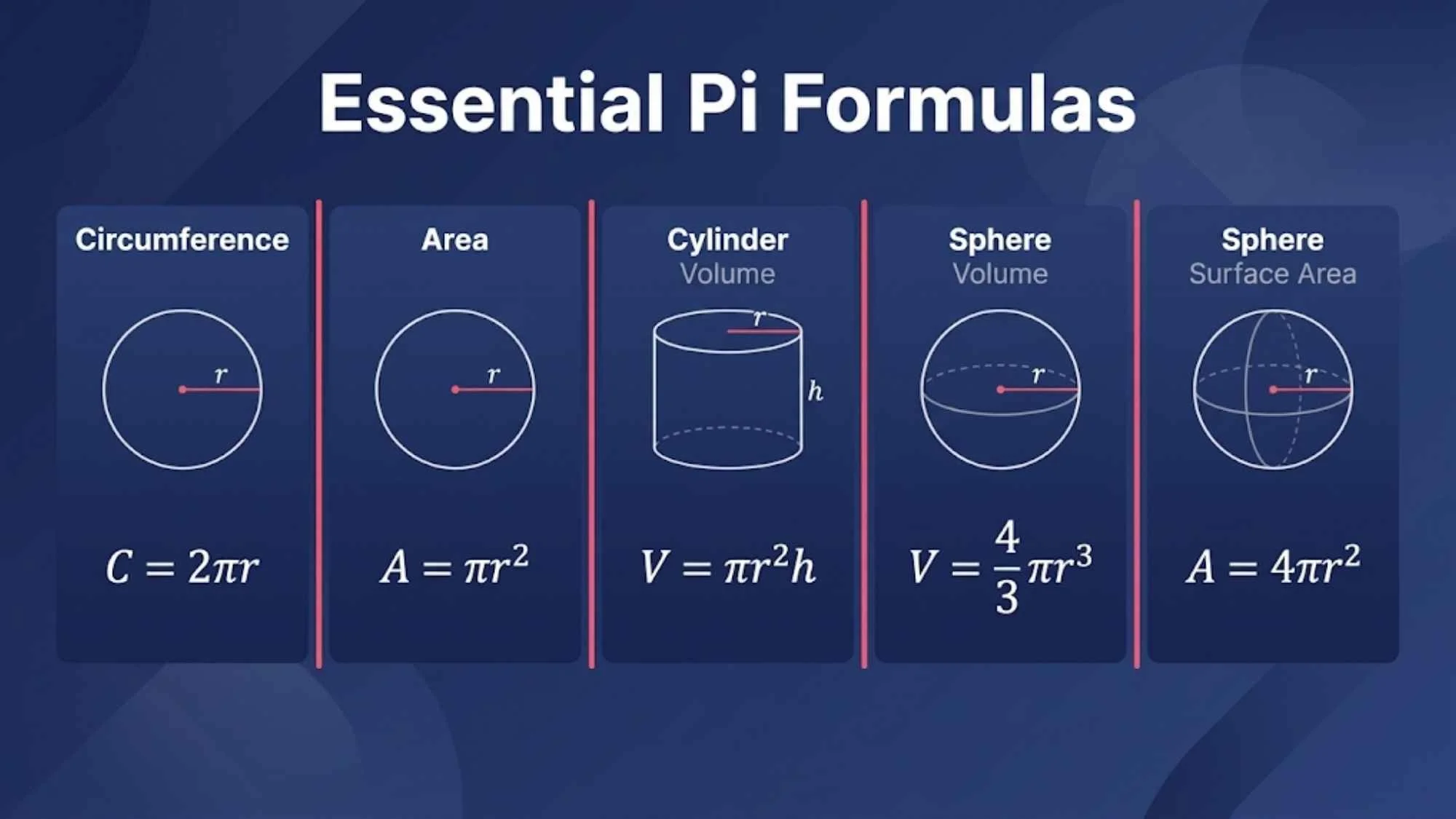
On every geometry exam I have ever helped students prepare for, at least one problem uses πr². Knowing these formulas cold — and remembering that r stands for radius, not diameter — saves points every single time. Here are the essential pi formulas across geometry and beyond. For a deeper look at how the volume formulas work across different shapes, our guide on volume in math walks through each one step by step.
| Formula | What It Calculates | Where You'll Use It |
|---|---|---|
| C = 2πr (or C = πd) | Circumference of a circle | Geometry, SAT/ACT Math |
| A = πr² | Area of a circle | Geometry, Common Core Gr. 7+ |
| V = πr²h | Volume of a cylinder | Geometry, AP Math |
| V = (4/3)πr³ | Volume of a sphere | Pre-Calc, AP Physics |
| A = 4πr² | Surface area of a sphere | AP Calculus, Physics |
| 180° = π radians | Degree-to-radian conversion | Trigonometry, Pre-Calc, SAT |
Pi also appears throughout calculus and physics — in integrals involving circular motion, in Fourier analysis, and in the famous Euler's identity (e^iπ + 1 = 0), which many mathematicians consider the most beautiful equation ever written. But for now, the table above covers everything you need for Common Core through AP level. When you see r² in these formulas, our guide on what 'squared' means in math is a helpful quick reference.
📅 Want help mastering these formulas? Book a free session with a HYE Tutor →
Real-Life Uses of Pi — Where Does π Actually Show Up?
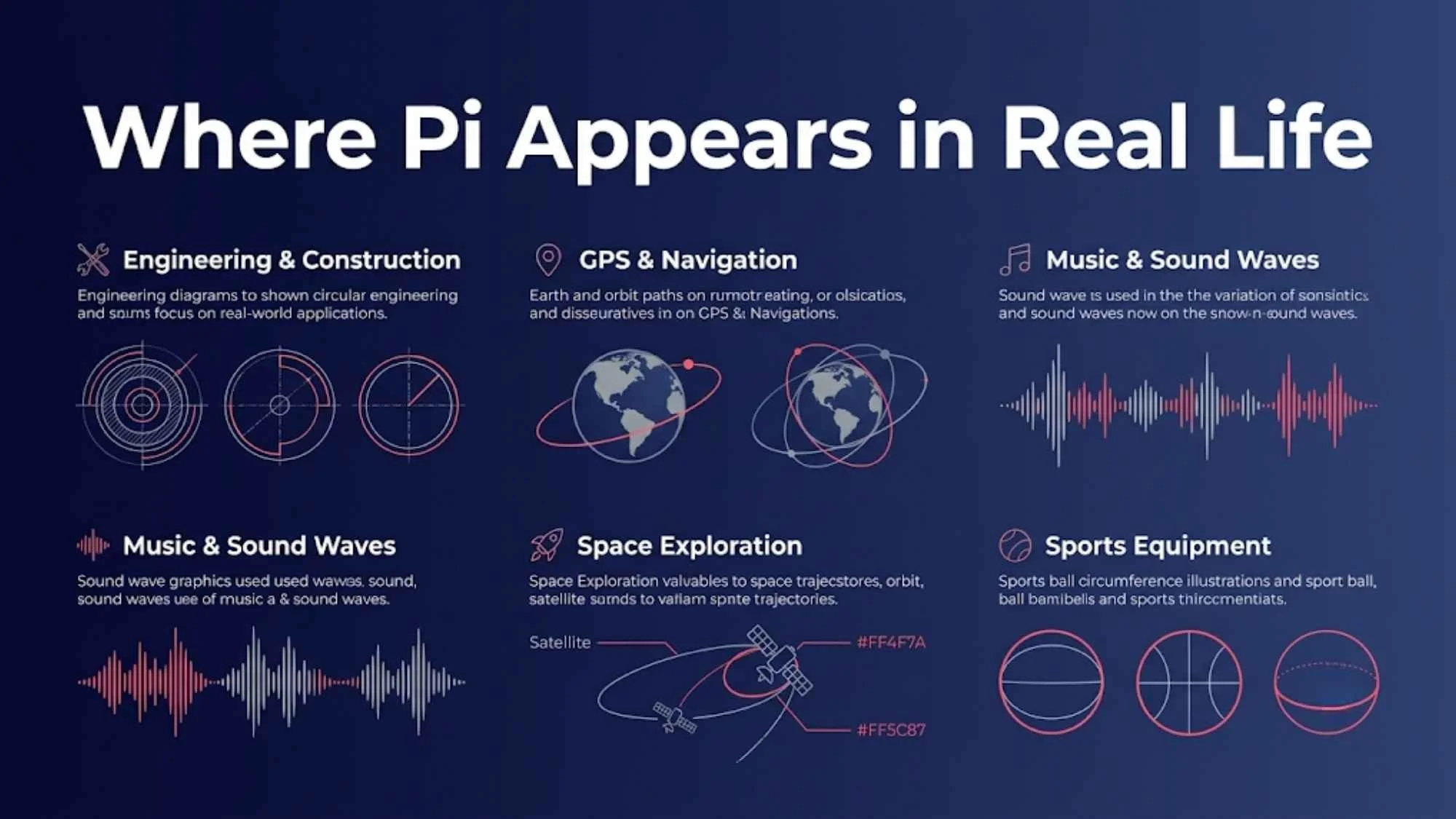
One of my favorite tutoring moments is asking students to name something circular in the room — a clock, a speaker, a water bottle — and pointing out that pi was used to design every one of them. According to NASA's Jet Propulsion Laboratory, pi is used across their work so regularly that they publish an annual "Pi in the Sky" challenge for students. Here is where π actually appears beyond the classroom:
Engineering & Construction: Bridges, tunnels, circular pipes, and structural arches are all designed using pi. Any curved surface in construction involves circumference or area calculations that depend on it.
GPS & Navigation: Earth is a sphere, and calculating distances across its curved surface requires pi. Every navigation app on your phone uses it.
Sound & Music: Sound travels in waves, and wave frequency calculations involve pi. Audio engineers and signal processors use it constantly in digital music production.
Space Exploration: NASA uses pi to calculate spacecraft trajectories, orbital paths, and antenna dish sizes. The math that put rovers on Mars ran through pi.
Sports Equipment: The circumference of every ball in every sport — basketball, soccer, tennis — is a pi calculation. Manufacturers use it to meet official size standards.
Just as the Golden Ratio appears in nature and art in ways most students never expect, pi shows up in physics and engineering far beyond anything covered in a typical geometry class. Both are famous mathematical constants worth knowing well.
Pi in Geometry vs. Pi in Trigonometry — What's the Difference?
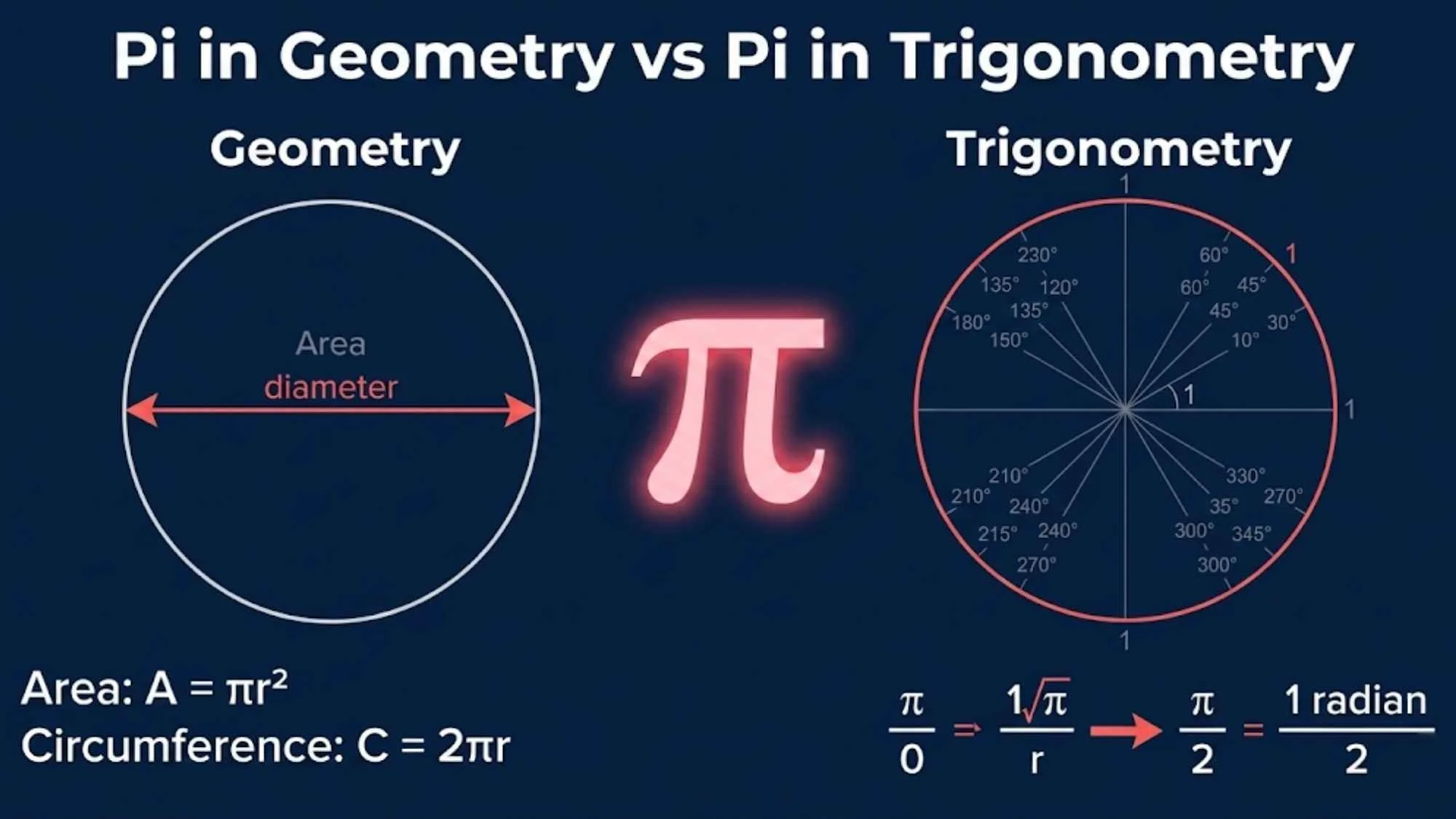
This is where students who only memorized pi as '3.14 for circle problems' suddenly hit a wall in pre-calculus. Understanding pi as a ratio — not just a decimal — is what makes radians click.
In geometry: pi is paired with a radius or diameter to compute circumference, area, or volume. It is a multiplier in a formula.
In trigonometry: pi represents half a full rotation. The full circle = 2π radians. So π radians = 180°, π/2 radians = 90°, and 2π radians = 360°. These conversions are tested on both the SAT and ACT.
To convert radians to degrees, multiply by 180/π. To go the other direction, multiply by π/180. For a deeper look at how pi connects to sine and cosine functions, our guide on sines and cosines in trigonometry picks up exactly where this section leaves off. And for the foundational geometry relationships that pi formulas build on, our Pythagorean theorem guide is a helpful companion read.
FAQs
Q: What is pi in simple terms?
A: Pi is the number you always get when you divide a circle's distance around the outside by its width straight across the middle. No matter how big or small the circle, that answer is always approximately 3.14159. That consistent ratio is what makes pi one of the most important numbers in mathematics.
Q: Why is pi 3.14?
A: It is not exactly 3.14 — that is a rounded approximation of the true value, which begins 3.14159265… and continues infinitely with no repeating pattern. We use 3.14 because it is accurate enough for most calculations and easy to remember. On exams, use your calculator's π button for precision.
Q: Is pi the same as 22/7?
A: No. 22/7 is a convenient fraction that approximates pi (it equals about 3.142857...), but it is not exactly pi. Pi is irrational — it cannot be expressed as any fraction. 22/7 is a rational number. Use the π button on your calculator whenever accuracy matters.
Q: What is pi used for in real life?
A: Pi is used in engineering (circular pipes, bridges), GPS and navigation (Earth's curved surface), music technology (sound wave calculations), space exploration (orbital trajectories), and sports equipment manufacturing. Anywhere a circle or curve is involved, pi is almost certainly part of the math.
Q: What is pi to 10 decimal places?
A: Pi to 10 decimal places is 3.1415926535. For virtually all student problems — from middle school geometry to AP Calculus — the value 3.14159 is more than sufficient. Most exam calculators store pi to at least 10 digits automatically.
Q: Is pi a real number?
A: Yes. Pi is a real, irrational, transcendental number. "Irrational" simply means its decimal never ends and never repeats — it is not a fraction. "Real" means it exists on the number line, unlike imaginary numbers. It is more "real" in everyday application than most numbers students encounter.
Conclusion
Now that you know what pi is in math, you can use it with genuine confidence — not just as a button on a calculator, but as a concept with real meaning. Pi is the ratio of circumference to diameter (approximately 3.14159), it is irrational, and it appears everywhere from circle area formulas to space trajectories. In my years of tutoring, students who understand what pi represents — not just its decimal — consistently perform better on geometry and standardized test sections. Pi is not just a number to memorize; it is a window into how mathematics describes the physical world. At HYE Tutors, we have built a growing library of math guides written by tutors with real classroom experience. As you continue, you may also find our guides on the Golden Ratio, Euler's number, and the Fibonacci sequence valuable — they cover other famous mathematical constants that appear across math, science, and nature in equally surprising ways.
📅 Book Your Free HYE Tutors Session — Geometry, Pre-Calc & Test Prep →
About the Author:
This guide was written by a HYE Tutors math mentor with affiliations at Columbia University, UC Berkeley, UCLA, and Harvard. With over 8 years of tutoring experience in geometry, pre-calculus, trigonometry, and standardized test prep (SAT Math, ACT Math, AP courses), our mentors specialize in making foundational math concepts genuinely click — not just for the exam, but for every course that comes after it. Have a question or want a personalized study plan? Our team is here.