

What Is a Tessellation in Math?
Curious to understand what a tessellation in math is and how shapes fit together perfectly with no gaps or overlaps? In this guide, you’ll explore how tessellations work in math, the different types of tessellation patterns, and where these fascinating designs appear in everyday life.

Tessellation in Math
A tessellation in math is a repeating pattern of shapes that fit together with no gaps or overlaps. These shapes cover a flat surface completely, like tiles on a floor. Tessellations can use regular, irregular, or mixed shapes and are often seen in art, architecture, and nature.
What Is a Tessellation in Math?
If you've ever looked at a tiled floor, a honeycomb, or a brick wall and noticed how every piece fits perfectly together, you've already seen a tessellation in action. So what is a tessellation in math? It's a pattern made of shapes that repeat over and over, covering a flat surface completely without leaving any gaps or causing any overlaps.
Picture laying tiles on a bathroom floor. Each tile touches its neighbors edge-to-edge, and when you're done, you can't see any of the floor underneath. That's exactly what a tessellation does—it fills a plane (a flat, two-dimensional surface) entirely using one or more shapes that repeat in a predictable pattern.
Tessellations belong to the branch of mathematics called geometry, and students typically encounter them in middle school when studying shapes, angles, and spatial relationships. Understanding what is a tessellation in math helps build pattern recognition skills that extend into algebra, design, and even computer graphics.
The Mathematical Rule Behind Tessellations
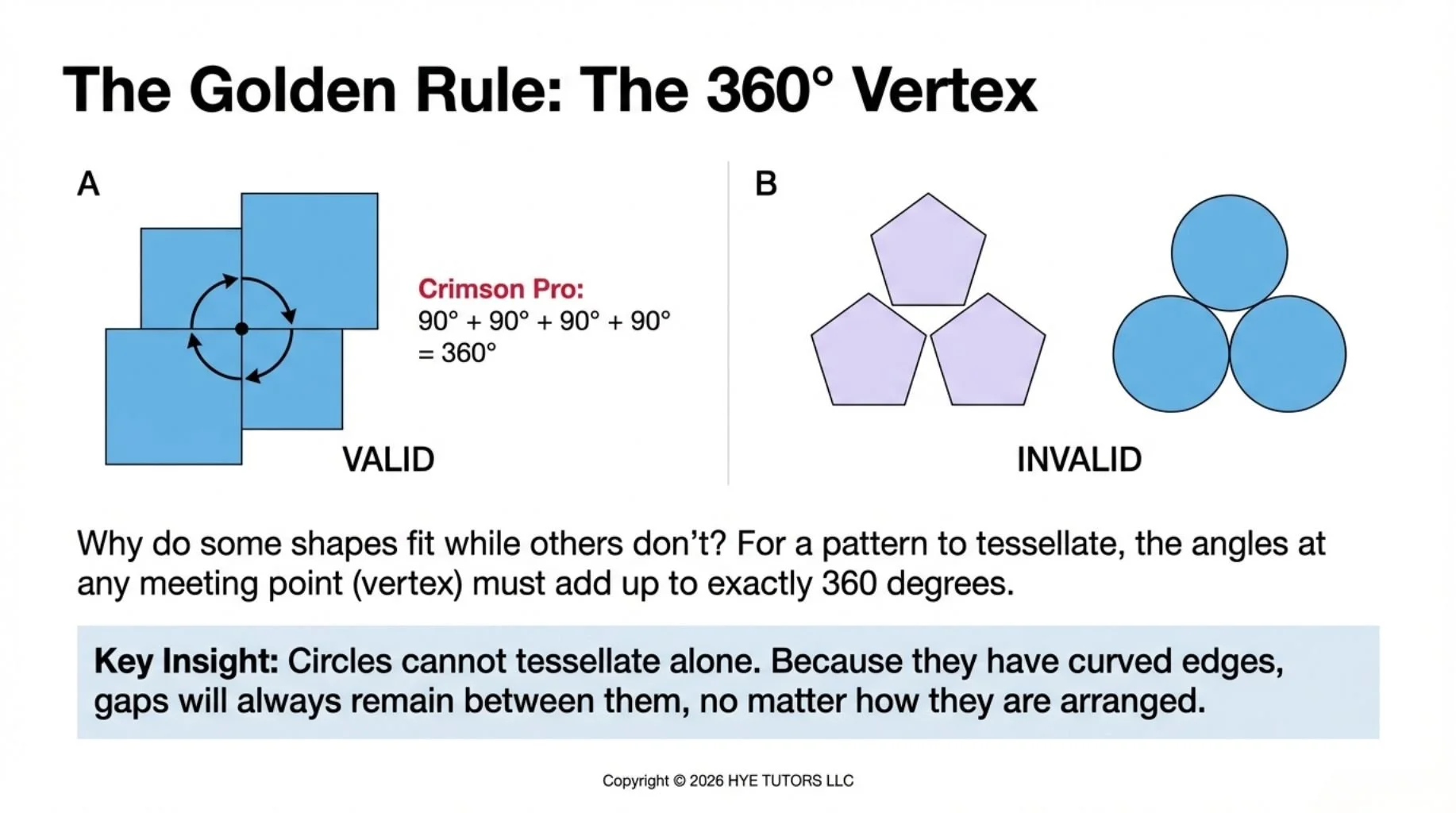
For shapes to tessellate, they must fit together at each vertex (corner point) so the angles add up to exactly 360 degrees. This is why certain shapes work and others don't. A square has 90-degree corners, and four squares meeting at a point give you 90 × 4 = 360 degrees—a perfect fit. Similarly, regular hexagons have 120-degree angles, so three hexagons meeting at a vertex create 120 × 3 = 360 degrees.
Why Circles Can't Tessellate Alone
Students often wonder why circles don't tessellate. The answer is simple: circles are curved, so no matter how you arrange them, gaps will always appear between them. Only shapes with straight edges that can share sides completely—and whose angles work mathematically—can form true tessellations.
Everyday Examples
Once you understand what is a tessellation in math, you'll start noticing them everywhere: kitchen backsplashes made of interlocking tiles, the hexagonal cells in a beehive, checkerboards, and the intricate geometric mosaics found in historic buildings around the world. Each of these demonstrates the same core principle—shapes repeating to fill space completely.
Types of Tessellations: Regular, Semi-Regular & Irregular
Mathematicians classify tessellations into three main categories based on the shapes used and how they repeat. Understanding these types helps you recognize patterns and predict which shapes can tile a surface.
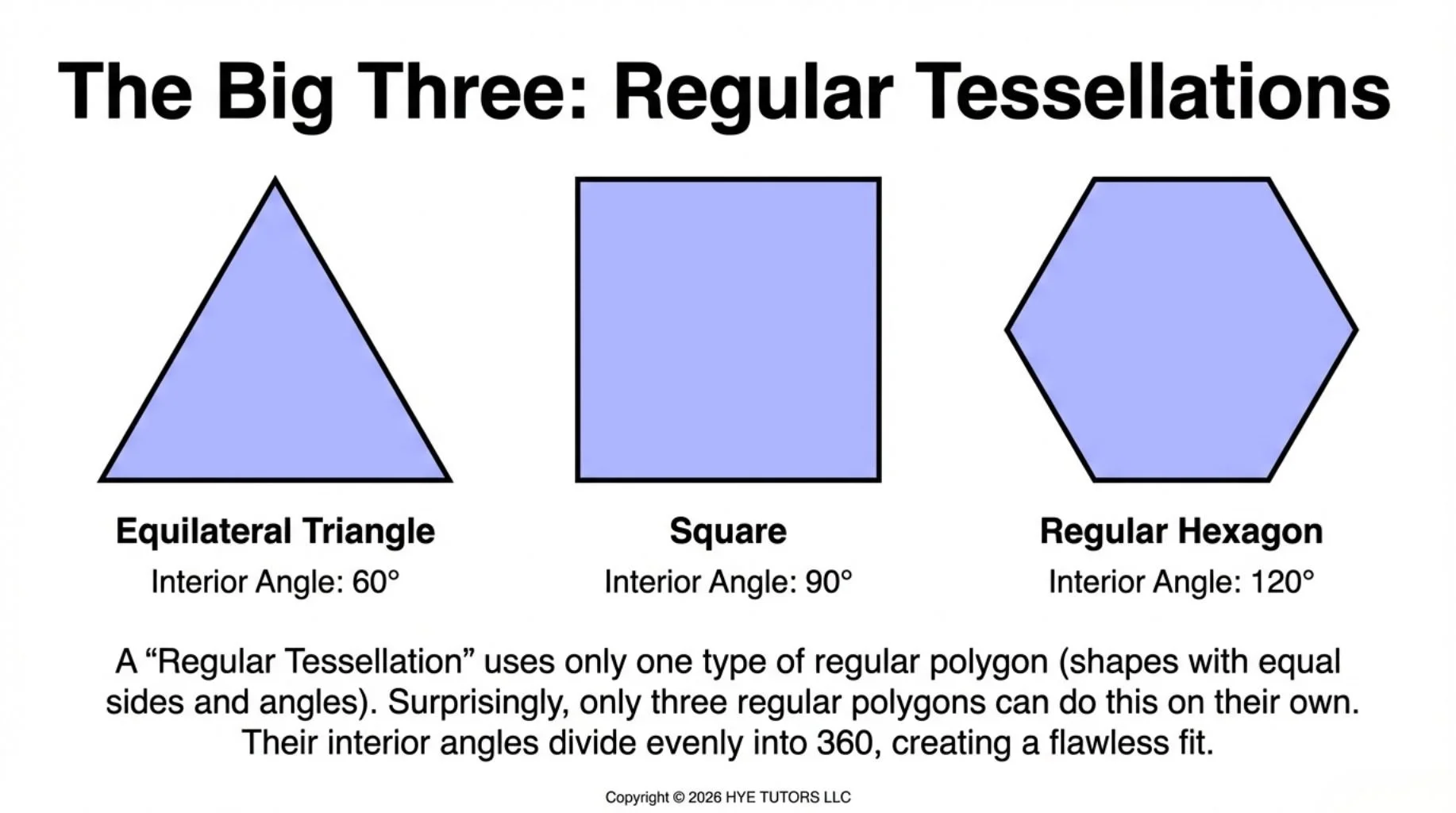
Regular Tessellations use only one type of regular polygon (a shape with equal sides and equal angles) repeated throughout. Only three regular polygons can do this on their own: equilateral triangles, squares, and regular hexagons. These are the only shapes whose interior angles divide evenly into 360 degrees.
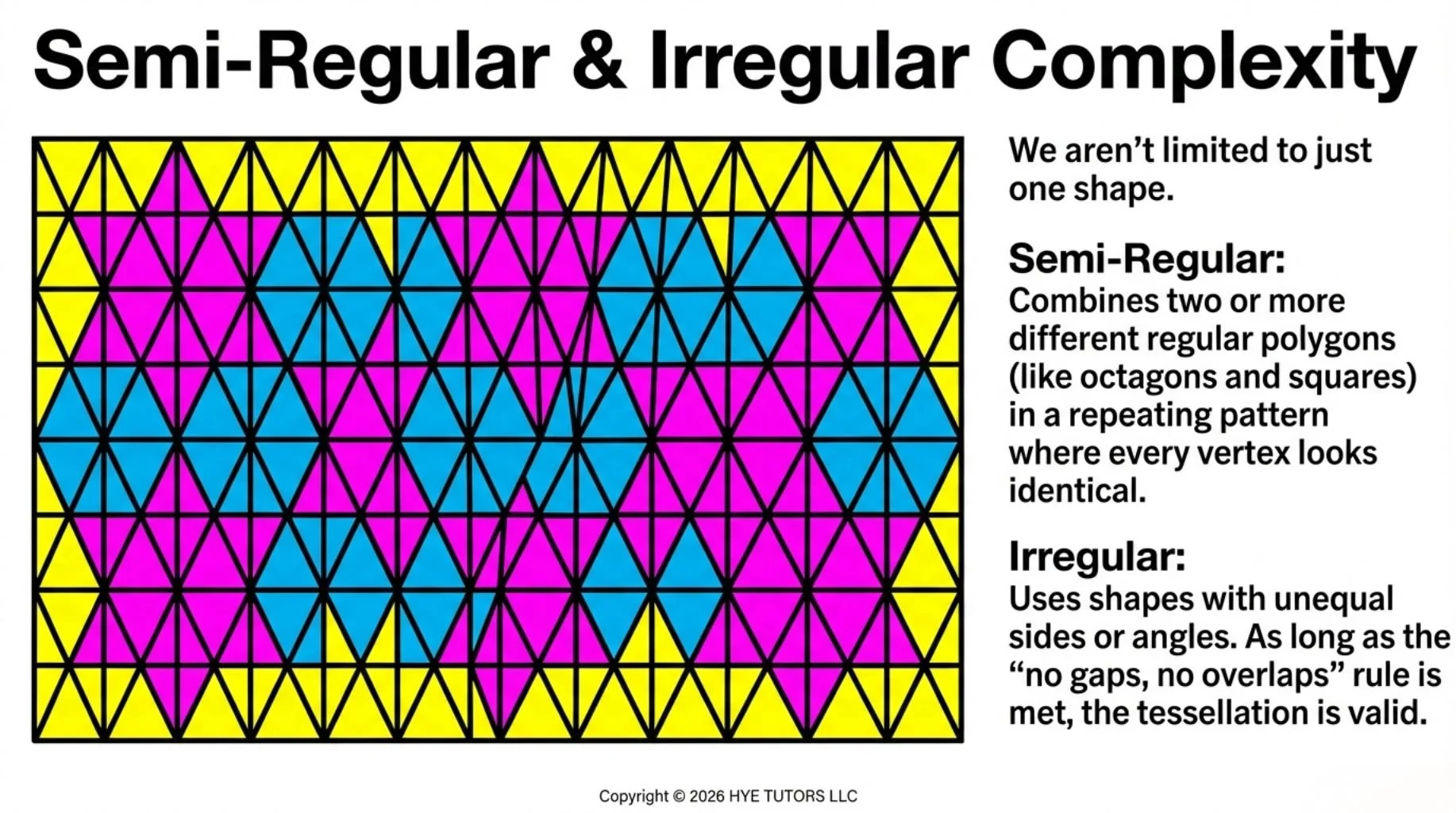
Semi-Regular Tessellations combine two or more different regular polygons in a repeating pattern. The arrangement at every vertex must be identical. For example, a pattern alternating octagons and squares creates a semi-regular tessellation you might recognize from certain floor tile designs.
Irregular Tessellations use shapes that aren't regular polygons—they might have unequal sides or angles. As long as the shapes fit together without gaps or overlaps, they form a valid tessellation. The artwork of M.C. Escher famously features irregular tessellations using birds, fish, and other interlocking figures.
Real-Life Examples of Tessellations
Tessellations aren't just abstract math concepts—they appear throughout the natural and human-made world. Recognizing these patterns helps students connect classroom learning to reality.
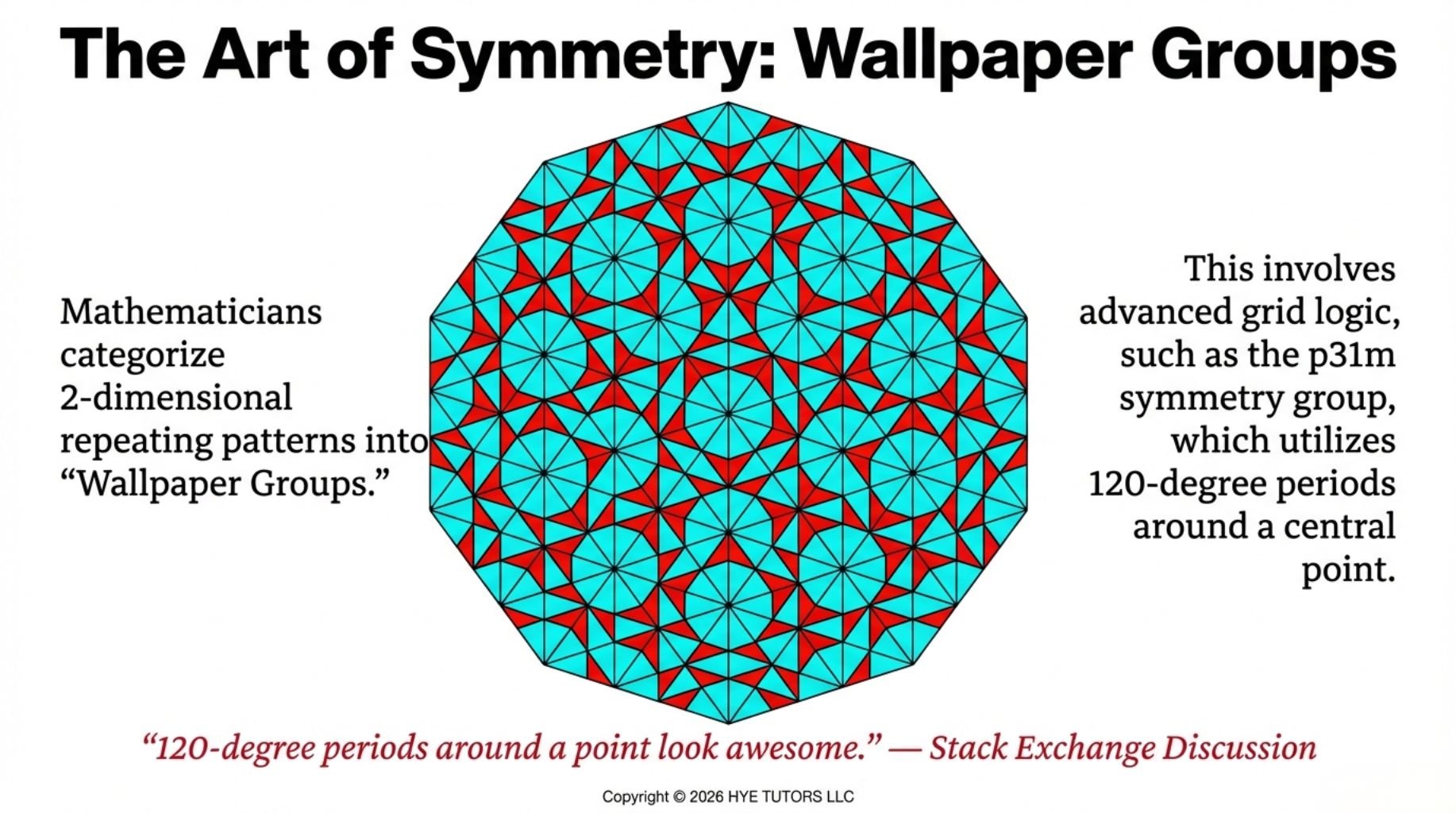
Brick walls use rectangular tessellations, with each brick offset to create strength and visual interest. Bathroom and kitchen tiles often feature square or hexagonal tessellations for complete floor coverage. Honeycomb structures showcase nature's efficiency—bees build hexagonal cells because hexagons use the least wax to create the most storage space.
Islamic geometric art found in mosques and palaces across the Middle East and North Africa displays stunning semi-regular tessellations that have inspired mathematicians for centuries. TheMetropolitan Museum of Art offers excellent examples of these intricate patterns. Meanwhile, M.C. Escher's artwork transformed tessellations into famous optical illusions, showing how irregular shapes like lizards and birds can interlock perfectly.
Why Are Tessellations Important in Math?
Learning about tessellations builds essential mathematical thinking skills. Working with these patterns strengthens spatial reasoning—the ability to visualize how shapes fit together and relate to each other. Students also practice calculating angles and symmetry, reinforcing core geometry concepts.
Beyond the classroom, tessellations matter in architecture, interior design, computer graphics, and engineering. Designers use tessellation principles to create efficient floor plans, textile patterns, and video game environments. The National Council of Teachers of Mathematics even offers interactive tools for students to explore creating their own tessellations.
FAQs
What is a tessellation in math in simple terms?
A tessellation is a pattern of shapes that fit together perfectly to cover a surface with no gaps and no overlaps, like puzzle pieces that repeat forever.
What shapes can tessellate?
Any triangle or quadrilateral can tessellate. For regular polygons, only equilateral triangles, squares, and regular hexagons tessellate on their own.
Why can't circles tessellate?
Circles have curved edges that can't fit flush against each other—gaps always remain between them no matter how they're arranged.
What grade do students learn about tessellations?
Tessellations are typically introduced in middle school (grades 5–8) as part of geometry units on shapes, angles, and patterns.
Are tessellations only in math?
No—tessellations appear in art, architecture, nature, and design. They're a perfect example of how mathematical principles show up in the real world.
Quick Summary
So what is a tessellation in math? It's a repeating pattern of shapes—like triangles, squares, or hexagons—that cover a flat surface completely without gaps or overlaps. You see tessellations daily in floor tiles, brick walls, and even honeycombs. Understanding tessellations strengthens geometry skills and reveals how math shapes the world around us.
Want to explore geometry concepts like tessellations with expert guidance? At HYE Tutors, we help students build strong foundations in math through personalized, one-on-one tutoring. Whether you're mastering shapes in middle school or preparing for advanced geometry, our tutors make every concept clear and approachable. Reach out today to get started.