

What Is Translation in Math? Definition & How-to Guide
Wondering how shapes move across a coordinate plane without changing their form? In this guide, you’ll explore what translation in math means, how this simple geometric transformation works, and how to apply translation rules step by step. You’ll also see clear examples, coordinate rules, and real-life comparisons that make it easier to visualize how shapes slide from one position to another while staying exactly the same.
Translation in Math
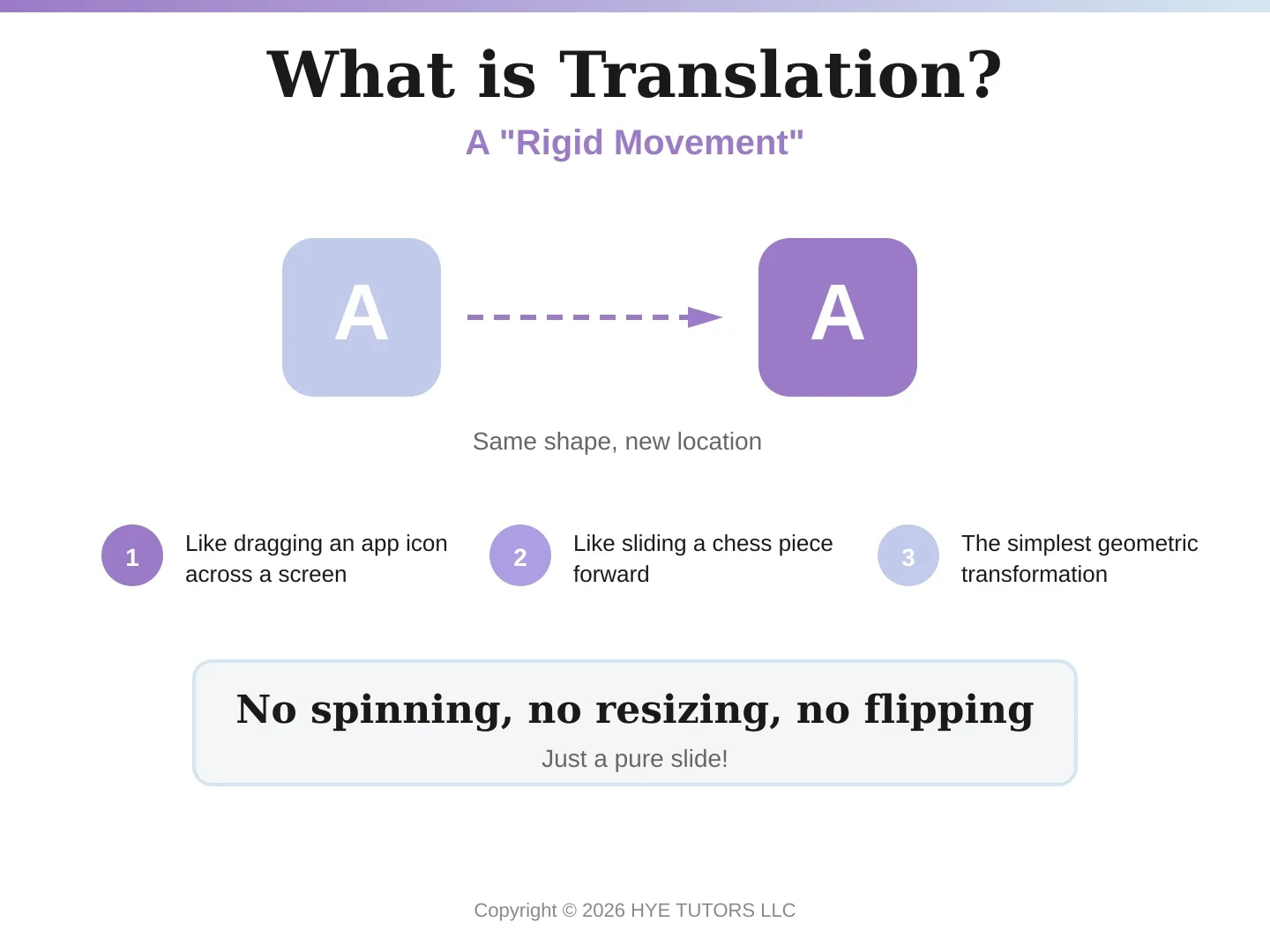
Translation in math is a type of transformation that slides a shape or point from one position to another without rotating, resizing, or flipping it. Every point moves the same distance in the same direction, meaning the shape stays exactly the same—only its location changes.
What Is Translation in Math?
If you've ever dragged an app icon across your phone screen or slid a chess piece forward without turning it, you've performed a translation. So what is translation in math? It's one of the four main geometric transformations—and the simplest to understand. A translation slides every point of a shape the same distance in the same direction, moving the entire figure to a new location without changing anything else about it.
The Key Characteristics of Translation
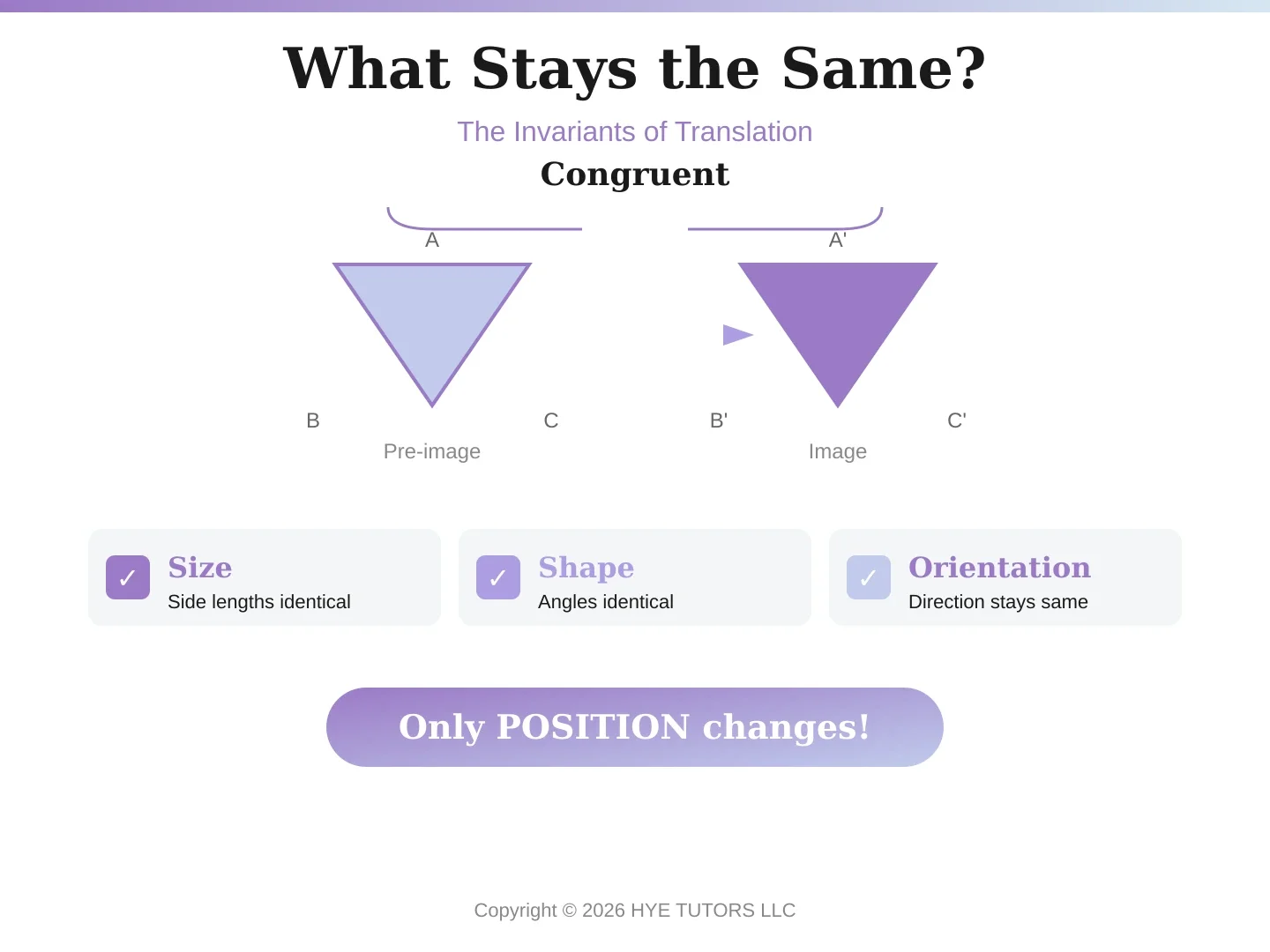
When you translate a shape, three things always stay the same: its size, its shape, and its orientation (which way it faces). A triangle translated five units to the right is still the exact same triangle—same angles, same side lengths, same direction. The only thing that changes is where it sits on the coordinate plane.
This is what makes translation different from other transformations. There's no spinning (that's rotation), no flipping (that's reflection), and no stretching or shrinking (that's dilation). Translation is pure sliding motion—predictable, measurable, and consistent.
Understanding Translation in Coordinate Geometry
In coordinate geometry, translation follows a simple rule. If you have a point at coordinates (x, y) and you want to translate it, you add values to move it horizontally and vertically:
(x, y) → (x + a, y + b)
Here, a represents horizontal movement (positive moves right, negative moves left), and b represents vertical movement (positive moves up, negative moves down). Every single point in the shape follows this same rule, which is why the shape stays identical.
Classroom Examples
Imagine a triangle with vertices at (1, 2), (3, 2), and (2, 4). If your teacher asks you to translate it 4 units right and 3 units up, you apply the rule to each vertex: (1, 2) becomes (5, 5), (3, 2) becomes (7, 5), and (2, 4) becomes (6, 7). Plot these new points, connect them, and you have your translated triangle—same size and shape, just in a different spot.
Understanding what is translation in math becomes easier when you visualize it on graph paper. TheGeoGebra graphing calculator is an excellent free tool for practicing translations and seeing how shapes move across the coordinate plane.
Why Translation Is Predictable and Measurable
Because every point moves by the exact same amount, translations are completely predictable. If you know the translation rule, you can determine exactly where any point will end up. This consistency makes translation a foundational concept in both geometry and algebra, and students typically encounter it in middle school before moving on to more complex transformations.
How Translation Works in Geometry: Rules & Coordinates
The translation rule in geometry is straightforward once you understand what the numbers mean. Starting with any point (x, y), you create a new point by adding the translation values:
Horizontal movement (a): Positive values slide the shape right; negative values slide it left. For example, adding 5 to the x-coordinate moves every point 5 units to the right.
Vertical movement (b): Positive values slide the shape up; negative values slide it down. Adding −3 to the y-coordinate moves every point 3 units down.
Consider a square with one corner at (2, 1). Translating it by (x + 4, y − 2) moves that corner to (6, −1). The entire square shifts 4 units right and 2 units down, maintaining its perfect square shape throughout the journey.
Examples of Translation in Math
Translation examples appear both in textbooks and everyday life. Here are some common scenarios that illustrate this transformation:
Moving a square right 3 units: A square at (1, 1) translated by (+3, 0) ends up at (4, 1). It moved horizontally but stayed at the same height.
Shifting a triangle up 2 units: A triangle translated by (0, +2) rises two units on the coordinate plane while maintaining its exact shape and orientation.
Sliding icons on a touchscreen: When you drag an app icon, you're performing a translation—the icon moves without rotating or changing size.
A chess rook moving forward: The rook slides along rows or columns without turning, demonstrating pure translational movement.
Shifting a graph function: In algebra, translating y = x² to y = (x − 2)² + 3 shifts the parabola 2 units right and 3 units up.
Translation vs Rotation, Reflection & Dilation
Students sometimes confuse translation with other geometric transformations. Here's how they differ:
Translation slides a shape to a new position. The shape doesn't turn, flip, or change size. Rotation turns a shape around a fixed point, like spinning a pinwheel. Reflection flips a shape over a line, creating a mirror image. Dilation resizes a shape, making it larger or smaller while keeping proportions.
The key distinction: translation is the only transformation where the shape remains completely congruent and identically oriented. The Math is Fun transformations guide offers helpful visual comparisons of all four types.
Why Is Translation Important in Math?
Learning translation builds essential skills that extend far beyond geometry class. It strengthens spatial reasoning—your ability to visualize how objects move through space. This skill matters for graphing equations, understanding coordinate systems, and solving real-world problems.
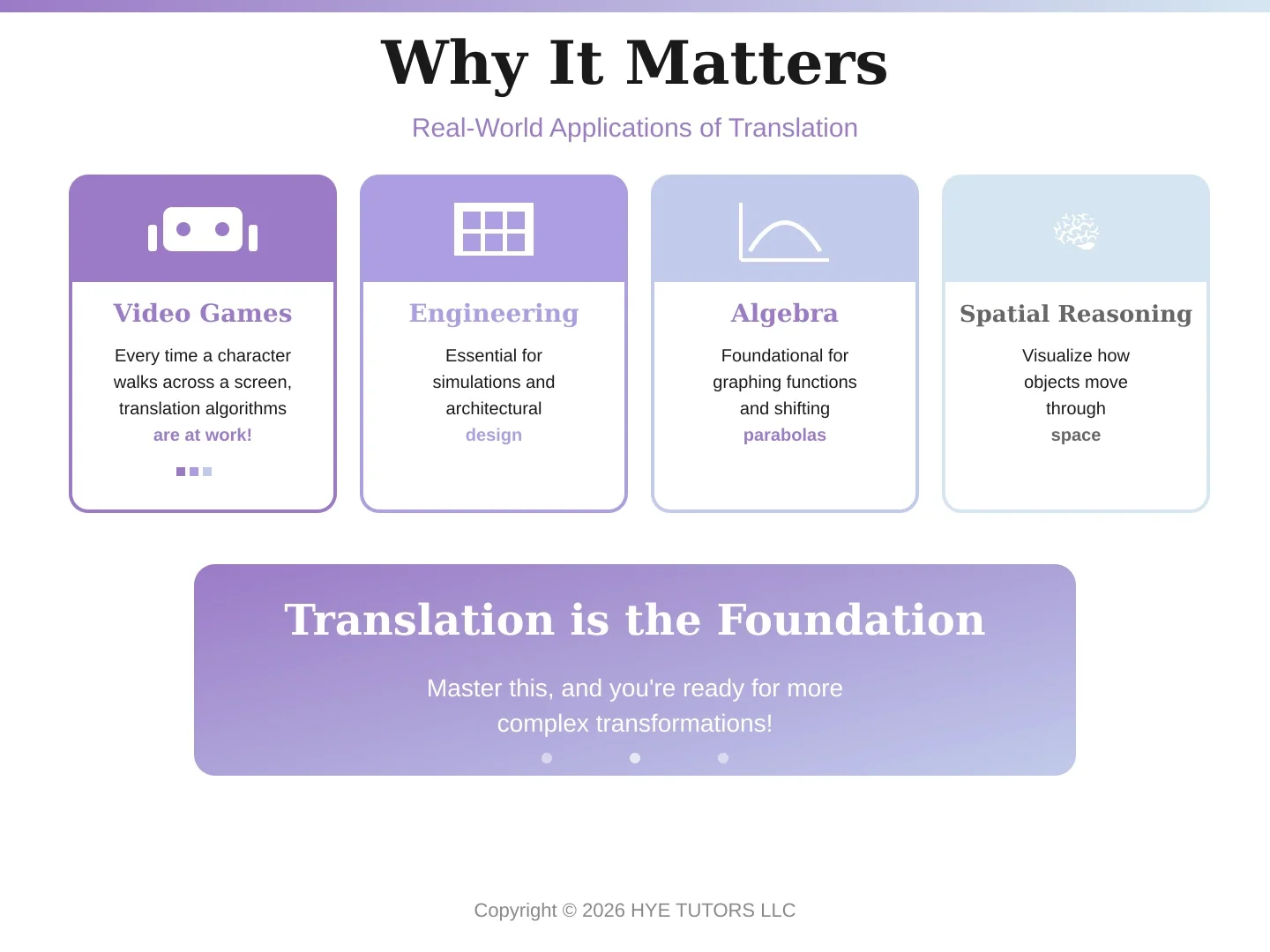
Translation also has practical applications in computer graphics, where every moving object on screen uses translation algorithms. Video game characters walking across landscapes, animated movies, architectural design software, and engineering simulations all rely on translation mathematics. Mastering this concept opens doors to understanding how technology brings motion to life.
FAQs
What is translation in math in simple words?
Translation is sliding a shape from one place to another without turning it, flipping it, or changing its size. Only the position changes.
What is an example of translation?
Dragging an icon across your phone screen is a real-life translation. The icon moves to a new spot but stays the same size and doesn't rotate.
What stays the same during translation?
Everything except position stays the same: the shape's size, angles, side lengths, and orientation all remain identical after translation.
What is the rule for translation in geometry?
The rule is (x, y) → (x + a, y + b), where 'a' is horizontal movement and 'b' is vertical movement applied to every point.
Is translation the same as shifting?
Yes, translation and shifting mean the same thing in math. Both terms describe sliding a shape or graph to a new location.
How is translation different from rotation?
Translation slides a shape without turning it. Rotation spins a shape around a point. After rotation, the shape faces a different direction.
Do shapes change size during translation?
No, shapes never change size during translation. The translated shape is always congruent (identical in size and shape) to the original.
Quick Summary
So what is translation in math? It's the simplest geometric transformation—a slide that moves every point of a shape the same distance in the same direction. Whether you're shifting a triangle on graph paper or watching a video game character walk across the screen, translation keeps the shape identical while changing only its location. Remember: same size, same shape, same orientation—just a new position.
Need help mastering transformations and other geometry concepts? At HYE Tutors, our experienced math tutors break down concepts like translation, rotation, and reflection into clear, manageable steps. Whether you're preparing for a geometry test or building foundations for algebra, we're here to help you succeed. Contact us today to schedule your first session.