

What Is the Pythagorean Theorem? Formula and Examples
What is the Pythagorean theorem, and why is it one of the most important rules in geometry? If you've heard the name and found yourself a little intimidated — that's completely normal. It sounds like a complicated concept, but once you understand what it's actually describing, you'll wonder why it ever seemed difficult in the first place.
The Pythagorean theorem is a foundational math rule that connects the three sides of a right triangle in a reliable, predictable way. In this guide, you'll learn exactly what it means, how the formula works, when to use it, and how to solve real problems step by step. You'll also discover how this ancient math rule shows up in everyday life — from construction sites to smartphone apps.
By the end, you'll have everything you need to use this theorem with confidence.
“The Pythagorean theorem applies to right triangles. It states that the square of the longest side (the hypotenuse) equals the sum of the squares of the two shorter sides. Written as a formula: a² + b² = c²
Here, c is the hypotenuse (the longest side, opposite the right angle), and a and b are the two legs. This relationship holds true for every right triangle, regardless of size.”
What Is the Pythagorean Theorem
The Pythagorean theorem is one of the most important ideas in geometry. It explains how the three sides of a right triangle are connected and allows you to find a missing side when the other two are known.
Pythagorean Theorem Definition
In plain English: if you know two sides of a right triangle, you can always find the third.
The Pythagorean theorem is a mathematical rule that describes a special relationship between the three sides of a right triangle. It doesn't measure angles or areas on its own — instead, it connects the lengths of the sides through a simple equation. That equation always produces one predictable result, which makes it one of the most reliable tools in geometry.
The formal statement is: the square of the hypotenuse equals the sum of the squares of the other two sides. It works only for right triangles — triangles that contain exactly one 90° angle — and it works for every right triangle, big or small. For a deeper visual exploration of the theorem,Khan Academy's Pythagorean theorem lesson is an excellent free resource.
Understanding a Right Triangle
Before using the theorem, it helps to clearly visualize the triangle it applies to. A right triangle is simply a triangle with one angle that measures exactly 90 degrees — like the corner of a piece of paper or the edge of a book.
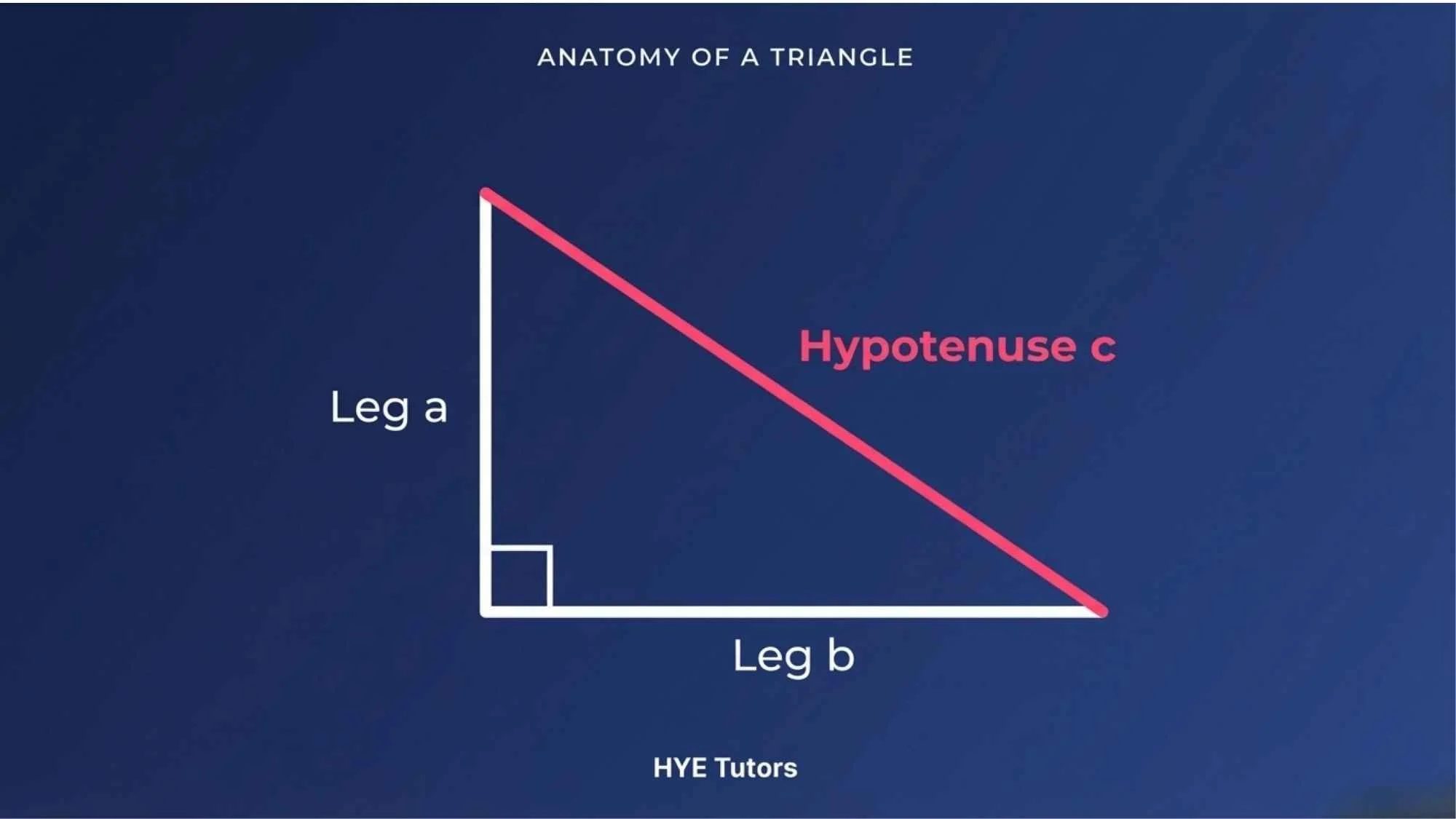
That 90° corner creates three sides with specific names. The two shorter sides that form the right angle are called the legs (labeled a and b). The longest side — always the one directly across from the right angle — is called the hypotenuse (labeled c).
Picture a ramp leaning against a wall. The wall is one leg, the ground is the other leg, and the ramp itself is the hypotenuse. The Pythagorean theorem describes exactly how those three lengths relate to each other.
The Pythagorean Theorem Formula Explained
The formula looks like this:
a² + b² = c²
Each part has a specific meaning:
• a = the length of one leg (shorter side)
• b = the length of the other leg (shorter side)
• c = the length of the hypotenuse (longest side, always opposite the right angle)
• The ² symbol means "squared" — multiply the number by itself. So a² = a × a.
• The formula works for right triangles of any size — tiny or enormous.
Don't let the squaring intimidate you. A calculator handles it in seconds. Your job is simply to identify the correct sides and plug in the numbers.
Why the Pythagorean Theorem Works (Conceptual)
You don't need to memorize a proof to understand why this works — just think about area.
Imagine drawing a square on each side of a right triangle. The Pythagorean theorem is saying: the area of the square built on the hypotenuse is exactly equal to the combined area of the squares built on the two legs.
It's not a coincidence or a trick — it's a geometric truth about how space works. The right angle creates a precise balance between the sides. That balance is what the formula captures. Once you see it this way, the theorem stops feeling like a rule to memorize and starts feeling like something that simply makes sense.
How to Use the Pythagorean Theorem (Step-by-Step)
This is one of the easiest geometry formulas to apply once you know the method. Follow these steps every time:
1. Confirm you have a right triangle (look for the 90° angle or a square corner symbol).
2. Identify the hypotenuse — it's always the longest side, directly opposite the right angle. Label it c.
3. Label the two legs a and b (the order doesn't matter).
4. Substitute the values you know into the formula: a² + b² = c²
5. Square each known number (multiply it by itself).
6. Add or subtract to isolate the unknown side.
7. Take the square root of the result to find the missing length.
That's it. The formula never changes — only the numbers do. With practice, these steps become second nature in about 60 seconds per problem. Need a quick square root calculator? Math is Fun's square root tool is a great bookmark to keep handy while you're practicing.
Pythagorean Theorem Examples
Once you see it in action, the theorem becomes much easier. Let's walk through two examples from start to finish.
Example 1 — Finding the Hypotenuse
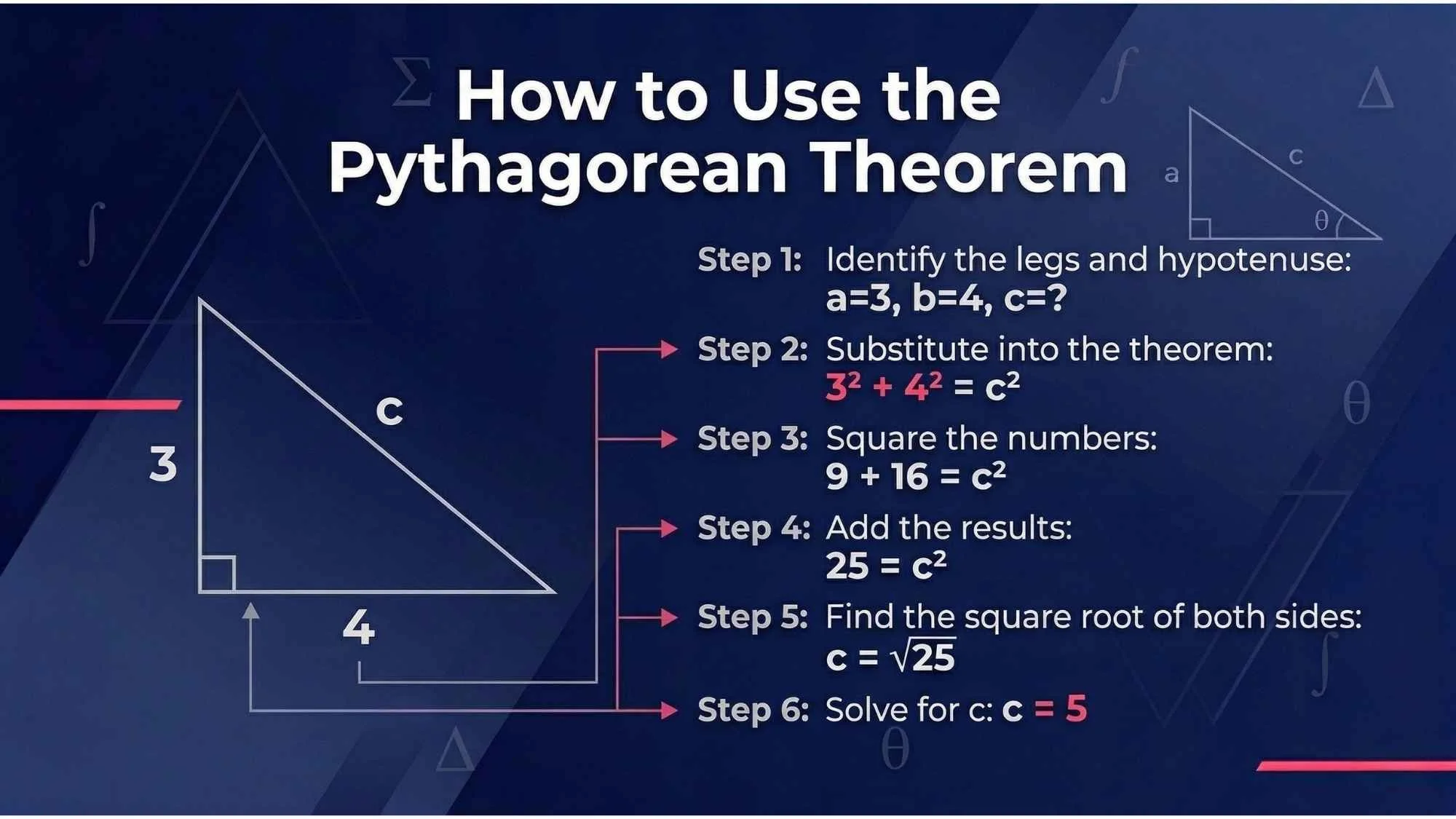
A right triangle has legs of 3 cm and 4 cm. What is the length of the hypotenuse?
Step 1: Write the formula: a² + b² = c²
Step 2: Substitute: 3² + 4² = c²
Step 3: Square: 9 + 16 = c²
Step 4: Add: 25 = c²
Step 5: Square root: c = √25
✅ Answer: c = 5 cm
Example 2 — Finding a Missing Leg
A right triangle has a hypotenuse of 13 cm and one leg of 5 cm. What is the other leg?
Step 1: Write the formula: a² + b² = c²
Step 2: Substitute known values: 5² + b² = 13²
Step 3: Square: 25 + b² = 169
Step 4: Subtract 25 from both sides: b² = 144
Step 5: Square root: b = √144
✅ Answer: b = 12 cm
When Can You Use the Pythagorean Theorem?
One of the most common student mistakes is trying to apply this theorem to the wrong type of triangle. Here's exactly when it works — and when it doesn't.
| ✅ Use the Theorem | ❌ Do NOT Use It |
|---|---|
| Right triangles only | Scalene triangles |
| Finding a missing side | Obtuse or acute triangles |
| Distance between two points | Triangles without a 90° angle |
| Coordinate geometry problems | Circles, polygons, other shapes |
The key rule: if there is no 90° angle, the Pythagorean theorem does not apply. For non-right triangles, you'd need different tools — like the Law of Cosines, which extends the same logic to any triangle.
Real-Life Uses of the Pythagorean Theorem
This theorem isn't just a classroom concept — it's quietly working behind the scenes in dozens of real-world situations every day.
• Construction & Architecture: Builders use it to check that walls and corners are perfectly square.
• Ladder Safety: Knowing the wall height and safe base distance lets workers calculate the exact ladder length needed.
• Navigation: GPS systems calculate the shortest straight-line distance between two points using this formula.
• Surveying Land: Engineers use right-triangle calculations to measure plots and boundaries accurately.
• Computer Graphics: Screens render diagonal lines and distances using the theorem millions of times per second.
• Sports Field Design: Groundskeepers use it to ensure fields and courts are perfectly rectangular.
Every time an architect designs a staircase, a developer writes a game engine, or a contractor frames a roof — they're relying on the same formula you just learned. For a comprehensive look at the theorem's history and proofs,Wolfram MathWorld's Pythagorean Theorem entry is a fascinating read for the curious student.
Common Mistakes Students Make
Every student makes a few missteps at first — here's what to watch for so you can avoid them:
• Forgetting to identify the hypotenuse first. Always label c before plugging in numbers.
• Mixing up the legs and hypotenuse. Remember: c is always the longest side, opposite the right angle.
• Forgetting to square the numbers. Substituting 3 instead of 9 (which is 3²) is one of the most common errors.
• Skipping the square root at the end. After finding c², you must take the square root to get c.
• Applying it to non-right triangles. If there's no 90° angle, stop — this formula doesn't apply.
These mistakes are easy to prevent once you know they exist. Slow down on the first few problems, label every side, and double-check your calculator inputs.
Quick Summary — Pythagorean Theorem
• Only for right triangles — triangles with one 90° angle.
• Formula: a² + b² = c² — where c is always the hypotenuse.
• Use it to find any missing side — rearrange the formula as needed.
• Square root at the end — don't forget this final step.
• Works for any size — the numbers change, the method never does.
• Appears everywhere — construction, tech, navigation, design, and more.
Conclusion
The Pythagorean theorem is one of the most reliable tools in geometry — and now it's yours. If the formula felt confusing at first, that's completely normal. Most students need to work through a few examples before it clicks, and that's exactly how learning is supposed to work.
With a little practice, you'll start seeing right triangles everywhere — in staircases, ramps, screens, and buildings — and you'll know how to work with them. The more you use this theorem, the faster and more natural it becomes.
Still wondering what is the Pythagorean theorem when it shows up on your next test? Come back to this guide, work through the examples again, and trust the process. You've got this.
About the Author
This article was written by the HYE Tutors team — educators based in Los Angeles with years of experience helping students in grades 6–12 build real confidence in math and science. Our tutors specialize in breaking down intimidating concepts into approachable, memorable lessons that stick. Learn more at hyetutors.com.
