

How to Transfer High Schools? Complete Guide
If you're searching for how to transfer high schools, you're likely facing significant concerns—academic struggles, bullying, family relocation, mental health challenges, or simply seeking better educational opportunities. Parents and students often receive conflicting advice from school counselors, district offices, and online forums, adding confusion to an already stressful situation. The uncertainty about whether transfers are even possible, how long they take, or what they cost creates additional anxiety.
The good news is that high school transfers are common, structured processes—not impossible bureaucratic nightmares. Thousands of students successfully transfer each year for various legitimate reasons. This comprehensive guide will explain exactly when students can transfer, how the process works step-by-step, how long it takes, what it costs, and how rules differ across states and major cities like NYC, California, Florida, and Chicago. You'll find clear, practical information with no confusion or unnecessary complexity. Let's walk through the complete transfer process together.
“To transfer high schools, students must meet eligibility requirements, apply through their school district or state system, submit academic records, and receive approval before enrolling. The process usually takes 2–8 weeks, may involve placement tests or counseling reviews, and can vary by state, city, and whether the transfer is mid-year.
”
How to Transfer High Schools
High school transfers follow an administrative process managed by school districts, not an informal school switch you can arrange independently. Understanding this fundamental structure helps you navigate the system effectively rather than becoming frustrated by perceived obstacles. While specific requirements vary by district and state, the overall framework remains consistent across the United States.
The transfer process exists to ensure students receive appropriate educational placement, maintain academic progress, and don't overwhelm schools beyond their capacity. School districts must balance student needs with available resources, which is why transfers require formal applications, documentation, and approval rather than simple enrollment.
Key principles of high school transfers:
Transfers are regulated by state education departments and implemented by local school districts. This means the California Department of Education sets statewide policies, but individual districts like Los Angeles Unified or San Diego Unified implement their own specific procedures within those guidelines. Similarly, New York State establishes frameworks, but New York City Department of Education (NYC DOE) manages the actual transfer process for city schools.
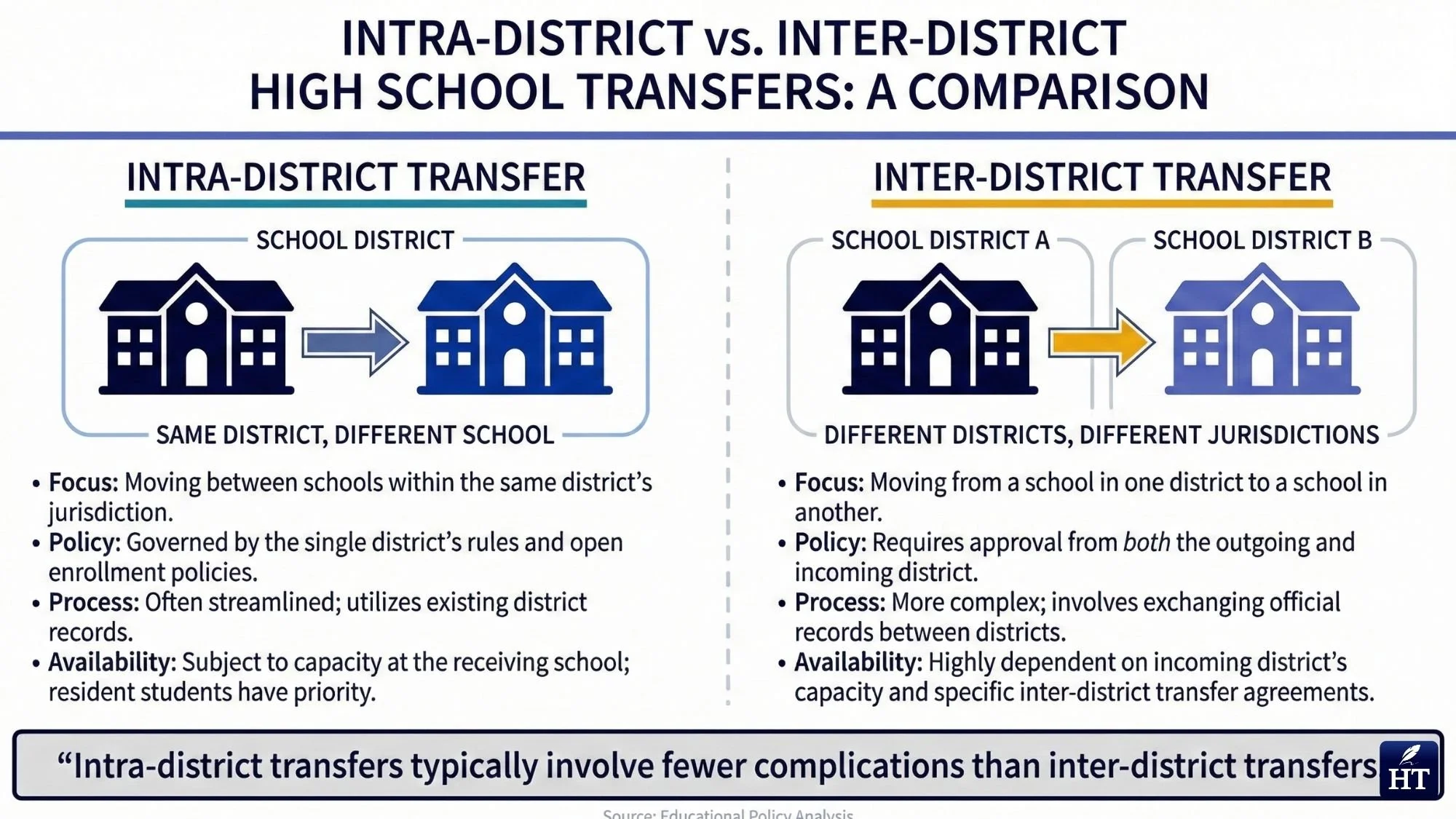
Most transfers fall into two categories:
Intra-district transfers move students between schools within the same district (like transferring from one public high school to another in the same city). These typically involve fewer complications because records stay within the same administrative system.
Inter-district transfers move students between different school districts (like transferring when your family moves to a new town, or choosing a school outside your assigned district). These require coordination between two separate administrative systems and often involve residency verification.
The reality of transfer difficulty:
Transferring isn't inherently hard, but it requires understanding specific rules, submitting correct documentation, and working within established timelines. Students transferring during summer enrollment windows with clear eligibility reasons and complete paperwork typically experience straightforward processes. Those attempting mid-year transfers with incomplete documentation face more challenges—not because transfers are impossible, but because they're working against administrative constraints.
Let's examine the step-by-step process, eligibility requirements, timelines, and costs in detail.
Step-by-Step Process to Transfer High Schools
The transfer journey follows a logical sequence from initial decision through final enrollment. While specific forms and procedures vary by location, understanding this general framework helps you prepare properly and avoid delays.
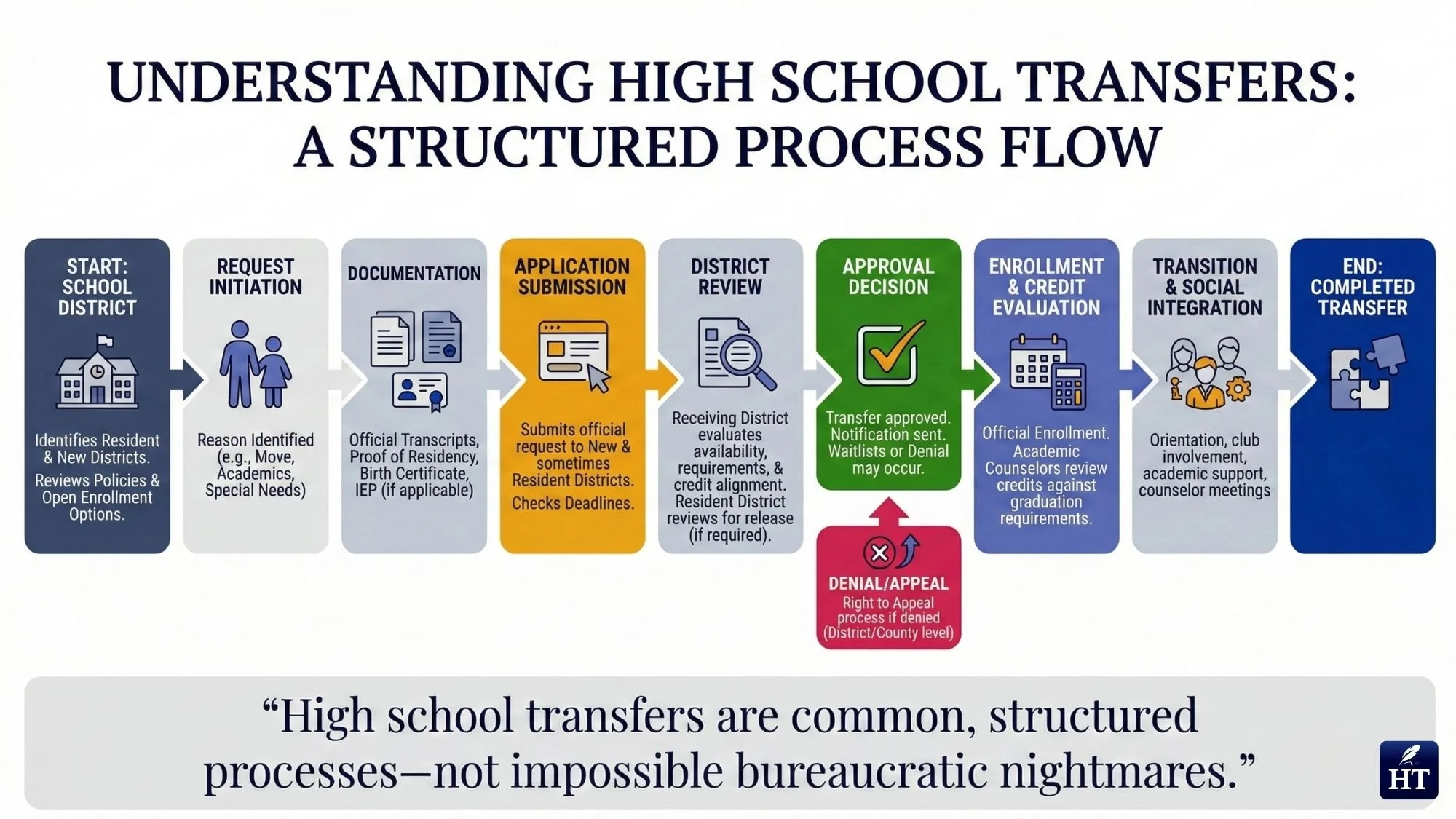
Complete transfer process:
1. Confirm eligibility with current school or district Before investing time in applications, verify that your reason for transferring qualifies under district policy. Contact your current school's guidance counselor or district enrollment office to discuss your situation. Some districts require specific documented reasons (safety concerns, medical needs, academic program unavailability) while others allow broader school choice.
2. Research available schools and transfer policies Identify potential receiving schools and understand their admission requirements, available programs, capacity constraints, and application deadlines. Public schools must publish transfer policies—check district websites or call enrollment offices directly. Consider factors like graduation requirements, course offerings, extracurricular programs, and transportation.
3. Submit transfer application (online or in-person) Complete the required transfer application through your district's designated process. Many urban districts use online portals (like NYC's MySchools or Chicago's CPS application system), while smaller districts may require paper forms submitted in person or by mail. Submit during published application windows when possible.
4. Provide transcripts, attendance, and discipline records Request official transcripts from your current school showing completed coursework and grades. Districts also typically require attendance records and disciplinary history. Some schools need immunization records and proof of residency. Incomplete documentation is the most common cause of processing delays.
5. Attend counseling review or placement assessment Many districts require meeting with a guidance counselor to review credit transfer, course placement, and graduation timeline. Some schools administer placement tests to determine appropriate class levels, especially in math and language arts. This ensures you're enrolled in classes matching your academic preparation.
6. Receive approval and enrollment confirmation After reviewing your application, the receiving school or district issues an approval decision. If approved, you'll receive enrollment instructions, registration dates, and required next steps. If denied, you should receive written explanation and information about appeal processes. Processing times vary but typically range from 2-8 weeks.
Who Is Eligible to Transfer High Schools?
Not every transfer request receives automatic approval. School districts evaluate requests based on both student circumstances and school capacity. Understanding common eligibility criteria helps you determine if your situation qualifies and how to present your case effectively.
Eligibility depends on several factors: documented need, available space at the receiving school, timing of the request, and compliance with district policies. Some reasons qualify almost universally, while others depend on district-specific school choice policies.
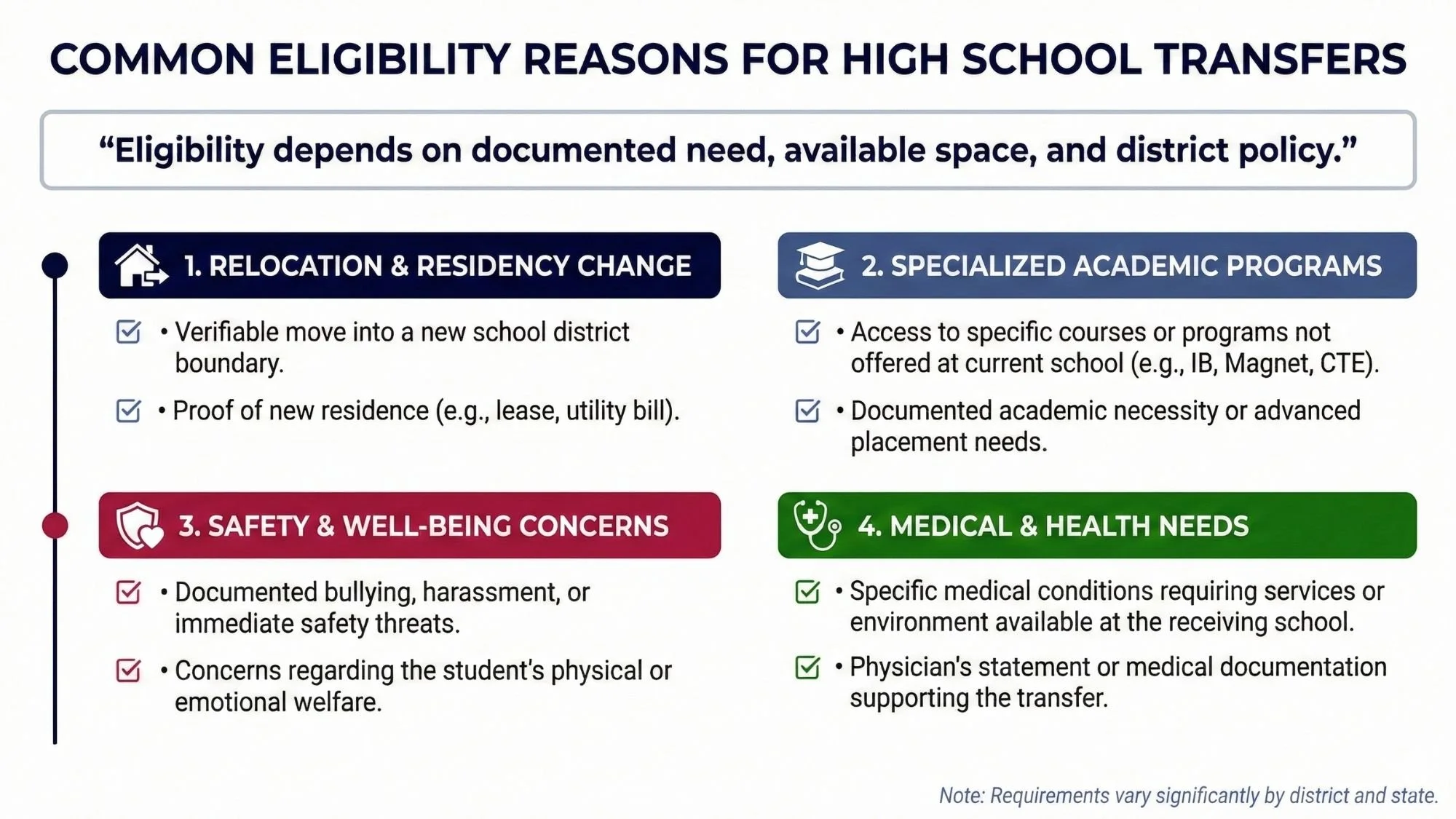
Common eligibility triggers that typically support transfer approval:
Family relocation or zoning changes – Moving to a new address often requires or permits transferring to your new neighborhood school; some districts allow staying at your current school if you provide transportation
Academic needs or program availability – Seeking specific programs, advanced courses, career/technical education, or special education services not available at your current school
Safety, bullying, or well-being concerns – Documented harassment, bullying, safety threats, or environments harmful to student mental health (usually requires incident reports or counselor documentation)
Medical or mental health reasons – Health conditions requiring proximity to medical facilities, mental health needs requiring specialized support, or disabilities requiring specific accommodations
Court or guardianship changes – Change in legal custody, foster care placement, or court orders affecting school assignment
Additional considerations that may support transfers:
Sibling attendance at the requested school
Parent employment location changes
Childcare or transportation hardships
Participation in specific athletic or arts programs
Magnet school or specialty program admission
Important limitation: Even with valid eligibility reasons, transfers may be denied if the requested school is at capacity or if the transfer would create imbalanced enrollment. Districts prioritize students living within school boundaries and must maintain manageable class sizes.
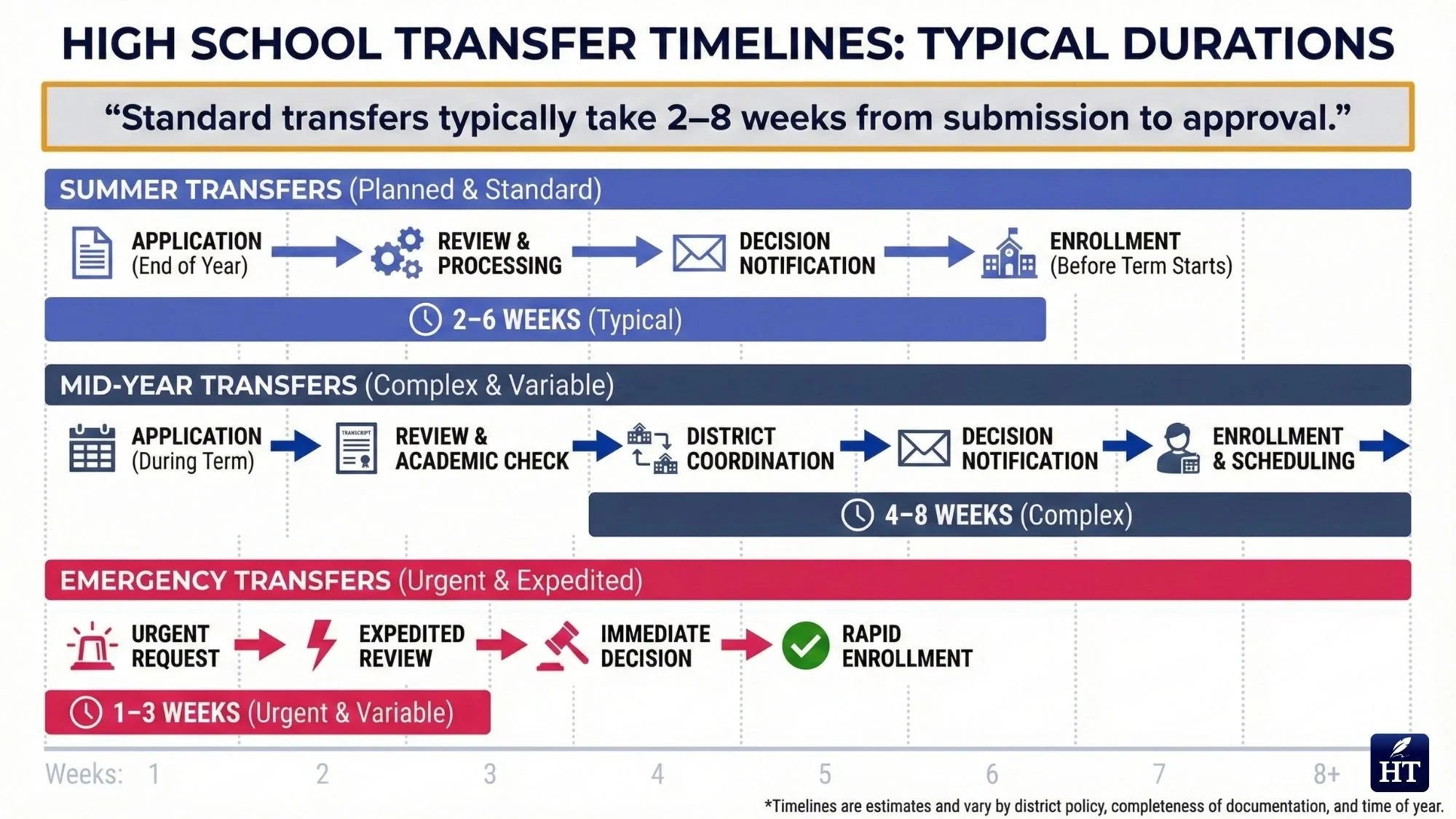
How Long Does It Take to Transfer High Schools?
Understanding "how long does it take to transfer high schools" helps you plan appropriately and set realistic expectations. Transfer timelines vary significantly based on when you apply, how complete your documentation is, and your district's administrative capacity.
Typical processing timeline:
Standard transfers: 2–8 weeks from complete application submission to enrollment approval. This includes time for records transfer, counselor review, placement assessment, and administrative processing.
Expedited transfers: 1–3 weeks in urgent situations (safety concerns, immediate relocation) when districts prioritize rapid processing.
Delayed transfers: 3–4 months when applications are incomplete, submitted during peak periods, or require inter-district coordination with slow-responding offices.
Factors affecting transfer speed:
Faster during summer enrollment windows – Districts process transfers more efficiently between academic years when staff focus on enrollment rather than ongoing instruction
Mid-year transfers may take longer – Processing during active semesters competes with other administrative priorities and requires careful credit evaluation
Delays often caused by missing records – Incomplete transcripts, unsigned forms, missing immunization records, or unreturned requests for information extend timelines significantly
Varies by district size and resources – Large urban districts with dedicated transfer offices often process applications faster than small rural districts with limited administrative staff
How long does it take to transfer schools high school in different scenarios:
Summer transfer (June-August): Typically 2-4 weeks
Mid-semester transfer (October or March): Typically 4-8 weeks
Emergency transfer (safety/custody): Can be expedited to 1-2 weeks with proper documentation
Inter-district transfer: Add 1-2 weeks for coordination between districts
Pro tip: Submit applications as early as possible within published windows, ensure all documentation is complete before submission, and follow up regularly with both sending and receiving schools to prevent delays.
How Much Does It Cost to Transfer High Schools?
Many families worry about "how much does it cost to transfer high schools" and whether financial barriers will prevent necessary moves. The answer depends primarily on whether you're transferring between public schools or to private institutions.
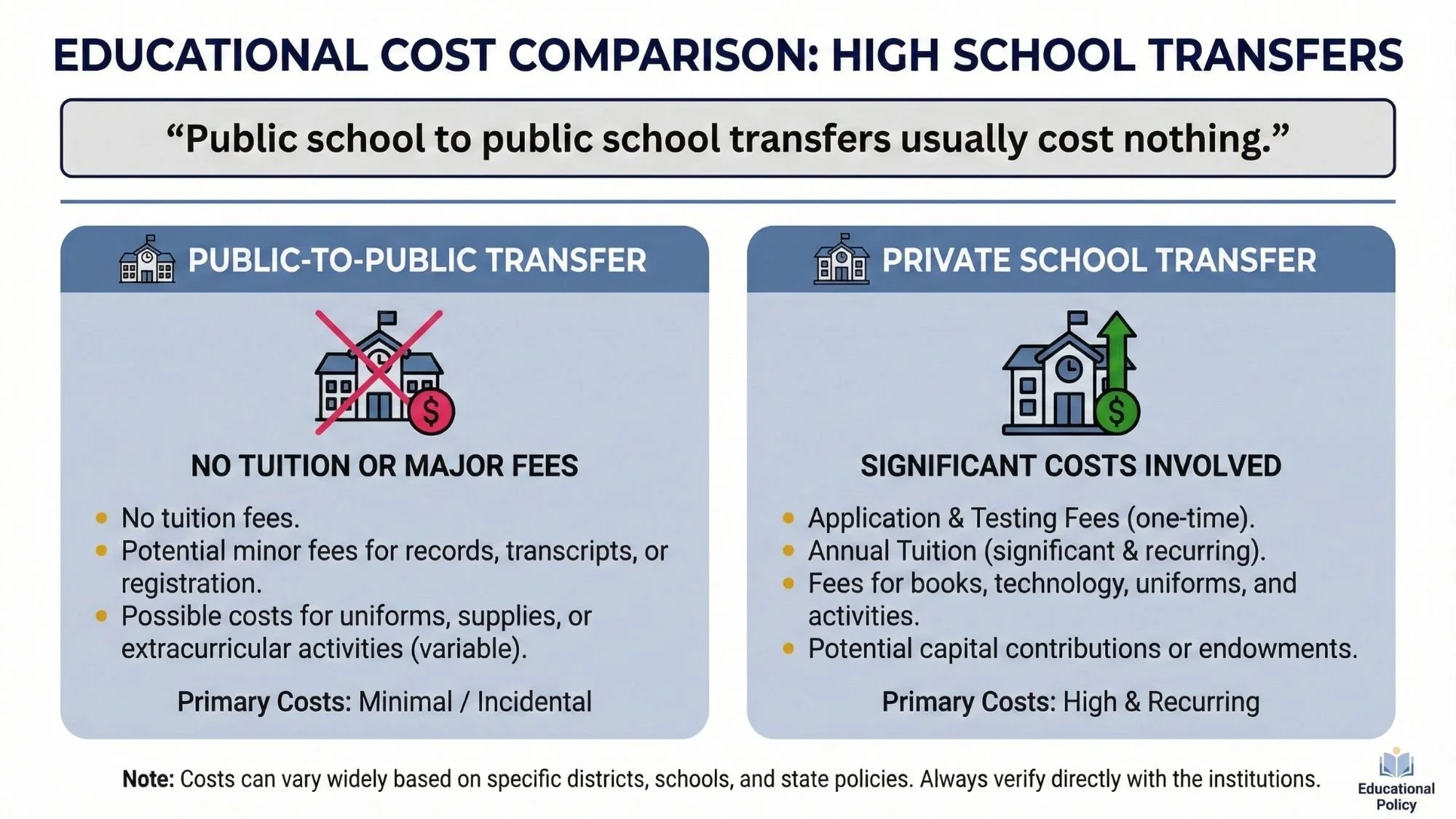
Cost breakdown for different transfer types:
Public school to public school transfers: usually no transfer fee – Public schools funded by tax dollars generally don't charge application or transfer fees for students residing within their district or approved for inter-district enrollment
Private schools: application and enrollment fees apply – Private institutions typically charge $50-$300 application fees plus annual tuition ranging from a few thousand to over $50,000 depending on the school
Transportation costs may increase – If transferring to a school outside your neighborhood zone, you may need to provide your own transportation instead of using free district buses (costs vary widely)
Records or testing fees: rare, district-specific – Some districts charge nominal fees ($5-$25) for official transcript copies or placement testing, though many waive these for in-district transfers
Important clarifications:
How much is it to transfer high schools within public systems: Typically $0 for the transfer itself, though you might incur indirect costs like transportation, new uniforms for schools with dress codes, or activity fees that vary by school.
Hidden costs to consider:
Lost deposit fees if leaving a private school mid-year
Tutoring or credit recovery if courses don't transfer perfectly
New textbooks or supplies if school requirements differ
Extracurricular participation fees at the new school
Financial assistance: Families facing financial hardship should inquire about fee waivers, which most districts offer for low-income students. Transportation assistance programs exist in some areas for students approved for special transfers.
How Hard Is It to Transfer High Schools?
Students and parents often ask "how hard is it to transfer high schools" expecting either reassurance that it's simple or confirmation of their fears that it's impossible. The truth lies in between, depending on specific circumstances.
Transfer difficulty is primarily administrative, not academic. The challenge usually involves navigating bureaucracy, gathering documentation, and meeting deadlines—not proving your student deserves education elsewhere.
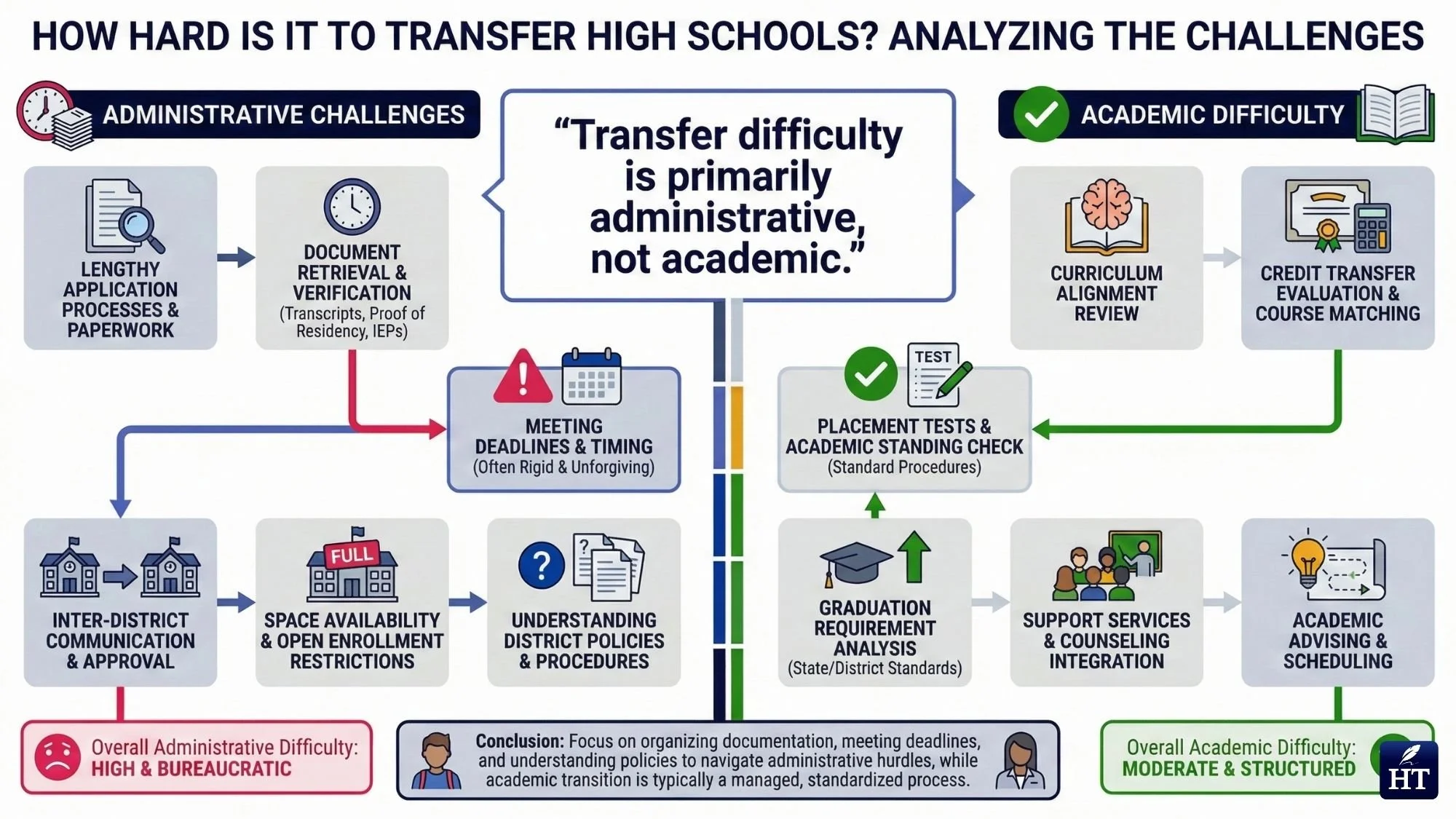
Factors that make transfers easier:
Transferring during scheduled transfer windows – Summer enrollment periods and semester breaks align with school administrative calendars, making processing smoother
Clear eligibility documentation – Well-documented reasons (relocation lease, medical records, bullying incident reports) streamline approval decisions
Complete application packages – Submitting all required forms, transcripts, and supporting documents together prevents back-and-forth delays
Proactive communication – Regular follow-up with both current and receiving schools keeps applications moving forward
Factors that make transfers harder:
Mid-semester or mid-year timing – Transferring outside standard enrollment windows requires special approval and creates credit transfer complications
School capacity constraints – Popular schools may have waiting lists or limited availability regardless of student qualifications
Incomplete documentation – Missing transcripts, unsigned forms, or inadequate supporting evidence causes rejections or indefinite delays
Inter-district transfers – Moving between different school districts requires coordination between separate administrative systems, adding complexity
Reality check: Transfers for legitimate, well-documented reasons during appropriate timeframes typically succeed. Difficulties arise when families attempt transfers for convenience during peak school capacity periods without compelling eligibility factors.
How to Know If You Should Transfer High Schools
Deciding whether to transfer requires careful evaluation of both current challenges and potential benefits. Transfers solve some problems but create new adjustments, so thoughtful analysis prevents regret.
Key factors to evaluate before transferring:
Academic fit and course availability – Does your current school offer the courses, programs, AP classes, career-technical education, or special services you need for your educational goals?
Emotional well-being and safety – Is your mental health suffering due to bullying, social environment, or safety concerns that cannot be resolved at your current school?
Commute and transportation impact – Will transferring create transportation burdens affecting attendance, extracurricular participation, or family logistics?
Long-term graduation requirements – Have you verified that credits will transfer appropriately and you'll meet graduation requirements on schedule at the new school?
Counselor and teacher recommendations – What do current educators who know your situation advise about the transfer decision?
Additional considerations:
Will you lose progress in ongoing extracurriculars, sports, or clubs?
How will starting over socially affect you?
Does the new school have better or worse performance metrics?
Are you transferring to solve a problem or escape temporary difficulty?
Have you explored resolving issues at your current school first?
When transfers typically make sense:
Transfers are often beneficial when students need specific academic programs, face documented safety issues, experience family relocations, or require specialized services unavailable at current schools. They're less beneficial when motivated by temporary conflicts, peer relationship issues that might follow you, or unrealistic expectations about new schools being perfect.
How to Transfer High Schools Mid Year
Mid-year transfers—changing schools in the middle of an academic year—are possible but more restricted than summer transfers. Districts limit mid-year transfers because they disrupt student academic continuity, complicate credit accounting, and may create classroom overcrowding.
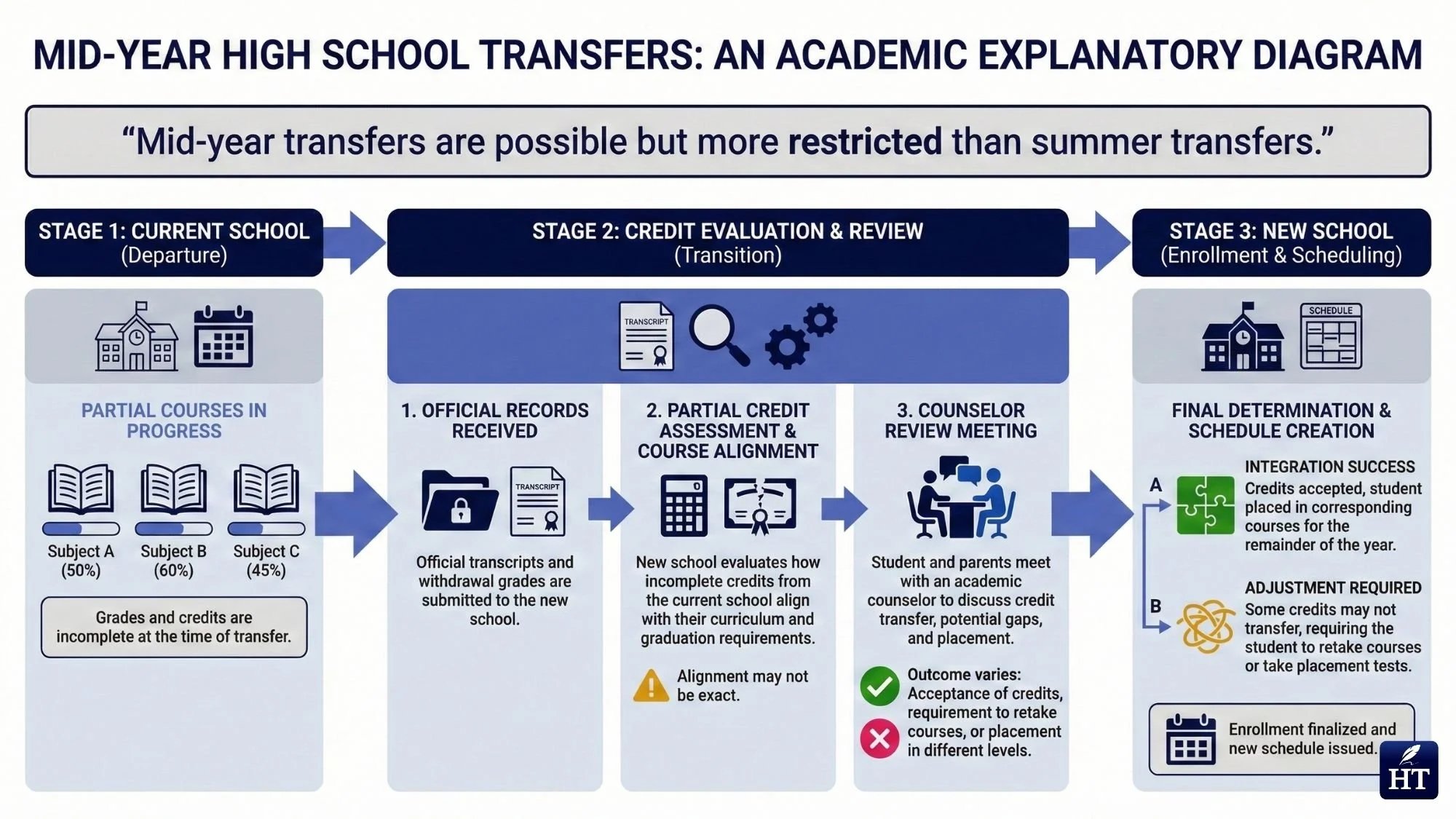
Why mid-year transfers are more challenging:
When you transfer mid-semester, you leave some courses partially completed and enter new courses already in progress. This creates complications for transcript recording, grade calculation, and ensuring you receive proper credit for all work. Additionally, schools plan staffing and class sizes based on beginning-of-year enrollment, so mid-year additions may exceed capacity.
Mid-year transfer guidelines:
Usually allowed for relocation or safety reasons – Districts recognize that families must move for employment, custody changes, or emergency situations regardless of the school calendar; safety concerns require immediate response
Credit evaluation is critical – Schools must determine how to count partial semester credits from your previous school and whether you can join current classes mid-progress without falling behind
Semester grading may not transfer cleanly – If your previous school operates on quarters and the new school uses semesters (or vice versa), reconciling grades becomes complex
Approval timelines are longer – Mid-year transfers require counselor review of current class placement, which takes additional time compared to summer enrollment
Best practices for mid-year transfers:
Submit requests as early as possible (ideally weeks before the intended transfer date), provide detailed transcripts showing current courses and grades, communicate frequently with counselors at both schools, and be prepared for potential placement in different class levels temporarily while evaluation completes.
Timing consideration: Transferring at semester breaks (typically December/January or May/June) is significantly easier than mid-semester transfers because it aligns with natural grade reporting periods.
How to Transfer High Schools by State & City
Education is regulated at the state level, which creates variation in transfer policies, procedures, and timelines across the United States. While the general framework remains similar (application, documentation, approval), specific requirements and systems differ significantly between locations.
Image 11
Understanding that "how to transfer high schools in California" involves different procedures than "how to transfer high schools in NYC" prevents confusion and ensures you follow the correct process for your location.
State-level variation stems from:
Different state education codes and regulations
Varying school choice policies and charter school laws
State-specific residency requirements
Different approaches to inter-district transfers
Local variation adds another layer:
Even within states, large urban districts like Los Angeles, Chicago, or Houston may have specialized transfer systems different from smaller districts in the same state.
How to Transfer High Schools in NYC
New York City operates one of the nation's largest and most centralized school transfer systems. Understanding how to transfer high schools nyc requires familiarity with the Department of Education's specific procedures.
NYC transfer process:
NYC DOE manages all transfers – The Department of Education oversees transfer applications for all public high schools in the five boroughs through a unified system
Online application via MySchools – Students apply through the MySchools portal (schools.nyc.gov/MySchools), which handles both initial high school applications and transfer requests
Transfer windows and priority rules – NYC publishes specific transfer application periods (typically fall and spring); students receive priority based on residence zone, sibling attendance, and program qualifications
Guidance counselor involvement required – Current school counselors must review and submit transfer requests; students cannot independently apply without counselor participation
NYC-specific considerations:
New York City offers specialized high schools requiring entrance exams, screened schools with academic criteria, and educational option schools with open enrollment. Transfer availability varies dramatically by school type. Popular schools may have multi-year waiting lists, while others actively recruit transfer students.
Resources: Contact NYC DOE's Office of Student Enrollment at 718-935-2009 or visit schools.nyc.gov for detailed guidance specific to your situation.
California, Florida, Chicago (Illinois)
These states and cities represent major educational markets with distinct transfer approaches. Understanding key differences helps you navigate the specific system relevant to your location.
How to transfer high schools in California:
District-based system with school choice laws – California operates primarily through local school districts, but state law provides intra-district and inter-district transfer rights under certain circumstances
Open enrollment policies vary widely – Some districts (like Los Angeles Unified) offer extensive school choice options, while others limit transfers to specific eligibility categories
California Education Code Section 46600 – Provides framework for inter-district transfers, allowing students to attend schools outside their residence district with approval from both sending and receiving districts
Proof of residency required – California districts strictly verify residence through utility bills, lease agreements, and other documentation to prevent enrollment fraud
How to transfer high schools in Florida:
Broad school choice options – Florida offers extensive school choice including magnet programs, career academies, and controlled open enrollment policies
School Choice application system – Most districts use application periods (typically February-March) for choice programs; some maintain year-round transfer options
Transportation considerations – While Florida supports school choice, districts aren't required to provide transportation to non-zoned schools, creating practical barriers for some families
McKay Scholarship and other options – Florida offers specialized transfer pathways for students with disabilities or other specific needs
How to transfer high schools in Chicago:
Chicago Public Schools (CPS) centralized application – CPS manages transfers through a structured application system similar to NYC's approach
GoCPS portal – Online platform for applying to high schools including transfer requests (go.cps.edu)
Selective enrollment and neighborhood options – Chicago distinguishes between competitive selective enrollment schools and neighborhood schools with different transfer processes
Proof of residency strictly enforced – Chicago requires multiple documents proving residence within city limits and specific attendance boundaries
Other major cities: Houston (HISD), Los Angeles (LAUSD), Philadelphia, and other large urban districts maintain similar centralized systems. Check your specific district's website or call enrollment offices for procedures.
FAQs
How do you transfer high schools?
To transfer high schools, contact your current school's guidance counselor to discuss eligibility, research receiving schools' transfer policies and application windows, submit a transfer application with required documentation (transcripts, attendance records, residency proof), attend any required counseling reviews or placement assessments, and wait for approval from the receiving school or district before enrolling.
How long does it take to transfer high schools?
Transferring high schools typically takes 2-8 weeks from application submission to enrollment approval. Summer transfers during standard enrollment windows process faster (2-4 weeks), while mid-year transfers take longer (4-8 weeks) due to credit evaluation and scheduling complexity. Emergency transfers for safety or custody reasons can be expedited to 1-2 weeks with proper documentation.
Can you transfer high schools mid year?
Yes, you can transfer high schools mid-year, though it's more restricted than summer transfers. Mid-year transfers are typically approved for family relocation, documented safety concerns, medical needs, or custody changes. They require careful credit evaluation to ensure proper placement and may take longer to process than transfers during standard enrollment periods between semesters.
How hard is it to transfer high schools?
Transferring high schools is moderately challenging due to administrative requirements, not academic difficulty. Transfers are easier during scheduled enrollment windows with complete documentation and clear eligibility reasons. They become harder mid-year, when schools are at capacity, or with incomplete paperwork. The process requires navigating bureaucracy and meeting deadlines rather than proving academic merit.
How much does it cost to transfer high schools?
Transferring between public high schools typically costs nothing—no application or transfer fees. However, families may incur indirect costs like transportation to non-neighborhood schools, new school supplies, or activity fees. Private school transfers involve application fees ($50-$300) plus tuition. Some districts charge nominal fees for transcripts or testing, often waived for low-income families.
Do credits transfer when you change high schools?
Yes, credits generally transfer when you change high schools, but evaluation processes vary by district. The receiving school reviews your transcript to determine which courses meet their graduation requirements and how partial semester credits are counted. Core academic credits (math, English, science, social studies) typically transfer smoothly, while electives may not always align perfectly with new school offerings.
Can parents request a high school transfer?
Yes, parents or legal guardians can request high school transfers on behalf of their students. Most districts require parent/guardian signatures on transfer applications and involvement in counseling meetings. While older high school students may participate in the process, parents typically must initiate and approve transfer requests, especially for students under 18 years old.
Conclusion
Understanding how to transfer high schools empowers families to make informed decisions and navigate the process successfully. While transfers require navigating administrative systems, meeting eligibility requirements, and submitting proper documentation, they are structured processes that thousands of students complete annually for legitimate reasons ranging from academic needs to family circumstances.
The key to successful transfers lies in understanding your specific district's procedures, submitting complete applications during appropriate timeframes, and maintaining clear communication with both current and receiving schools. Whether you're facing a summer transfer with months to prepare or an urgent mid-year situation requiring quick action, following the step-by-step process and providing thorough documentation increases approval likelihood significantly.
Remember that most transfer challenges stem from timing and paperwork management rather than eligibility denials. With proper preparation and realistic expectations about processing timelines, transferring high schools becomes manageable rather than overwhelming.
Ready to explore more educational guidance and school-related resources? Visit HYE Tutors for comprehensive guides on choosing the right high school, understanding graduation requirements, navigating college applications, academic planning strategies, and student support resources designed to help students and families make informed educational decisions.
References:
U.S. Department of Education: School Choice – Federal guidance on transfer rights
NYC Department of Education: Transfers – Official NYC transfer information
California Department of Education: Intradistrict and Interdistrict Transfers – California-specific regulations