

What Are Sines and Cosines? Definitions and Uses Explained
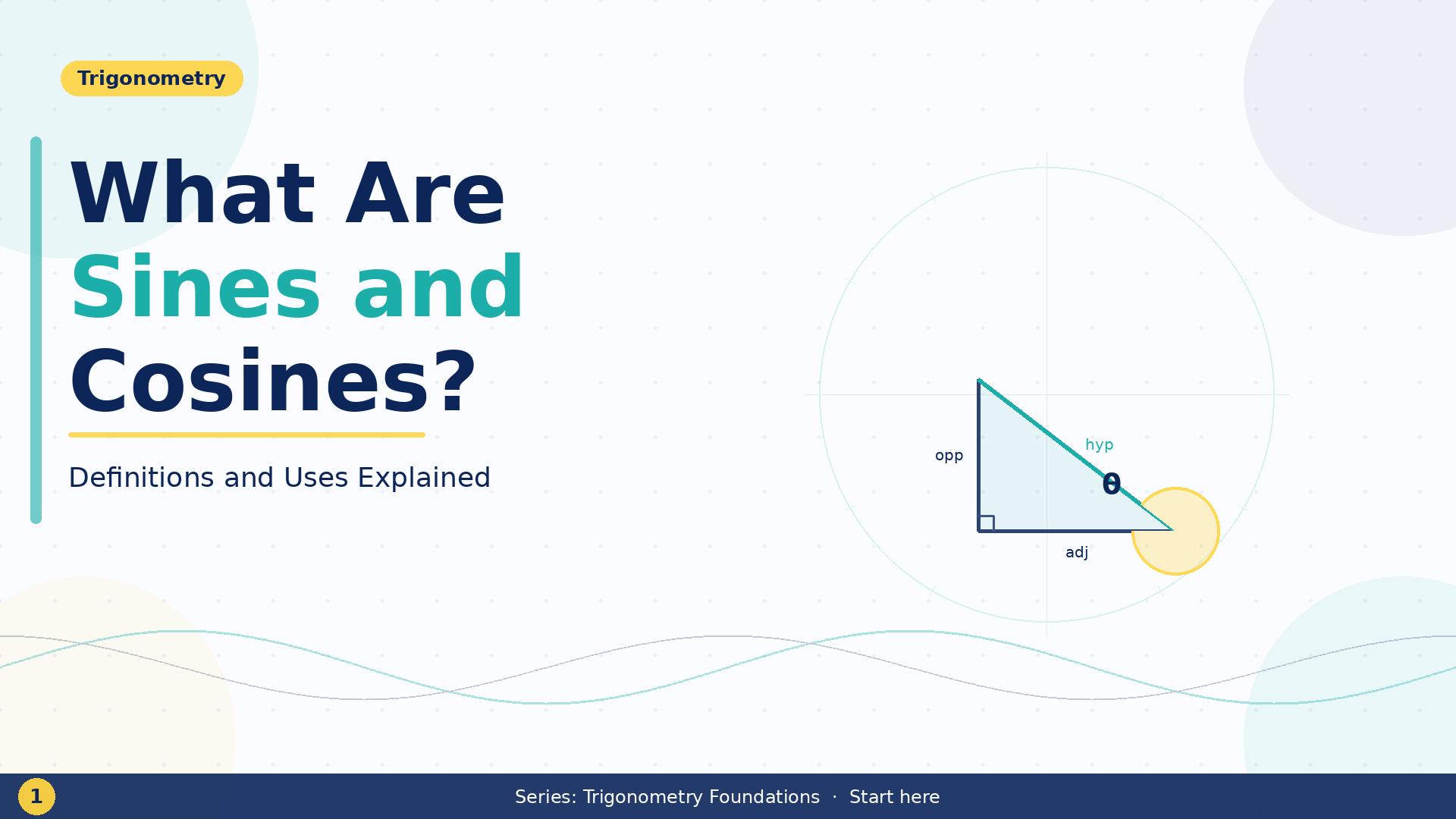
If you've ever wondered, "what are sines and cosines?" you're not alone. These two terms appear constantly in math class, but they often feel mysterious at first. Here's the good news: sines and cosines are much simpler than they seem, and once you understand the core idea, everything else clicks into place.
Sine and cosine are foundational concepts in trigonometry—the branch of mathematics that deals with relationships between angles and sides in triangles. Beyond the classroom, these ideas power everything from architecture to smartphone apps. In this guide, we'll walk through triangles, angles, ratios, and real-world meaning step by step. By the end, you'll feel confident explaining these concepts to anyone.
Quick Answer: Sine and cosine are trigonometric ratios that describe the relationship between an angle in a right triangle and the triangle's sides. Specifically, sine equals the opposite side divided by the hypotenuse, while cosine equals the adjacent side divided by the hypotenuse. These ratios remain constant for any given angle, regardless of the triangle's size.
What Are Sines and Cosines
At their core, sine and cosine are tools for measuring relationships. Imagine you're standing at one corner of a right triangle, looking at a specific angle. Sine and cosine tell you how the sides of that triangle compare to each other based on where that angle sits. They're not complicated calculations—they're simply ratios that describe proportion.
Think of it this way: if you know one angle and one side of a right triangle, sine and cosine help you figure out everything else. This makes them incredibly powerful for solving problems in geometry, physics, engineering, and countless other fields.
Definition of Sine and Cosine
Let's start with plain English. Sine and cosine are ratios—not angles, not measurements, but comparisons between two quantities. They describe how the sides of a right triangle relate to a specific angle within that triangle.
Here's what you need to remember:
Sine compares the side opposite the angle to the hypotenuse
Cosine compares the side adjacent to the angle to the hypotenuse
Both ratios always use the hypotenuse (the longest side) as the reference point
They only make sense when applied to angles—you can't calculate sine of a side length alone
The key insight is that these ratios stay the same for any angle of a particular size, no matter how big or small the triangle is. A 30-degree angle always produces the same sine value, whether your triangle fits on a postage stamp or spans a football field.
Sine and Cosine in a Right Triangle
Before diving deeper into sine and cosine, let's make sure we're all on the same page about right triangles. A right triangle is any triangle that contains exactly one 90-degree angle—that perfect corner you see in door frames and book edges.
Image 03
When working with right triangles, we name the sides based on their position relative to a specific angle (not the 90-degree angle, but one of the other two):
Hypotenuse: The longest side, always opposite the right angle
Opposite side: The side directly across from the angle you're examining
Adjacent side: The side next to the angle you're examining (that isn't the hypotenuse)
Position matters: If you switch which angle you're looking at, the "opposite" and "adjacent" sides swap roles
This is why visualizing the triangle is so important. The Khan Academy trigonometry course offers excellent interactive diagrams if you'd like additional practice identifying these sides.
Sine Formula and Cosine Formula
Now that you understand the vocabulary, the formulas become straightforward. Don't let the Greek letter intimidate you—θ (theta) simply represents whatever angle we're examining.
The sine formula and cosine formula are:
sin(θ) = opposite ÷ hypotenuse
cos(θ) = adjacent ÷ hypotenuse
θ (theta) represents the angle you're working with
These ratios remain constant for the same angle, even if the triangle is scaled larger or smaller
Many students remember these formulas using the mnemonic SOH-CAH-TOA: Sine = Opposite/Hypotenuse, Cosine = Adjacent/Hypotenuse, Tangent = Opposite/Adjacent. This simple memory trick has helped generations of students keep the ratios straight.
Image 06
Sine vs Cosine — What's the Difference?
Students often confuse sine and cosine because they look so similar. The crucial difference lies in which side of the triangle each one uses. Here's a clear breakdown:
Different reference sides: Sine uses the opposite side; cosine uses the adjacent side
Angle position affects values: As an angle increases from 0° to 90°, sine increases while cosine decreases
When sine is larger: For angles greater than 45°, sine is larger than cosine
When cosine is larger: For angles less than 45°, cosine is larger than sine
At exactly 45 degrees, sine and cosine are equal—both equal approximately 0.707. This symmetry is beautiful and useful in many applications.
Sine and Cosine on the Unit Circle
Once you're comfortable with sine and cosine in triangles, the unit circle opens up a whole new perspective. The unit circle is simply a circle with a radius of 1, centered at the origin of a coordinate plane.
Here's the elegant connection: for any point on the unit circle, the x-coordinate equals the cosine of the angle, and the y-coordinate equals the sine of the angle. The angle is measured from the positive x-axis, rotating counterclockwise.
Why does this matter? The unit circle allows us to extend sine and cosine beyond the 0° to 90° range of right triangles. You can find sine and cosine values for any angle—including 180°, 270°, or even negative angles. This expansion is essential for advanced mathematics, physics, and engineering. The Math is Fun unit circle guide provides helpful visualizations of this concept.
You may also encounter angles measured in radians rather than degrees. A full circle equals 2π radians (approximately 6.28), but don't worry about mastering radians right away—understanding degrees first builds a solid foundation.
Real-Life Uses of Sines and Cosines
You might wonder when you'll ever use trigonometry outside of school. The answer is: constantly, even if you don't realize it. Here are some practical applications:
Measuring heights and distances: Surveyors calculate the height of buildings and mountains using angles and trigonometry
Engineering and construction: Architects use sine and cosine to design stable structures with precise angles
Physics and waves: Sound, light, and electrical signals are modeled using sine waves
Navigation and GPS: Your smartphone calculates your position using trigonometric principles
Computer graphics and games: Every rotating object in a video game relies on sine and cosine calculations
Image 04
For students interested in STEM careers, understanding trigonometry is essential. The National Council of Teachers of Mathematics offers additional resources for exploring mathematics education and career pathways.
Common Mistakes Students Make with Sine and Cosine
Everyone makes mistakes when learning trigonometry—it's part of the process. Here are the most common pitfalls to watch out for:
Mixing up opposite and adjacent: Always identify which angle you're working with first, then label the sides from that angle's perspective
Using the wrong angle: Remember, you never use the 90-degree angle for sine or cosine calculations—use one of the other two angles
Forgetting that sine and cosine are ratios: They always produce values between -1 and 1 (in a right triangle, between 0 and 1)
Confusing sine with cosine in formulas: When in doubt, sketch the triangle and use SOH-CAH-TOA
Image 05
Making these mistakes doesn't mean you're bad at math—it means you're learning. Each error is an opportunity to strengthen your understanding.
Conclusion
Sines and cosines describe relationships—specifically, how angles and sides connect in right triangles and beyond. They're ratios that unlock the ability to solve real-world problems, from calculating building heights to programming video games.
If trigonometry feels confusing at first, that's completely normal. Even the most accomplished mathematicians were once beginners who mixed up their opposite and adjacent sides. The key is practice: draw triangles, label the sides, and work through problems until the patterns become second nature.
So the next time someone asks you "what are sines and cosines?" you can confidently explain that they're simple ratios that describe how angles and sides relate—and that they're used everywhere from your GPS to the games on your phone. Keep practicing, stay curious, and remember: math is a skill that grows with effort.