

How To Find the Legs Using the Pythagorean Theorem?

Have you ever stared at a right triangle problem wondering, how do you find b in the Pythagorean theorem when you already know the hypotenuse and the other leg? You’re not alone — and the good news is that solving for a missing leg is much easier than it looks once you rearrange the formula.
How to Find b in the Pythagorean Theorem
Before you can solve for b, you need to understand what each letter actually means. Confusion about labeling is where most students go wrong.
What Does “b” Represent in a Right Triangle?
In the Pythagorean theorem, the variables a, b, and c each refer to a specific side of a right triangle:
a and b are the two legs — the shorter sides that form the right angle
c is the hypotenuse — always the longest side, always opposite the right angle
a and b are interchangeable; which one you label “a” and which you label “b” doesn’t matter
Only c is fixed — it must always be the hypotenuse
A helpful visual: picture a right triangle like a ramp. The two sides forming the corner are a and b. The slanted top edge is c. For a deeper visual overview of right triangle sides, visit Khan Academy’s introduction to the Pythagorean theorem.
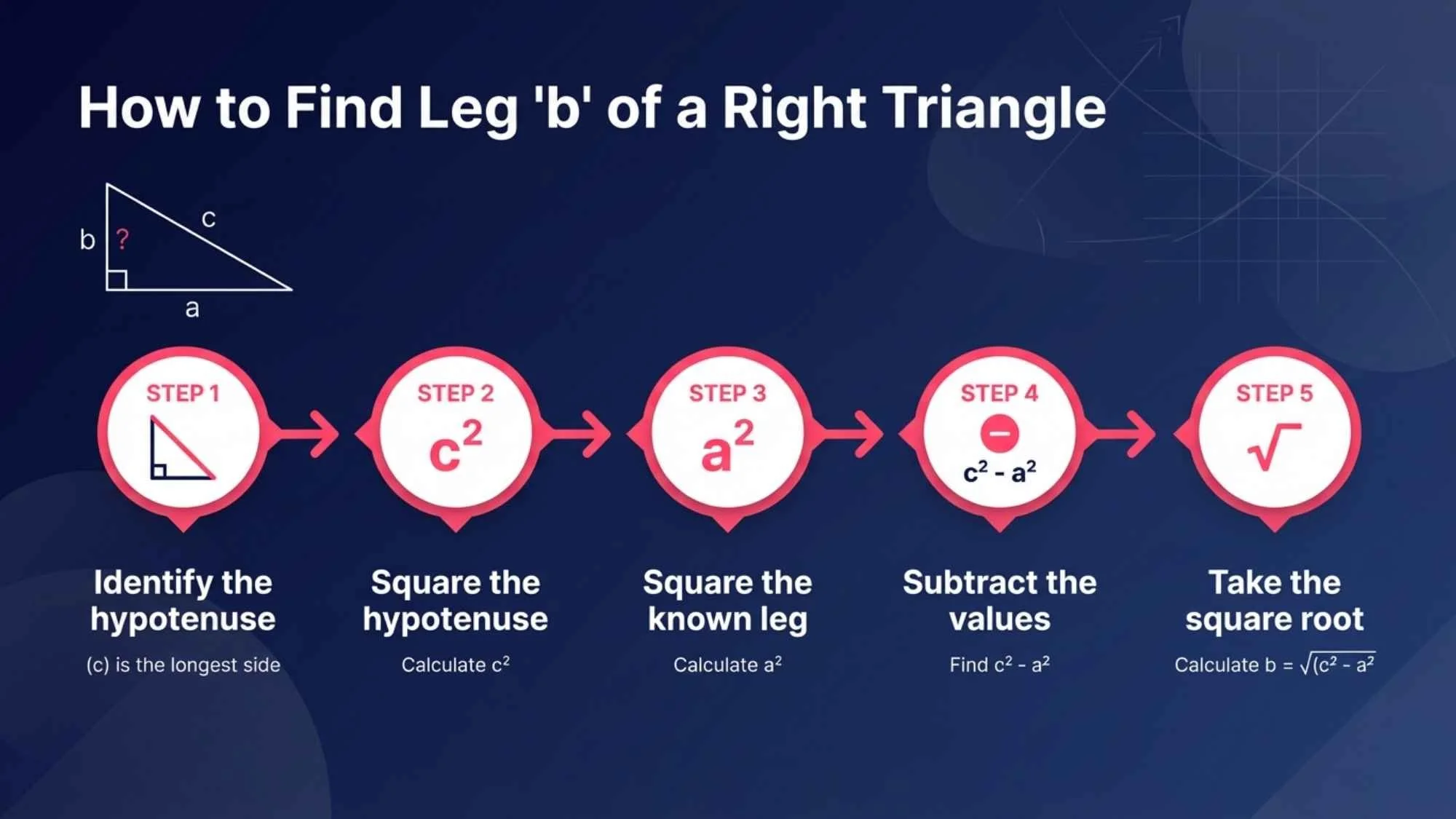
Formula to Solve for b
Many students panic when they see algebra rearrangement. Don’t worry — we’ll go through it slowly, one move at a time.
Start with the standard Pythagorean theorem:
a² + b² = c²
To isolate b, follow these steps:
Step 1: Subtract a² from both sides → b² = c² − a²
Step 2: Take the square root of both sides → b = √(c² − a²)
📌 Teaching Tip: Always subtract before you square root. The square root undoes squaring — but only after you’ve isolated b² on one side.
How to Find b: A Repeatable 6-Step Process
Use these numbered steps every time you need to find a missing leg. Predictability builds confidence.
Identify the hypotenuse (c) — it’s always opposite the right angle and always the longest side
Square the hypotenuse: calculate c²
Square the known leg: calculate a²
Subtract: find c² − a²
Take the square root: b = √(c² − a²)
Check your answer: b should always be shorter than c
Example: Finding b with Real Numbers
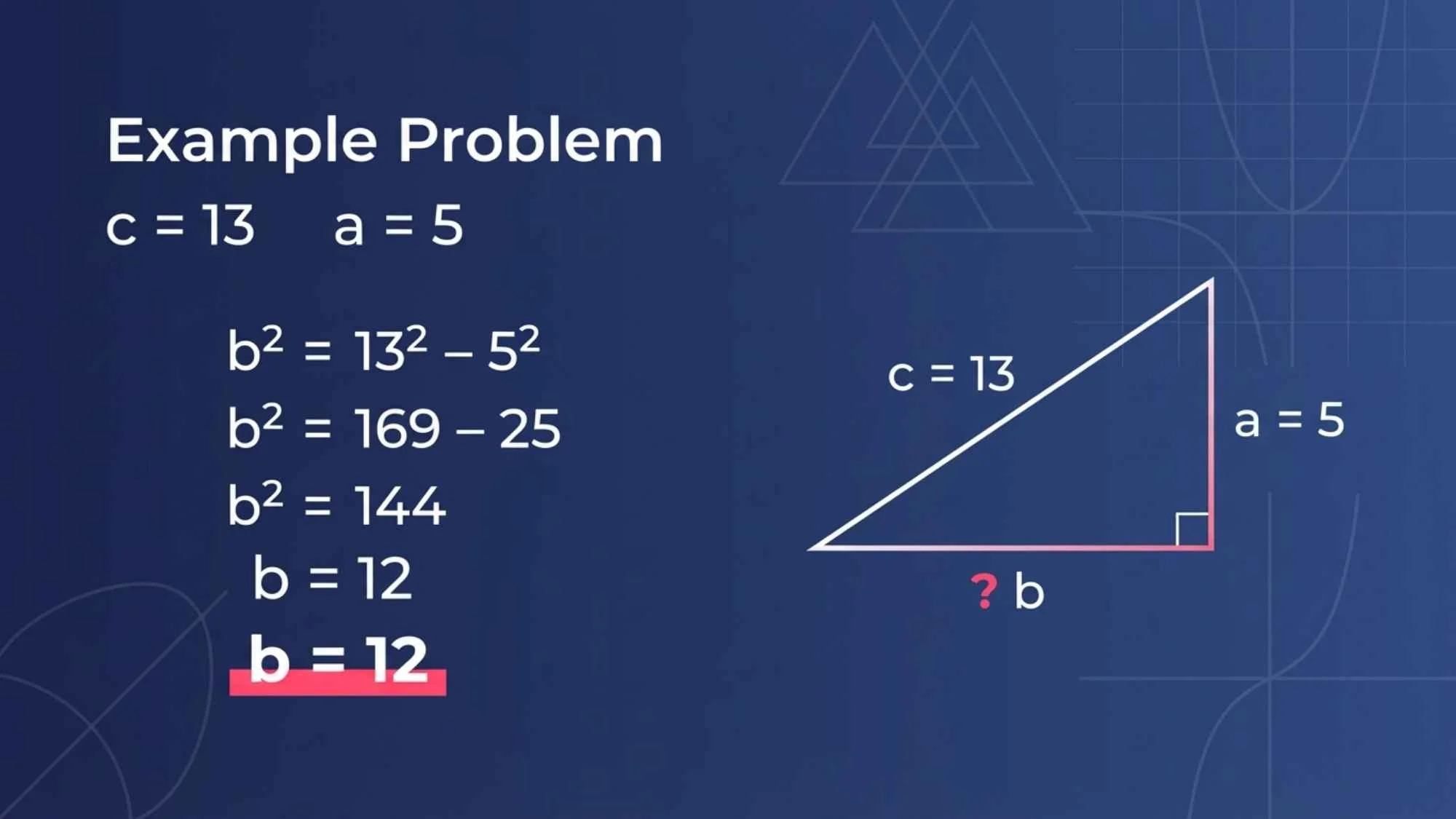
Let’s say you have a right triangle where c = 13 and a = 5. What is b?
Step 1: Write the formula: b = √(c² − a²)
Step 2: Substitute values: b = √(13² − 5²)
Step 3: Square each: b = √(169 − 25)
Step 4: Subtract: b = √144
Step 5: Take the square root: b = 12
Answer: b = 12. The missing leg measures 12 units. Notice that 12 is shorter than 13 — which confirms our answer makes sense.
Want to check your work with an online calculator? Try Mathway’s Pythagorean Theorem Solver to verify your answers as you practice.
When Solving for b — Rules, Mistakes, and Quick Tips
Before applying the formula to find b, it helps to pause and confirm that the situation actually fits the Pythagorean theorem. Understanding when the rule applies — and recognizing a few common pitfalls — can save you from small mistakes that often lead to the wrong answer.
In this section, we’ll quickly review the conditions that must be true before using the formula, along with the most frequent errors students make when solving for a missing leg of a right triangle.
When Can You Use This Formula?
Not every triangle problem calls for the Pythagorean theorem. Before you apply b = √(c² − a²), run through this checklist:
The triangle must be a right triangle (has one 90° angle)
You must know the hypotenuse (c)
You must know one leg (a)
You are solving for the other leg (b)
If the triangle doesn’t have a right angle, you’ll need a different approach — such as the Law of Cosines. The Pythagorean theorem only works for right triangles.
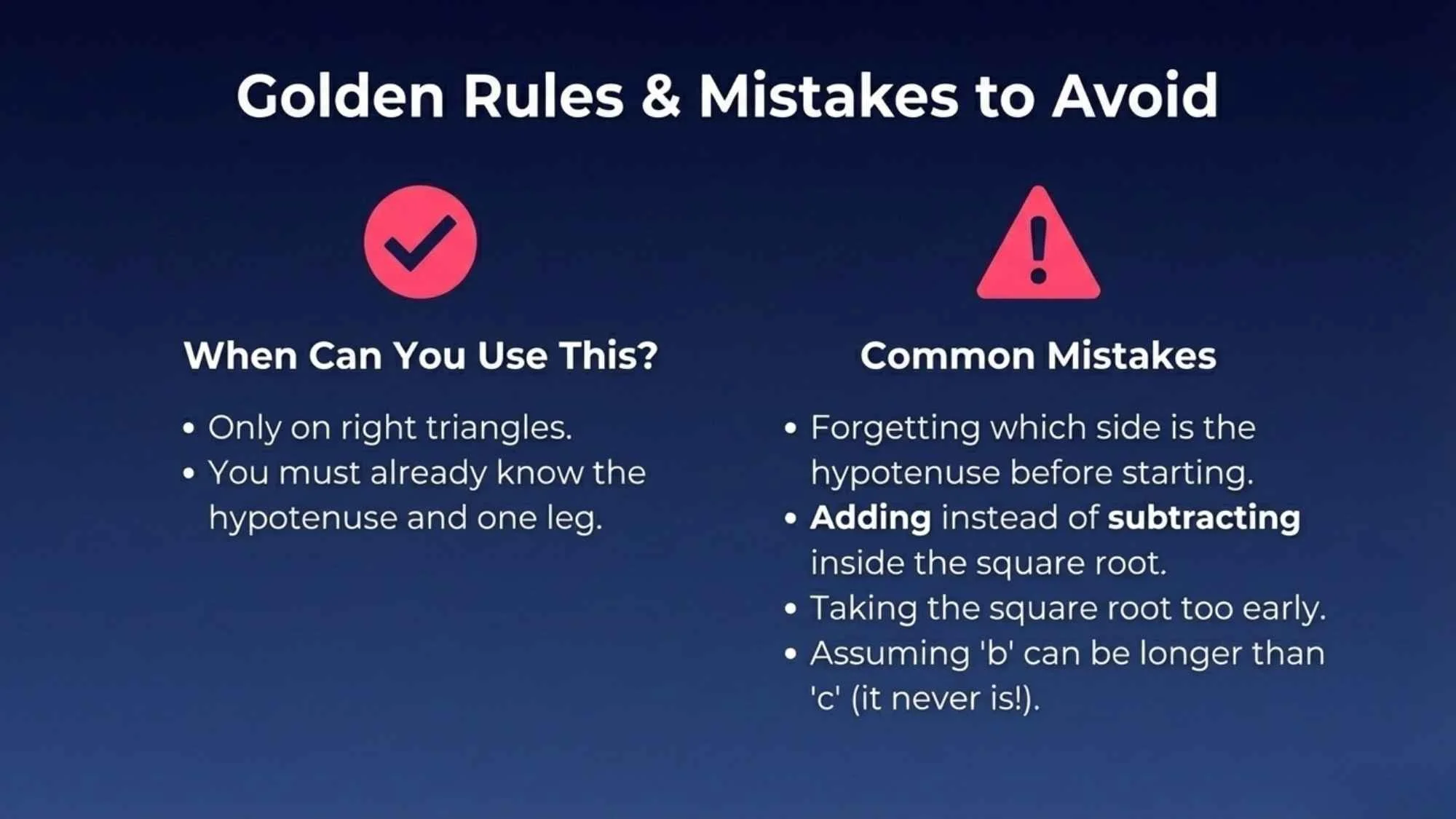
Common Mistakes Students Make
Everyone makes these errors at first — knowing them in advance puts you ahead of the curve.
Mixing up the hypotenuse and a leg: Always confirm c is opposite the right angle before plugging in numbers
Taking the square root too early: You must subtract first to get b², then square root — never in reverse order
Adding instead of subtracting: The rearranged formula uses subtraction (c² − a²), not addition
Calculator mistakes: Square each number separately before subtracting — don’t subtract first
Assuming b can be longer than c: The hypotenuse is always the longest side. If your b comes out bigger than c, recheck your work
Quick Memory Trick for Finding b
Struggling to remember the steps under pressure? Use this simple phrase:
“Square the longest, subtract the shorter, root the result.”
That single sentence captures the entire process: square c, subtract a², then take the square root. Repeat it a few times before your next test and it’ll stick naturally.
For more memory strategies and math study techniques, explore Art of Problem Solving’s student resources — a trusted platform for math learners at every level.
Conclusion
Knowing how to find b in the Pythagorean theorem comes down to one key skill: isolating b from the equation. Start with a² + b² = c², subtract a², and take the square root. That’s it.
The formula feels tricky at first because rearranging equations can be intimidating — but the more you practice, the more automatic it becomes. Try running through the 6-step process with a couple of different number sets and you’ll quickly build the confidence to solve any missing-leg problem.
Math is a skill, and skills improve with repetition. You’ve already taken the right step by learning the method. Now put it to work.
― About HYE Tutors ―
HYE Tutors is a team of experienced educators specializing in K–12 math instruction. Our tutors combine classroom expertise with a deep understanding of how students think — breaking down algebraic concepts like the Pythagorean theorem into clear, confidence-building steps. Whether your student needs help with geometry fundamentals or advanced problem-solving, HYE Tutors meets learners exactly where they are.
