

Top 5 Best MCAT Prep Books 2026
You Googled "best MCAT prep book," and now you're staring at a wall of options — Princeton Review, Kaplan, Blueprint, Examkrackers — each claiming to be the one that will get you into medical school. I've been there. And in over a decade of mentoring pre-med students, I've watched the book-buying decision paralyze more students than it should.
Here's my honest take, as someone who scored 522 on the MCAT and has helped hundreds of students navigate this exact decision: there is no single best MCAT prep book for everyone. But there is a right book for you — and by the end of this guide, you'll know exactly what it is.
I'm not going to walk you through every book on the market. I'm going to give you the only five worth considering in 2026, tell you honestly what each one does well and where it falls short, and give you a simple decision framework so you stop overthinking and start studying.
“The best overall MCAT prep book for full content coverage is The Princeton Review MCAT Complete 7-Book Subject Review.
Kaplan MCAT Complete 7-Book is the strongest alternative for students who prefer a more structured learning approach.
For CARS preparation specifically, Princeton Review MCAT CARS Review stands out on its own.
Blueprint MCAT is ideal for digital and adaptive learners, while Examkrackers excels for fast, high-yield review.
Ultimately, the best choice depends on your target score, weakest sections, and study timeline.”
The 5 Best MCAT Prep Books in 2026 — Ranked and Reviewed
In 10 years of mentoring pre-med students, I've seen every book on this list used successfully — and unsuccessfully. The difference was never the book. It was whether the student chose the right one for their situation. Here's how to get that decision right.
We've also worked with students at HYE Tutors who came to us mid-prep, already 6 weeks in with the wrong book, burning time they didn't have. The guide below is designed so that doesn't happen to you.
| # | Book | Best For | Sections | Verdict |
|---|---|---|---|---|
| 1 | Princeton Review Complete 7-Book | Overall / 515+ scorers | All | Best overall |
| 2 | Kaplan MCAT Complete 7-Book | Structured learners | All | Best alternative |
| 3 | Princeton Review MCAT CARS | CARS strugglers | CARS only | Best for CARS |
| 4 | Blueprint MCAT Complete Prep | Digital/visual learners | All | Best for tech-first |
| 5 | Examkrackers Complete Package | Fast review / retakers | All | Best for efficiency |
A note before we dive in: all five of these books are designed to supplement — not replace — the AAMC's official prep materials. Official AAMC full-length practice exams are non-negotiable regardless of which book you choose.
#1 — Princeton Review MCAT Complete 7-Book Subject Review
Verdict: Best overall choice for first-time studiers targeting 515+
This is the series I used when I scored 522, and it remains my first recommendation for students who have the time to use it properly — meaning 4 months or more. The 7-book set covers all four MCAT sections (Chemical & Physical Foundations, Critical Analysis and Reasoning Skills (CARS), Biological & Biochemical Foundations, and Psychological/Social/Biological Foundations of Behavior) with a level of content depth that genuinely rivals a second pass through your undergraduate coursework.
Biggest strength: The biochemistry and biology volumes are exceptional — dense, accurate, and written at the right level for the exam. The biochemistry volume alone covered content I hadn't reviewed since sophomore year.
Honest weakness: Volume. This set is not designed to be read cover to cover. Students who try to treat it as a linear textbook get overwhelmed by week three. Use it as a reference and content-builder — read the sections that map to your weak areas, not everything in order.
⭐⭐⭐⭐⭐ Content Depth | ⭐⭐⭐⭐ Practice Questions | ⭐⭐⭐⭐ CARS Coverage
#2 — Kaplan MCAT Complete 7-Book Subject Review
Verdict: Best for students who need structure, checkpoints, and chapter-by-chapter progression
The student who thrives with Kaplan is someone who said to me: "I need a plan, not just a pile of books." If you like working through structured chapters, checking content off a list, and knowing exactly where you are in your prep at any given moment — Kaplan's format is built for you.
Biggest strength: Consistent, reliable science content paired with a clean, sequential format. Built-in chapter review questions help you test comprehension as you go, rather than saving all practice for the end. The online Qbank access is a meaningful bonus.
Honest weakness: The CARS strategies are noticeably weaker than Kaplan's science coverage. Students who rely solely on Kaplan for CARS typically plateau. Pair it with the Princeton Review CARS volume if your reading score needs work.
When to choose Kaplan over Princeton Review: when you prefer structured chapters over dense reference-style text, and when having clear daily milestones keeps you accountable.
⭐⭐⭐⭐⭐ Structure | ⭐⭐⭐⭐ Science | ⭐⭐⭐ CARS
#3 — Princeton Review MCAT CARS Review
Verdict: Non-negotiable for any student scoring below 127 in CARS
The Critical Analysis and Reasoning Skills (CARS) section is the part of the MCAT that most prep books handle badly — because most prep books treat it like a science section. It isn't. You cannot memorize your way to a high CARS score. CARS tests reasoning, argument analysis, and reading under pressure. It is a skill, and skills are built through practice — not content review.
The Princeton Review MCAT CARS Review gets this right. It provides passage strategy frameworks, reasoning methodology, and timed practice passages drawn from humanities, ethics, philosophy, and social sciences — exactly the content the AAMC uses. It's the only dedicated CARS resource I consistently recommend.
Biggest strength: The strategy frameworks are genuinely transferable. Students who apply the passage breakdown method from this book show measurable improvement within 3–4 weeks of consistent practice.
Honest weakness: Not a substitute for daily reading practice. The book gives you the framework; you build the skill by reading dense academic articles every single day.
⭐⭐⭐⭐⭐ CARS Strategy | ⭐⭐⭐⭐⭐ Passage Practice | N/A Science Sections
#4 — Blueprint MCAT Complete Prep
Verdict: Best for digital-first and visual learners; ideal for retakers needing a fresh approach
Blueprint is the most modern option on this list, and it earns its place not on brand recognition but on one specific strength: the quality of its full-length practice exams. I've reviewed score reports from students who have used every major prep platform, and Blueprint's practice tests consistently produce the most realistic estimate of actual MCAT performance among third-party options.
The physical content books are solid — not as deep as Princeton Review, but paired with the adaptive online platform, Blueprint delivers a genuinely personalized prep experience. The platform tracks your weak areas, adjusts question difficulty, and gives you granular performance data. For students who learn better through a screen than a textbook, this is the strongest option available.
Honest weakness: The physical books feel less comprehensive as standalone resources. If you're going Blueprint, commit to the full digital platform — the books alone aren't worth the investment.
⭐⭐⭐⭐⭐ Practice Tests | ⭐⭐⭐⭐ Content | ⭐⭐⭐⭐⭐ Digital Platform
#5 — Examkrackers Complete MCAT Study Package
Verdict: Best for retakers, time-limited students, or those with strong science foundations needing a lean final review
Examkrackers is the honest underdog on this list. It has a devoted following among high scorers — and it is actively misused by beginners. Let me be direct: I do not recommend Examkrackers as a starting point. If you have significant content gaps, this book will leave you exposed.
What Examkrackers does brilliantly is exactly what its name promises: it cracks the high-yield content and strips out everything else. For a student who already has a strong science foundation and needs to consolidate knowledge in the final 6–8 weeks before test day, there is no more efficient resource.
Biggest strength: No filler, no padding. Every page earns its place. Students in the final stretch of prep — especially retakers who know the content but need a focused refresh — find this invaluable.
Honest weakness: Not deep enough for first-time studiers with notable content gaps. If you haven't completed your prerequisite science coursework or it's been more than two years, start with Princeton Review or Kaplan instead.
⭐⭐⭐⭐⭐ Efficiency | ⭐⭐⭐ Depth | ⭐⭐⭐⭐ High-Yield Focus
Choosing the right prep book is one step in a much larger journey. If you're still mapping out your full pre-med path, our How to Get into Medical School Step by Step Guidebook lays out the entire roadmap — from GPA strategy to MCAT timelines and beyond.
Which MCAT Prep Book Is Right for You? (Quick Decision Guide)
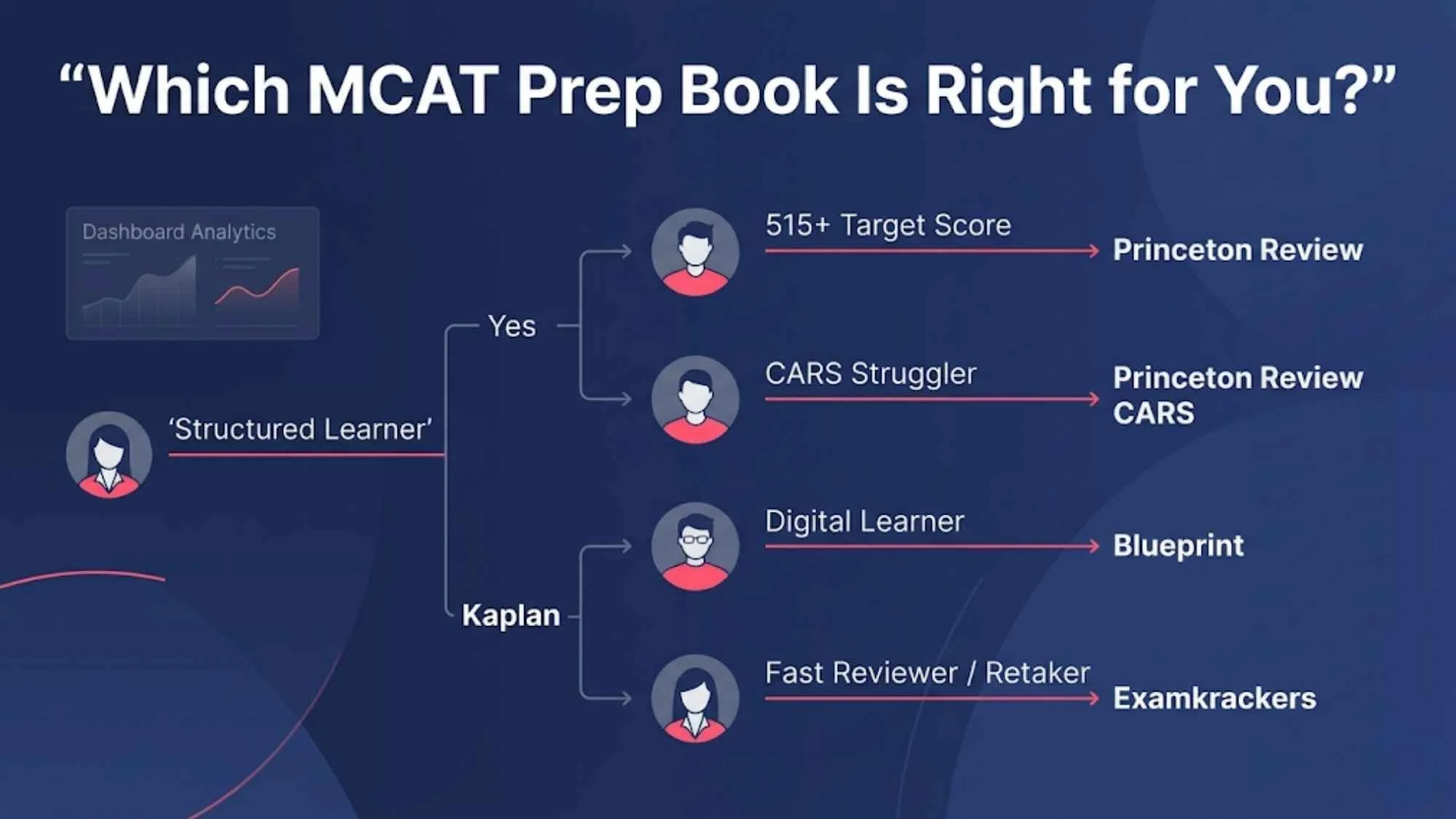
The biggest mistake I see every application cycle: students buying the most popular book instead of the right book. I've worked with students at HYE Tutors who spent 6 weeks on the wrong resource, then had to restart — losing time they couldn't recover. Spend 5 minutes with the framework below. It will save you weeks.
| Your Situation | Recommended Pick |
|---|---|
|
Target score: 500–509 |
Kaplan Complete 7-Book — structure + solid content base |
|
Target score: 510–517 |
Princeton Review Complete 7-Book Series |
| Target score: 518+ | Blueprint (practice exams) + Examkrackers (final pass) + all AAMC Official materials |
| CARS score below 127 | Princeton Review MCAT CARS first — before anything else |
| Science content gaps | Princeton Review or Kaplan science volumes |
| 5+ months to test day | Full 7-book series: Princeton Review or Kaplan |
| 3–4 months to test day | Blueprint or Kaplan + standalone CARS book |
| Under 10 weeks | Examkrackers + AAMC Official materials only |
|
Retaker needing fresh approach |
Blueprint for new practice tests + Examkrackers for high-yield review |
One principle that overrides every row in that table: whatever book you choose, all AAMC official materials are non-negotiable. The AAMC Section Bank, Question Packs, and Full-Length Practice Exams are the most accurate predictors of your actual test-day score. Every student, every timeline, every target score: use them
FAQs
What is the best MCAT prep book for beginners?
For most beginners, Princeton Review Complete 7-Book or Kaplan Complete 7-Book are the strongest starting points. Princeton Review offers deeper content; Kaplan provides more structured, chapter-by-chapter guidance. Either works well when paired with AAMC official materials — the key is choosing one and working through it systematically, not buying both.
Do I need more than one MCAT prep book?
For most students: one strong content series plus AAMC official materials is enough. The most common mistake is buying three or four books and finishing none of them. The exception: if CARS is a significant weak point, add the Princeton Review MCAT CARS volume as a dedicated supplement regardless of which primary series you choose.
Is Princeton Review or Kaplan better for the MCAT?
Neither is objectively superior — it depends on how you learn. Princeton Review is better for students who want the deepest possible content coverage and are comfortable navigating a dense, reference-style resource. Kaplan is better for students who want structured daily chapters, clear milestones, and built-in checkpoints. Both produce high scorers. Pick the format that matches how you actually study.
Can I self-study for the MCAT using only prep books?
Yes — many students successfully self-study using a prep book series combined with AAMC official materials. That said, the students at HYE Tutors who improve the most are those who get personalized guidance: a mentor who can diagnose weak areas from practice exam data and adjust the plan accordingly accelerates progress significantly, especially through plateaus. Book a free consultation if self-study alone hasn't moved your score.
Are older MCAT prep book editions still useful?
Use 2023 editions or newer only. The MCAT was substantially redesigned in 2015, adding the Psych/Soc section and restructuring the science content. Any book published before the 2015 overhaul reflects a different exam entirely. Even post-2015 editions from 2020 or earlier may have outdated content in biochemistry and psychology. When in doubt, check the AAMC's current content specifications against any book you're considering.
Once your MCAT is behind you, your personal statement becomes your next mountain. Our guide on How to Write a Personal Statement for Medical School is the first thing I send every student the week after their exam.
Conclusion
The best MCAT prep book is the one that matches your starting score, your weakest section, and the time you have between now and test day. Not the most popular one. Not the most expensive one. The right one for your specific situation.
Here's the insight I come back to with every student I coach: the students I've seen break 515 weren't the ones with the most books on their desk. They were the ones who chose the right book, worked through it with a real plan, and paired it with AAMC official materials from start to finish. Consistency with the right resource will always outperform chaos with five wrong ones.
If you want a personalized MCAT study plan built around your test date and starting score, our mentors at HYE Tutors are ready. Book your free consultation today — no commitment required, just a clear, honest conversation about the best MCAT prep book and strategy for where you are right now.
About the Author
This article was written by an HYE Tutors MCAT specialist with degrees from Columbia University and UCLA and over 10 years of pre-med mentoring experience. A 522 MCAT scorer, they specialize in diagnostic-driven prep strategy and have guided students into Johns Hopkins, UCLA David Geffen School of Medicine, and UCSF, among other top programs. Their focus: helping students stop studying harder and start studying smarter.