

How to Study for MCAT
There's a moment every pre-med student hits — usually sophomore year, sometimes later — when the MCAT stops feeling like a distant problem and starts feeling like an immediate one. You sit down, look at what the exam actually covers, and think: I have no idea where to begin. That feeling is completely normal. And it is exactly where good MCAT preparation starts.
I know that moment well. I scored 522 on the MCAT — but not on my first attempt at serious preparation. What I learned the hard way, and what I've spent 15 years teaching students at HYE Tutors, is that knowing how to study for MCAT matters more than how many hours you log. The students who walk out of that testing center with a 515 or higher aren't always the ones who studied the most. They're the ones who studied right.
In this guide, I'm going to give you the complete system — the same one I've used to help 200+ pre-med students reach their target scores, from diagnostic to test day. Phase by phase, section by section, resource by resource. If you follow this, you won't just study for the MCAT. You'll be ready for it.
How do you study for the MCAT?
To study for the MCAT effectively:
Start 3–6 months before your test date.
Diagnose your baseline with a full-length AAMC practice test before any content review.
Build a weekly study schedule covering all four sections: C/P, CARS, B/B, and P/S.
Study content first, then shift to practice tests and thorough review.
Complete all official AAMC materials before test day. Most successful students study 300–500 total hours, depending on their starting score and target.
How to Study for the MCAT — The Complete Strategy
The first thing I tell every student who sits down with me is this: the MCAT is not a knowledge test. It is an application test. Most students struggle not because they don’t know enough biology — they struggle because they never learned how to think the way the MCAT demands. Once you understand that, everything about how to study changes.
Understand What the MCAT Actually Tests
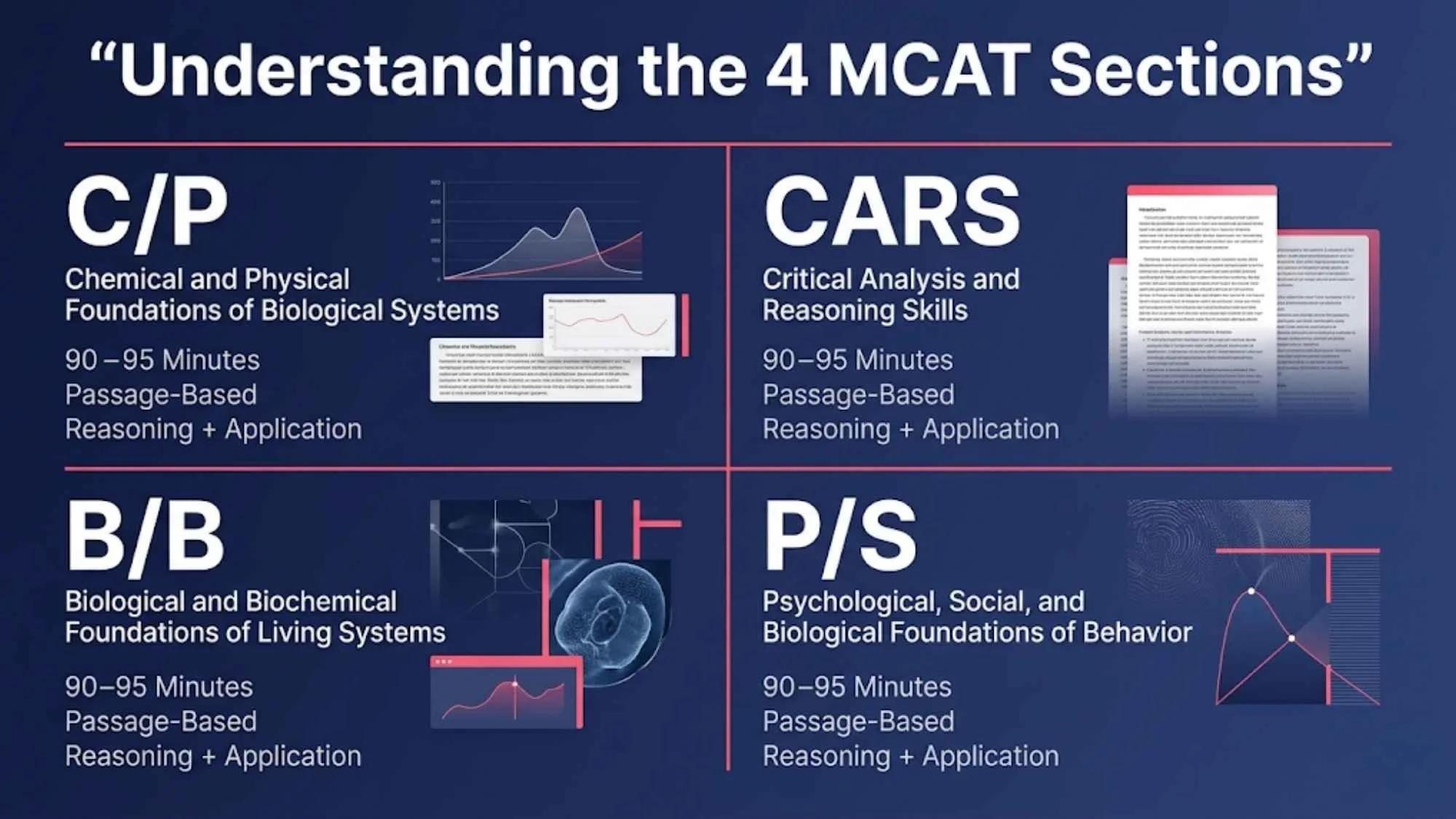
The MCAT has four sections. Understanding what each one actually demands of you is step zero.
C/P — Chemical and Physical Foundations of Biological Systems: 59 questions, 95 minutes. Tests general chemistry, organic chemistry, physics, and biochemistry through passage-based experimental setups. It rewards data interpretation, not memorization.
CARS — Critical Analysis and Reasoning Skills: 53 questions, 90 minutes. Passages from humanities, ethics, philosophy, and social sciences. No science knowledge required. Purely reasoning, inference, and argument analysis.
B/B — Biological and Biochemical Foundations of Living Systems: 59 questions, 95 minutes. The heaviest content section. Molecular biology, genetics, biochemistry, cell biology, and physiology.
P/S — Psychological, Social, and Biological Foundations of Behavior: 59 questions, 95 minutes. Psychology theories, sociology concepts, and biological bases of behavior. Requires memorization of specific theorists and frameworks.
Set Your Target Score Before You Open a Single Book
Before I build a study plan with any student, I ask one question: what’s the median MCAT at your top three schools? If they don’t know, we look it up together immediately. Everything — timeline, resource selection, intensity, which sections to prioritize — flows from that number.
The AAMC’s official MCAT score percentile tables give you the percentile breakdown for every scaled score. Your goal isn’t to “get a good score” in the abstract — it’s to hit or exceed the median score of students accepted to your specific target schools. That number is available in the AAMC’s MSAR database. Use it.
Take a Diagnostic Test First — Before Any Studying
One of the things I did — and still recommend to every student I mentor — is take a real AAMC full-length practice test before touching a single prep book. Cold. No preparation. That score told me exactly where to spend my next four months. Without it, I would have studied my strong areas and ignored my real weaknesses for weeks.
The most common mistake I see at HYE Tutors: students who skip the diagnostic and study “everything equally,” wasting 6–8 weeks reinforcing sections they were already decent at while their actual score-limiting sections went untouched. Take the diagnostic. Interpret it by section. Build your plan around what it reveals.
Build Your MCAT Study Schedule Around Three Phases
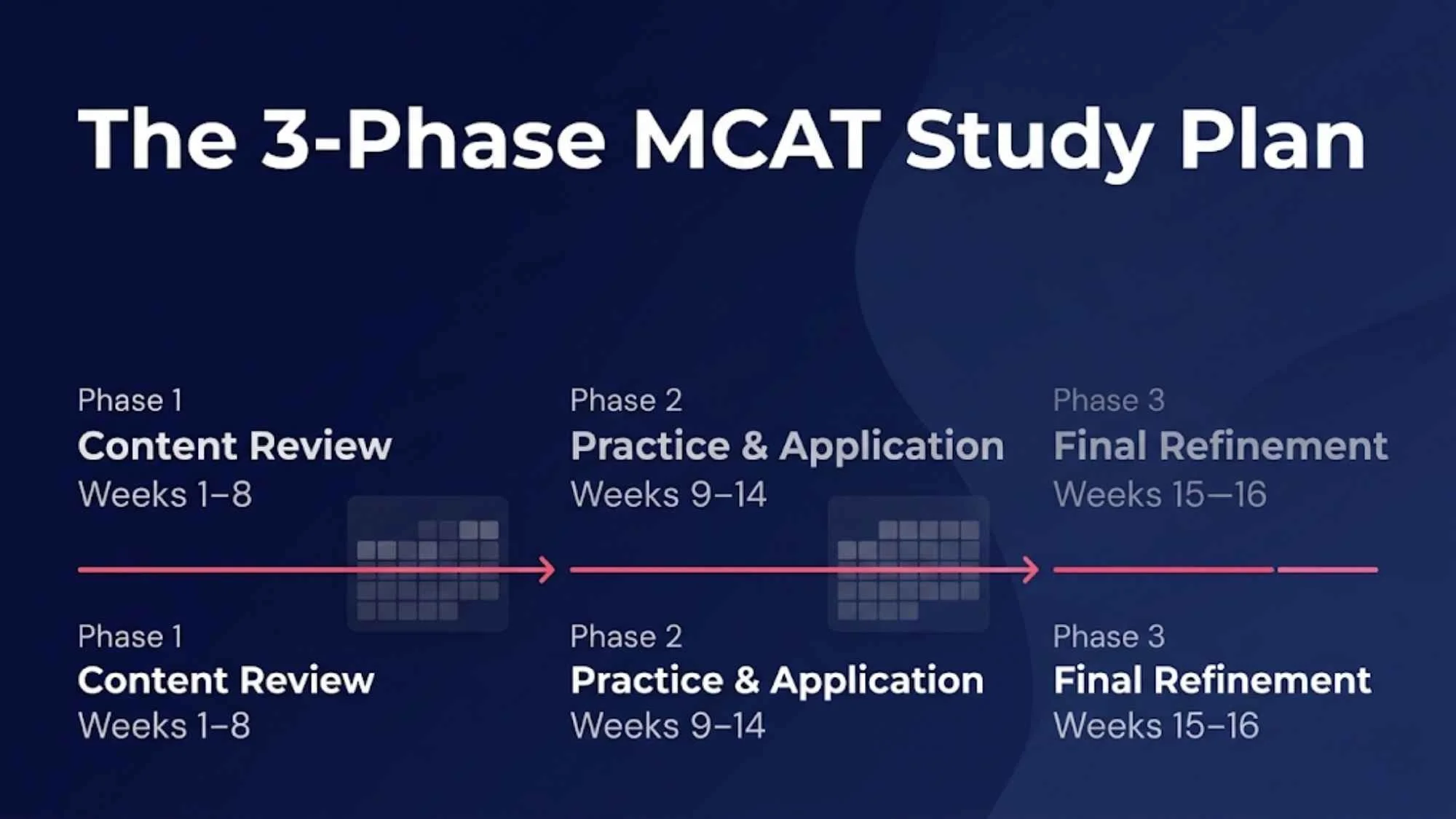
This three-phase framework is the backbone of every study plan I build for students. It’s not arbitrary — it mirrors how skill acquisition actually works: foundation first, application second, refinement third. CARS practice runs through all three phases without exception.
| Phase | Timeframe | Focus |
|---|---|---|
| Phase 1: Content Review | Weeks 1–8 | Build science foundations across all sections + daily CARS practice from day one |
| Phase 2: Practice & Application | Weeks 9–14 | Full-length practice tests every weekend + section-level targeted review mid-week |
| Phase 3: Final Refinement | Weeks 15–16 | AAMC-only materials, weak area polish, test-day simulation and mental reset |
A warning I give every student: the students who score 504 when they should be scoring 512 are almost always the ones who spent 14 weeks in Phase 1 and left two weeks for full-length tests. I’ve seen this pattern repeat across hundreds of students. The test is a skill. You have to practice the full exam under real conditions, repeatedly, before test day.
Most successful students need 300–500 total study hours, depending on the gap between their diagnostic score and their target. The larger the gap, the more hours required — and the more critical it is to invest those hours in Phase 2 and Phase 3, not just Phase 1.
How to Study Each MCAT Section
C/P (Chemical & Physical Foundations):
Focus on interpreting graphs, experimental setups, and data tables — most C/P questions are passage-based, not isolated formula recall
Physics and general chemistry concepts must be understood mechanically, not just memorized — the MCAT will apply them in new experimental contexts
Use any major prep book’s C/P volume for content, then move to AAMC official question packs for realistic practice
CARS (Critical Analysis and Reasoning Skills):
Do 1–2 timed CARS passages every single day from day one — no exceptions, no postponing “until I’m ready”
After each passage, review every wrong answer for reasoning errors, not factual gaps — CARS mistakes are almost always logical, not factual
“I tell every student: CARS is the one section where reading outside of MCAT prep actually raises your score. I spent 20 minutes every morning reading The Atlantic during my own prep. Dense writing builds the exact cognitive stamina CARS rewards.”
B/B (Biological & Biochemical Foundations):
The heaviest content load on the exam — prioritize biochemistry, cell biology, and molecular genetics above all else
Build Anki flashcard decks for amino acids, enzyme pathways, and cell signaling — spaced repetition dramatically outperforms re-reading for this material
Enzyme inhibition, DNA replication, and metabolic pathways appear with near-certainty every test cycle — know them cold
P/S (Psychological, Social & Biological Foundations):
Most students underestimate this section; it has the highest score-raising potential per study hour of any section on the exam
Focus on psychology theory, sociology frameworks, research methods, and the specific theorists the AAMC formally lists: Piaget, Freud, Erikson, Vygotsky, Bandura, and others
Build P/S into every study week from week one — not as an afterthought in the final month
Before you dive into section-by-section prep, it helps to understand everything the MCAT involves — format, scoring, registration, and score reporting. Our guide MCAT Exam: Everything You Need to Know covers all of that in one place. Read it alongside this article to get the full picture.
How Long Should You Study for the MCAT?
This is the question I get in the first five minutes of almost every new student consultation. The honest answer is: it depends on your score gap — the difference between your diagnostic score and your target score. But “it depends” without benchmarks is useless, so here are the real numbers.
The 3–6 Month Rule — and When It Doesn’t Apply
The standard 3–6 month range holds for most students — but where you fall within that range is driven by one factor above all others: how large your score gap is.
Score gap under 5 points: 8–12 weeks of focused, intensive prep may be sufficient
Score gap of 5–10 points: 4–5 months is the realistic minimum
Score gap over 10 points: plan for the full 6 months — and consider whether the test date you’ve chosen is realistic
The biggest timing mistake I see repeatedly: students who push their test date back “to be more ready” — and then push it back again. At some point, you have to commit and trust your preparation. Endless delay is its own kind of failure.
Weekly Study Hours — A Realistic Breakdown
Quality matters more than quantity. Three focused hours of active recall and timed practice beat six hours of passive re-reading. That said, here are the realistic weekly benchmarks:
| Student Type | Hours/Week | Recommended Timeline |
|---|---|---|
| Full-time student, limited work | 20–25 hrs | 4–5 months |
| Working part-time | 15–20 hrs | 5–6 months |
| Post-bacc / gap year full focus | 30–40 hrs | 3–4 months |
| Retaker with strong foundation | 10–15 hrs | 6–8 weeks intensive |
During my own MCAT prep, I followed one rule that changed my efficiency completely: no passive studying. No re-reading notes. No highlighting the same paragraph twice. Every hour had to involve active recall — answering questions, explaining concepts out loud, or working through passages under a timer. That rule alone was worth 10 points.
Not sure how many hours your specific situation requires? Book a free session with an HYE Tutors MCAT mentor — we’ll map out your exact timeline in 30 minutes.
Best MCAT Study Resources — What to Actually Use
In 15 years of mentoring, I’ve watched students spend over $1,500 on every prep book and Qbank available — and score lower than students who used three resources consistently. More materials is not better preparation. The right materials, used correctly, is.
AAMC Official Materials — Your Non-Negotiables
The AAMC produces the MCAT. Their official materials — full-length practice tests, section banks, question packs, and the official guide — are the only resources made by the test-maker. They are not optional for any student aiming above a 508.
Every year, two or three question types appear on the real MCAT that are nearly identical to questions in the AAMC Section Banks. That’s not a coincidence. The AAMC is showing you what they value. Don’t ignore that signal. All six AAMC full-length practice tests must be completed under timed, exam-day conditions — same start time, no interruptions, full break schedule.
Third-Party Prep Books and Qbanks — What to Supplement With
Third-party resources serve one purpose: content review and additional practice volume. They are supplements to AAMC materials, never replacements.
For content review: a full 7-book series (Princeton Review or Kaplan) for systematic first-pass coverage
For CARS specifically: a dedicated CARS strategy book used alongside daily passage practice
For biochemistry and P/S memorization: Anki decks (the Anking MedCard deck or MCAT-specific variants) reviewed daily for 15 minutes using spaced repetition
Warning: using more than one primary Qbank dilutes review time. Choose one, work it deeply, and prioritize AAMC materials in the final 6 weeks
For a complete, ranked breakdown of which prep book matches your target score, learning style, and timeline, see our guide: Top 5 Best MCAT Prep Books 2026.
Free MCAT Resources Worth Your Time
Khan Academy MCAT — AAMC-partnered, genuinely excellent for C/P and P/S foundations. I used it myself for electrochemistry review during my own prep. Don’t overlook it because it’s free.
The AAMC free sample test and Score Preview — use these early as part of your diagnostic process
Reddit’s r/MCAT community — useful for peer experience and morale; less reliable for specific content advice. Read it critically.
Your MCAT score is one part of your medical school application — but your pre-med major and GPA strategy matter too. If you’re still mapping your undergraduate path, our guide on What is the Best Pre-Med Major? Biology vs. Alternatives is worth reading before you commit to a course sequence.
Common MCAT Study Mistakes — and How to Avoid Them
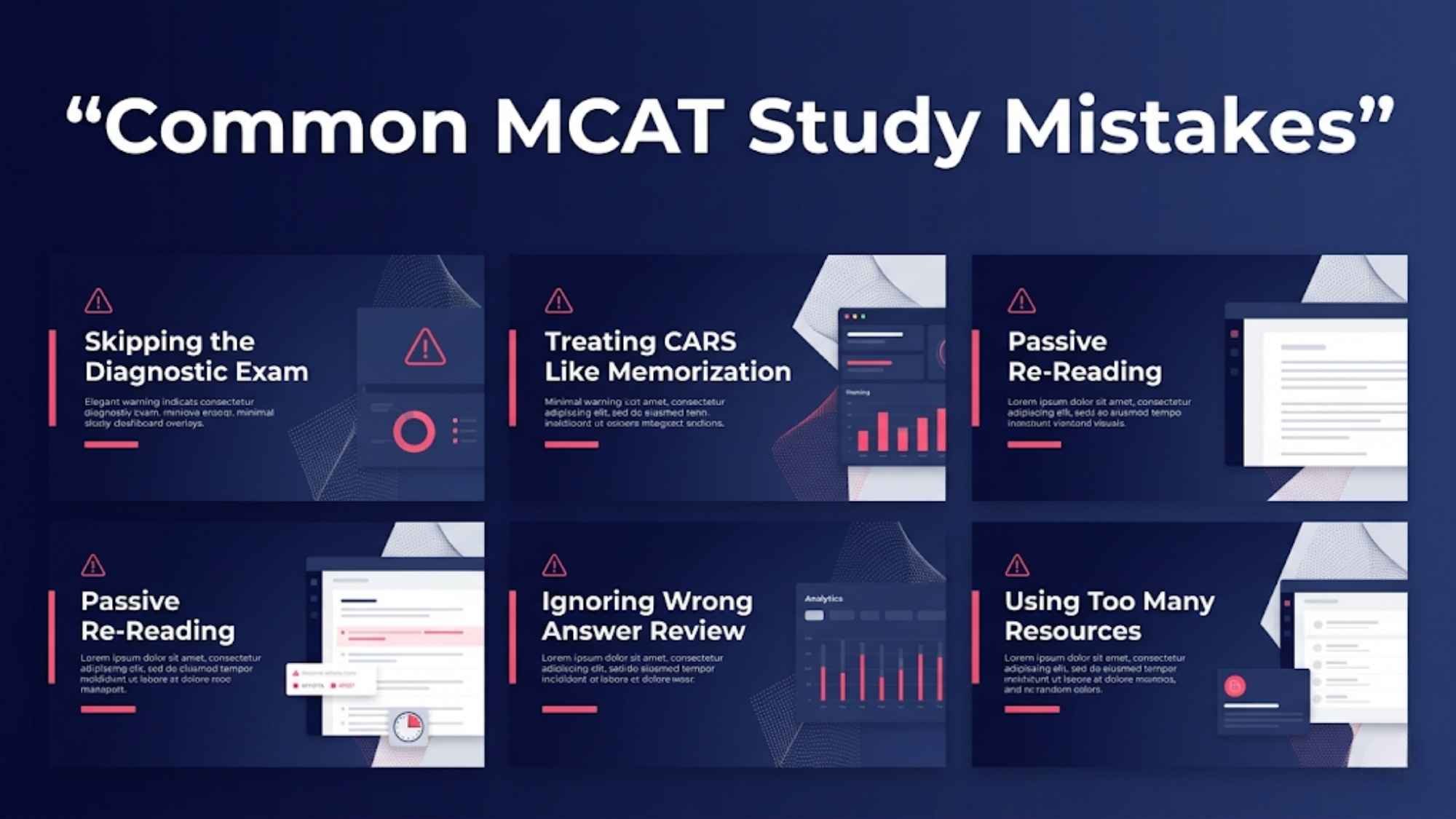
After 15 years and 200+ students, I can usually predict who will struggle on the MCAT before they even sit down for it — not because of their GPA or major, but because of how they’re studying. Here are the patterns I see every single year.
Mistake #1: Starting content review before taking a diagnostic.
Fix: Take an AAMC full-length test first — always. Your diagnostic is your map. Without it, you’re studying blind.
Mistake #2: Treating CARS like a content section.
Fix: Practice 1–2 timed passages daily from week one. Never "save CARS for later" — there is no later that will rescue a skill you never built.
Mistake #3: Over-highlighting and re-reading instead of active recall.
Fix: Close the book. Explain the concept out loud. Then check. Every single study session. Passive reading creates the illusion of learning without the substance of it.
Mistake #4: Doing practice questions without reviewing wrong answers deeply.
Fix: Spend 2x as long reviewing wrong answers as answering questions. The explanation for every wrong answer — not just why the right answer is right, but why each incorrect option is wrong — is where the learning lives.
Mistake #5: Using too many resources without mastering any.
Fix: Choose one primary prep book, one Qbank, and all AAMC materials. Master those. Add supplemental resources only if a specific weak area demands it.
Mistake #6: Not simulating real exam conditions for full-length tests.
Fix: Every full-length test must be taken in one uninterrupted sitting, at the same time of day as your real test, with proper breaks and no phone access. Your brain needs to be physiologically trained for this format.
Mistake #7: Ignoring P/S until the final weeks.
Fix: P/S is the highest return on investment per study hour of any section on the exam. Build it into every week from day one. Students who start P/S in week 12 consistently leave 5–8 points on the table.
MCAT Study Tips From a 522 Scorer — What Actually Works
These are the habits and strategies that separated my own preparation — and the preparation of the highest-performing students I’ve mentored — from everyone else. They don’t appear in prep books. You earn them.
Tip 1: Study in 50-minute blocks with 10-minute breaks.
Your brain consolidates information during rest, not during continued input. Multiple focused 50-minute sessions outperform a single 4-hour marathon every time. This is how I structured every study day during my own prep, and it’s the first scheduling change I make with any new student.
Tip 2: Do CARS passages at the same time every day.
Consistency in timing builds the reading stamina that CARS requires. Most students do best with CARS in the morning, before other sections, while mental sharpness is highest. Pick a time and protect it.
Tip 3: Build a ‘weak concept list’ and revisit it every week.
Not an error log — a running document of every concept you cannot explain from memory without notes. Review it every Sunday. If a concept appears twice in a week, it becomes a priority. This list is more valuable than any prep book by month three.
Tip 4: Use the ‘teach it’ method after every content chapter.
After every content section, close the book and explain the concept as if you’re teaching a 10-year-old. If you stumble, you don’t know it yet — regardless of how many times you’ve read it. This technique, supported by research on retrieval-based learning, is among the most effective study strategies available for high-stakes exams.
Tip 5: Use spaced repetition for P/S and biochemistry terms.
Anki decks reviewed daily for 15 minutes retain far more than one 3-hour weekly cram session. This is not a preference — it’s how memory consolidation works. Set a daily Anki review habit in week one and maintain it through test day.
Tip 6: Simulate test day at least 4 times before the real thing.
Full exam, same start time, correct break schedule, same snacks. By the fourth simulation, the format should feel completely routine. Familiarity with the exam’s physical demands — the length, the mental fatigue, the transition between sections — reduces test-day anxiety by a meaningful margin.
MCAT Study Plan — Sample Week-by-Week Overview
These are not generic templates. They are the actual weekly structures I use when building study plans for HYE Tutors students in Phase 1 and Phase 2. Adapt them to your diagnostic results and section weaknesses — but don’t change the core principle: every week includes CARS practice, every full-length test is followed by a deep review.
Sample Phase 1 Week (Content Review)
| Day | Morning (2 hrs) | Afternoon (2 hrs) | Evening (1 hr) |
|---|---|---|---|
| Mon | C/P Chapter Review | Active recall + Anki | CARS 1 passage (timed) |
| Tue | B/B Chapter Review | Practice questions | Anki review |
| Wed | P/S content | P/S practice questions | CARS 1 passage (timed) |
| Thu | C/P weak concepts | Content Q's + review | Anki review |
| Fri | B/B biochemistry | Passage-based questions | CARS 1 passage (timed) |
| Sat | Longer CARS block (5–6 passages, timed) | Weak concept review | Rest |
| Sun | Light review / plan next week | — | — |
Sample Phase 2 Week (Practice & Application)
| Day | Activity |
|---|---|
| Sat or Sun | Full-length AAMC practice test — all 4 sections, full conditions, same start time as real exam |
| Mon | Full test review — every question, every wrong answer, reason documented in error log |
| Tue | Continue test review; flag recurring weak content areas |
| Wed | Targeted content review of weak areas revealed by the test |
| Thu | Targeted content review continued + Anki deck review |
| Fri | 1 section-level practice set + 3–4 timed CARS passages |
Once you’ve mapped out your MCAT timeline, your next major decision is which medical schools to target — and how to build an application that gets you there. Our How to Get into Medical School Step by Step Guidebook covers the full roadmap, including exactly how MCAT score fits into your overall application strategy.
When to Start Studying for the MCAT — A Decision Guide
The most common timing mistake I see: students who choose a test date based on what feels comfortable rather than what their application calendar actually requires. Your MCAT score must be valid — within three years — when you submit your application. The medical school application cycle opens June 1 each year through AMCAS. Plan backward from that date, not forward from "when I feel ready."
| Your Situation | Recommended Start Time |
|---|---|
| Strong science GPA, 2+ years prereqs complete | January of junior year, test in April/May |
| Average science GPA, needs content foundation | Summer before junior year, test in January |
| Post-bacc or gap year student | 4–6 months before application deadline |
| Retaker — gap under 5 points | 8–12 weeks intensive prep |
| Retaker — gap 5+ points | 4–6 months full structured prep |
The January vs. April vs. June test date tradeoff matters more than most students realize. A January score gives you time for a retake if needed before the application cycle opens. An April or May score is ideal for same-cycle application. A June or later score works but narrows your margin for error significantly.
Unsure when your ideal MCAT date is given your current coursework and application goals? Book a free 30-minute planning session with an HYE Tutors mentor — we’ll help you choose the right date and build backward from it.
FAQs
How many hours a day should I study for the MCAT?
Full-time preppers with limited other commitments should aim for 4–6 focused hours per day. Students balancing coursework: 2–3 focused hours daily. The total benchmark is 300–500 hours over your full prep period. Quality always beats quantity — three hours of active recall and timed practice outperform six hours of passive re-reading every time.
Can I study for the MCAT in 2 months?
Two months is realistic only for retakers with a strong foundation and a score gap under 5 points. For most first-time test-takers, two months is insufficient — expect a score that underrepresents your potential. Three to four months is the realistic minimum for most students, and 5–6 months for those with larger content gaps. Rescheduling to give yourself adequate time is always better than rushing.
What is the hardest section of the MCAT to study for?
Most students find CARS the hardest to improve — because it cannot be memorized and requires daily practice from week one. That said, the section that feels hardest is highly individual. Some students struggle with C/P physics; others with B/B biochemistry. A diagnostic exam will tell you which section is your personal ceiling. Trust the data, not the reputation.
Is it possible to self-study for the MCAT without a tutor?
Yes — many students do, and do it successfully. What a mentor adds: faster diagnosis of what’s actually limiting your score, a personalized study schedule, CARS strategy refinement, and accountability through plateaus. At HYE Tutors, we’ve seen students improve 10–15 points with structured mentorship after plateauing on self-study. Book a free consultation if self-study hasn’t moved your score in 4+ weeks.
How do I stay motivated while studying for the MCAT?
This question is under-discussed — and it matters. What works: tracking weekly progress in a visible score chart, building in one genuine rest day per week, studying with a peer on the same timeline, and returning to your why regularly — the reason you’re doing this. During my own prep, the weeks I felt least motivated were always the weeks I’d stopped tracking progress. Visible forward movement is the best motivator I know.
Should I take a prep course or self-study for the MCAT?
Structured learners who need external accountability and a preset schedule often benefit from prep courses. Self-motivated students with strong time management frequently outperform course-based learners when studying independently. HYE Tutors’ personalized one-on-one approach is a middle path: the structure and accountability of a course, tailored to your specific score report, timeline, and section weaknesses. Neither extreme suits everyone — the key is knowing which describes you.
If your MCAT prep is progressing well and you’re starting to think about your application, don’t wait to begin your personal statement. Our guide How to Write a Personal Statement for Medical School is the first resource I share with every student the week after their exam. Start early.
Conclusion
Success on the MCAT is not a function of how many hours you study or how many books you buy. It’s a function of strategy, consistency, and honest self-assessment. The students I’ve seen break 515 — students I’ve worked with over 15 years at HYE Tutors — are the ones who took a diagnostic first, built a phase-based plan, practiced under real conditions, and reviewed every mistake more rigorously than they studied any new content.
Here’s the insight I’d leave you with if this were our first tutoring session: the MCAT is a learnable exam. It rewards the student who approaches it as a skill to develop, not a wall to survive. Every weak section can be improved. Every score can be moved. The question is always whether you have the right system in place.
Every student’s path looks slightly different — different starting scores, different target schools, different timelines and life circumstances. That’s precisely why personalized mentorship produces better outcomes than generic advice. Knowing how to study for MCAT in the abstract is the starting point. Knowing how you specifically should study for the MCAT is what actually moves your score.
If you want a personalized MCAT study plan built around your diagnostic score, target schools, and available timeline, our mentors at HYE Tutors are ready. Book your free consultation today — no commitment required.