

Common App Essay Prompts — Answered with Examples
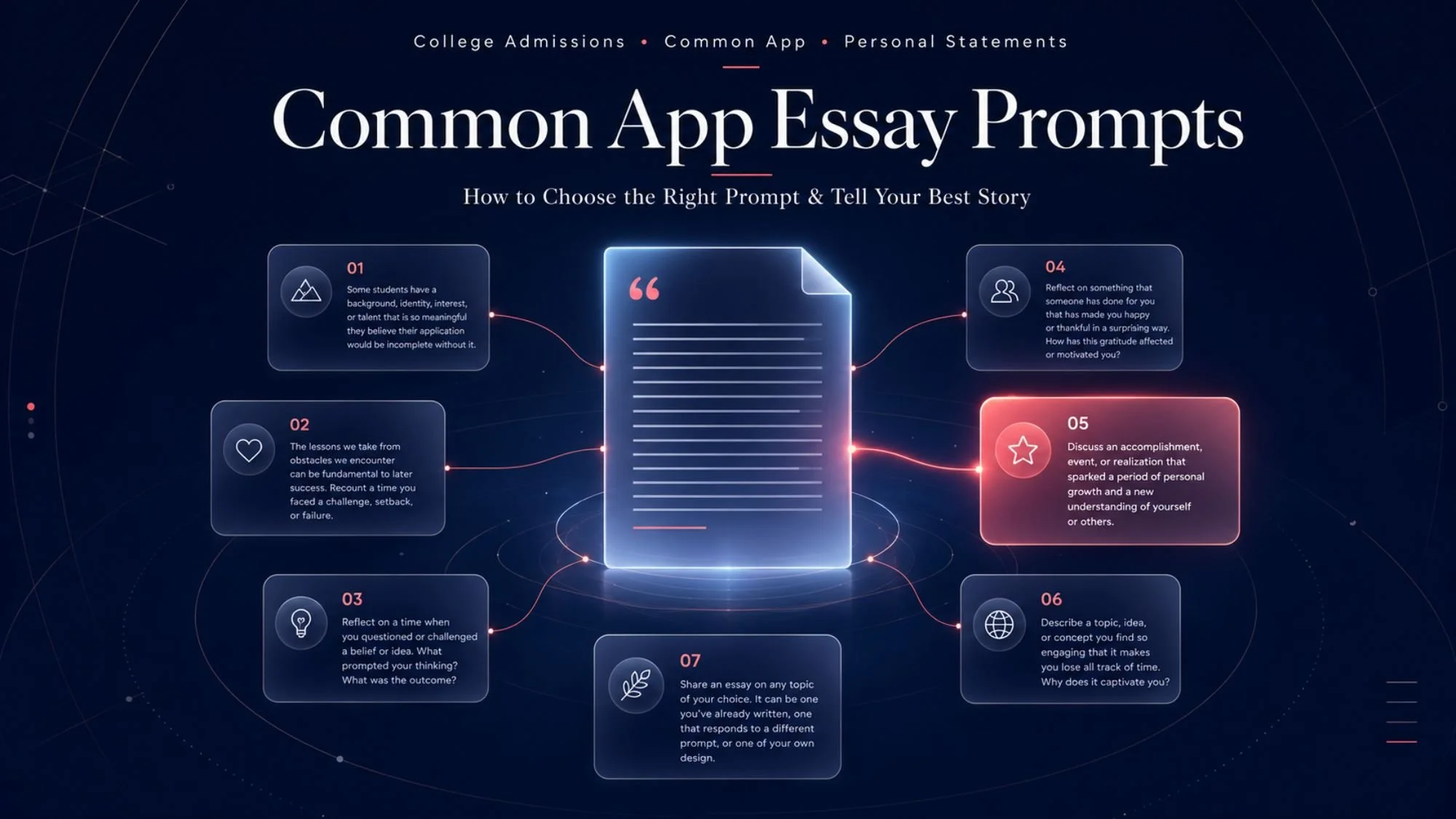
You've opened the Common App — the centralized application platform (Common App) used by hundreds of colleges — and you're staring at seven essay prompts with no idea which one is yours. That moment is exactly where most of the students I work with get stuck, and I've sat across the table from hundreds of them at exactly this stage. So let's fix that: here's a complete breakdown of all Common App essay prompts, what each one is really asking, how to choose between them, and what admissions officers actually want to see in your answer.
“The Common App offers 7 essay prompts for the current application cycle. Students write one personal statement of 250–650 words responding to any prompt of their choice. The prompts cover identity, challenges overcome, intellectual debate, problem-solving, personal growth, intellectual curiosity, and a topic of your choice. Prompt 7 (“Topic of Your Choice”) allows complete creative freedom.”
All 7 Common App Essay Prompts
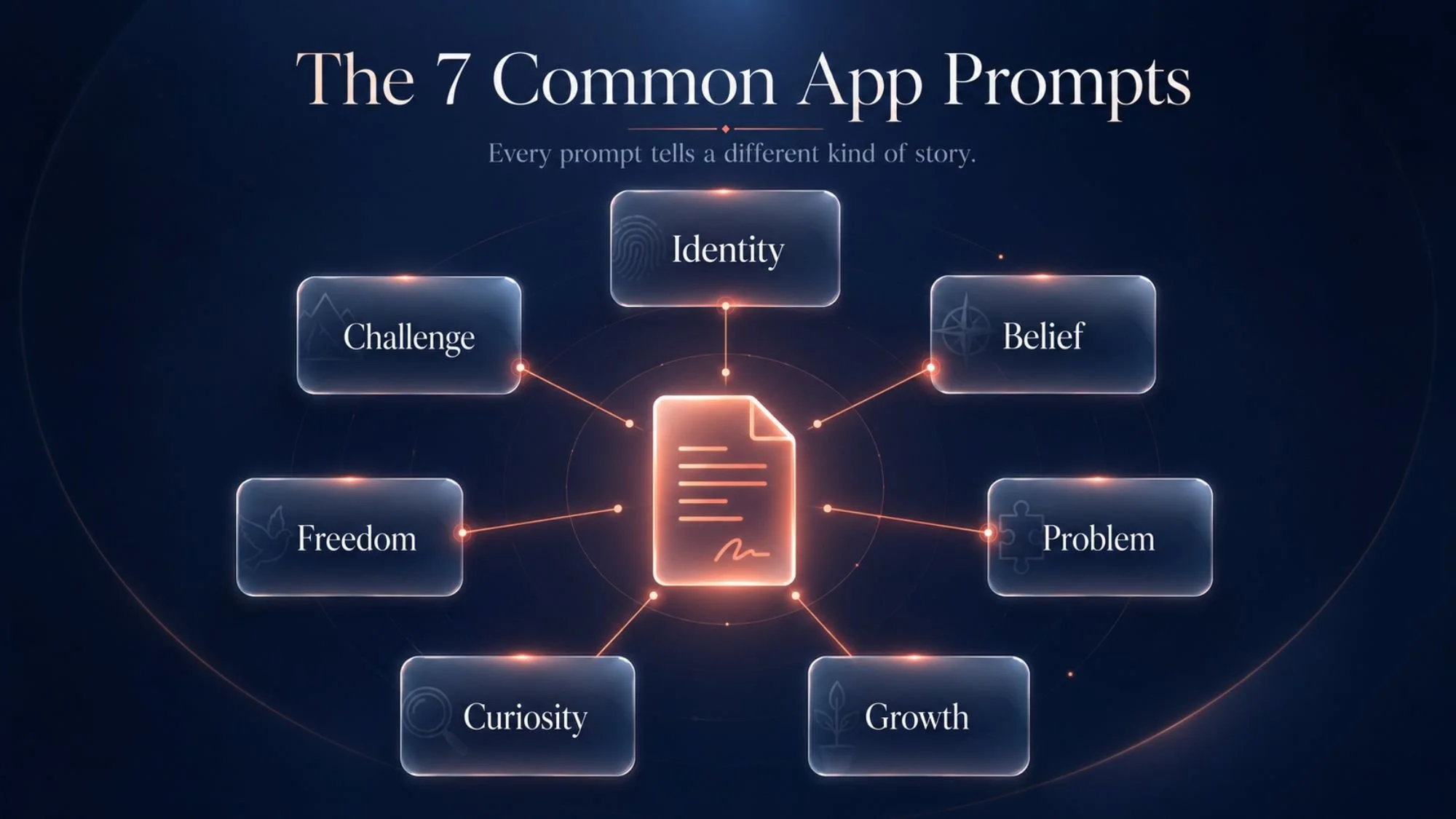
Every fall, I sit with students who've been staring at these 7 prompts for weeks without writing a word. Here's how I explain each one — and the question I always ask to help students figure out which one is actually theirs.
| # | Prompt (Abbreviated) | Best Fit For |
|---|---|---|
| 1 | Background, identity, interest, or talent so meaningful your story would be incomplete without it | A defining facet of identity, culture, or talent |
| 2 | Lessons learned from an obstacle, setback, or failure | Honest reflection on a real setback, big or small |
| 3 | A time you challenged a belief or idea | Students who enjoy debate, advocacy, or changing their mind |
| 4 | A problem you've solved or would like to solve | Initiative and analytical thinking, any field |
| 5 | An accomplishment, event, or realization that sparked personal growth | A quiet or dramatic shift in understanding |
| 6 | A topic, idea, or concept that captivates your curiosity | Genuine intellectual obsessions, not just good grades |
| 7 | Topic of your choice | Stories that truly don't fit Prompts 1–6 |
Prompt 1 — Background, Identity, Interest, or Talent
This is the broadest prompt on the list — and therefore the most misused. Admissions officers reading this essay are looking for a specific facet of your identity, not a summary of who you are. The best-fit stories come from students with a defining cultural background, an unusual hobby, or a formative family experience.
Common mistake: treating this as an autobiography instead of a focused, revealing narrative about your specific common app essay about identity.
Prompt 2 — Lessons from Failure or Setback
Students often avoid this prompt out of fear of appearing weak. In reality, it's one of the strongest options for demonstrating maturity and self-awareness — the kind of common app essay about challenge or failure that rewards honest reflection, not dramatic suffering.
Common mistake: spending 80% of the essay on the failure itself and only two sentences on the lesson learned.
Prompt 3 — Challenging a Belief or Idea
This is the intellectual prompt. It rewards students who can articulate a clear argument — not just describe an experience. It tends to suit students who enjoy debate, philosophy, advocacy, or research, and the essay should show your reasoning process, not just the conclusion you reached.
Avoid: essays that read as opinion pieces without any personal stakes attached.
Prompt 4 — Problem You've Solved or Would Like to Solve
Strong for STEM-bound students, but accessible to anyone who has tackled a real problem in their community, school, or daily life. The problem can be intellectual, social, logistical, or creative — admissions officers want evidence of initiative and analytical thinking, not just a description of the problem itself.
Prompt 5 — Personal Growth Through an Event or Realization
Similar to Prompt 2 but focused on a transition — a shift in worldview, confidence, or understanding. Often the most emotionally resonant essays come from this prompt, and the "event" doesn't need to be dramatic. It can be quiet and entirely internal: moving to a new country, changing friend groups, discovering a passion, or one conversation that changed everything.
Prompt 6 — What Captivates Your Intellectual Curiosity
This prompt rewards students with genuine intellectual passions. It's distinct from the identity prompt — a strong common app essay about intellectual interest should read like a mini intellectual journey, showing curiosity in action rather than simply stating that you love a subject.
Common mistake: describing a class you did well in, rather than a genuine rabbit hole you went down on your own.
Prompt 7 — Topic of Your Choice
Complete freedom — which means this is both the most flexible and the most dangerous prompt on the list. Use it when your story doesn't fit any of the other six, or when your topic is so specific and original that a predefined frame would limit it.
Warning: don't default to this prompt just because the other six feel limiting — that usually means you haven't found your real story yet.
Once you've chosen your prompt and drafted your essay, two questions come up immediately: how long should it be, and how should it be formatted? We've answered both in our guides on How Long Should a College Essay Be? and How to Format a College Essay — worth reading before you finalize your draft.
How to Choose the Right Common App Essay Prompt
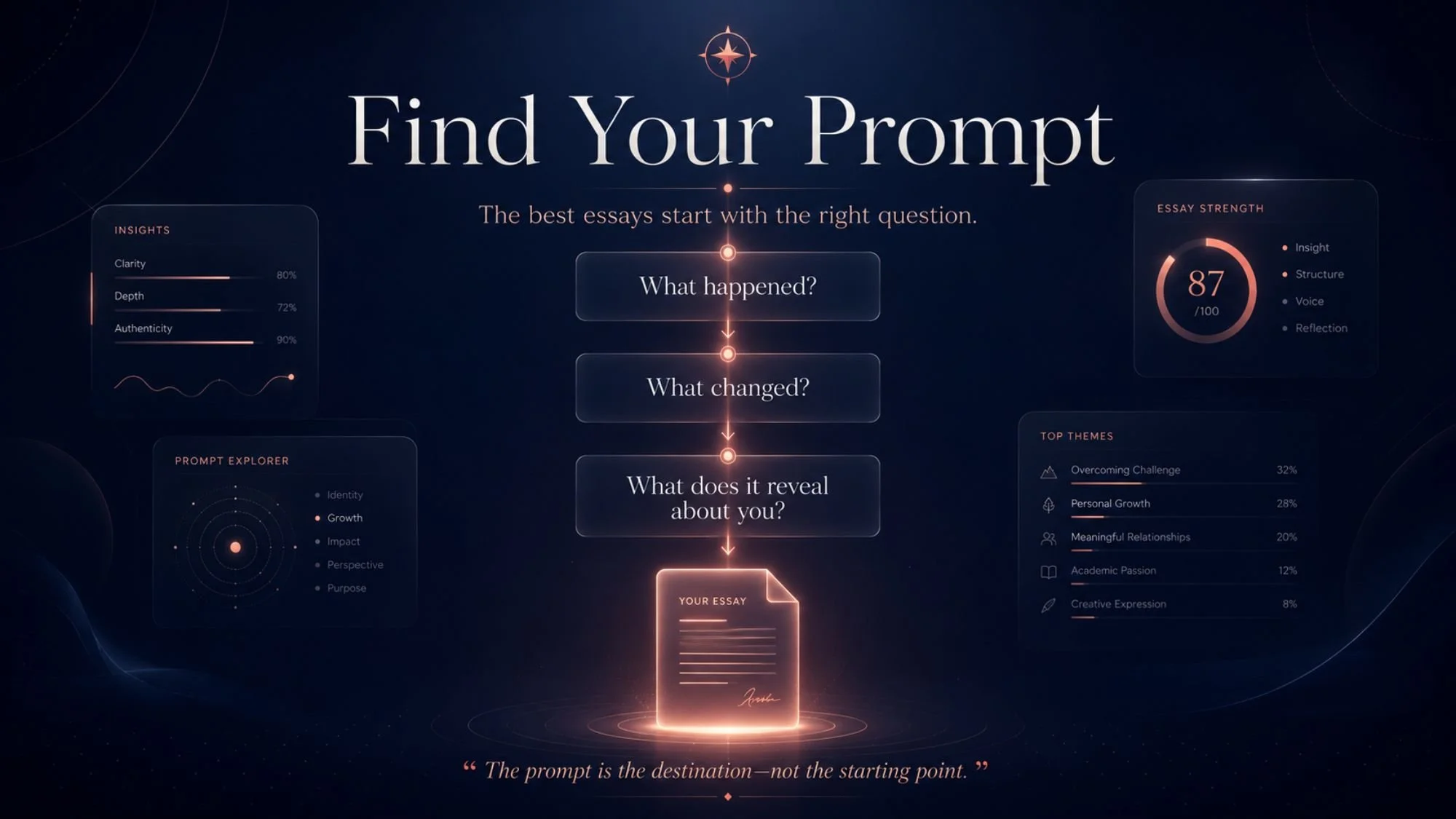
Most students searching this question aren't just looking for a list — they're trying to figure out which one to pick. Here's the framework I use with every student I mentor: start with your best story, then find the prompt that fits it. Not the other way around.
Ask yourself three questions:
What moment or experience do I keep coming back to?
What do I want the admissions officer to know about me that isn't anywhere else in my application?
Which prompt gives my story the most natural home?
One more thing worth saying clearly: all 7 prompts are equally valid in admissions readers' eyes. Topic and execution matter — not which prompt number you chose. According to the Common Application's own guidance, every prompt is designed to give students a fair, flexible path to share their story, and that's reflected in how readers evaluate them.
FAQs
Q: How many Common App essay prompts are there?
A: There are 7 prompts for the current application cycle. Students choose one and write a single personal statement of 250–650 words in response.
Q: Do Common App essay prompts change every year?
A: The prompts have been largely stable for several years, though minor wording updates occasionally occur. Always verify the current prompts directly at CommonApp.org before you start writing.
Q: Which Common App essay prompt is the most popular?
A: Prompts 1 and 5 tend to be the most commonly chosen. But popularity doesn't indicate the best choice — story fit matters far more than which prompt other students prefer.
Q: Can I write about anything for Prompt 7?
A: Yes — Prompt 7 is the "topic of your choice" option with full creative freedom. That freedom requires more discipline, not less. Only use it if your story genuinely doesn't fit Prompts 1 through 6.
Q: Do colleges see which Common App prompt I chose?
A: Yes — admissions officers see both the prompt and your response. No prompt is scored higher than another; the quality and authenticity of the essay matter far more than the prompt selected.
If you're deep in the Common App process, the recommendation letter and financial aid steps are coming up fast. Our guides on How to Ask for a Letter of Recommendation and How Do I Fill Out a FAFSA Form will help you stay ahead of both.
Your Next Step
All 7 Common App essay prompts are equally valid — the right one is simply the one that fits your best story. If you take only one thing from this page, take this: start with your story, not the prompt. Every student I've watched try to choose a prompt first got stuck. Every student who started with "what actually happened to me that matters" found their prompt within minutes.
The students I've seen write their strongest essays weren't trying to impress anyone. They were finally being honest about something that mattered to them.
If you'd like a mentor to help you find that story and write it well, HYE Tutors' college admissions advisors are here. Book your free session today, and let's turn your Common App essay prompts into the essay that actually sounds like you.
If you're also navigating the transfer process or researching your financial aid options, our guides on How to Transfer from Community College to University and How Do I Fill Out a FAFSA Form are worth bookmarking alongside this one.