

What Is the Common App? Everything You Need to Know
If you're applying to college this year, the Common App is where almost everything happens — and yet most students start their senior year having heard the name a hundred times without anyone explaining what it actually is, how it works, or what's inside it.
As admissions mentors who have guided hundreds of applicants through the college process — from a blank account all the way to acceptances at top UCs and Ivies — we've answered this question more times than we can count. So here's the complete guide: what the Common App (Common Application) is, every section you fill out, when it opens, what it costs, and the answers to the questions students ask us every single cycle.
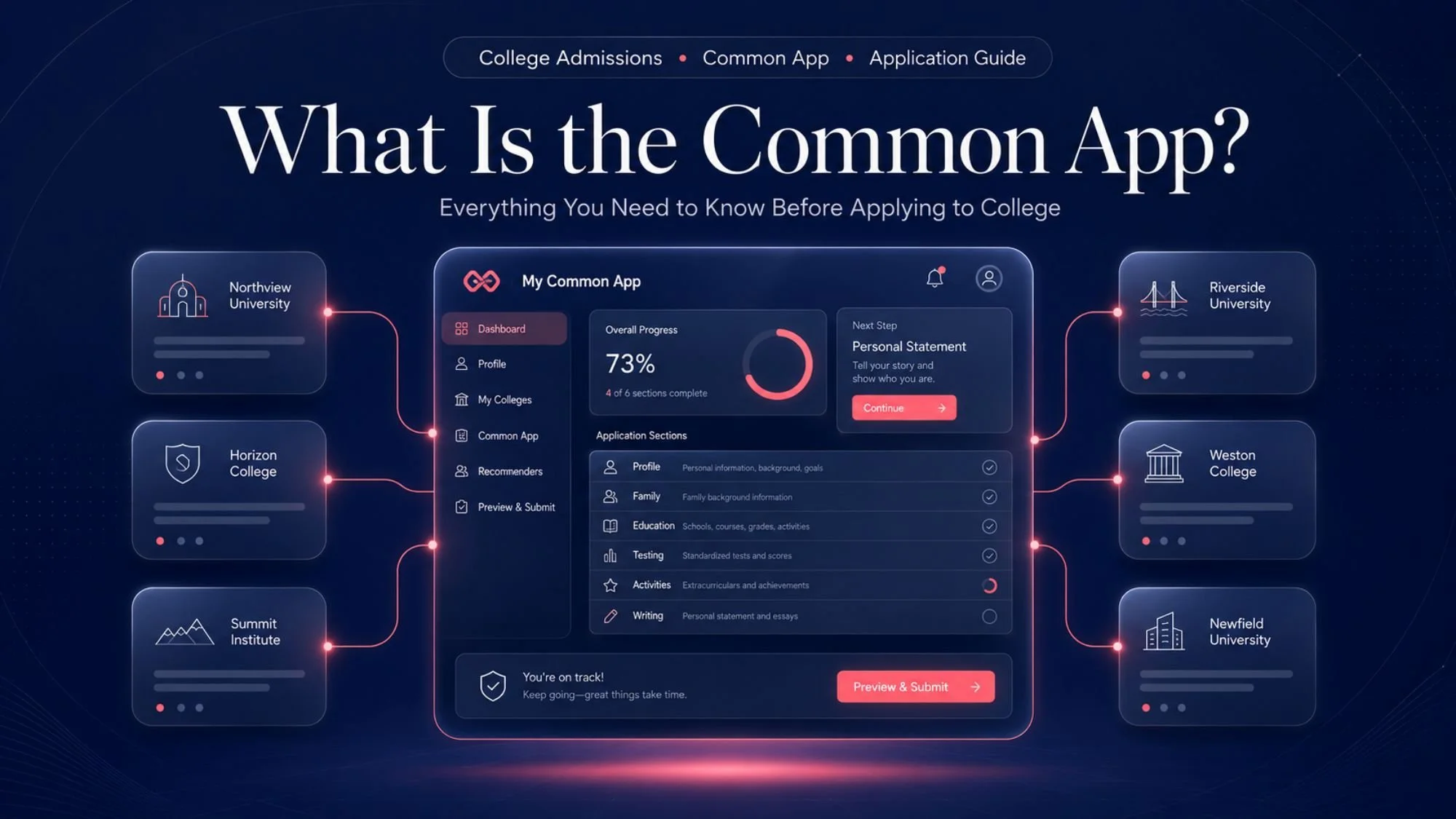
What Is the Common App?
The Common App (Common Application) is a free-to-join online platform that lets students apply to more than 1,100 colleges with a single application. You complete your profile, activities, essay, and recommender details once — then submit to each college you add. It opens August 1 each year, allows up to 20 colleges per cycle, and charges a per-college application fee set by each school — though fee waivers are widely available. Per CommonApp.org, over 1.5 million first-year applicants used the platform in the most recent cycle.
What Is the Common App? (And Why It Exists)
Almost every student I mentor pictures the Common App as twenty separate forms — one per school, everything from scratch each time. It isn't. It's one core application you build once, then submit to every college on your list. That single realization changes how students plan their entire senior fall.
The Common Application was created to solve a real problem: before it existed, applying to twelve schools meant filling out twelve separate sets of identical background information — name, address, GPA, activities — for every single one. The Common App eliminated that repetition by creating a shared application that member colleges agree to accept. Your profile travels to every school you add; only the college-specific supplement questions require unique writing per school.
Today, more than 1,100 colleges participate — including most private universities, a growing number of public flagships, and institutions in more than 20 countries. The platform also now includes community colleges for the first time in the 2025–26 cycle, expanding access further.
What You Fill Out on the Common App (Every Section Explained)
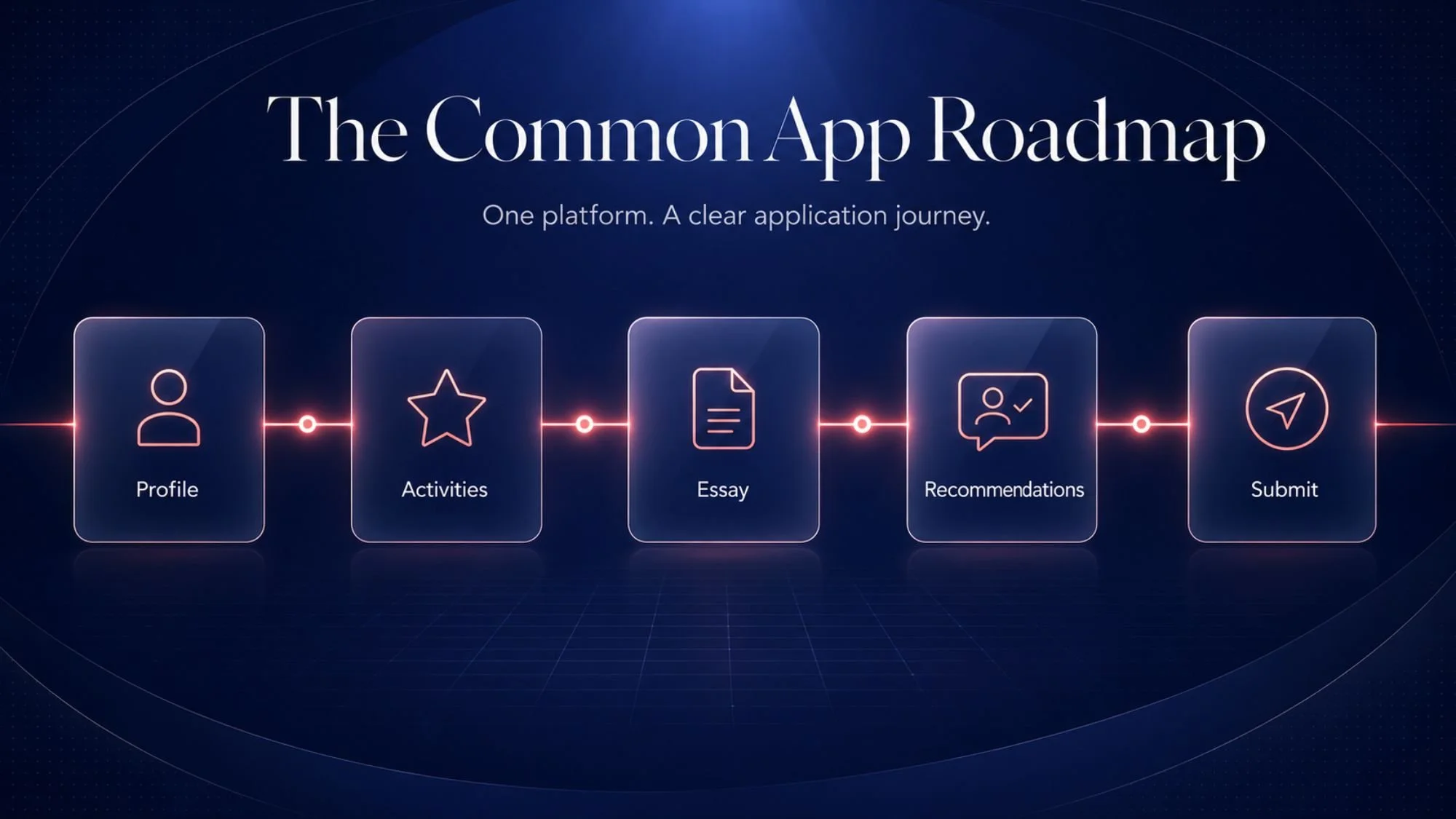
The Common App has a consistent structure: a shared core you complete once, plus college-specific sections unique to each school. Here's every section, in order.
Profile & Education (GPA Scale Reporting, Class Rank & Change in Progression)
This is where you enter your personal and contact information, demographics, and your academic history — the schools you attended, your GPA, class rank, and courses.
Two fields here trip up almost every student:
GPA scale reporting: this asks what scale your school uses to report your GPA — typically a 4.0 or 5.0 for weighted. It does not ask you to recalculate anything. Just enter the scale your transcript shows.
Class rank reporting: if your school provides a class rank, report it. If your school doesn't rank students — increasingly common — select "none reported" and move on. This is not a red flag.
Change in progression: this asks whether your grade scale, schedule type, or school changed during high school. Answer yes only if it literally did — switching from a 4.0 to a 5.0 scale when you entered a weighted program, for example. Most students answer no.
The Activities Section (Up to 10 Activities, 150 Characters Each)
You can list up to 10 extracurricular activities, jobs, volunteering, family responsibilities, or hobbies — in order of importance to you. Each description is limited to 150 characters (that's characters, not words), with honors listed separately at 100 characters each.
The real skill here isn't listing — it's compression. You have about two short sentences to convey what you did, at what level, and what it meant. Lead with impact. Cut every article and filler word. A weak line reads: "I was a member of the debate team and competed at meets." A strong line reads: "1st place, State Debate Championship; coached JV team of 12 in argumentation and evidence research."
On the question of whether the Common App checks for AI in the activities section: as of the 2025–26 cycle, Common App has not implemented automated AI-detection tools in the activities section. However, admissions officers read these entries closely, and voice inconsistencies across your application are noticed. Write in your own voice — the 150-character limit makes AI assistance less useful anyway.
The Common App Essay (Personal Statement)
The personal statement is 250–650 words, written from one of seven annual prompts, and sent identically to every college you apply to. For 2025–26, the prompts are unchanged from the prior cycle — a deliberate choice based on feedback from students and admissions officers.
This essay carries significant weight — not because length = importance, but because it's the one place in the application where your voice comes through unfiltered. The essays we've seen work best aren't the ones with the most dramatic events. They're the ones with the most specific, honest detail that only that student could have written.
The essay deserves its own deep dive. Our guides on Common App Essay Prompts — Answered with Examples, How Long Should a College Essay Be, and How to Format a College Essay cover prompts, length strategy, and formatting end to end.
Recommenders (Counselor & Teacher Letters)
Inside the Common App, you invite your school counselor and up to three teachers directly through the platform. Once invited, they receive a link to upload their letters themselves — you never handle the letters directly.
Letters can be submitted after you apply; most colleges accept them as long as they arrive close to the application deadline. That said, recommenders need lead time to write something meaningful.
Not sure how to ask, or how a teacher should approach writing one? Our guides on How to Ask for a Letter of Recommendation and How to Write a Letter of Recommendation cover both sides with ready-to-use language.
Supplemental Essays (Unique to Each College)
Supplements are the extra essays set by individual colleges — the "Why us?" essays, additional short responses, and program-specific prompts. They live in the "My Colleges" section of the platform and unlock once you add a school to your list.
This is where most of the per-school work actually lives. A student applying to eight schools with supplements could easily write 20+ additional responses on top of the main essay. Budget time accordingly — students almost universally underestimate supplements until they see the list.
Common App Deadlines — When It Opens, Closes & Is Due
The Common App opens August 1 every year — the same date, every cycle. There is no single national closing date: each college sets its own deadline, and your account and data carry over each year. The question "when does the Common App close?" usually means "when is my specific school's deadline?" — and that answer lives in the "My Colleges" tab once you add a school.
Early Decision vs. Early Action vs. Regular Decision
| Deadline Type | Typical Date | Key Feature |
|---|---|---|
| Early Decision (ED) | ~Nov 1 | Binding — you commit to attend if admitted; typically single-school ED allowed |
| Early Action (EA) | ~Nov 1–15 | Non-binding — early answer, full freedom to compare offers |
| Regular Decision (RD) | ~Jan 1–15 | Most widely used; decisions typically arrive March–April |
"Binding" in the Early Decision context means that if you're admitted, you commit to attend and withdraw all other applications. It's appropriate when a school is genuinely your first choice and you've reviewed financial aid policies carefully — ED applicants typically receive aid decisions at the same time as admissions decisions, but you should understand a school's typical packages before committing. Deadlines listed above vary by school; always verify in CommonApp.org's requirements grid.
How Many Colleges Can You Apply To on the Common App?
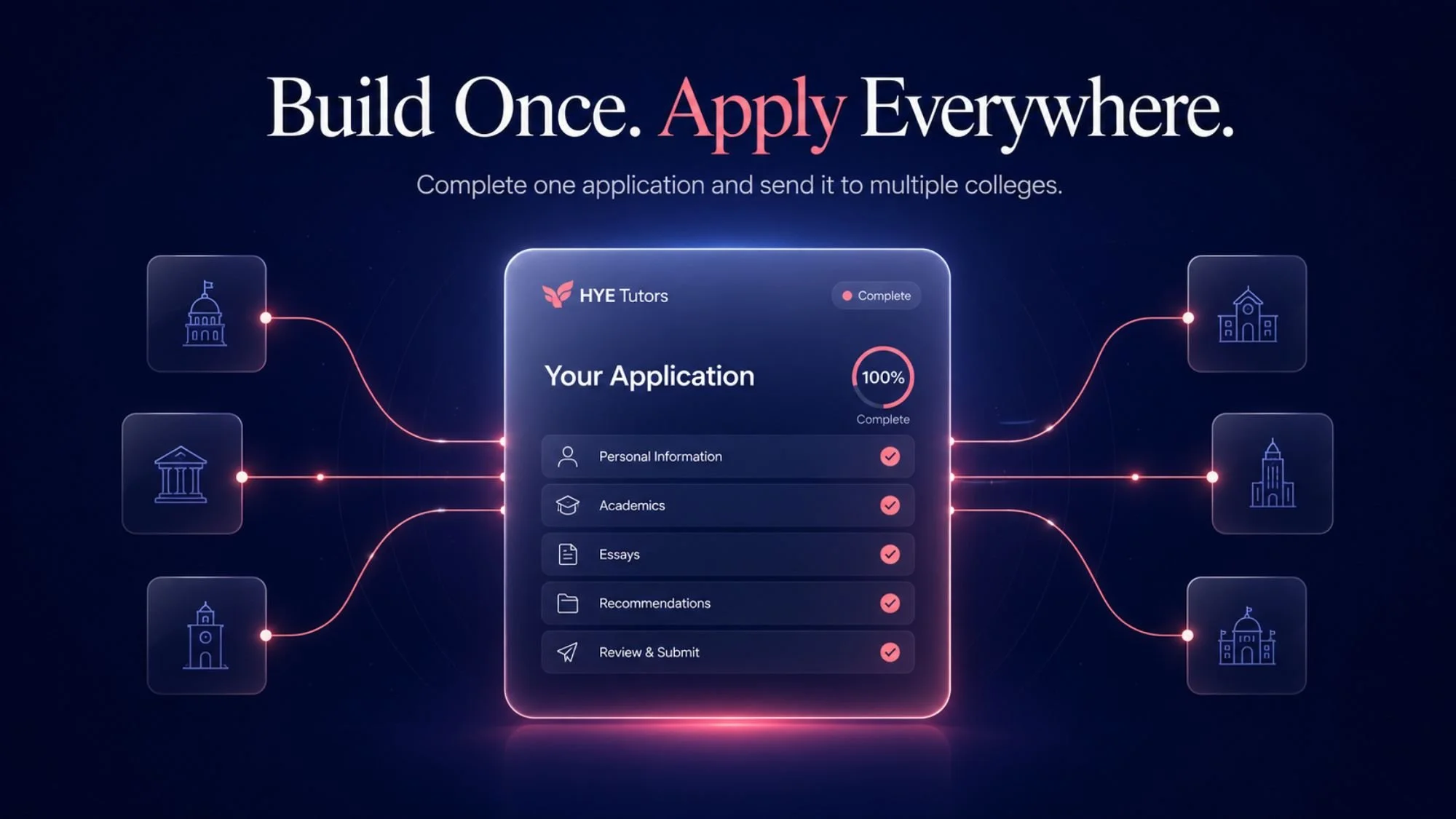
You can add up to 20 colleges per application cycle. In practice, the average applicant submits to roughly 6–8 schools. More isn't necessarily better.
A balanced list of 10–12 schools — reach, match, and safety schools selected thoughtfully — will serve most students better than maxing out at 20. We've worked with students who applied to 18 schools, spent November and December buried in supplements, and submitted weaker writing to every school because they stretched too thin. Quality of fit outperforms quantity every time.
How Much Does the Common App Cost? (Fees & Fee Waivers)
Creating a Common App account is completely free. Application fees come from the individual colleges — not from the Common App itself — and they vary widely: some schools charge nothing, while others charge up to approximately $90 per application.
If cost is a barrier, fee waivers are available directly inside the platform for eligible students. The Common App fee waiver covers every college on your list — you don't apply for it separately per school. Over 3.4 million fee waiver forms were submitted in the 2024–25 cycle, and no college penalizes students for requesting one. No one should skip a dream school over an application fee.
Once your applications are in, financial aid is next. Our walkthrough on How Do I Fill Out a FAFSA Form guides students and parents through every step of the financial aid process.
How to Add (or Remove) Colleges on the Common App
To add a college, use the "College Search" feature inside the "Explore" menu, then click "Add to My Colleges." The school will appear in your "My Colleges" tab with its deadlines, requirements, and any supplement prompts unlocked for you to complete.
To remove a college before you've submitted: click into the school's page in "My Colleges" and select remove. To remove a school after you've already submitted to it: you can no longer withdraw through the Common App — contact the admissions office directly if needed.
Submitting Your Common App — and What Happens After
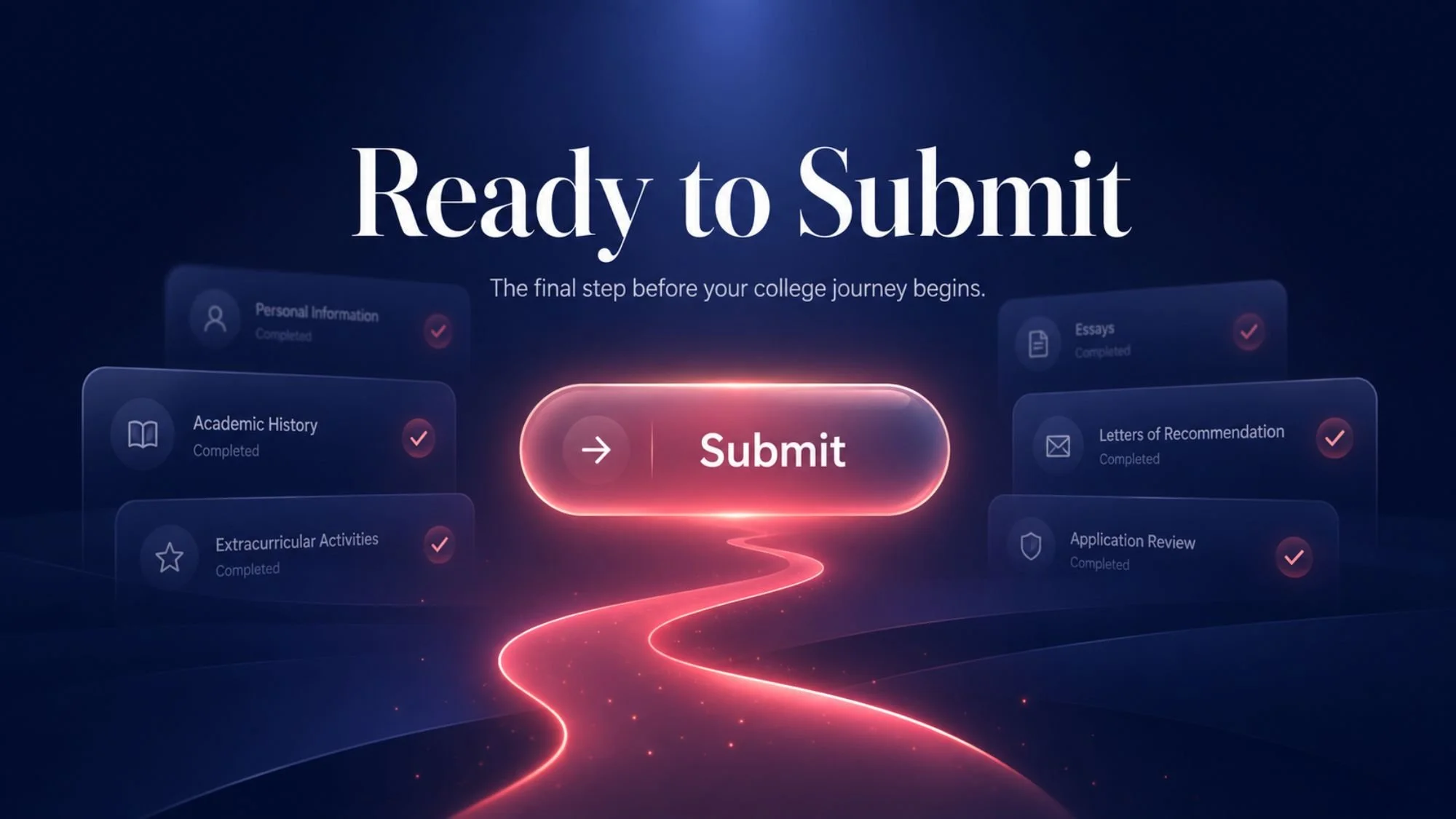
You submit to each college individually — one submission per school, not one submission to all. For each college, you complete the shared application plus any supplements, pay the fee (or apply a waiver), and hit submit. The college then receives your application as a snapshot of everything at that moment.
Can you edit the Common App after submitting? Once a college has received your application, that college's version is locked. However, you can still make changes to your profile, essay, or activities before submitting to other schools on your list — each submission is independent. If you need to correct something after submission (a significant error, updated test scores, a new award), contact the admissions office directly; most will accept an update.
Recommendation letters are one exception: recommenders can submit their letters after you've submitted your application, and most admissions offices account for this. Just make sure recommenders know your deadlines.
Common App vs. Coalition App (Quick Comparison)
Both are application platforms accepted by selective colleges, but they are not interchangeable. Here's the comparison that matters most for planning:
| Feature | Common App | Coalition App |
|---|---|---|
| Member colleges | 1,100+ colleges worldwide | ~200 colleges, mostly large research universities |
| Essay length | 250–650 words | Varies by prompt (can differ) |
| College cap | 20 per cycle | No stated cap |
| Use case | Most students — widest acceptance | Required only at a handful of schools |
The Common App is far more widely accepted and the default choice for the vast majority of applicants. The Coalition App (now called the Scoir Common App at some schools) is required by a small number of institutions — typically certain flagships and research universities. Our advice: use the Common App unless a specific target school requires an alternative.
Transfer Students and the Common App
Yes — transfer students use the Common App, but through a separate transfer application, not the first-year version. The transfer application asks for college transcripts, a college activities list, a short essay explaining your reasons for transferring, and often a longer personal statement.
The timeline for transfer applicants also differs: many transfer deadlines fall in February or March for fall enrollment, significantly earlier than most students expect. Community college to university transfers have their own pathways — including articulation agreements that can guarantee admission to certain UCs and Cal States if grade benchmarks are met.
Planning a transfer path? Our guide on How to Transfer from Community College to University maps every step, including articulation agreements and timeline planning.
FAQs
Q1: Does the Common App check for AI in the activities section?
As of the 2025–26 cycle, Common App has not deployed automated AI detection in the activities section. Admissions officers, however, do read for voice consistency — entries that don't match the essay can raise questions. Write in your own voice.
Q2: What does "PE" mean on the Common App?
"PE" refers to Physical Education as a course category in the academic section. If you're entering coursework, select PE for gym or sports health classes. It's a course label, not an abbreviation for anything related to your application status.
Q3: How does the Common App work?
You create a free account, complete one shared application (profile, activities, essay), add up to 20 colleges, finish any school-specific supplement essays, pay or waive the per-college fee, and submit. Each college receives your completed application individually.
Q4: How many colleges can you apply to on the Common App?
Up to 20 colleges per cycle. The average applicant submits to 6–8. A thoughtful balanced list beats maxing out the cap.
Q5: Is the Common App free?
Creating an account and filling out the application is free. Application fees are set by each individual college (typically $0–$90) and paid at submission. Fee waivers are available inside the platform for eligible students.
Q6: What does "change in progression" mean on the Common App?
It asks whether your GPA scale, course schedule type, or school itself changed during high school. Answer yes only if it literally changed — for example, switching to a weighted 5.0 scale mid-high-school. Most students answer no.
Q7: What is GPA scale reporting on the Common App?
GPA scale reporting asks what scale your school uses (e.g., 4.0 unweighted, 5.0 weighted). It is asking about the scale, not your actual GPA, and not asking you to recalculate anything. Enter what's on your transcript.
Q8: When does the Common App open and close?
The Common App opens August 1 every year. There is no single national closing date — each college sets its own deadline. Your account data rolls over year to year. Check deadlines in the "My Colleges" tab after adding schools.
Q9: Can you edit the Common App after submitting?
Not for the college you already submitted to — that version is locked on their end. But you can edit your application before submitting to other schools on your list. Each submission is independent.
Q10: Do transfer students apply through the Common App?
Yes — through the separate transfer application, not the first-year version. Transfer deadlines typically fall in February or March for fall enrollment. Timeline and requirements differ significantly from first-year applications.
The Bottom Line
The Common App is one account, one core application, and one personal essay — sent to up to 20 colleges. It opens August 1. Creating an account is free. Fees are per-college and waivable. And the sections, once you understand what each one is asking for, are entirely manageable.
The students who handle the Common App best understand it first — then the work feels smaller. Every component has a purpose, every character limit has a strategy, and every deadline is knowable before September arrives.
If you'd like a mentor to walk you through your Common App from account to submitted — covering essay strategy, activities compression, recommender timing, and supplement planning — our advisors at HYE Tutors are ready. Book your free session today.
About the Author:
This guide was written by HYE Tutors admissions mentors affiliated with Columbia University, Harvard, UC Berkeley, and UCLA. Our team has personally guided hundreds of students through the Common App process — from first-generation applicants navigating the platform for the first time to competitive applicants building lists across Ivies, top UCs, and selective liberal arts colleges. We specialize in college admissions counseling, essay strategy, and helping families understand a process that no one fully explains until it's already started.