

How to Read the Periodic Table?
The first time most students sit down with the periodic table, they see exactly the same thing: a wall. Rows and columns of boxes stuffed with letters, numbers, and abbreviations that seem to follow no logic at all. Where do you even start — top left? The symbols that look nothing like the element names? The two numbers crammed into every box?
I have spent eight years teaching high-school and AP Chemistry, and I have walked hundreds of students from that exact feeling of overwhelm to real confidence. The question I hear on day one, every single time, is the same: how to read the periodic table. The honest answer is that it comes down to three things — and once you see them, the whole grid makes sense.
In the next few minutes, you will be able to look at any element and know exactly what it is telling you.
How to Read the Periodic Table?
How do you read the periodic table? Read it left to right, top to bottom, by increasing atomic number. The horizontal rows are called periods and show energy levels; the vertical columns are called groups and share similar chemical properties. Each box lists the element's atomic number (number of protons), its one- or two-letter symbol, and its atomic mass. Colors separate metals, nonmetals, and metalloids.
How to Read the Periodic Table (Step by Step)
Every student I tutor asks the same question on day one: "How do I even read this?" So here is exactly what I show them — three simple parts that unlock the entire table. We will follow one element all the way through: Oxygen (O), one of the most familiar elements and a perfect teaching example.
Step 1: Start With the Layout — Periods (Rows) and Groups (Columns)
Think of the periodic table as a map, not a list. Every position is intentional. There are two directions that matter, and each one tells you something different.
Periods are the 7 horizontal rows. Moving left to right across any period, the atomic number increases by exactly one with each step. All elements in the same period have the same number of electron shells — the layers of electrons surrounding the nucleus.
Groups are the 18 vertical columns. Elements in the same group share similar chemical behavior. Group 1 elements (like sodium and lithium) are highly reactive metals. Group 18 elements (like helium and neon) are the stable noble gases that almost never react with anything.
The single rule worth memorizing: same column = similar behavior; same row = same number of electron shells. I tell every student I work with — columns are personality, rows are size. That one line clears up half the confusion on any chemistry exam.
The table currently contains 118 confirmed elements. Curious how they all fit and where the count stands today? Our guide on How Many Elements Are on the Periodic Table breaks down all 118 and the story behind how the table grew.
Step 2: Read Each Element Box — Atomic Number, Symbol, and Atomic Mass
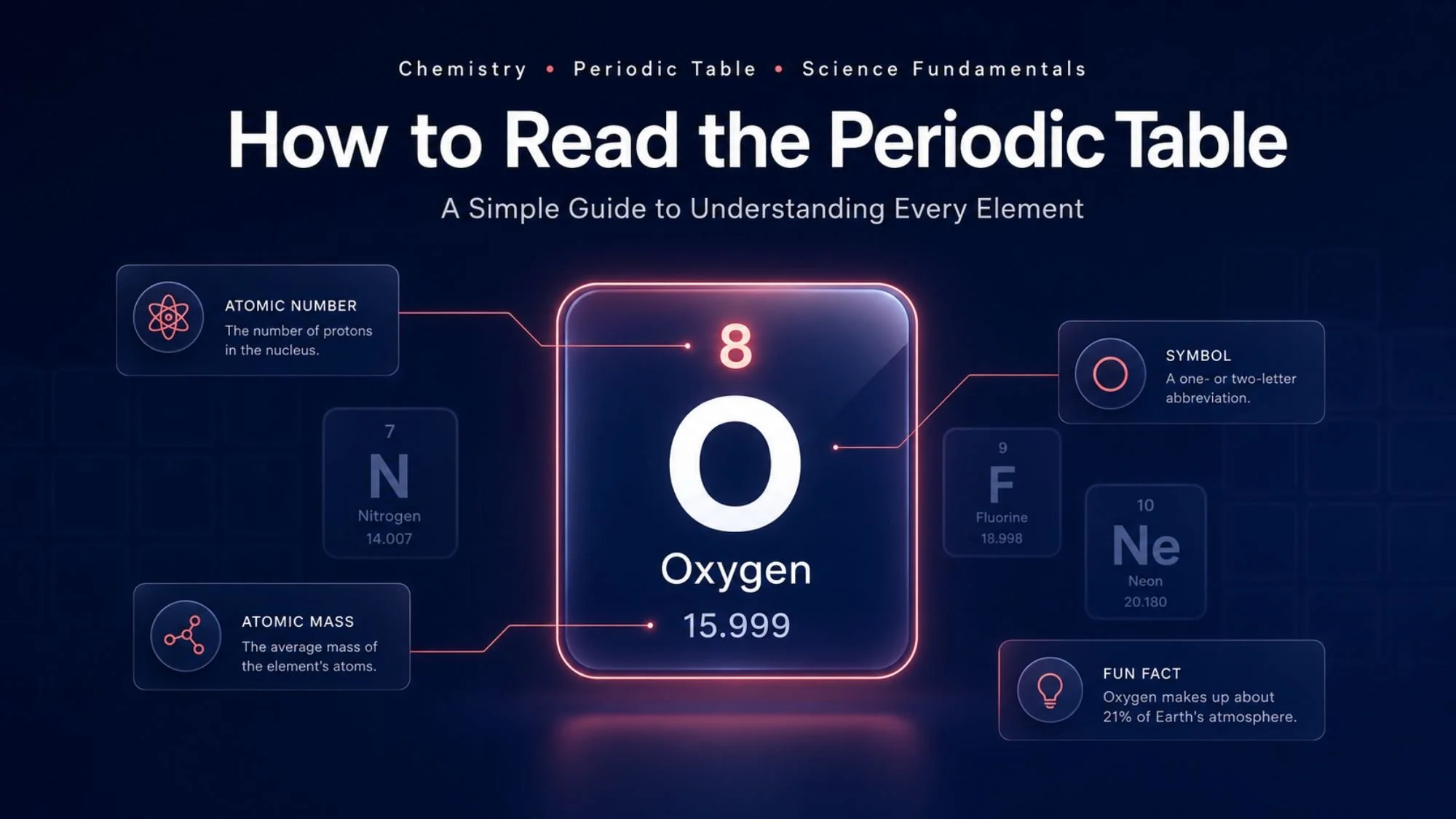
Zoom into Oxygen's box. It looks small, but every piece of information in it has a specific job.
Atomic Number (top): For Oxygen, this is 8. The atomic number tells you exactly how many protons are in the nucleus — and because no two elements share a proton count, it is the element's unique ID. It also determines its position in the table.
Symbol (center): Oxygen's symbol is O. Symbols are one or two letters — first letter always capitalized, second always lowercase (Na for Sodium, not NA or na). Some symbols, like Na from the Latin natrium, look nothing like the English name, but they are consistent worldwide.
Atomic Mass (bottom): Oxygen's atomic mass is approximately 16.00. This represents the average mass of the atom, accounting for all naturally occurring isotopes. It is the number you will reach for the moment calculations begin.
Read order: atomic number → symbol → element name → atomic mass. That sequence is all you need to get oriented inside any box on the table.
That atomic mass number is far from trivial — it becomes essential the moment you start stoichiometry. Our guide on How to Find Theoretical and Percent Yield in Chemistry shows exactly where atomic mass feeds into real chemistry calculations.
Step 3: Use the Color Blocks — Metals, Nonmetals, and Metalloids
The colors on the periodic table are not decoration. They divide all 118 elements into three families, and each family has a distinct personality when it comes to reactions.
Metals (left side and center block): The majority of the table. Metals are shiny, conduct electricity, and lose electrons easily in chemical reactions. Think iron, copper, gold.
Nonmetals (upper right): Elements like oxygen, nitrogen, and fluorine. They gain or share electrons rather than giving them away.
Metalloids (the staircase boundary between left and right): Elements like silicon and germanium that behave somewhere in between — semiconductors that power every computer chip.
The one-line rule I give every student: left side gives electrons, right side takes them. That is the foundation of every chemical reaction you will study in high-school chemistry — and it all starts with where an element sits on the table.
This electron-giving and electron-taking is exactly what drives batteries and electrochemical cells. See our Galvanic Cell vs Electrolytic Cell guide for high school chemistry for a clear look at how these electron transfers power real technology.
For authoritative reference on element classification and the official IUPAC naming standards, the IUPAC periodic table and nomenclature guide is the global standard used by chemists worldwide.
Quick-Reference Table — What Each Part of the Periodic Table Tells You
| Part of the Table | What It Means | Why It Matters |
|---|---|---|
| Row (Period) | Same number of electron shells | Tells you atom size & energy level |
| Column (Group) | Similar chemical properties | Predicts how an element behaves |
| Atomic Number | Number of protons | The element's unique ID & position on the table |
| Symbol | 1–2 letter abbreviation | How elements appear in formulas and equations |
| Atomic Mass | Average atomic weight | Used in chemistry calculations and yield problems |
| Color Block | Metal / nonmetal / metalloid | Predicts electron-sharing behavior in reactions |
The mentor's rule #1: Columns tell you behavior, rows tell you size. Master those two facts and you can read any element on the table, cold, on any exam.
Quick Tips to Read the Periodic Table Faster (for Exams and Homework)

In my experience, the students who struggle most on chemistry exams are not the ones who know too little — they are the ones who tried to memorize too much. The periodic table has 118 elements. No student needs all 118 in their head. Here is what actually works:
Always read by atomic number (left to right, top to bottom). That is the table's built-in logic — it is never random, and the number never lies.
Learn the group patterns, not every element: Group 1 (alkali metals, highly reactive), Group 17 (halogens, love to gain one electron), Group 18 (noble gases, stable and unreactive). Know those three groups and you can reason through dozens of exam questions.
Use position to predict before memorizing: If an element is far left, it gives away electrons. Far right? It takes them. That positional logic is worth more than flashcards.
Check the period for atom size: Higher periods (lower rows) mean more electron shells and bigger atoms. A quick glance at the row tells you relative size without any memorization.
An element's position even hints at whether it tends to form acids or bases in solution. Start with our guide What Is Acid and Base in Chemistry to see how the periodic table connects directly to one of the most tested topics in high-school chemistry.
For additional practice with reading element data and connecting it to calculations, MIT OpenCourseWare's introductory chemistry materials offer rigorous, free exercises aligned with what we cover at HYE Tutors.
FAQs
Q: How do you read the periodic table for beginners?
A: Read left to right by atomic number. Rows are periods (same electron shells), columns are groups (similar properties), and each box shows atomic number, symbol, and mass. Those three things are all you need to start.
Q: What do the numbers on the periodic table mean?
A: There are two key numbers. The top number is the atomic number — it tells you the number of protons and uniquely identifies the element. The bottom number is the atomic mass — the atom's average weight, used in calculations.
Q: What is the difference between a period and a group?
A: A period is a horizontal row — all elements in it have the same number of electron shells. A group is a vertical column — all elements in it share similar chemical properties. Rows = size; columns = behavior.
Q: How is the periodic table arranged?
A: By increasing atomic number, left to right and top to bottom, with elements that share similar properties aligned in the same vertical column. The arrangement reflects underlying atomic structure, not alphabetical order or discovery date.
Q: Why are there colors on the periodic table?
A: Colors sort elements into three families — metals (left and center), nonmetals (upper right), and metalloids (the staircase boundary). The color block tells you how an element interacts with electrons, which predicts its behavior in reactions.
Once acids and bases click, the natural next step is buffer solutions — our beginner guide What Is Buffer Solution in Chemistry explains them simply and connects directly back to the periodic table trends you just learned.
For a comprehensive visual reference, the Royal Society of Chemistry's interactive periodic table is one of the most reliable and clearly annotated tools available — we recommend it to every student getting started.
Book your free session →
Conclusion
The periodic table is a map — and like any map, it only looks overwhelming before you know how to read it. Periods tell you atom size and energy level. Groups tell you chemical behavior. The element box gives you the atomic number, symbol, and mass you need for every calculation. Color blocks sort elements into metals, nonmetals, and metalloids at a glance.
The students I have seen transform their chemistry performance are almost never the ones who memorized more. They are the ones who stopped fearing the table and started reading it. Columns are behavior, rows are size — keep that in your head, and the rest follows.
Now that you know how to read the periodic table, you have the foundation every chemistry course and standardized test builds on. If you want a mentor to walk you through how to read the periodic table step by step — with a real element in front of you — our chemistry advisors at HYE Tutors are ready. Book your free session today and let us make chemistry make sense.