

How to Calculate the Area of a Rectangle: A Guide for High School Students
Picture this: it's the night before your geometry exam, and you're staring at a rectangle drawn on your practice sheet. Two measurements are labeled on the sides. The question reads: "Find the area." You know it's something about multiplying — but which sides? And what do you write at the end? If that scenario feels familiar, you're in exactly the right place.
Understanding how to calculate the area of a rectangle is one of the most frequently tested skills in high school geometry. In our years working with students at HYE Tutors, we've prepped hundreds of kids for everything from weekly quizzes to the SAT and ACT — and rectangle area shows up on nearly every exam, often in at least two different forms: a straightforward calculation and a word problem in disguise.
By the time you finish this guide, you'll have the formula locked in, a step-by-step method you can apply under pressure, worked examples, memory tricks, and a clear picture of the mistakes students most commonly lose marks on. Let's get into it.
How to Calculate the Area of a Rectangle?
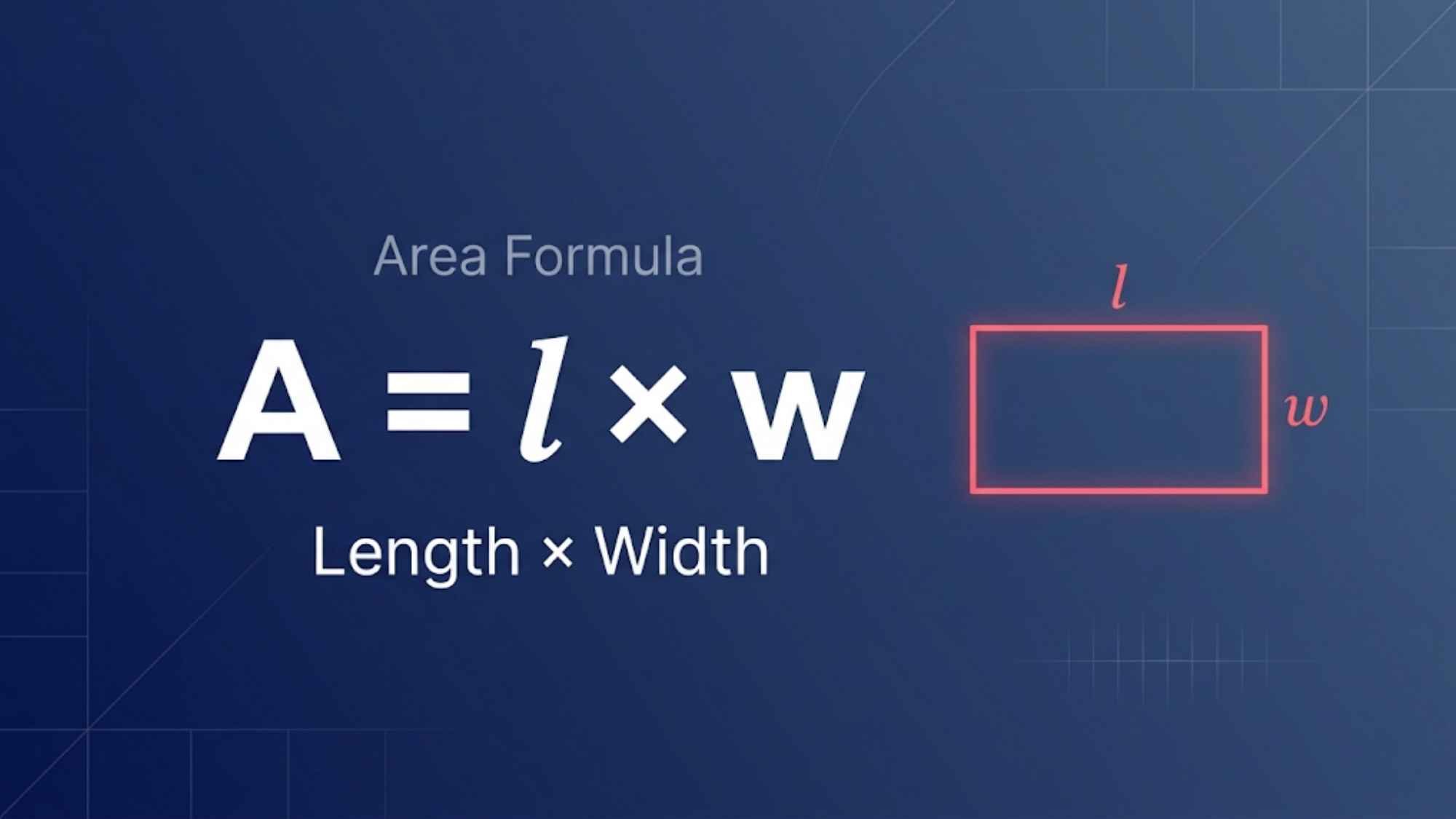
To calculate the area of a Rectangle multiply its length by its width.
Formula: Area = Length × Width (also written A = l × w)The result is always expressed in square units. If the sides are in centimeters, the area is in cm².Example: A rectangle with a length of 8 cm and a width of 5 cm has an area of 8 × 5 = 40 cm².
How to Calculate the Area of a Rectangle
In our experience working with students across every grade from 8 to 12, we've noticed a pattern: most kids who lose marks on rectangle area problems already know the formula. The errors happen in the details — mixed-up units, a forgotten superscript, a word problem that hid the dimensions inside a sentence. We're going to close every one of those gaps, starting from the very beginning.
What Is the Area of a Rectangle? (Definition)
Before we touch the formula, let's build the intuition. Area is the amount of flat space a 2D shape covers — think of it as the surface enclosed inside its boundary. For a rectangle specifically, that's the space sitting inside its four right angles and two pairs of equal, parallel sides.
The easiest way to picture it: imagine you want to tile a rectangular bathroom floor. The area tells you exactly how many tiles you'll need to cover it — no gaps, no overlaps. That's it.
Area shows up constantly in the real world: the size of a phone screen, the square footage of a room, the coverage of a football field. Every one of those is a rectangle with a measurable area. While area measures 2D space (length × width), volume extends this to 3D by multiplying by height
One thing to establish right now: area is not the same as perimeter. Area measures the inside surface; perimeter measures the boundary going around. We've seen students mix these up on exams more times than we can count — so we'll revisit this distinction in its own section below.
The Area of a Rectangle Formula
Here it is, clean and simple:
Area = Length × Width
Also written: A = l × w or A = lw
In words: multiply the longer side (length) by the shorter side (width). These two sides are always perpendicular — meaning they meet at a right angle (90°). That right angle is what makes this formula work.
⚠ Exam Tip: Always write the unit² The single most common mark students lose at HYE Tutors is writing "40 cm" instead of "40 cm²." Area is two-dimensional — your unit must be squared. The calculation can be perfect; a missing superscript still costs you the mark. Make writing "²" the last step of every area problem, every time.
How to Calculate the Area of a Rectangle — Step-by-Step
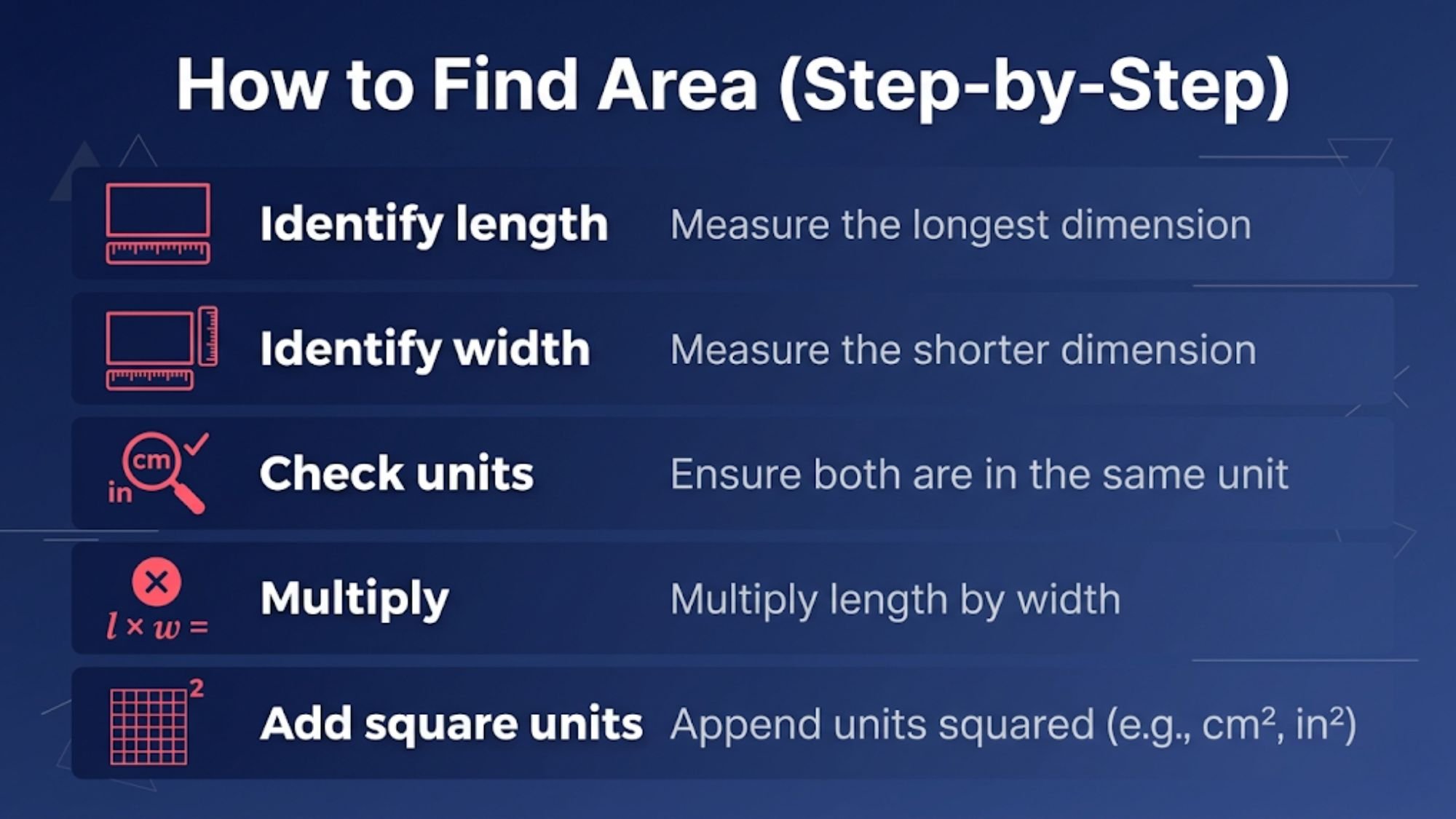
Here's the exact method we walk students through in our tutoring sessions. Follow these five steps every time, and you won't miss a mark.
Identify the length — the longer dimension of the rectangle.
Identify the width — the shorter dimension.
Check that both measurements are in the same unit. If one is in meters and the other is in centimeters, convert before you multiply.
Multiply: Length × Width.
Write your answer with the correct square unit (cm², m², ft², in², etc.).
Worked Example 1 — Simple
Length = 10 cm, Width = 4 cmArea = 10 × 4 = 40 cm²
Worked Example 2 — Decimals (same process)
Length = 6.5 m, Width = 3 mArea = 6.5 × 3 = 19.5 m²Decimals work exactly the same way — don't let them throw you off.
📌 Step 3 Warning: We've marked student papers where length was measured in meters and width in centimeters. The resulting number was wildly off — and the student lost the entire question. Always verify your units match before you multiply. According to Khan Academy's geometry curriculum, unit consistency is one of the foundational skills for all area and volume problems.
Area of a Rectangle with Variables (Algebraic Expressions)
In Algebra I and Geometry, you'll sometimes see rectangle dimensions written as expressions rather than numbers — for example, l = (x + 3), w = 5. Don't panic. The formula doesn't change at all.
You still multiply length by width — you're just multiplying an expression instead of a plain number:
Example: Length = (x + 2), Width = 4Area = 4(x + 2) = 4x + 8
Treat the variable like any other number and distribute normally. We've worked with students who completely freeze when they see an x in a geometry problem — once they realize the formula is identical, the anxiety disappears. If algebraic expressions feel unfamiliar, Math is Fun's introduction to algebra is an excellent, no-pressure starting point.
How to Find Area When Only the Perimeter Is Given
This is one of the most common exam traps we warn students about. A problem gives you the perimeter and one side — and asks for the area. It's testing whether you know two formulas, not one. Here's the two-step approach:
Use the perimeter formula to find the missing side: P = 2(l + w)
Plug both dimensions into the area formula: A = l × w
Worked Example:Perimeter = 30 cm, Width = 5 cmStep 1: 30 = 2(l + 5) → 15 = l + 5 → l = 10 cmStep 2: Area = 10 × 5 = 50 cm²
Quick note: If you're given only the perimeter with no other dimension, the area cannot be uniquely determined — infinitely many rectangles share the same perimeter. If a problem seems to give you only one number, re-read carefully; there's almost certainly a second constraint hidden in the wording.
Memory Tricks to Remember the Area Formula
These are the exact tricks our tutors share verbally in sessions. Simple, sticky, and exam-proof.
The L-Times-W Chant: Say it out loud -- Length times Width, length times width -- five times before your exam. By the time you are sitting at your desk, the formula fires automatically.
The tiling trick: Imagine laying square floor tiles over the rectangle. If the room is 4 tiles long and 3 tiles wide, you need 12 tiles. Count the rows, count the columns, multiply. That number is always the area.
Real-world anchor: Think of your phone screen or a sheet of notebook paper. You already intuitively know its area is length × width — you've been looking at rectangles your whole life.
I tell every student: if you go blank on exam day, just imagine tiling the shape. Count the rows, count the columns, multiply. That's area — every time." — HYE Tutors Geometry Coach
Area of a Rectangle — Practice Problems
In our sessions at HYE Tutors, we've found that students who practice a variety of problem types perform significantly better than those who drill only basic calculations. The problems below progress from straightforward to exam-level — work through every one.
Problem 1 — BasicA rectangle has a length of 12 m and a width of 7 m. Find its area.Solution: A = 12 × 7 = 84 m²
Problem 2 — DecimalsA rectangle has a length of 4.5 ft and a width of 3 ft. Find its area.Solution: A = 4.5 × 3 = 13.5 ft²
Problem 3 — Algebraic ExpressionA rectangle has a length of (2x) and a width of (x + 1). Express the area as a simplified algebraic expression.Solution: A = 2x(x + 1) = 2x² + 2x
Problem 4 — Word ProblemA classroom measures 9 meters in length and 6 meters in width. What is the area of the classroom floor?Step 1: Identify dimensions — Length = 9 m, Width = 6 m.Step 2: Apply the formula — A = 9 × 6 = 54 m²The classroom floor covers 54 square meters.
Problem 5 — Perimeter to Area (Two-Step)A rectangle has a perimeter of 40 cm and a width of 6 cm. What is its area?Step 1: Solve for length using P = 2(l + w)40 = 2(l + 6) → 20 = l + 6 → l = 14 cmStep 2: A = 14 × 6 = 84 cm²
Word problems are worth practicing more than any other type. At least one problem on every geometry exam we've seen disguises the rectangle's dimensions inside a written scenario — and students who haven't practiced them lose those marks unnecessarily.
Want to work through more problems with a real tutor?
Our team at HYE Tutors has helped hundreds of students raise their geometry scores. Book a free session today and we'll show you exactly where you're losing marks — and how to fix it.
⇒ Book a Free Session TodayArea vs. Perimeter of a Rectangle — Key Differences
This confusion trips up students at every level, from Grade 8 right through to SAT prep. Both concepts involve rectangles and both appear on the same exam — which is exactly why teachers test them together. Here's the clearest breakdown we give our students.
| Area | Perimeter | Why It Matters | |
|---|---|---|---|
| What it measures | Surface/space inside | Total boundary/outline | Different questions, different formulas |
| Formula | Length × Width | 2(Length + Width) | Easy to confuse under pressure |
| Units | Square units (cm², m²) | Linear units (cm, m) | Squared vs. not squared |
| Real-life example | Carpet for a floor | Fencing around a yard | Both show up on the same exam |
Conceptually: area is the inside of the shape; perimeter is the fence going around it. You calculate area when buying carpet for a room. You calculate perimeter when installing a baseboard trim or fencing a yard.
On exams: Read every geometry question twice. Ask: is it asking "how much space" or "how far around"? "How much carpet?" → area. "How much fencing?" → perimeter. The wrong formula on the right calculation is still a wrong answer.
We've covered perimeter in detail in a separate guide — since area and perimeter are almost always taught and tested together, we strongly recommend reading it alongside this one.
Real-Life Applications of Rectangle Area
One of the first things we do in our tutoring sessions when students seem disengaged with geometry is ask: "Have you ever helped pick out flooring for a room at home?" Almost immediately, the lightbulb goes on. Rectangle area isn't abstract — it's everywhere.
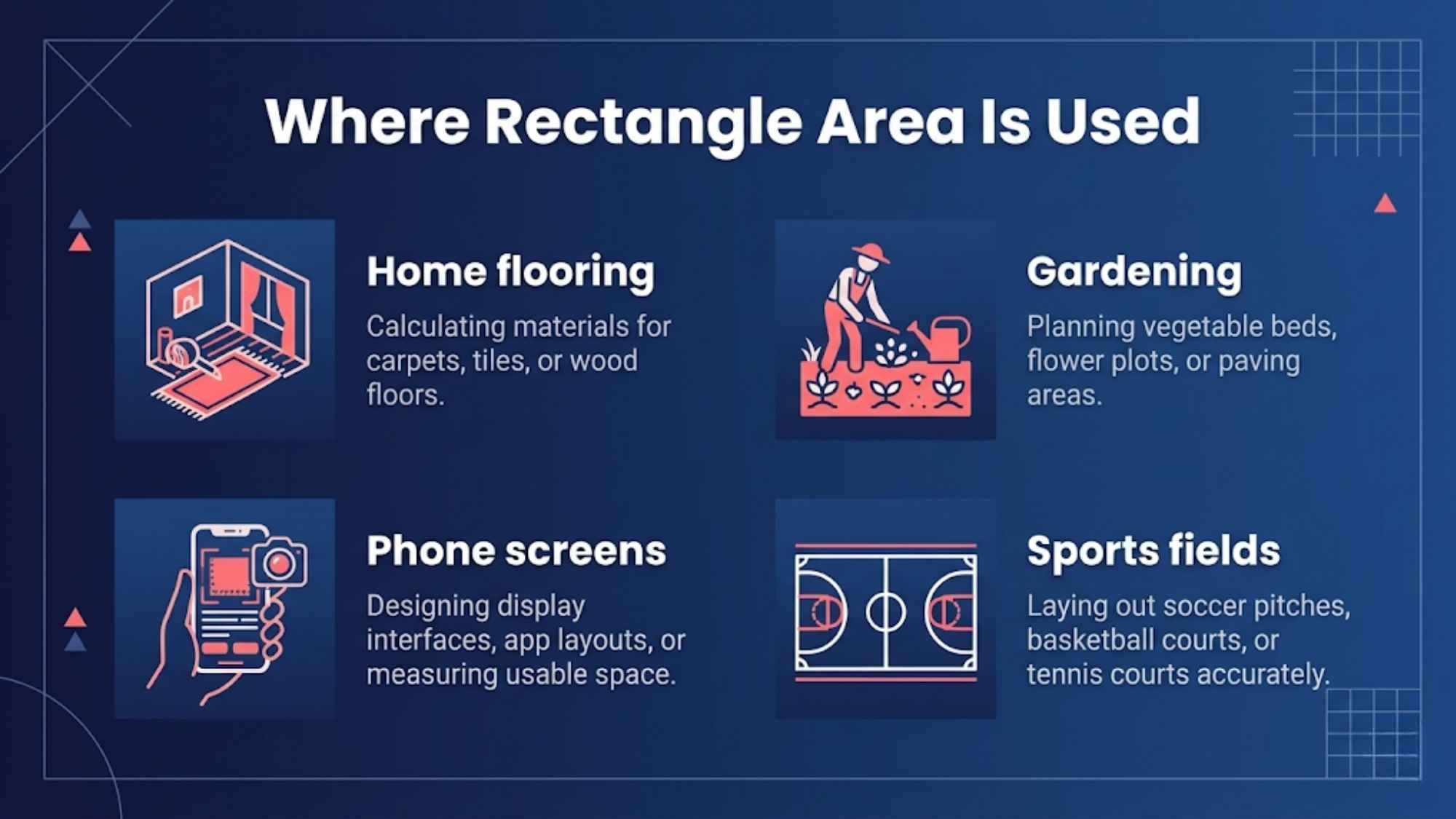
Home renovation: Calculating how many tiles, square feet of carpet, or cans of paint are needed for a rectangular room directly uses this formula.
Gardening: Figuring out how much topsoil, mulch, or fertilizer to buy for a rectangular garden bed is a pure area calculation.
Technology: Your phone's screen size is measured as a rectangle — length × width gives you the display area. Same for laptop screens and monitors.
Architecture & design: Architects calculate room areas to determine ventilation requirements, occupancy limits, and furniture layout plans.
Sports: Soccer fields, basketball courts, and Olympic swimming pools are all rectangles. Area calculations determine how much turf, paint, or water volume each requires.
According to the Common Core State Standards for Mathematics, area measurement is a foundational skill that underpins science, engineering, and everyday decision-making — which is why it appears across standardized testing from middle school through the SAT.
Common Mistakes Students Make When Calculating Rectangle Area
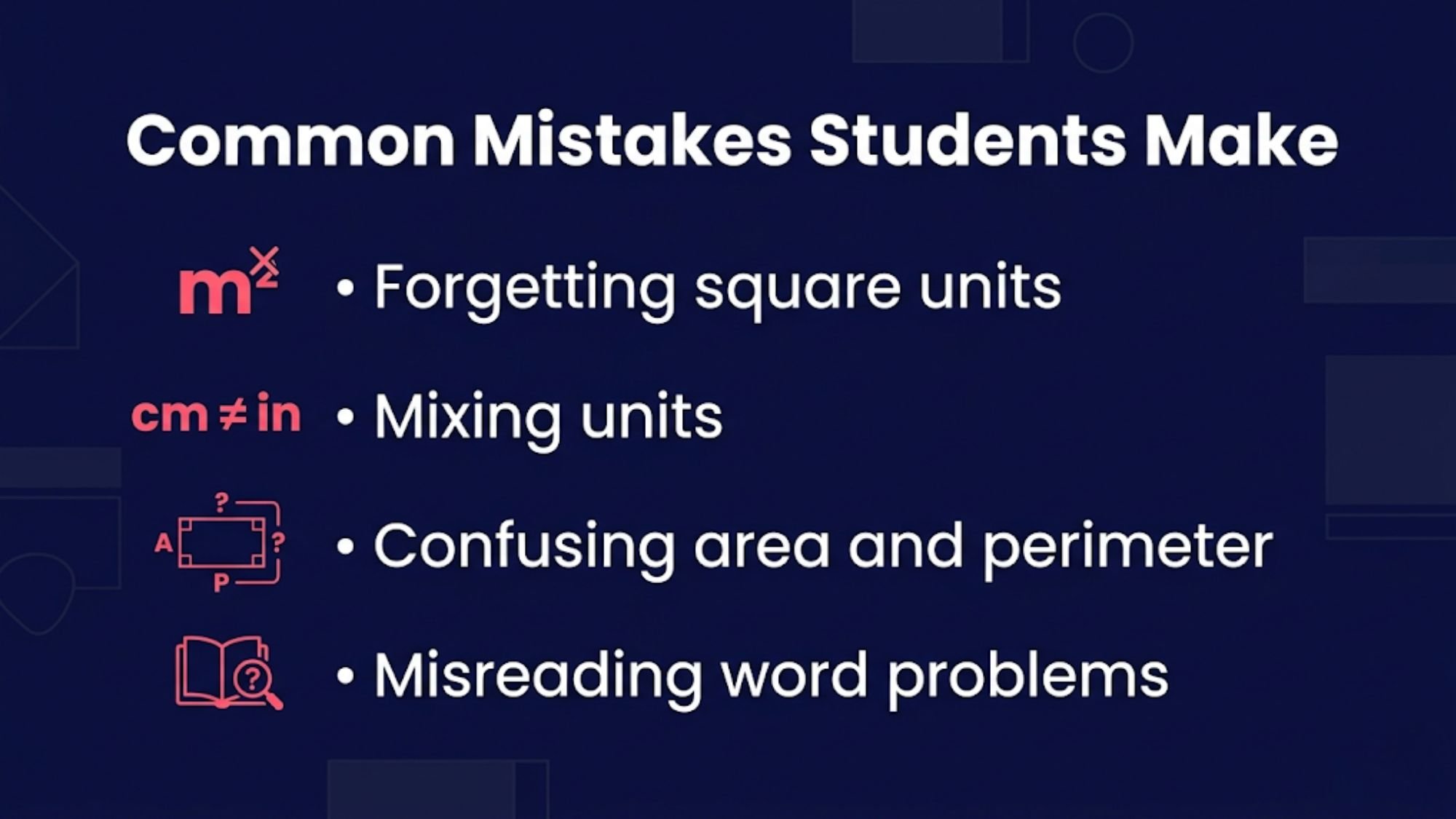
Knowing the formula is only half the battle. In our experience reviewing hundreds of student papers, here are the mistakes that cost marks most often — and exactly how to avoid them.
❌ Mistake #1: Forgetting to square the units
Writing "40 cm" instead of "40 cm²" is the single most common error we see — week after week. The calculation is correct; the missing superscript loses the mark.
Fix: Write "cm²" last, before you circle your answer.
❌ Mistake #2: Mixing units
Using meters for length and centimeters for width produces an answer that's off by a factor of 100.
Fix: Convert all measurements to the same unit before multiplying.
❌ Mistake #3: Confusing area and perimeter
Adding the sides (getting perimeter) when the question asks for area.
Fix: Underline the key word in the question — "area" or "perimeter" — before picking a formula.
❌ Mistake #4: Misreading word problems
Failing to extract the correct dimensions from a written scenario.
Fix: Read the problem twice. Underline every number and its unit. Identify what each number represents before writing the formula.
✅ Before You Submit" Checklist
Did I multiply (not add) the two sides?
Did I write square units (cm², m², ft²)?
Are both sides measured in the same unit?
If the problem gave perimeter, did I find the missing side first?
Did I answer the right question (area, not perimeter)?
FAQs
What is the formula for the area of a rectangle?
The formula is Area = Length × Width, also written as A = l × w or A = lw. The result is always expressed in square units — if the sides are in cm, the area is in cm².
How do you find the area if only the perimeter is given?
Use the perimeter formula P = 2(l + w) to solve for the missing side, then apply the area formula. Example: P = 30 cm, w = 5 cm → 30 = 2(l + 5) → l = 10 cm → Area = 10 × 5 = 50 cm².
What units are used for the area of a rectangle?
Always square units — cm², m², ft², in², etc. Area is two-dimensional, so the unit is always raised to the power of 2. This is one of the most frequently dropped marks on geometry exams.
Is the area of a rectangle calculated the same way as a square?
Yes — the formula is identical (l × w). For a square, length and width are equal, so the formula simplifies to side². A square is simply a special case of a rectangle where all four sides are equal.
Can two different rectangles have the same area?
Absolutely. For example, a 4 × 6 rectangle and a 3 × 8 rectangle both have an area of 24 square units. Area doesn't determine the shape's dimensions uniquely — which is why exam problems can specify area and still ask you to find the sides.
How is the area of a rectangle used in real life?
Any time you need to cover or fill a flat rectangular surface — buying flooring, planning a garden, sizing a phone screen, designing a room — you're calculating rectangle area. According to the National Council of Teachers of Mathematics, area and measurement concepts are among the most practically applied math skills students develop in secondary school.
Conclusion
You now have everything you need to solve any rectangle area problem with confidence — whether it's a clean two-number calculation or a multi-step word problem hiding the dimensions inside a sentence. Remember: Area = Length × Width, always expressed in square units, and always multiply (never add).
When exam nerves strike, fall back on the tiling trick: imagine covering the rectangle with square tiles, count rows × columns, and that's your area. And before you circle any answer, run through the checklist — did you multiply? Did you write cm²? Are your units consistent?
Knowing how to calculate the area of a rectangle is the foundation for surface area, volume, coordinate geometry, and a dozen other topics you'll encounter through high school and standardized testing. Get this one right, and you'll find the rest significantly easier.
If you haven't read our guide on the Perimeter of a Rectangle yet, that's your next stop — area and perimeter are tested together, and mastering both in the same study session is the most efficient use of your prep time.
Ready to raise your geometry grade?
Our tutors at HYE Tutors have helped hundreds of students go from confused to confident — in geometry and across all of high school math. Book your free session today and let's get you the score you're working toward.
⇒ Book a Free Session TodayRelated Articles from HYE Tutors
How To Solve the Pythagorean Theorem — the next big geometry skill after area
What Is PEMDAS? Rules, Examples, and Order of Operations Guide — master the order of operations used in every area calculation
How to Do Long Division — Step-by-Step Guide — strengthen the arithmetic foundation underneath all geometry problems
