

How to Transfer from Community College to University
Starting at a community college and aiming to transfer to a four-year university is one of the smartest academic moves a student can make — and it’s far more common than most people realize. But for many students and families, the transfer process feels unclear, even overwhelming. What GPA do you need? Which courses count? When do you apply? What goes in the essay?
At HYE Tutors, we’ve guided dozens of students through exactly this process — students who came to us uncertain about their path and left with acceptance letters from schools like UCLA, UC Berkeley, USC, and the University of Michigan. The process is genuinely achievable. It just requires a clear plan, early action, and a solid understanding of what universities are looking for.
This guide breaks down the transfer process step by step, covers the most important requirements, highlights the mistakes that cost students acceptances, and gives you the practical tools to approach your application with confidence. Whether you’re in your first semester at community college or already partway through, this is where to start.
“To transfer from community college to university, students should:
(1) choose target universities and confirm their transfer requirements,
(2) complete the required prerequisite courses and maintain a competitive GPA of 3.0 or higher,
(3) prepare application materials including transcripts, a personal statement, and letters of recommendation, and
(4) submit applications before official deadlines. Planning from your first semester at community college gives you the strongest possible chance of acceptance.”
How to Transfer from Community College to University: Step-by-Step Guide
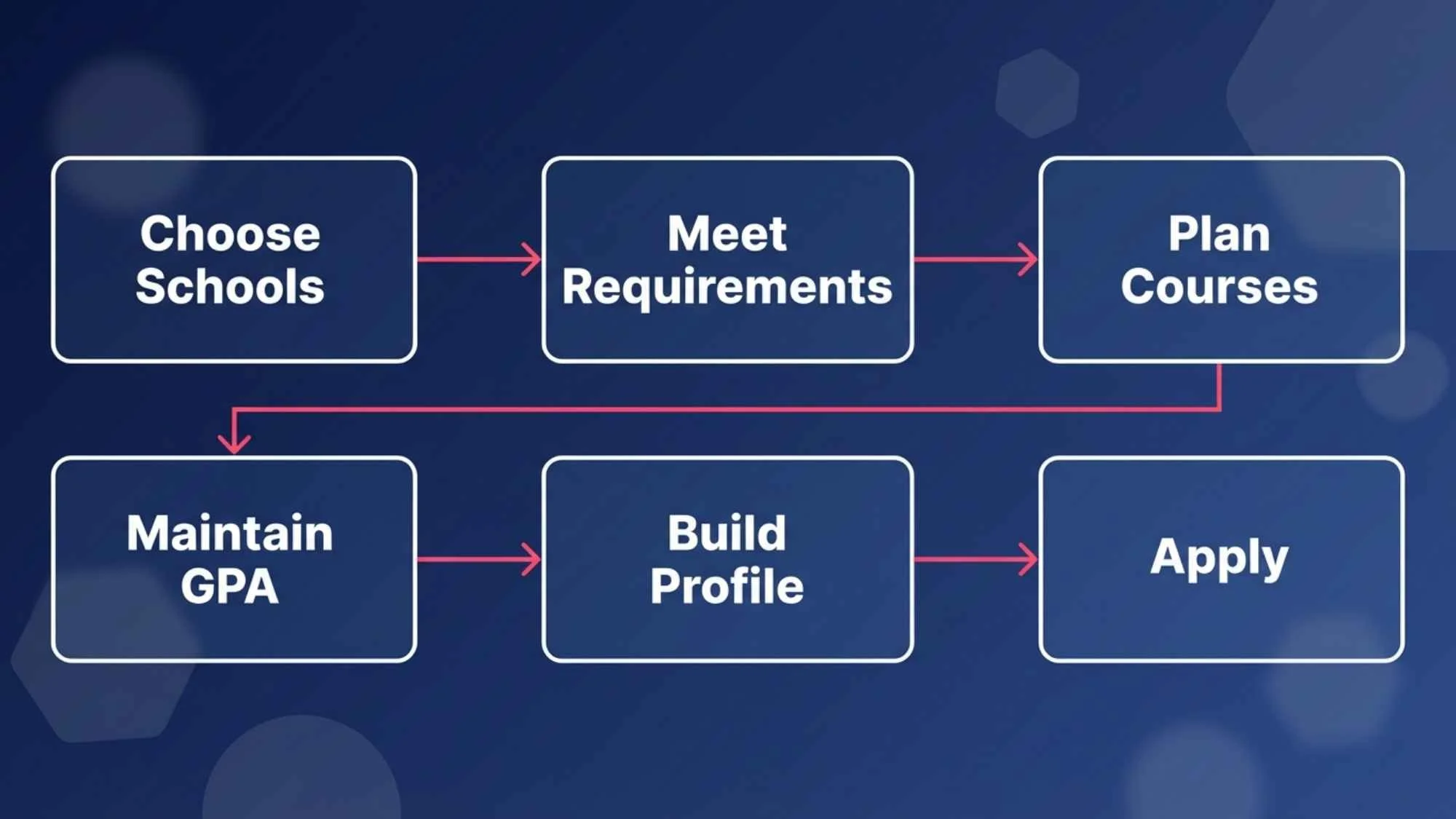
The transfer process looks complex from the outside, but it becomes straightforward when you treat it as a sequence of decisions made at the right time. Here’s the roadmap we walk students through at HYE Tutors.
Step 1: Decide Your Transfer Goals and Target Universities
The first and most important step is clarity about where you want to go and why. Students who start planning early — ideally in their first semester — have a significant advantage over those who wait until the semester before applying.
Declare or narrow down your intended major. Many universities have major-specific admission requirements for transfers. Knowing your field early shapes which courses you take.
Research universities that align with your goals. Consider program strength, location, campus culture, and cost of attendance.
Check transfer acceptance rates. These vary widely — some schools actively recruit community college transfers; others admit fewer than 20% of transfer applicants.
Build a balanced school list: include reach schools, target schools, and safety schools to maximize your options.
Step 2: Understand Transfer Requirements for Each University
Every university sets its own transfer criteria, and assuming they’re all the same is one of the most common — and costly — mistakes students make.
Minimum GPA requirements: Most universities require a 2.5 minimum; competitive programs expect 3.5 or higher.
Required prerequisite courses: Many programs (engineering, nursing, business) require specific courses completed before transfer.
Credit transfer policies: Not all credits transfer, and how they transfer differs by institution. Always verify with the registrar.
Application deadlines: Fall transfer deadlines are typically November–March; spring deadlines are July–October. Missing a deadline by a day can mean waiting a full year.
The U.S. Department of Education’s transfer guide, referenced in this article from Federal Student Aid, notes that students who research transfer pathways early are significantly more likely to complete their four-year degree on time.
Step 3: Plan Your Community College Courses Strategically
The courses you take at community college directly determine how smoothly you transfer — and how quickly you graduate from your four-year institution. Strategic course selection is one of the highest-leverage things you can do.
Use articulation agreements. Many states have formal agreements guaranteeing that specific community college courses transfer as equivalent credits. In California, ASSIST.org maps this in detail.
Complete IGETC (if in California). The Intersegmental General Education Transfer Curriculum satisfies lower-division general education for UC and CSU systems — it can save an entire semester of coursework.
Take major-specific prerequisites early. Don’t leave required courses to your last semester. Incomplete prerequisites are a leading reason transfer applications are rejected.
Avoid excess units. Some universities cap transferable credits at 60–70 units. Taking unnecessary courses beyond that limit wastes time and money.
Step 4: Maintain a Strong GPA (The Most Critical Factor)
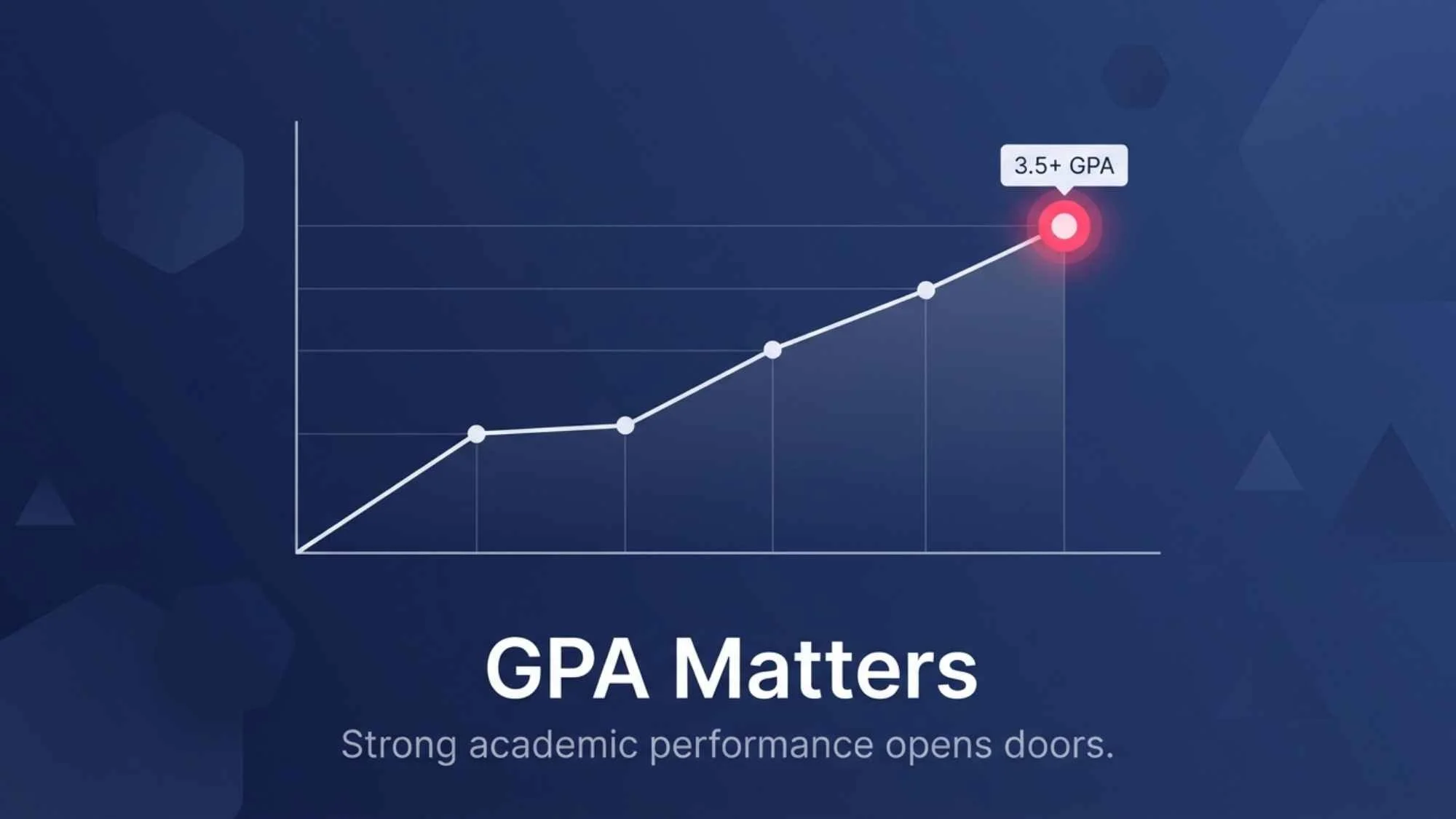
If there’s one number that carries more weight than any other in a transfer application, it’s your GPA. We’ve worked with students who had compelling stories and strong essays, but whose GPA held them back from their top choices. Don’t let that be you.
Aim for 3.5 or higher if targeting selective universities. A 3.0 is the floor for most schools; a 3.5+ opens significantly more doors.
Show an upward trend. A student who earned a 2.8 freshman year and a 3.7 sophomore year tells a more compelling story than one with a flat 3.2.
Address weak subjects immediately. If you’re struggling in a course, get help early — not after the midterm grade lands.
Consider retaking low-grade courses. Some community colleges allow grade forgiveness or replacement. Check your school’s policy.
Step 5: Build a Strong Academic and Extracurricular Profile
GPA and grades are necessary but not always sufficient, especially for competitive programs. Universities want to admit students who will contribute to campus life — not just students who performed well in courses.
Join clubs or student organizations — especially those related to your intended major or career interests.
Pursue leadership roles. President, treasurer, event organizer — any position that demonstrates initiative and responsibility.
Volunteer or complete community service. It shows character and civic engagement, both valued by admissions committees.
Seek internships, research, or work experience in your field. This is particularly impactful for competitive programs like nursing, engineering, and business.
We always tell students: your extracurricular profile doesn’t need to be long — it needs to be coherent. A student with two meaningful, sustained commitments reads better than one with twelve surface-level activities.
Step 6: Prepare Your Transfer Application Documents
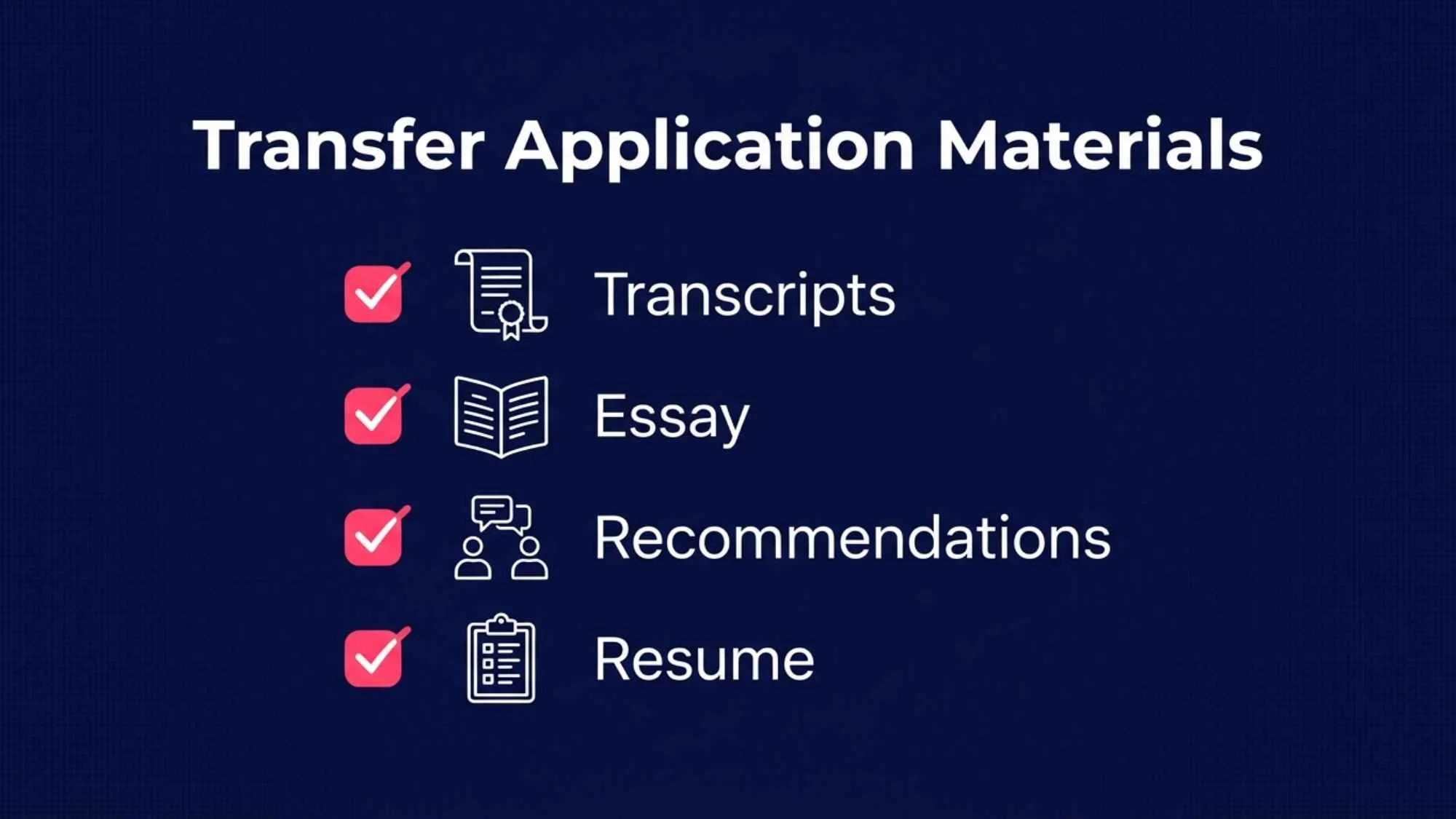
Most transfer applications require the same core set of materials. Start gathering these well before your deadline — last-minute requests for transcripts or recommendation letters are a frequent source of stress that’s entirely avoidable.
Official transcripts: Request these from your community college registrar early. Processing can take 1–2 weeks.
Personal statement or transfer essay: This is your single most important opportunity to differentiate yourself. (More on this in Step 7.)
Letters of recommendation: Most universities request 1–2 letters from professors who know your academic work. Ask at least 6–8 weeks before the deadline.
Resume or activity list: Not always required, but always worth including if given the option. It gives context to your extracurricular profile.
Proof of English proficiency: Required for international students. Submit TOEFL or IELTS scores within required ranges.
Step 7: Write a Strong Transfer Essay
The transfer essay is where your application becomes human. Admissions officers read thousands of transcripts. What they remember are the students who told a clear, honest, specific story about why they’re transferring and where they’re headed.
A strong transfer essay addresses four things:
Why you started at community college. Be direct and honest — financial reasons, family circumstances, uncertain major. Admissions committees respect clarity over spin.
What you’ve accomplished there. Academic growth, meaningful experiences, skills developed. Show what you did with the opportunity.
Why this specific university. Name programs, professors, research opportunities, or campus resources that connect to your goals. Generic essays are forgettable.
Where you’re going. Your academic and professional direction. Demonstrate that you have a plan — even if the details evolve.
We’ve reviewed hundreds of transfer essays at HYE Tutors. The ones that succeed are specific, honest, and forward-looking. The ones that don’t tend to be either too vague (“I want to challenge myself academically”) or too focused on hardship without showing growth.
Step 8: Apply Before Deadlines — and Apply Early
Deadlines in transfer admissions are hard stops, not guidelines. One day late is the same as not applying.
Know fall vs. spring intake timelines. Fall transfers are more common and typically have more spots available. Spring transfers exist at fewer schools.
Distinguish early and regular deadlines. Some universities offer priority review for early applicants. Submitting early can improve your odds.
Apply to 6–10 schools. Include a range of selectivity. Even strong applicants benefit from a safety net.
Use a spreadsheet to track every deadline, required document, and portal login. Juggling multiple applications across different systems is where organizational failures happen.
Step 9: Track Your Application and Respond to Offers
After you submit, the work isn’t over. Stay actively engaged with your applications throughout the review period.
Monitor application portals regularly. Universities sometimes request additional documents, clarifications, or supplemental essays. Missing these requests can result in an incomplete application.
Respond to offers promptly. Admission offers typically come with response deadlines of 2–4 weeks. Don’t let them lapse.
Compare financial aid packages carefully. The university with the best academic fit isn’t always the most affordable. Run the net cost numbers before deciding.
Put down your enrollment deposit once you’ve decided. This secures your spot and allows you to begin orientation planning.
Step 10: Transfer Credits and Enroll
The final step is making sure your hard-earned community college credits work for you at your new institution.
Request a credit evaluation from the university registrar as soon as you’re admitted. This determines which courses transfer and how they apply toward your degree.
Verify course equivalencies. A community college course labeled “English Composition” doesn’t automatically satisfy the same requirement at every university. Confirm with your academic advisor.
Attend orientation. Transfer student orientations are often separate from freshman orientations and specifically address credit evaluation, registration priority, and campus resources for transfer students.
Meet with an academic advisor immediately. Map out your remaining coursework toward graduation in your first week. Students who do this graduate faster and with less stress.
Community College Transfer Requirements: What You Need to Know

While every university sets its own standards, most four-year institutions look for a consistent set of requirements across transfer applicants:
GPA: Typically 2.5 minimum; competitive programs expect 3.3–3.7+
Credit completion: Most universities require 30–60 transferable semester units completed before applying
Prerequisite courses: Major-specific requirements must be completed (or in progress) at time of application
Official transcripts: From all colleges attended, including dual-enrollment courses taken in high school
Personal statement: Required by most universities; some (like UC schools) use a specific prompt format
Letters of recommendation: Typically 1–2 academic letters from professors
English proficiency: TOEFL or IELTS scores required for international students
The College Board offers a detailed breakdown of transfer admission criteria in this article — a reliable reference for comparing what different types of institutions prioritize in transfer applicants.
Common Mistakes to Avoid When Transferring
These are the errors we see most often — and the ones that are entirely preventable with early planning:
Not planning from the start. Students who wait until their second year to think about transfer often discover they’re missing prerequisite courses that take another full semester to complete.
Taking non-transferable courses. Remedial or developmental courses, certain vocational courses, and repeated failed courses often don’t transfer. Verify transferability before enrolling.
Missing application deadlines. There is no grace period. Build in a personal deadline at least one week before the official one.
Writing a generic transfer essay. “I want to grow academically” is not a story. Admissions readers want specific motivation, specific plans, and specific reasons for choosing their school.
Neglecting the GPA too long. A difficult first semester is recoverable — but only if you address it immediately. Waiting until the second year to turn around your GPA often leaves too few graded semesters to offset a low start.
Applying to too few schools. Even strong applicants face uncertainty. A list of 6–10 schools with varied selectivity protects you.
Tips to Increase Your Chances of Transfer Acceptance
Research from the National Student Clearinghouse, summarized in this article on transfer and mobility, consistently shows that students who receive structured academic advising and plan their transfer pathway early are significantly more likely to earn a four-year degree. Here are the practical strategies that move the needle:
Start planning in your first semester. The students with the smoothest transfers aren’t smarter — they started earlier.
Build real relationships with professors. Go to office hours. Ask questions. A professor who knows your work can write a specific, compelling recommendation letter — not a generic one.
Connect with your community college’s transfer center. Most have dedicated advisors, articulation agreements on file, and information about transfer admission guarantees (like TAG programs at UC schools).
Apply to multiple universities. Range your list intentionally: 2–3 reach schools, 3–4 target schools, 2–3 safety schools.
Stay organized with a tracking system. A simple spreadsheet with schools, deadlines, required documents, and portal logins prevents the disorganization that derails otherwise strong applications.
Get feedback on your essays before submitting. A second set of eyes — from a tutor, advisor, or trusted mentor — almost always improves the final product.
Need Help Transferring to University? HYE Tutors Can Help
Even with a clear roadmap, the transfer process involves a lot of moving parts — course planning, GPA management, essay drafting, deadline tracking, and financial aid decisions. We’ve seen motivated, capable students make avoidable mistakes simply because they were navigating it alone.
At HYE Tutors, we work with transfer students one-on-one to build a personalized plan from day one. Our advisors and tutors hold degrees from UC Berkeley, UCLA, Harvard, and other top universities, and many of them transferred themselves — they know this process from the inside.
How HYE Tutors Supports Transfer Students:
- Personalized transfer planning from first semester through enrollment
- GPA improvement tutoring in specific courses and subject areas
- Transfer essay coaching — brainstorming, drafting, and revision
- Application review and deadline management support
- 1-on-1 sessions built around your schedule and target schools
Transfer Checklist: Before You Apply
Use this checklist to confirm you’re ready to submit your transfer application:
🎯 University Transfer Checklist
FAQs
Is it easy to transfer from community college to university?
Transferring is very achievable, but it requires planning. Students who research requirements early, maintain a strong GPA, and prepare their applications carefully have excellent success rates — especially at schools with established transfer pathways from community colleges.
What GPA do I need to transfer?
Most universities require a minimum GPA of 2.5, but competitive schools and programs typically expect 3.3 or higher. For programs like engineering, nursing, or business at selective universities, a 3.5+ is often the realistic floor. Check each school’s requirements individually.
How many credits transfer from community college?
Most universities accept up to 60–70 transferable semester credits from a community college. Credits beyond that cap often don’t count toward your degree. Always verify transferability with the receiving institution before enrolling in courses.
When should I apply to transfer?
Applications for fall semester typically open in October–November and are due by November–March, depending on the school. Spring transfer deadlines are usually July–October. Begin your application at least 3–4 months before the deadline to allow time for essays and recommendations.
Can I transfer after one year of community college?
Yes — some universities accept transfers after just one year (30 semester units). However, most four-year institutions prefer applicants who have completed 60 transferable units (two full years). Check each school’s policy. The Community College Research Center at Columbia University offers comprehensive data on transfer outcomes by institution type.
Does my high school GPA matter when transferring?
Generally, no. Once you have at least 30 transferable college credits, most universities base their transfer decision entirely on your college GPA and coursework. High school records become largely irrelevant — which is great news for students who struggled in high school and have since demonstrated strong academic performance.
Conclusion
Learning how to transfer from community college to university is less about navigating a complicated system and more about executing a clear plan at the right time. Choose your target schools early, understand their requirements, take the right courses, protect your GPA, build a strong profile, and tell your story honestly in your application. Ten steps, done consistently, lead to an acceptance letter.
We’ve watched students who arrived at community college uncertain about their future leave with admission to some of the most competitive universities in the country. What made the difference wasn’t some secret advantage — it was planning early, getting the right support, and staying consistent. That path is available to you too.
If you’d like a partner in building your transfer plan, our team at HYE Tutors is ready to help. Let’s get started.