

How to Solve Optimization Problems in Calculus
If you’ve ever stared at a calculus word problem and thought, “I don’t even know where to start” — you’re not alone. Optimization problems are one of the most common sticking points we see at HYE Tutors, and they trip up students at every level, from AP Calculus AB to first-year university courses.
The frustration usually isn’t the math itself. It’s the translation — turning a paragraph of words into a solvable equation. Once that step clicks, everything else falls into place. And that’s exactly what this guide is designed to help you do.
Optimization is genuinely important beyond the classroom. Businesses use it to maximize profit. Engineers use it to design structures with minimum material. Economists use it to model efficiency. Even GPS systems use optimization principles to find the shortest route. Understanding how to solve these problems doesn’t just help you pass your exam — it builds a way of thinking that carries into almost every technical field.
In this guide, we’ll break down optimization problems step-by-step, walk through a complete worked example, cover the most common mistakes students make, and show you exactly how to approach these problems with confidence.
Optimization Problems in Calculus
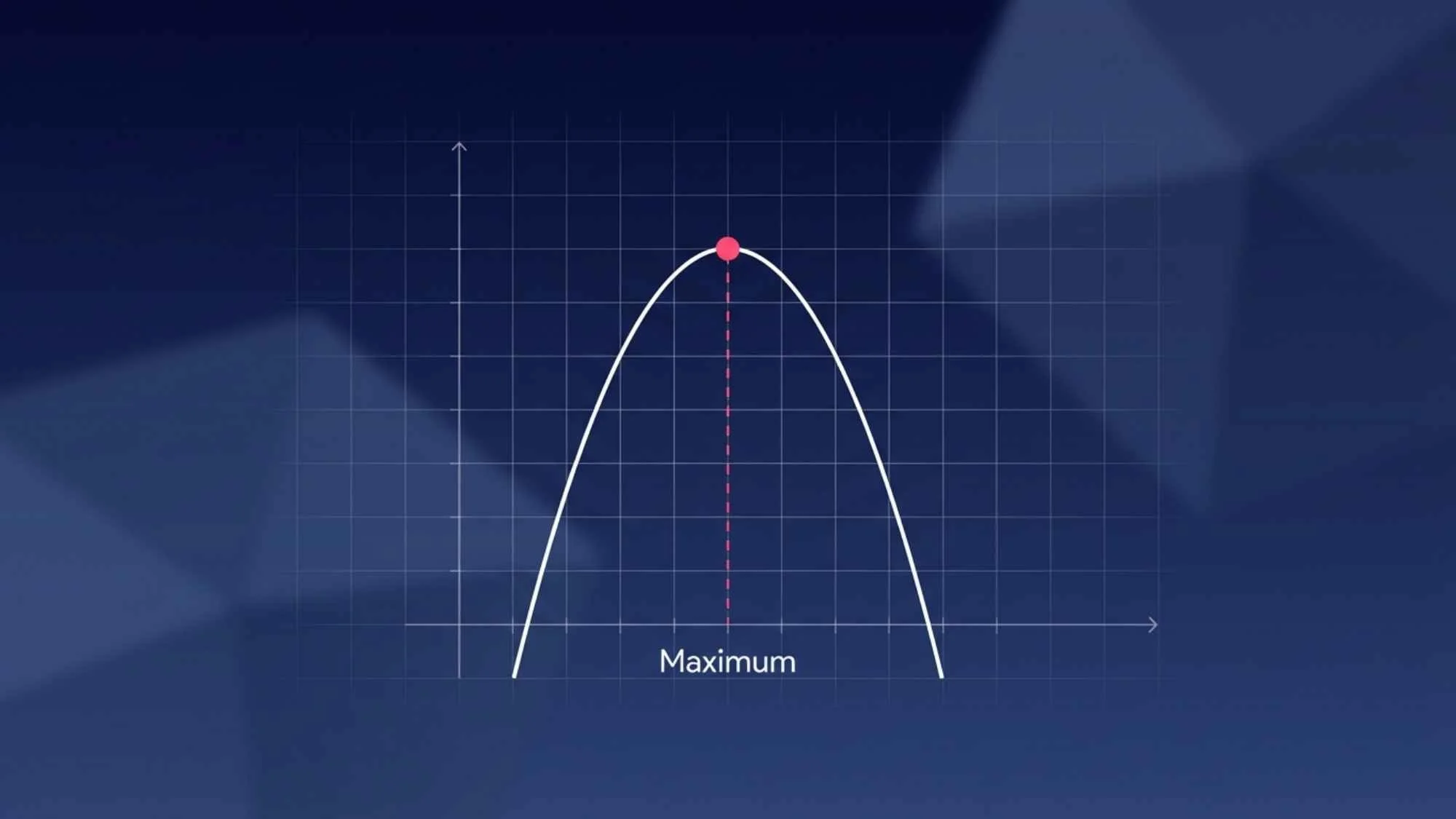
Optimization problems in calculus involve finding the maximum or minimum value of a function using derivatives. The process has four core steps: identify the objective function, take its derivative, solve for critical points, and test whether each point is a maximum or minimum. Common applications include maximizing profit or area, minimizing cost or time, and solving real-world engineering and physics challenges.
Optimization Problems in Calculus: What You Need to Know
An optimization problem asks a simple question: what value of a variable makes a function as large — or as small — as possible?
In calculus, the answer comes through derivatives. Because a derivative tells you the rate of change of a function, setting it equal to zero identifies the points where the function stops increasing and starts decreasing (or vice versa). These are called critical points, and they’re where your maximum or minimum values hide.
There are two broad types of optimization problems:
Maximization problems — You want the biggest possible value. Classic examples: maximum area enclosed by a fence, maximum profit from a pricing model, maximum volume of a container.
Minimization problems — You want the smallest possible value. Classic examples: minimum cost of materials, minimum time to complete a journey, minimum surface area of a can.
Where students most often struggle isn’t with differentiation — it’s with the setup. Translating a written problem into a mathematical equation requires careful reading, clear variable definitions, and the ability to spot the constraint (the rule that limits what’s possible). We’ll break all of that down in the step-by-step section below.
According to this article from Khan Academy, optimization is one of the most practically relevant applications of calculus — and one of the highest-yield topics for AP exam preparation.
Real-Life Examples of Optimization Problems
One reason we encourage students to care about optimization is how concretely it maps onto problems people actually solve. Here are a few of the most common categories:
Business and economics: A company wants to set a price that maximizes total revenue. Too high and sales drop; too low and margin disappears. Calculus finds the sweet spot.
Geometry and design: A manufacturer needs to build a rectangular box with a fixed volume using the least amount of cardboard. Minimizing surface area while holding volume constant is a classic optimization setup.
Physics and engineering: What angle maximizes the range of a projectile? What shape minimizes drag on an aircraft wing? These are optimization problems solved with derivatives.
Agriculture and land use: A farmer with a fixed length of fencing wants to enclose the largest possible area. (We’ll solve this exact problem below.)
Shortest path problems: Finding the quickest route between two points, or the path that minimizes energy use, is foundational in both physics and computer science.
This article from Math Is Fun offers an accessible breakdown of how maxima and minima appear across geometry and everyday life — a great companion read for building intuition before tackling exam problems.
Solve Optimization Problems in Calculus (Step-by-Step)
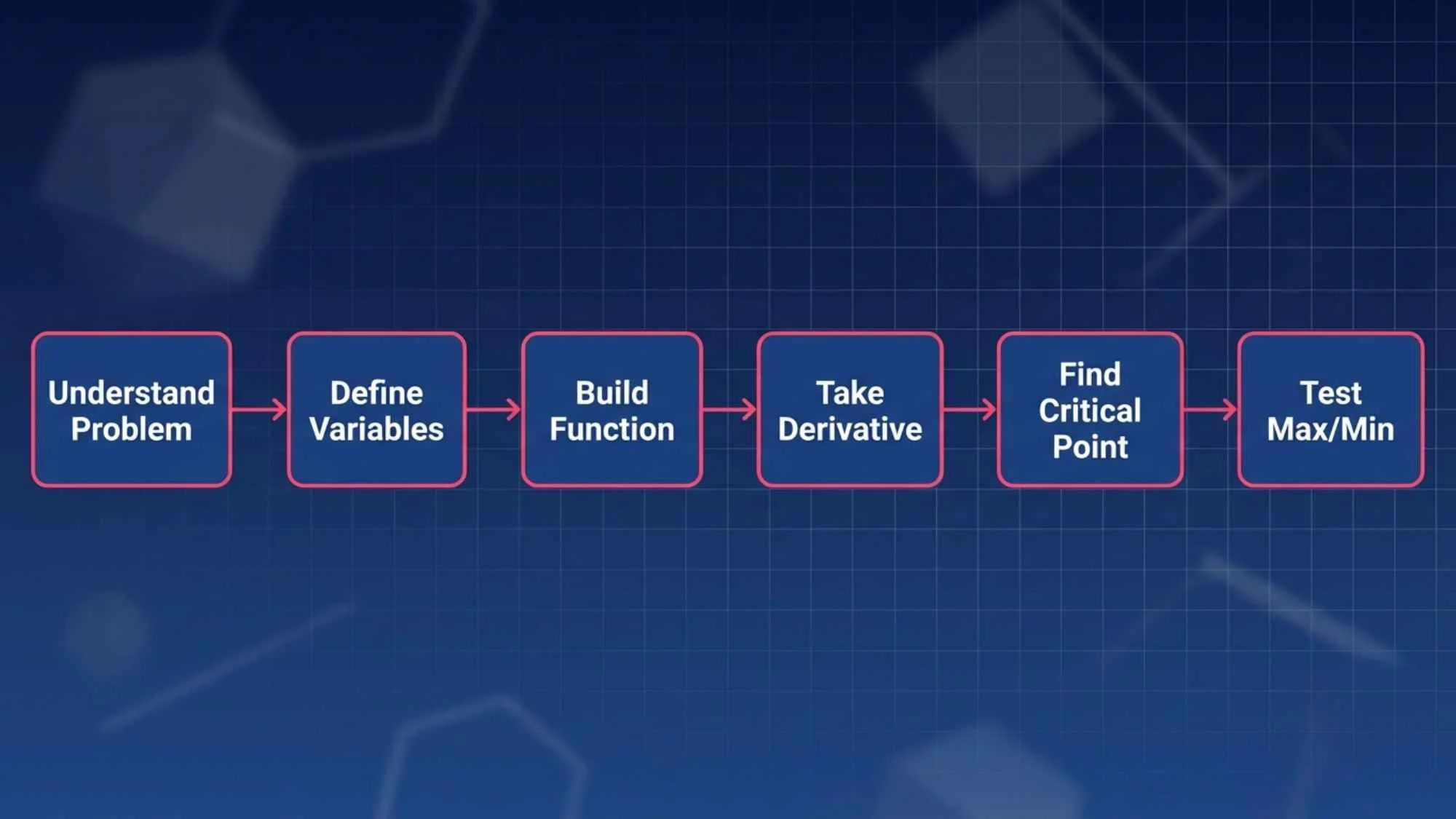
This is the section most students bookmark. Follow these six steps on every optimization problem and you’ll have a reliable process — even when the problem looks unfamiliar.
Step 1: Understand the Problem
Before writing a single equation, read the problem twice. Ask yourself:
What quantity am I trying to maximize or minimize?
What are the variables involved?
Is there a constraint — a rule limiting the possible values?
This is where most students lose points: they rush into math before they’ve understood what’s being asked. We’ve worked with students who could differentiate flawlessly but set up the wrong function entirely — because they skipped this step. If the problem involves a physical shape, sketch a diagram. Label everything. It takes 30 seconds and saves several minutes of confusion later.
Step 2: Formulate the Objective Function
The objective function is the equation that represents what you’re trying to optimize. Writing it down clearly is the most important step in the entire process.
Convert the words into a mathematical expression
Identify the constraint equation (usually given in the problem)
Use the constraint to eliminate one variable — your objective function must be in terms of a single variable before you differentiate
For example: if you’re maximizing area A = length × width, and the constraint says the perimeter is fixed at 200 m (so 2l + 2w = 200), use the constraint to express width in terms of length: w = 100 − l. Then substitute: A = l(100 − l). Now you have one variable, and you’re ready for Step 3.
Step 3: Take the Derivative
Differentiate your objective function with respect to the single variable you’ve identified. Apply standard differentiation rules — power rule, product rule, chain rule — as needed.
Work carefully and show every step (especially in exams)
If the function is complex, simplify before differentiating
Label your result clearly: dA/dx, dC/dt, dV/dr — whatever fits the problem
A simple trick: if your derivative looks much more complicated than the original function, it’s worth double-checking that you simplified the objective function as much as possible before differentiating. A clean function produces a clean derivative.
Step 4: Find Critical Points
Set your derivative equal to zero and solve for the variable. These are your critical points — the candidates for your maximum or minimum.
Solve the equation: f’(x) = 0
Check whether the domain has endpoints — in closed-interval problems, endpoints must be tested too
If you get multiple critical points, list them all; you’ll test each one in the next step
Step 5: Test Maximum or Minimum
Finding a critical point doesn’t tell you whether it’s a maximum, minimum, or neither. You need to test it. Two methods work:
Second derivative test: Compute f’’(x). If f’’ < 0 at the critical point, it’s a maximum. If f’’ > 0, it’s a minimum. If f’’ = 0, the test is inconclusive — use the first derivative test instead.
First derivative test: Check the sign of f’(x) on either side of the critical point. If f’ changes from positive to negative, it’s a maximum. Negative to positive — a minimum.
Most students default to the second derivative test because it’s faster. Just remember: it only works when the second derivative is not zero at the critical point.
Step 6: Interpret the Answer
This is the step that separates a complete solution from an incomplete one — and it’s the one students most often forget under exam pressure.
Convert your mathematical answer back into the real-world context of the problem
Check units — if the question asked for metres, your answer should be in metres
Check reasonableness — does the answer make physical sense? A box cannot have a negative dimension.
Re-read the original question — sometimes it asks for the optimal value of the function (e.g., maximum area), not just the variable (e.g., the dimensions)
Common Mistakes Students Make in Optimization Problems
We’ve reviewed thousands of student solutions at HYE Tutors. These are the errors we see most consistently — and the ones that cost the most marks:
Not defining variables clearly. If you don’t state what x represents, a small confusion early on cascades into a wrong answer.
Setting up the wrong objective function. Students sometimes maximize the constraint and minimize the objective by accident. Always label which equation is which.
Forgetting to use the constraint. You cannot differentiate a function with two unknowns. The constraint is what lets you eliminate one variable. Skipping this step makes the problem unsolvable.
Not verifying the critical point type. Just because f’(x) = 0 doesn’t mean you’ve found a maximum or minimum. Always test.
Ignoring the domain. Physical problems have boundaries. A length cannot be negative. A probability cannot exceed 1. Always check that your answer falls within the valid range.
Arithmetic errors in differentiation. A sign error or dropped coefficient in the derivative produces a wrong critical point. Slow down and check the derivative before solving.
Practice Example with Full Solution
Let’s walk through a complete optimization problem — the kind you’ll see on AP Calculus exams and in first-year university courses.
| Problem | A farmer has 200 metres of fencing. He wants to enclose a rectangular area. What dimensions maximise the enclosed area? |
|---|---|
| Variables | Let length = x, width = y. Constraint: 2x + 2y = 200, so y = 100 − x. |
| Objective | Maximise Area A = x × y = x(100 − x) = 100x − x² |
| Derivative | dA/dx = 100 − 2x |
| Critical pt | Set 100 − 2x = 0 → x = 50 |
| 2nd deriv. | d²A/dx² = −2 < 0 → confirms maximum |
| Answer | x = 50 m, y = 50 m. Maximum area = 2,500 m². The optimal shape is a square. |
→ Tutor Insight
Notice how the constraint (fixed perimeter) did all the heavy lifting. Once we used it to write y in terms of x, the problem reduced to a straightforward single-variable maximization. That substitution step is the key move in almost every optimization problem.
Tips to Master Optimization Problems Faster
Research consistently shows that structured, deliberate practice — not passive re-reading — is what builds mathematical fluency. This article from the American Psychological Association confirms that practice testing produces stronger long-term retention than any other study method. Here’s how to apply that to optimization:
Practice the setup, not just the calculus. Find problems and stop after writing the objective function — before differentiating. Quiz yourself on whether you set it up correctly. This is the weakest part of most students’ process.
Categorize problems as you practice. Area/perimeter, volume/surface area, revenue/cost, distance/time. Recognizing the type of problem speeds up equation setup dramatically.
Memorize the standard formulas. Area of a rectangle, circumference of a circle, volume of a cylinder. You’ll use these constantly and shouldn’t be deriving them mid-problem.
Always draw a diagram. Even for non-geometric problems, a quick sketch of what’s being maximized or minimized helps catch setup errors early.
Write out every step in exams. Partial credit is real. Even if your final answer is wrong, clear reasoning earns marks.
When Should You Get Help with Optimization Problems?
Optimization problems are one of those topics where a small gap in understanding — a shaky grasp of derivatives, or uncertainty about constraints — can make the whole unit feel impenetrable. In our experience, students who struggle here usually fall into one of these situations:
You understand derivatives in isolation but freeze when they appear inside a word problem
Your exam scores are consistently lower than expected given the time you put into studying
You can follow a solution when it’s explained, but can’t replicate the steps independently
You feel anxious about calculus in general and need to rebuild confidence from the ground up
These are all completely solvable with the right support. As this article from Edutopia explains, 1-on-1 tutoring is one of the most effective educational interventions available — particularly for subjects that require procedural fluency, like calculus.
Get Expert Help to Master Optimization Problems in Calculus
At HYE Tutors, we’ve helped hundreds of students go from confused to confident in calculus — including students who came to us convinced they “just weren’t math people.” Every single one of them was capable. They just needed someone to slow down, explain the logic behind the steps, and give them the structured practice to make it stick.
Our tutors hold degrees from top universities including Berkeley, Harvard, UCLA, and MIT. We specialize in making hard math feel manageable — not by simplifying it, but by building the foundation that makes it make sense.
What HYE Tutors Offers:
- Personalized 1-on-1 calculus tutoring tailored to your course and exam
- Clear, step-by-step guidance on derivatives, optimization, and beyond
- Patient, encouraging tutors who meet you exactly where you are
- Proven results — improved grades, stronger exam performance, real confidence
Conclusion
Optimization problems in calculus are challenging — but they’re not mysterious. Behind every intimidating word problem is the same process: define your variables, write your objective function, use your constraint, differentiate, find the critical point, and test it. Six steps. Every time.
The students we’ve seen make the biggest gains are not the ones who study the hardest — they’re the ones who slow down at the setup, resist the urge to jump straight to differentiation, and build a consistent process they trust. That’s learnable. And it’s worth learning, because optimization is everywhere: in engineering, in economics, in design, and in the algorithms behind the apps you use every day.
If this guide helped you, practice the worked example on your own without looking at the solution. Then find a second problem and try the full six steps. Repetition with reflection is how this becomes second nature.
And if you’d like a tutor in your corner to accelerate the process — we’re here.