

How to Get Into Medical School – a Step by Step Guidebook

Getting into medical school is one of the most challenging yet rewarding journeys aspiring physicians can undertake. With acceptance rates hovering around 36% and thousands of qualified applicants competing for limited spots, understanding how to get into medical school requires strategic planning, academic excellence, and meaningful clinical exposure.
This comprehensive guide breaks down everything you need to know—from GPA and MCAT requirements to school-specific strategies for Harvard, Stanford, and Johns Hopkins, plus pathways for applicants with lower GPAs. Whether you're just starting your pre-med journey or preparing to apply, this evidence-based roadmap will help you navigate the competitive admissions landscape with confidence and clarity
Medical School Admissions Calculator
Assess your competitiveness and get personalized recommendations for medical school using this module!
What Do You Need to Get into Medical School?
Understanding what you need to get into medical school begins with recognizing the multifaceted nature of medical school admissions. Admissions committees evaluate applicants holistically, looking beyond grades to assess character, commitment to medicine, and readiness for the rigors of medical training.
Required Academic Credentials
The foundation of any medical school application starts with solid academic credentials:
Bachelor's Degree: You must complete a four-year undergraduate degree from an accredited institution. While any major is acceptable, most successful applicants complete rigorous coursework that demonstrates critical thinking and scientific literacy.
Pre-Med Coursework: Medical schools require specific prerequisite courses, typically including one year each of biology with lab, general chemistry with lab, organic chemistry with lab, physics with lab, and mathematics (statistics or calculus). Many schools also recommend or require biochemistry, English, psychology, and sociology.
GPA and Academic Rigor: Competitive applicants typically maintain a cumulative GPA of 3.5 or higher, with a science GPA (Biology, Chemistry, Physics, Math) ideally above 3.4. Top-tier medical schools often see average GPAs approaching 3.8 to 3.9.
MCAT Requirements
The Medical College Admission Test (MCAT) is a standardized exam that assesses problem-solving, critical thinking, and knowledge of natural, behavioral, and social science concepts.
Typical Score Range: MCAT scores range from 472 to 528. Competitive applicants generally score 510 or higher, while top medical schools expect scores of 515 to 520+. The national median typically falls around 501-502.
Competitive Schools vs Easier Schools: Elite institutions like Harvard and Stanford see median MCAT scores of 520+, while schools with higher acceptance rates may accept students with scores in the 500-505 range.
Clinical & Extracurricular Experience
Medical schools seek applicants who understand the realities of healthcare and demonstrate genuine commitment to serving patients.
Shadowing: Observing physicians across various specialties shows your understanding of the profession
Research: Involvement in scientific research demonstrates intellectual curiosity and analytical skills
Volunteering: Community service, especially in healthcare settings, reveals your commitment to service
Patient-Facing Roles: Clinical experience through positions like medical scribing, EMT work, or hospital volunteering provides direct patient interaction
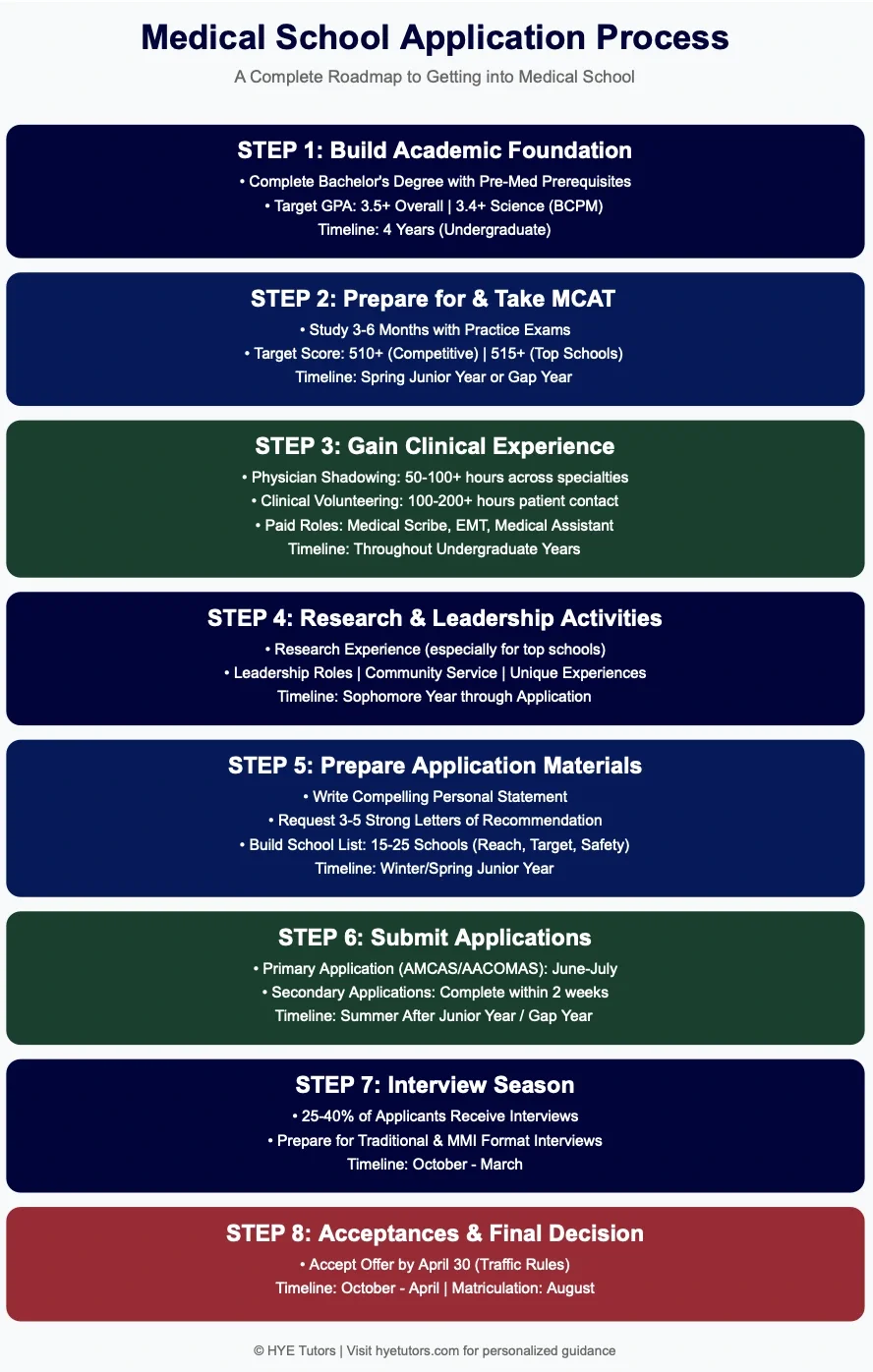
How to Get into Medical School (Step-by-Step Process)
Following a structured approach to how to get into medical school dramatically increases your chances of acceptance. Here's a comprehensive roadmap to guide you from freshman year through matriculation.
Step 1 — Build a Competitive Academic Profile
Your academic record forms the backbone of your application and often serves as the first screening criterion.
GPA Benchmarks: Aim for a cumulative GPA of 3.5+ and a science GPA of 3.4+. For top-tier schools, target 3.8+. Remember that consistency matters—an upward trend can offset a weaker start, but sustained excellence is ideal.
Course Selection Strategy: Challenge yourself with upper-level science courses beyond minimum requirements. Taking biochemistry, physiology, genetics, or anatomy demonstrates academic courage and prepares you for medical school rigor.
Addressing "How Hard Is It to Get into Medical School?": The difficulty varies significantly. While the average acceptance rate across all applicants is approximately 36%, individual experiences differ based on GPA, MCAT scores, application quality, and school selectivity. Strategic planning and authentic experiences make the process manageable.
Step 2 — Prepare Early for the MCAT
The MCAT is arguably the most important standardized component of your application.
Timeline: Most students take the MCAT during spring of their junior year or early in their gap year. Allow 3-6 months of dedicated preparation, depending on your baseline knowledge and study schedule.
Recommended Study Resources: High-yield resources include AAMC official practice materials, comprehensive review books from Kaplan or Princeton Review, third-party question banks like UWorld, and content review through platforms such as Khan Academy.
Score Expectations for Top Schools: Harvard, Stanford, and Johns Hopkins typically see median MCAT scores of 520-522. Mid-tier schools often accept students scoring 508-512, while DO schools and schools with higher acceptance rates may consider scores in the 500-505 range.
Step 3 — Gain Meaningful Clinical Experience
Admissions committees want to see that you understand what being a physician truly involves.
Hospital Volunteering: Regular volunteering in clinical settings demonstrates your comfort in healthcare environments and exposes you to patient populations and hospital operations.
Scribing: Working as a medical scribe provides unparalleled exposure to clinical decision-making, medical documentation, and physician-patient interactions.
Shadowing Physicians: Observing doctors across multiple specialties—primary care, surgery, emergency medicine—gives you diverse perspectives on medical practice and helps you articulate why you want to be a physician.
Step 4 — Strengthen Your Application Materials
Your written materials and letters of recommendation bring your story to life.
Personal Statement: Craft a compelling narrative that explains your motivation for medicine, highlights formative experiences, and demonstrates self-reflection. Avoid clichés and show rather than tell.
School-Specific Secondary Essays: After submitting your primary application through AMCAS or AACOMAS, you'll receive secondary applications. Tailor each response to the specific school's mission, programs, and values.
Letters of Recommendation: Secure strong letters from science professors who know you well, a physician you've shadowed or worked with, and potentially a non-science faculty member or employer. Aim for 3-5 letters that speak to different aspects of your candidacy.
Step 5 — Apply Smartly Through AMCAS/AACOMAS
Strategic school selection can make or break your application cycle.
School Selection Strategy: Apply to 15-25 schools with a balanced list including "reach" schools (above your stats), "target" schools (matching your stats), and "safety" schools (below your stats). Research each school's mission fit and consider factors like location, curriculum style, and patient populations.
MD vs DO Pathways: Doctor of Osteopathic Medicine (DO) programs offer an alternative pathway with a holistic, whole-person approach to medicine. DO schools typically have slightly lower average MCAT and GPA requirements than MD schools, and graduates can practice in all specialties.
Step 6 — Prepare for Interviews (MMI + Traditional)
The interview is your opportunity to demonstrate interpersonal skills, ethical reasoning, and genuine passion for medicine.
Answering Common Questions: Prepare thoughtful responses to questions like "Why medicine?", "Tell me about yourself", "Describe a challenge you've overcome", and "Why our school?"
What Percentage of Medical School Applicants Get an Interview?: Nationally, approximately 25-40% of applicants receive at least one interview invitation. At highly selective schools, interview rates may be 5-15%, while schools with higher acceptance rates interview 40-60% of qualified applicants.
Behavioral vs Situational Questions: Traditional interviews include behavioral questions about past experiences, while Multiple Mini Interviews (MMI) present ethical scenarios requiring you to think on your feet. Practice both formats with mock interviews.
How Hard Is It to Get into Medical School?
The question of how hard it is to get into medical school depends on multiple factors including your academic profile, clinical experiences, application strategy, and the selectivity of schools you target.
According to the Association of American Medical Colleges (AAMC), approximately 22,000 students matriculate into U.S. MD programs annually from roughly 55,000-60,000 applicants. When including DO programs, about 36% of applicants gain acceptance to at least one medical school. However, this varies widely by individual credentials.
Difficulty Contributors include:
GPA: Below 3.0 makes acceptance extremely challenging; 3.5+ significantly improves odds
MCAT Score: Scores below 500 correlate with very low acceptance rates; 510+ opens more doors
School Selectivity: Top-tier schools accept 2-4% of applicants; some newer or less competitive schools accept 15-20%
Interview Performance: Converting an interview to acceptance requires strong communication skills and authentic engagement
Clinical Exposure: Lack of meaningful patient interaction raises red flags about your commitment.
| Applicant Profile | Estimated Acceptance Rate |
|---|---|
| GPA 3.8+, MCAT 515+ | 80–90% |
| GPA 3.5–3.7, MCAT 508–514 | 50–70% |
| GPA 3.2–3.4, MCAT 500–507 | 20–35% |
| GPA < 3.2, MCAT < 500 | < 10% |
Easy vs Hard Medical Schools to Get Into
Understanding the landscape of easiest medical schools to get into versus the hardest medical schools to get into helps you build a balanced school list.
What Is the Easiest Medical School to Get Into?
"Easier" is relative—all medical schools are competitive. However, some institutions have higher acceptance rates due to newer programs, mission-focused recruitment, or regional preferences.
Schools often cited with higher acceptance rates (15-20%) include:
University of North Dakota School of Medicine
University of Missouri-Kansas City School of Medicine
Meharry Medical College
Morehouse School of Medicine
Central Michigan University College of Medicine
These schools often prioritize mission fit, such as serving rural populations or underrepresented communities, over pure statistics. "Easier" doesn't mean "less competitive"—you still need solid credentials and authentic alignment with their mission.
For DO schools, institutions like Rocky Vista University College of Osteopathic Medicine and Liberty University College of Osteopathic Medicine have acceptance rates around 10-15%, higher than most MD programs.
What Is the Hardest Medical School to Get Into?
The most selective medical schools maintain acceptance rates of 2-4% and expect exceptional credentials:
Harvard Medical School: ~3% acceptance rate, median MCAT 520, median GPA 3.9
Stanford University School of Medicine: ~2.3% acceptance rate, median MCAT 521, median GPA 3.9
Johns Hopkins University School of Medicine: ~3.5% acceptance rate, median MCAT 521, median GPA 3.93
University of California, Los Angeles (UCLA): ~2.4% acceptance rate, median MCAT 517, median GPA 3.87
Columbia University Vagelos College of Physicians and Surgeons: ~3.4% acceptance rate, median MCAT 521, median GPA 3.9
These institutions seek applicants with extraordinary research accomplishments, unique perspectives, leadership roles, and near-perfect academic records.
How to Get into Top Medical Schools (Harvard, Stanford, Yale, UCLA, Columbia, Johns Hopkins, NYU)

Understanding how to get into Harvard medical school, Stanford, and other elite programs requires recognizing what sets their admitted students apart.
How to Get into Harvard Medical School
Harvard Medical School (HMS) is consistently ranked among the world's best medical schools, with an acceptance rate around 3%.
MCAT/GPA Expectations: Median MCAT of 520, median GPA of 3.9. Virtually all admitted students have near-perfect academic records.
Research Activities: HMS heavily values research experience. Most admitted students have significant research accomplishments, including publications, presentations, or substantive involvement in meaningful projects.
Letter Strength: HMS expects exceptional letters from distinguished faculty who can speak to your intellectual abilities, character, and potential for leadership in medicine.
Unique Criteria: HMS looks for future leaders in medicine, research, and healthcare policy. Demonstrate how you'll contribute to advancing medicine beyond clinical practice.
How to Get into Stanford Medical School
Stanford seeks applicants who will become leaders and innovators in medicine.
Statistics: Approximately 2.3% acceptance rate, median MCAT 521, median GPA 3.9.
Distinctive Factors: Stanford values intellectual curiosity, creativity, and commitment to improving healthcare systems. Many admitted students have entrepreneurial experiences, unique research contributions, or significant leadership roles.
Mission Alignment: Show how you align with Stanford's mission to "advance human health through innovative research, education, and care."
How to Get into Yale Medical School
Yale School of Medicine offers a unique thesis-based curriculum emphasizing research and scholarship.
Academic Profile: Median MCAT 521, median GPA 3.9, acceptance rate approximately 4%.
Research Emphasis: Yale's curriculum requires all students to complete a thesis, so demonstrated research interest and capability are essential.
Holistic Review: Yale emphasizes finding students who are not only academically excellent but also compassionate, curious, and committed to service.
How to Get into NYU Medical School
NYU Grossman School of Medicine is notable for its full-tuition scholarship for all students.
Competitiveness: With free tuition, NYU has become increasingly competitive, with an acceptance rate around 2.5-3%.
Academic Standards: Median MCAT 522, median GPA 3.96—among the highest in the nation.
Service Commitment: NYU values applicants who demonstrate commitment to serving diverse, underserved populations and who align with the school's mission of education without financial burden.
How to Get into Columbia Medical School
Columbia University Vagelos College of Physicians and Surgeons seeks future physician-leaders.
Statistics: Acceptance rate approximately 3.4%, median MCAT 521, median GPA 3.9.
New York Connection: Columbia values applicants excited about training in New York City's diverse clinical environment.
Research and Service: Strong research background combined with meaningful service experiences, particularly those addressing health disparities.
How to Get into Johns Hopkins Medical School
Johns Hopkins is renowned for research and consistently ranks among the top medical schools globally.
Academic Excellence: Median MCAT 521, median GPA 3.93, acceptance rate around 3.5%.
Research Powerhouse: JHU strongly prefers applicants with substantive research experience. Publications, presentations, or significant research roles strengthen your application considerably.
Mission Fit: Demonstrate interest in advancing medical science and improving public health through innovation.
How to Get into UCLA Medical School
UCLA David Geffen School of Medicine seeks diverse, service-oriented students.
Competitiveness: Acceptance rate approximately 2.4%, median MCAT 517, median GPA 3.87.
Mission Emphasis: UCLA values commitment to serving underserved communities, particularly in California.
PRIME Programs: UCLA offers specialized Programs in Medical Education (PRIME) focusing on specific populations or issues. Interest in these programs can strengthen your application if authentic.
How to Get into Medical School with a Low GPA
Many applicants wonder how to get into medical school with a low GPA. While challenging, it's not impossible with strategic planning and strong compensatory factors.
Post-Baccalaureate Programs: Formal post-bacc programs designed for career-changers or academic enhancement allow you to complete additional science coursework and demonstrate academic capability. A strong post-bacc GPA (3.7+) can offset a weaker undergraduate record.
Special Master's Programs (SMP): These intensive one-year graduate programs, often at medical schools, allow you to take medical school-level coursework. Excelling in an SMP (3.7+ GPA) provides compelling evidence that you can handle medical school rigor.
Retaking Courses: Some schools allow grade replacement or consider upward trends favorably. Strategically retaking courses where you earned C's or lower can boost your science GPA.
Exceptional MCAT Score: A high MCAT (515+) can partially compensate for a lower GPA by demonstrating your academic potential and current knowledge level.
Strong Clinical Experience: Extensive, meaningful clinical work shows your commitment to medicine despite academic setbacks. Roles like EMT, medical assistant, or scribe carry significant weight.
Compelling Narrative: Address your GPA honestly in your personal statement or secondary essays. Show maturity, self-awareness, and concrete evidence of growth and improved study strategies.
DO Schools and Caribbean Schools: Consider DO programs or Caribbean medical schools, which may have more flexible GPA requirements while still providing pathways to medical practice.
What Percentage of Applicants Get into Medical School?
Understanding what percentage of applicants get into medical school helps calibrate expectations and application strategy.
According to AAMC data:
Approximately 36-43% of applicants gain acceptance to at least one U.S. medical school (MD or DO) in a given cycle
About 60% of applicants are rejected from all schools to which they applied
Roughly 25-40% of applicants receive at least one interview invitation
Of those interviewed, approximately 50-60% convert at least one interview to an acceptance
MD Schools Specifically:
Around 22,000 students matriculate annually from approximately 55,000 applicants
Overall acceptance rate to MD programs: ~40%
DO Schools:
Approximately 8,000-9,000 students matriculate annually from about 20,000 applicants
Overall acceptance rate to DO programs: ~40-45%
Interview Statistics:
Top-tier schools: 5-15% of applicants receive interviews
Mid-tier schools: 15-30% receive interviews
Schools with higher acceptance rates: 40-60% receive interviews
These percentages vary significantly based on individual credentials, application quality, and school selectivity.
Can You Get Scholarships for Medical School?
Many students ask, "Can you get scholarships for medical school?" The answer is yes, though competition is intense.
Merit-Based Scholarships: Top medical schools offer substantial merit scholarships to attract the most competitive applicants. Schools like NYU offer full-tuition scholarships to all students, while others provide partial merit awards ranging from $10,000 to full tuition.
Need-Based Financial Aid: Most medical schools offer need-based financial aid packages calculated using federal methodology and institutional assessment. Many top schools have eliminated or minimized loans for students demonstrating financial need.
Service-Based Programs:
Health Professions Scholarship Program (HPSP): Military scholarships (Army, Navy, Air Force) covering full tuition, fees, and providing monthly stipend in exchange for years of service
National Health Service Corps (NHSC): Provides scholarships or loan repayment for students committed to practicing in underserved areas
Indian Health Service: Scholarships for students committed to serving Native American communities
Institutional Scholarships: Many schools offer named scholarships for students with specific backgrounds, interests, or career goals (rural medicine, primary care, research).
Application Tips:
Complete FAFSA and CSS Profile promptly
Research school-specific scholarship opportunities
Highlight unique backgrounds or commitments that align with scholarship missions
Don't assume you won't qualify—apply broadly
Consider schools known for generous financial aid packages

How to Get into Caribbean Medical Schools
Some students explore how to get into Caribbean medical schools as an alternative pathway to becoming a physician.
What Are Caribbean Medical Schools?: These are international medical schools, primarily located in Caribbean nations, that accept American students. Notable schools include St. George's University, Ross University, American University of the Caribbean, and Saba University.
Pros:
Generally more accessible admissions (lower GPA/MCAT requirements)
Rolling admissions and multiple start dates
Often smaller class sizes
Option for students who struggled academically or didn't gain U.S. admission
Cons:
Lower residency match rates compared to U.S. schools (though improving)
Significantly higher cost than U.S. public schools
Potential difficulties qualifying for certain state licenses
More challenging transition back to U.S. for clinical rotations
Variable accreditation standards
Accreditation Considerations: Ensure any Caribbean school is recognized by the Educational Commission for Foreign Medical Graduates (ECFMG) and ideally accredited by the Caribbean Accreditation Authority for Education in Medicine and Other Health Professions (CAAM-HP).
Who Should Consider This Route?: Caribbean schools may be appropriate for mature students who have addressed academic weaknesses, understand the trade-offs, and are committed to working harder to achieve competitive residency placement. They're generally not recommended as a first choice but can be a viable option after unsuccessful U.S. application cycles.
Residency Match Considerations: Residency match rates for Caribbean graduates are lower (approximately 50-60%) compared to U.S. MD graduates (95%+) and U.S. DO graduates (90%+). Competitive specialties are particularly difficult to match into from Caribbean schools.
Application Timeline for Medical School
A strategic application timeline for medical school spans all four undergraduate years and sometimes beyond.
Freshman Year:
Enroll in prerequisite science courses (biology, chemistry)
Maintain strong GPA (3.5+)
Join pre-med organizations or clubs
Begin exploring clinical volunteer opportunities
Sophomore Year:
Continue prerequisites (organic chemistry, physics)
Secure ongoing clinical volunteer position
Begin shadowing physicians in multiple specialties
Consider starting research if interested
Junior Year (Most Critical):
Complete remaining prerequisites
Study for and take MCAT (spring semester ideal)
Deepen clinical experiences
Request letters of recommendation from professors
Draft personal statement
Attend pre-med advising regularly
Summer After Junior Year:
Gain intensive clinical experience (scribing, EMT, research)
Finalize school list (15-25 schools)
Complete AMCAS/AACOMAS primary application
Submit applications early (June/July for AMCAS opening in May)
Senior Year (Application Year):
Complete secondary applications promptly (July-September)
Prepare for and attend interviews (October-March)
Update schools with any new accomplishments
Receive acceptances (October-May)
Make final school decision (by April 30 for most schools)
Gap Year(s) (if applicable):
Work in clinical role, research, or public health
Strengthen application weaknesses
Gain life experience and maturity
Take MCAT if not yet completed
Apply with stronger, more mature application
Common Mistakes to Avoid When Applying to Medical School
Avoiding these common mistakes when applying to medical school can significantly improve your chances:
Weak Letters of Recommendation: Generic letters from professors who barely know you hurt more than they help. Build relationships with faculty through office hours, research, or discussion participation. Choose recommenders who can provide specific examples of your abilities and character.
Poor MCAT Planning: Underestimating MCAT difficulty or cramming last-minute leads to disappointing scores. Allow 3-6 months of dedicated preparation and take practice exams seriously. Retaking the MCAT after inadequate preparation wastes time and money.
Generic Personal Statement: Writing what you think admissions committees want to hear rather than authentic reflection on your journey makes you forgettable. Avoid clichés like "I want to help people" without specific experiences demonstrating this commitment.
Insufficient Clinical Exposure: Applying with minimal patient contact raises concerns about your understanding of medicine's realities. Aim for at least 100-200 hours of clinical experience, preferably ongoing rather than one-time events.
Applying to Unrealistic Schools: Only applying to top-tier schools despite average stats guarantees rejection. Build a balanced school list including reach, target, and safety options. Research each school's statistics and mission fit.
Missing Deadlines: Late applications face significant disadvantages due to rolling admissions. Submit your primary application in June when AMCAS opens, complete secondaries within two weeks of receipt, and respond to interview invitations promptly.
Ignoring School Missions: Applying broadly without researching schools wastes money and effort. Generic secondary essays that ignore school-specific programs or values are easily spotted.
Neglecting Professional Development: Poor interview preparation, inappropriate attire, or unprofessional communication can sink an otherwise strong application. Practice mock interviews and maintain professional email etiquette throughout the process.
Failing to Address Weaknesses: Ignoring red flags like gaps in education, academic struggles, or professional setbacks rather than addressing them honestly suggests lack of self-awareness.
Medical School Application Checklist
Use this medical school application checklist to ensure nothing falls through the cracks:
Complete bachelor's degree with required prerequisites
Achieve competitive GPA (cumulative 3.5+, science 3.4+)
Take MCAT and achieve competitive score (508+ for MD, 500+ for DO)
Accumulate 100-200+ hours of clinical experience
Complete 50-100+ hours of physician shadowing across specialties
Engage in meaningful research (if applying to research-intensive schools)
Maintain regular volunteering (100+ hours preferred)
Secure 3-5 strong letters of recommendation
Draft and revise compelling personal statement
Create list of 15-25 balanced schools
Submit primary application early (June/July)
Complete secondary applications promptly (within 2 weeks)
Prepare for interview (research schools, practice responses)
Maintain professional communication throughout
Update schools with significant accomplishments
Send letters of intent or interest to top-choice schools post-interview
Complete financial aid applications (FAFSA, CSS Profile)
Make final school decision by deadline (April 30 for most)
FAQs — Frequently Asked Questions
How long does it take to get into medical school?
The typical pathway takes 4 years of undergraduate education, plus the application year during senior year. Many students also take 1-2 gap years between college and medical school to strengthen applications, gain experience, or take the MCAT. From starting college to matriculating into medical school typically takes 4-6 years.
What is a good GPA for med school?
A competitive GPA for medical school is 3.5 or higher overall, with a science GPA of 3.4+. Top-tier schools expect GPAs of 3.8-3.9+. However, GPA alone doesn't determine acceptance—MCAT scores, clinical experience, and personal qualities matter significantly.
What is a good MCAT score?
A good MCAT score depends on your target schools. Generally, 510-511 is considered competitive for MD schools, while 500-505 is competitive for DO schools. Top-tier institutions expect scores of 515-522. The national median is approximately 501-502.
Can I get into medical school without research?
Yes, especially for schools emphasizing primary care or community medicine. Research is more important for academic medical centers and top-tier institutions. Strong clinical experience, meaningful service, and compelling personal narrative can compensate for lack of research at many schools.
Do med schools prefer certain majors?
No. Medical schools accept students from all majors as long as prerequisites are completed. While biology and chemistry are common, schools value diversity of perspectives. Non-science majors with strong science GPAs and MCAT scores are often viewed favorably for bringing unique viewpoints.
Can international students get into U.S. medical schools?
Yes, but opportunities are limited. Many public medical schools cannot accept international students due to state funding. Private schools are more likely to consider international applicants, but the process is more competitive. International students typically need to demonstrate ability to pay (many schools don't offer financial aid to non-citizens) and may need additional visas.
Can I get into medical school without shadowing?
While possible, it's not advisable. Shadowing demonstrates your understanding of what physicians actually do daily. Lack of shadowing raises questions about whether you truly understand the profession you're pursuing. Even 40-50 hours across 2-3 specialties significantly strengthens your application.
Do med schools look at all four years of GPA?
Yes. Medical schools calculate your GPA using all undergraduate coursework, including any post-baccalaureate work. They examine overall GPA, science GPA (BCPM: Biology, Chemistry, Physics, Math), and trends. An upward trend can partially mitigate a weak freshman year, but consistency is ideal.
Conclusion
Navigating the journey of how to get into medical school requires strategic planning, genuine commitment, and authentic clinical exposure. While the process is undeniably competitive—with acceptance rates around 36% and thousands of qualified applicants vying for limited positions—success is absolutely achievable with the right approach. Focus on building a strong academic foundation, gaining meaningful patient experiences, crafting compelling application materials, and selecting schools that align with your credentials and values.
Remember that medical schools seek not just academic excellence, but individuals who demonstrate compassion, resilience, leadership, and genuine dedication to serving others. Whether you're targeting elite institutions like Harvard and Stanford or building a balanced school list with various acceptance rates, the key is starting early, remaining authentic, and showcasing the unique perspective you'll bring to medicine.
For additional guidance on MCAT preparation, pre-med advising, and career planning, explore more resources at hyetutors.com.