

How to Write a Personal Statement for U.S. Universities

Writing a personal statement for U.S. college applications can feel overwhelming. You're facing high-stakes applications, intense competition from thousands of applicants, and the pressure to stand out—all while trying to capture who you are in just a few hundred words. Many students struggle with authenticity, worry about sounding clichéd, or simply don't know how to showcase their unique story.
This comprehensive guide will show you exactly how to write a personal statement for U.S. universities that gets noticed by admissions committees. You'll discover proven formats, real examples, fill-in templates, and tailored advice for Common App essays, UC Personal Insight Questions, Ivy League supplements, top 20 university applications, and community college transfer statements. Whether you're a high school senior applying for the first time or a transfer student crafting your next chapter, this step-by-step approach will help you write with confidence, clarity, and authenticity.
Let's transform your confusion into a compelling personal statement that showcases your unique voice, experiences, and potential.
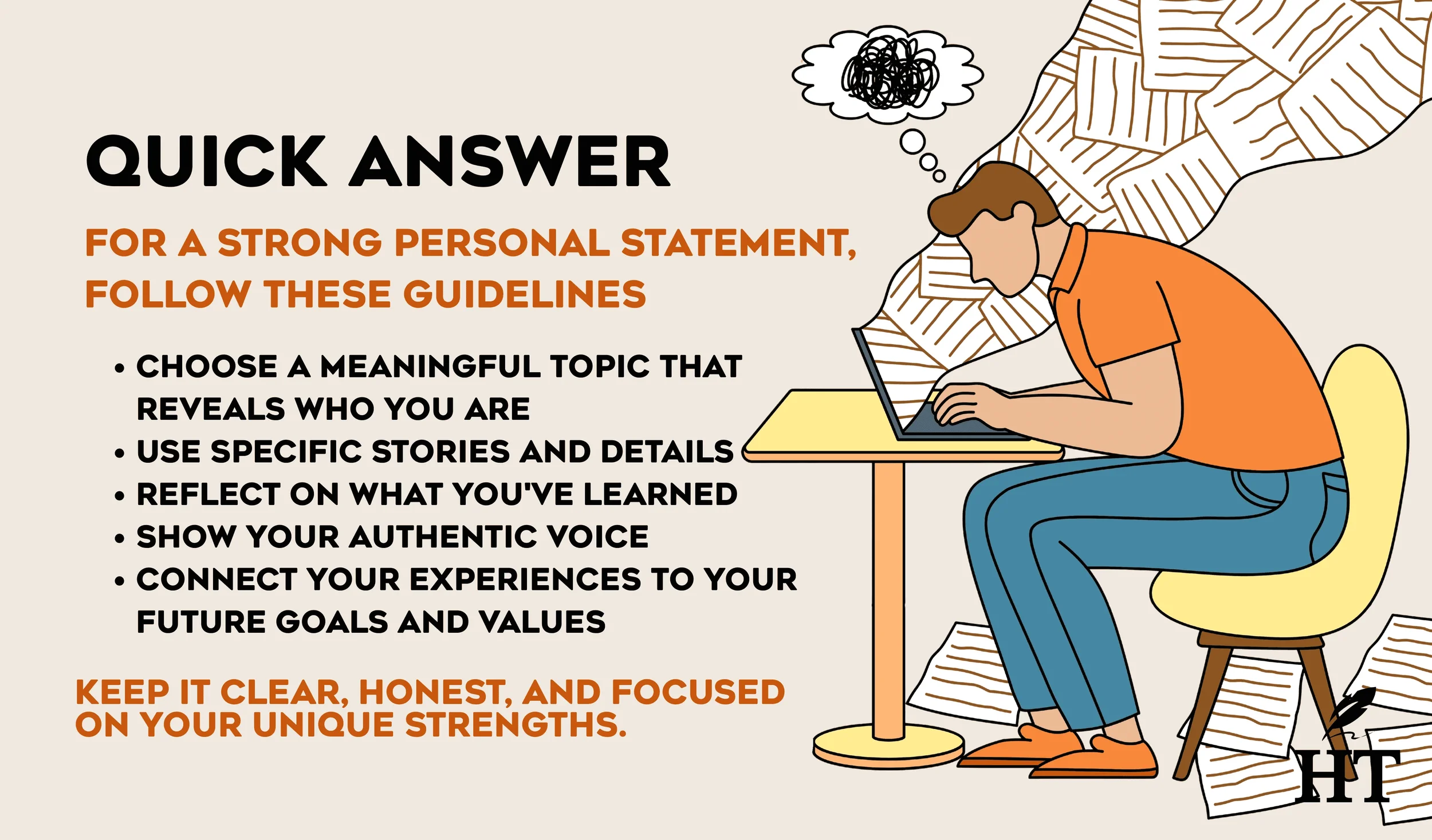
“A personal statement for U.S. universities is a reflective essay where you share your authentic story, values, growth experiences, and perspective with admissions committees. Unlike academic-focused statements, U.S. essays emphasize personal identity, character development, community impact, and how you’ll contribute to campus diversity. To write a strong personal statement, choose a meaningful topic that reveals who you are, use specific stories and details, reflect on what you’ve learned, show your authentic voice, and connect your experiences to your future goals and values.”
What Is a Personal Statement for U.S. Universities?
A personal statement for U.S. universities is your opportunity to speak directly to admissions committees about who you are beyond grades, test scores, and activity lists. It's the most personal component of your college application—whether you're submitting through the Common Application, UC application system, Coalition Application, or individual university portals.
U.S. college essays serve multiple purposes. Admissions officers use personal statements to evaluate your authenticity and voice, your capacity for self-reflection and growth, the diversity of perspective you'll bring to campus, your writing and communication skills, your values and character, and how you think about and engage with the world around you.
Key Differences: U.S. vs. UK Personal Statements
U.S. Personal Statements Focus On:
Personal growth and character development
Identity, background, and lived experiences
Overcoming challenges and resilience
Community impact and social awareness
Diverse perspectives and unique viewpoints
How experiences shaped your values
30-40% academic interests, 60-70% personal narrative
UK Personal Statements Focus On:
Academic preparation and subject knowledge
Intellectual curiosity in your field
Research and independent study
Course-specific qualifications
70-80% academic interests, 20-30% personal activities
Why Personal Statements Matter in U.S. Admissions
Personal statements play a crucial role in U.S. college admissions because they:
Reveal your authentic voice – Admissions officers read thousands of applications; your unique perspective makes you memorable
Demonstrate self-awareness – Reflection on experiences shows maturity and capacity for growth
Showcase diversity – Your background, perspective, and experiences contribute to campus community richness
Provide context – Explain circumstances that may have affected your academic record or opportunities
Predict campus contribution – How you've engaged with your communities suggests how you'll contribute to university life
Show fit – Your values, interests, and goals align with the institution's mission and culture
How to Write a Personal Statement for U.S. Universities (Step-by-Step)
Creating a compelling personal statement doesn't have to be mysterious. Follow this proven framework to craft an essay that captures attention and reveals your authentic self.
Step 1 — Understand the Application Type and Prompts
U.S. college applications come in several formats, each with different requirements:
Common Application (Most Private Universities):
One personal essay from 7 prompt options
650 words maximum
Sent to all Common App schools you apply to
Plus school-specific supplemental essays (typically 150-400 words each)
UC Application (University of California System):
4 Personal Insight Questions (PIQs) chosen from 8 prompts
350 words maximum per PIQ
Focuses on specific experiences and accomplishments
No main essay—each PIQ carries equal weight
Coalition Application:
One essay from 5 prompts
500-650 words
Used by 150+ colleges including some top universities
Individual University Applications:
Schools like MIT, Georgetown, and others use their own systems
Vary widely in requirements and word counts
Always check specific requirements for each school
Before writing, carefully read all prompts for your application type and note word limits, specific questions asked, and which essays are required vs. optional.
Step 2 — Brainstorm Your Stories, Values & Defining Moments
U.S. personal statements shine when they reveal authentic experiences and genuine reflection. Create a comprehensive inventory of potential essay material:
Identity and Background:
Cultural heritage and family traditions
Languages you speak and what they represent
Where you grew up and how it shaped you
Economic background and how it influenced your perspective
Identity aspects that are central to who you are
Defining Experiences:
Challenges you've overcome (personal, academic, family)
Moments that changed your perspective
Failures and what you learned from them
Times you stepped outside your comfort zone
Experiences with injustice or inequality
Community and Impact:
Volunteer work and community service
Leadership roles and responsibilities
How you've helped others or contributed to your community
Activism or advocacy work
Family responsibilities or caregiving
Intellectual Curiosity:
Academic passions and why they matter to you
Questions that fascinate you
Projects or research you've pursued independently
How you think about and solve problems
Books, ideas, or experiences that shaped your thinking
Values and Character:
What principles guide your decisions
Times you stood up for your beliefs
How you handle ethical dilemmas
What makes you unique
Your quirks, interests, or unusual hobbies
Don't filter yet—just capture everything. The best essays often come from unexpected topics.
Step 3 — Choose Your Topic Strategically
With your brainstorming complete, select the topic that best accomplishes three goals:
Reveals something meaningful about you – Choose a topic that shows who you are at your core, not just what you've done
Has room for reflection – The best topics allow you to show growth, insight, or changed understanding
Is genuinely yours – Pick something authentic to your experience, not what you think admissions wants to hear
Strong Topic Selection:
✅ "How learning to cook traditional dishes with my grandmother taught me about cultural preservation and my role in keeping our family history alive"
✅ "The summer my debate team lost nationals and I learned that losing gracefully is harder—and more important—than winning"
✅ "Why I spend my weekends mapping accessibility barriers in my city and what urban planning teaches me about invisible inequalities"
Weak Topic Selection:
❌ "My mission trip to Costa Rica" (often superficial, savior complex issues)
❌ "How I won the championship game" (focuses on achievement, not reflection)
❌ "COVID-19 taught me resilience" (overused, rarely offers unique insight)
Step 4 — Craft a Compelling Opening
Your opening lines must capture attention immediately while introducing your authentic voice. Avoid generic openings that could apply to anyone.
Opening Strategies That Work:
Start with a vivid moment: "The first time I saw my mother cry was in the parking lot of our apartment complex, holding a $400 medical bill she couldn't afford to pay. I was eleven, and I didn't fully understand why healthcare worked differently for families like mine—but I knew I wanted to understand, and eventually, to change it."
Open with an unexpected statement: "I've failed at piano seven times. Not seven recitals or seven pieces—seven complete attempts to learn the instrument over the past ten years. But each failure taught me something new about persistence, and more importantly, about knowing when to pivot instead of pushing through."
Begin with a question or observation: "Why do grocery stores in wealthy neighborhoods stock organic produce while stores in my neighborhood barely have fresh vegetables at all? This question, which hit me during a summer food justice project, revealed how zip codes predict health outcomes more accurately than genetics ever could."
Show your unique perspective: "In my family, we don't say 'I love you'—we say 'did you eat yet?' This indirect expression of care taught me that love speaks different languages, a lesson that shaped how I approach connection, communication, and ultimately, my passion for linguistics and cross-cultural understanding."
Step 5 — Build Your Narrative with Specific Details and Reflection
The body of your essay should balance concrete storytelling with meaningful reflection. This is where you show and tell—using specific details to illustrate broader insights about yourself.
The Show and Tell Balance:
Show (Concrete Details):
Use sensory descriptions and specific moments
Include dialogue when relevant
Provide context and scene-setting
Share observable actions and events
Tell (Reflection and Insight):
Explain what experiences meant to you
Describe how your thinking changed
Connect specific moments to broader values or understanding
Show self-awareness and growth
Example of Strong Show + Tell:
"Every Thursday evening, I translate medical appointments for Mrs. Chen, our elderly neighbor who speaks Mandarin. Last month, when her doctor explained her diabetes diagnosis, I watched her face shift from confusion to fear as I searched for the right words in Chinese. Translating isn't just converting words between languages—it's converting fear into understanding, medical jargon into actionable care, and isolation into connection. [SHOW]
That evening made me realize that healthcare equity isn't just about access to doctors or insurance—it's about whether you can understand what's happening to your own body. Language barriers turn treatable conditions into health crises. This realization pushed me beyond just volunteering as a translator; I started organizing ESL classes focused on medical terminology and worked with our local clinic to create multilingual health resources. [TELL] I learned that bridging divides requires more than good intentions—it requires systematic thinking about how small actions can address larger inequities."
Step 6 — Connect Your Experiences to Your Values and Future
U.S. admissions officers want to understand not just what you've done, but why it matters to you and how it shapes your future contributions. Make these connections explicit.
Effective Connection Strategies:
Link experiences to values: "My three years working at my family's restaurant didn't just teach me about customer service—it taught me about dignity. I watched my parents serve people who sometimes treated them as invisible, yet they maintained grace and pride in their work. This showed me that dignity isn't given by others; it's something we carry within ourselves. That understanding now guides how I approach service, leadership, and advocacy."
Show forward thinking: "Understanding urban food deserts through mapping my neighborhood's food access has shown me that solving complex social problems requires both data and community trust. This is why I'm drawn to urban planning and public policy—fields where quantitative analysis meets human impact. I want to develop solutions with communities, not for them."
Demonstrate self-awareness: "I used to think my role as the oldest of four siblings was a burden that limited my opportunities. But helping raise my brothers while my parents worked two jobs each taught me crisis management, creative problem-solving with limited resources, and how to balance responsibilities without losing myself. These aren't skills that show up on transcripts, but they're the skills that will help me thrive in college and contribute meaningfully to any community I join."
Step 7 — Write a Memorable Conclusion
Your conclusion should create a sense of completion while leaving admissions officers with a clear sense of who you are and what you value. Avoid summarizing what you've already said—instead, look forward or zoom out to the bigger picture.
Effective Conclusion Approaches:
Look forward with purpose: "The medical bill in that parking lot when I was eleven planted a question that still drives me today: what kind of society lets a working family choose between healthcare and rent? I don't have all the answers yet, but I know my path forward involves understanding healthcare systems deeply enough to change them. Every economics class, every volunteer shift at the free clinic, every conversation about policy brings me closer to being part of the solution."
Return to your opening with new meaning: "Piano and I may never work out—I've accepted that some challenges aren't meant to be conquered, just learned from. But understanding when to persist and when to pivot has become my unexpected superpower. It's helped me let go of perfectionism, embrace calculated risks, and approach failures as data points rather than defeats. Seven piano failures taught me flexibility. I can't wait to discover what college will teach me."
Connect to your broader impact: "Thursday evenings with Mrs. Chen are a small part of my week, but they represent something larger: my belief that expertise becomes meaningful only when it serves others. Whether I'm translating medical terminology, teaching coding workshops at the library, or eventually working in healthcare policy, my goal remains the same—taking specialized knowledge and making it accessible to those who need it most. That's the work that drives me, and that's the person I want to become."
Personal Statement Format & Structure
A clear structure makes your personal statement compelling and ensures you use your word count effectively. Here's the recommended framework for U.S. applications:
Standard Essay Structure
Introduction (100-120 words for 650-word essays):
Hook the reader with a compelling opening
Establish your topic and why it matters
Introduce your authentic voice
Body Paragraphs (400-450 words):
Share specific experiences with concrete details
Develop your narrative chronologically or thematically
Balance storytelling with reflection and insight
Show growth, learning, or changed perspective
Connect experiences to your values
Conclusion (100-120 words):
Bring your essay full circle
Look forward to your future impact or goals
Leave the reader with a clear sense of who you are
End with confidence and authenticity
Word Count Guidelines by Application Type
Common Application Personal Essay:
650 words maximum
No minimum (though 550-650 is recommended)
Quality over length—a tight 500-word essay beats a padded 650-word one
Common App Supplemental Essays:
Typically 150-300 words for "Why This College" essays
Sometimes 400-650 words for additional personal statements
Always check specific requirements for each school
UC Personal Insight Questions:
350 words maximum per question
Answer exactly 4 questions
Each answer should be focused and complete
Total word count: 1,400 words across 4 PIQs
Coalition Application:
500-650 words
Same prompts and approach as Common App
Ivy League and Top 20 Supplements:
"Why This College": 200-400 words typically
Additional essays: 250-650 words
Some schools require multiple supplemental essays
MIT, for example, has several shorter essays (200-250 words each)
Community College Transfer Essays:
Varies by institution: 500-1,000 words typically
Some colleges use Common App transfer essay
Focus on growth during community college experience
What to Include (and What to Avoid)
Must Include:
Specific, concrete details and examples
Personal reflection and self-awareness
Your authentic voice and personality
Growth, change, or deepened understanding
Connection between experiences and values
What makes your perspective unique
Proper grammar, spelling, and clarity
Must Avoid:
Generic statements that could apply to anyone ("I'm passionate about learning")
Résumé listing of achievements without reflection
Trying to cover too many topics superficially
Controversial political or religious proselytizing
Complaining or making excuses without showing growth
Thesaurus language that doesn't sound like you
Clichéd phrases ("at the end of the day," "gave 110%")
Inappropriate humor or oversharing
Spelling and grammatical errors
Anything dishonest or exaggerated
Personal Statement Examples & Samples
Learning from strong examples helps you understand tone, structure, and effective storytelling. Here are four complete sample openings and body paragraphs showing different approaches:
Example 1: Identity and Family (Common App)
Opening: "I became the translator of my family's life before I could properly conjugate English verbs. At seven years old, I sat across from bank tellers explaining overdraft fees to my parents in broken Spanish-English hybrid sentences, pretending I understood terms like 'insufficient funds' and 'account balance.' These early experiences at adult tables, navigating systems my parents couldn't access alone, taught me that language isn't just communication—it's power, access, and sometimes survival."
Body Excerpt: "The weight of translation followed me everywhere. Parent-teacher conferences meant explaining why Mami couldn't attend evening meetings—her night shift started at 6 PM. Medical appointments required me to describe symptoms I only half understood, hoping my thirteen-year-old vocabulary could capture the difference between 'sharp pain' and 'dull ache.' I resented this responsibility, feeling robbed of a childhood where my biggest worry should have been soccer practice, not whether I correctly translated 'pre-authorization' at the pharmacy.
But my perspective shifted during freshman year when I started volunteering at the community center's immigrant services program. Meeting other families navigating similar barriers, I realized my bilingual experience wasn't a burden—it was a bridge. I could do for others what no one had done for my family when we first arrived: explain the confusing systems, translate the bureaucratic language, help people advocate for themselves."
Why this works: Opens with a striking visual; shows vulnerability about resentment before demonstrating growth; uses specific, relatable examples; reveals values about service and equity.
Example 2: Intellectual Curiosity and Failure (Common App)
Opening: "My first robotics competition lasted exactly four minutes before our robot died on the field. We'd spent six months building it—mapping circuits, programming autonomous functions, testing movements until our fingers cramped. When the buzzer sounded and our robot sat motionless while competitors scored points around us, I felt my stomach drop. But standing there, watching our spectacular public failure, I learned something crucial: failure is the most information-rich experience in engineering."
Body Excerpt: "The walk back to our pit area felt like a mile. My teammates were silent, processing the gap between what we'd built in theory and what actually worked in competition. Rather than pack up in defeat, we did something unexpected—we started debugging on the spot. What we discovered changed everything: our battery connections were sound, our programming was solid, but we'd missed a single loose wire in our power distribution system. One wire. Six months of work undone by one overlooked connection.
This moment taught me that engineering isn't just about building things that work—it's about building in ways that make failure useful. After that competition, I started approaching projects differently. I documented everything, created failure trees for troubleshooting, and most importantly, I started testing for breaks before they happened. Our team didn't win that competition, but we won the next three. More importantly, I learned to see failure not as the opposite of success, but as a necessary step toward it."
Why this works: Opens with specific, dramatic moment; shows resilience and problem-solving; demonstrates intellectual growth; reveals how you approach challenges.
Example 3: Community Impact and Social Justice (UC PIQ)
Prompt: Describe how you have taken advantage of a significant educational opportunity or worked to overcome an educational barrier you have faced.
"The summer I mapped food deserts in my neighborhood, I learned that data tells stories about justice. Walking twenty-three blocks to find a grocery store with fresh produce wasn't unique to my experience—it was systemic design. Using GIS software I learned through a free online course, I documented where food markets existed, layered that data with income levels and health outcomes, and presented findings to our city council.
The map revealed what residents already knew from experience: zip code predicted access more than any other factor. Low-income neighborhoods like mine had convenience stores and fast food, while wealthy areas three miles away had organic markets and farmers markets. I didn't create this inequality, but mapping it made it undeniable.
What started as a summer project became sustained advocacy. I partnered with local organizations to present data at community meetings, helping residents articulate what they experienced daily but couldn't always quantify. Two years later, our city approved incentives for grocery stores in underserved areas and expanded public transportation routes to existing markets. The first new grocery store opened six blocks from my house last spring.
This experience taught me that changing communities requires both data and relationships. Maps show the problem, but organizing creates the pressure for solutions. I learned to code and analyze data not as abstract skills, but as tools for justice. More importantly, I learned that expertise means nothing without accountability to the communities you claim to serve."
Why this works: Specific project with measurable impact; shows initiative in learning new skills; demonstrates systems thinking; connects action to values; perfect length for UC's 350-word limit.
Example 4: Personal Growth Through Challenge (Transfer Essay)
Opening: "Community college wasn't my first choice—it was my only choice after my family lost our home to foreclosure my senior year of high school. While classmates debated dorm room furniture, I was learning to navigate homelessness, couch-surfing between relatives' apartments while completing my first semester at community college. Those two years weren't the traditional college experience I'd imagined, but they taught me more about resilience, resourcefulness, and determination than any four-year path could have."
Body Excerpt: "Studying became an exercise in creative problem-solving. I couldn't always afford textbooks, so I became an expert at finding open-source materials, sharing copies with classmates, and spending hours in the library. When our housing situation was particularly unstable, I studied at 24-hour coffee shops, completing chemistry problem sets at 2 AM between shifts at my retail job.
The instability forced me to develop systems for success that most traditional students never need. I created digital backups of everything, knowing I might lose physical materials. I built strong relationships with professors who became mentors, understanding that guidance mattered more than connections. I learned to advocate for myself, requesting deadline extensions when family emergencies hit and finding campus resources I didn't initially know existed.
Community college taught me that education is a privilege I refuse to take for granted. Every A I earned represented not just academic understanding, but triumph over circumstances designed to derail students like me. Transferring to a four-year university isn't just about continuing my education—it's about proving that talent and determination matter more than starting circumstances."
Why this works: Provides honest context about challenges; shows specific strategies for overcoming obstacles; demonstrates maturity and self-awareness; frames transfer as next step in established pattern of persistence.
Personal Statement Template for U.S. Universities
Use this flexible template as your starting framework. Fill in your specific details while maintaining the overall structure:
INTRODUCTION (100-120 words)
[Opening hook: specific moment, striking image, unexpected statement, or provocative question]
[Brief context: what was happening, where you were, why this moment mattered]
[Thesis or theme: hint at what this experience taught you or what question it raised]
BODY PARAGRAPH 1: The Story/Experience (150-180 words)
[Set the scene with specific, sensory details]
[Describe what happened, including relevant dialogue or action]
[Show your initial response or understanding]
[Begin to hint at complexity or what you didn't understand yet]
BODY PARAGRAPH 2: Complication or Growth (150-180 words)
[Describe how your understanding changed or deepened]
[Share a specific moment that shifted your perspective]
[Include what you learned about yourself, others, or the world]
[Show the actions you took based on new understanding]
BODY PARAGRAPH 3: Broader Meaning and Values (120-150 words)
[Connect your specific experience to broader themes or values]
[Explain how this shapes who you are today]
[Demonstrate self-awareness about your growth]
[Link to how you engage with the world now]
CONCLUSION (100-120 words)
[Return to opening image/moment with new meaning, or look forward]
[Articulate what you've learned and what drives you forward]
[End with confidence, showing how this experience shapes your future contributions]
Total: 620-650 words (adjust based on specific requirements)
How to Write a Common Application Essay
The Common Application serves over 1,000 colleges and universities, making it the most widely used application platform in the U.S. Your personal essay is submitted to every Common App school you apply to, so choose your topic strategically.
Common App Prompts (2024-2025)
Choose ONE prompt from these seven options:
Identity: Some students have a background, identity, interest, or talent that is so meaningful they believe their application would be incomplete without it. If this sounds like you, then please share your story.
Failure: The lessons we take from obstacles we encounter can be fundamental to later success. Recount a time when you faced a challenge, setback, or failure. How did it affect you, and what did you learn from the experience?
Beliefs: Reflect on a time when you questioned or challenged a belief or idea. What prompted your thinking? What was the outcome?
Gratitude: Reflect on something that someone has done for you that has made you happy or thankful in a surprising way. How has this gratitude affected or motivated you?
Accomplishment: Discuss an accomplishment, event, or realization that sparked a period of personal growth and a new understanding of yourself or others.
Topic of Interest: Describe a topic, idea, or concept you find so engaging that it makes you lose all track of time. Why does it captivate you? What or who do you turn to when you want to learn more?
Open Topic: Share an essay on any topic of your choice. It can be one you've already written, one that responds to a different prompt, or one of your own design.
Choosing Your Prompt
Don't overthink prompt selection—focus on finding a story that reveals who you are. Most strong essays could work for multiple prompts. Choose based on which prompt best frames your story, not which prompt seems easier.
Strategic Prompt Selection:
Prompt 1 (Identity): Best for essays about cultural background, family, identity aspects central to who you are
Prompt 2 (Failure): Ideal for showing resilience, problem-solving, and growth mindset
Prompt 5 (Accomplishment): Good for intellectual curiosity or personal development stories
Prompt 6 (Interest): Perfect for showcasing passion and how you pursue learning
Prompt 7 (Open): Use if your topic doesn't fit other prompts but tells your story well
Common App Essay Strategy
What makes Common App essays strong:
Focus on ONE story or theme deeply rather than covering multiple topics superficially
Show vulnerability and authenticity—admissions officers read thousands of "perfect" essays
Reveal how you think, not just what you've done
Use your authentic voice—write how you naturally speak (appropriately formal)
Take intellectual or emotional risks that reveal character
Connect your story to your values and how you engage with the world
Common App essay pitfalls:
Trying to fit your entire life story into 650 words
Writing what you think admissions wants to hear instead of your truth
Choosing a topic that's too small (lost my phone) or too big (solved world hunger)
Spending too much on backstory instead of reflection
Ending without showing growth or looking forward
Sample Common App Approach
Prompt 2 (Failure) Example Structure:
Introduction: Open with the moment of failure (robot dying, losing debate, failing chemistry test)
Body: Describe your initial response, what you did next, specific actions you took, how your understanding changed
Reflection: What this taught you about yourself, how you approach challenges differently now, how failure became valuable data
Conclusion: Look forward to how this mindset serves you, connect to your values about growth and learning
How to Write UC Personal Insight Questions (PIQs)
The University of California system uses a unique approach—instead of one long essay, you answer 4 out of 8 shorter questions. This format allows you to showcase different dimensions of your experience and personality.
UC PIQ Format
Choose 4 questions from 8 prompts
350 words maximum per question
No question is weighted more heavily than others
Total: 1,400 words across all 4 responses
Each answer should be complete and focused on a single experience or theme
The 8 UC Personal Insight Questions
Question 1 (Required for some majors): Describe an example of your leadership experience in which you have positively influenced others, helped resolve disputes, or contributed to group efforts over time.
Question 2 (Required for some majors): Every person has a creative side, and it can be expressed in many ways: problem solving, original and innovative thinking, and artistically, to name a few. Describe how you express your creative side.
Question 3: What would you say is your greatest talent or skill? How have you developed and demonstrated that talent over time?
Question 4: Describe how you have taken advantage of a significant educational opportunity or worked to overcome an educational barrier you have faced.
Question 5: Describe the most significant challenge you have faced and the steps you have taken to overcome this challenge. How has this challenge affected your academic achievement?
Question 6: Think about an academic subject that inspires you. Describe how you have furthered this interest inside and/or outside of the classroom.
Question 7: What have you done to make your school or your community a better place?
Question 8: Beyond what has already been shared in your application, what do you believe makes you a strong candidate for admissions to the University of California?
Strategic Question Selection
Choose questions that allow you to showcase different aspects of your experience while avoiding repetition:
Balanced Portfolio Approach:
One question about intellectual/academic interests (Q2, Q3, or Q6)
One question about challenges or growth (Q4 or Q5)
One question about community impact (Q1 or Q7)
One open question highlighting uniqueness (Q3 or Q8)
What to avoid:
Answering multiple questions about the same experience
Choosing questions where you have weak examples
Leaving gaps (e.g., only academic questions, nothing personal)
UC PIQ Writing Strategy
Each answer should include:
Specific example or experience (not general description)
Concrete details (numbers, names, specific actions)
Your role and contribution (what YOU did, not just what happened)
Outcome or impact (measurable when possible)
Brief reflection (what you learned or how you grew)
UC-specific tips:
Be direct: Jump straight into your example—no lengthy introductions
Use all 350 words: Make your responses complete and detailed
Show impact with specifics: "I tutored 15 students weekly for two years" beats "I tutored students"
Focus on one story per question: Depth over breadth
Avoid repeating: If you mentioned debate in Q1, don't use it again in Q3
Sample UC PIQ Response
Question 7: What have you done to make your school or community a better place?
"When my high school cut music funding, forty students lost access to instrumental classes that many, like me, couldn't afford privately. Rather than accept this quietly, I organized a parent-student coalition to advocate for music program restoration.
I started by gathering data. I surveyed students affected, documented the correlation between music participation and academic performance at our school, and researched grant opportunities. Armed with evidence, I presented to the school board, explaining that cutting music didn't save money—it eliminated opportunities for low-income students who depended on school access.
The board was unmoved initially, so I shifted strategies. I organized a community concert showcasing students who would lose music education, invited local news coverage, and launched a social media campaign that gained 2,000 signatures in two weeks. I coordinated meetings with district administrators, brought student testimonies, and worked with parent volunteers to identify alternative funding sources.
Eight months later, we won. The district restored partial music funding and, more importantly, established a community partnership program that brings in additional resources. Through this program, we've served 120 students over three years.
This experience taught me that advocacy requires both data and storytelling. Statistics matter, but they become powerful only when connected to human impact. Leading this campaign also showed me that systemic change requires sustained pressure—one meeting or petition isn't enough. You need strategy, persistence, and the ability to mobilize others around shared purpose.
More personally, I learned that my voice matters. As a junior, I initially doubted whether adults would listen to student concerns. But I discovered that speaking up, backed by preparation and persistence, can shift decisions that affect entire communities. This confidence in my ability to create change, even against institutional inertia, now guides how I approach problems in every context."
Word count: 311 (within 350 limit)
Why this works: Specific campaign with clear timeline; shows initiative and strategy; includes concrete numbers; demonstrates both action and reflection; reveals leadership approach and values.
How to Write Ivy League Supplemental Essays
Ivy League schools and other highly selective universities require supplemental essays in addition to your Common App personal statement. These essays are your opportunity to show why you're specifically interested in each school and how you'll contribute to their particular community.
Types of Supplemental Essays
"Why This College" Essays (Most Common):
200-400 words typically
Requires specific research about the school
Must demonstrate genuine interest and fit
Should connect your interests to specific opportunities
Community and Diversity Essays:
Focus on what perspective you'll bring to campus
May ask about background, identity, or experiences
Should show how you engage with difference
250-400 words typically
Intellectual Interest Essays:
Ask about academic passions or ideas that fascinate you
Want to see how you think, not just what you know
Should show curiosity and depth
200-300 words typically
Activity Deep-Dive Essays:
Expand on one meaningful extracurricular
Show sustained commitment and impact
150-300 words typically
Creative/Quirky Prompts:
University of Chicago style questions
Want to see personality and creativity
Take intellectual risks here
Vary widely in length
"Why This College" Essay Strategy
This is the most common supplement, and it's where many students write generic, forgettable responses. Stand out by being specific and personal.
What Admissions Officers Look For:
Evidence you've researched the school thoroughly
Specific programs, courses, professors, or opportunities that appeal to you
Clear connection between your interests and what they offer
Understanding of campus culture and values
How you'll contribute, not just what you'll gain
Research Checklist:
Review academic departments and specific courses
Identify professors whose research interests align with yours
Explore special programs, centers, or initiatives
Understand campus culture and student life
Note unique traditions or values
Find clubs, organizations, or opportunities you'd engage with
Formula for Strong "Why This College" Essays:
Opening: Hook with specific reason this school appeals to you (not rankings or prestige)
Academic Fit: Name 2-3 specific courses, programs, or professors and explain why they excite you
Beyond Academics: Identify specific extracurricular opportunities, research centers, or campus resources
Contribution: Show what you'll bring to campus community
Connection: Tie everything back to your goals and values
What NOT to Write:
❌ "Your prestigious university has an excellent reputation"
❌ "The beautiful campus and strong programs attract me"
❌ "I want to attend because you're ranked highly"
❌ Generic statements that could apply to any school
❌ Only mentioning things you could do anywhere
Sample Ivy League Supplemental Essay
Columbia University: "Why are you interested in attending Columbia University?" (200 words)
"When I read Professor Saskia Sassen's work on global cities and migration patterns, I realized that understanding urban inequality requires looking beyond borders. Columbia's unique position in New York City transforms this from theoretical interest into lived research opportunity—the city itself becomes the laboratory.
I'm drawn to the Urban Studies program's emphasis on combining quantitative analysis with ethnographic methods. Courses like 'Cities and Social Justice' and 'Urban Research Methods' align perfectly with my interest in studying how housing policy affects immigrant communities. Working with Professor Lance Freeman on affordable housing research would allow me to continue the food access mapping work I've done in my own community while learning more rigorous analytical approaches.
Beyond academics, I want to contribute to Columbia's Urban Experience and Community Impact initiatives, bringing my experience organizing community advocacy campaigns. The Earl Hall Center's partnerships with Harlem organizations particularly excite me—continuing my work translating for immigrant families while learning from communities who've been organizing for justice for generations.
Columbia's Core Curriculum challenges me to explore beyond my comfort zone. Wrestling with foundational texts while learning from classmates with radically different perspectives embodies the intellectual cross-pollination I'm seeking. In a school where my subway commute can take me from campus to research sites across five boroughs, theory and practice don't exist separately—they inform each other constantly."
Word count: 200 exactly
Why this works: Names specific professor and their work; mentions actual courses; connects to personal interests and experience; shows understanding of location's value; demonstrates contribution potential; references Core Curriculum (Columbia-specific); every sentence is specific to Columbia.
Ivy League-Specific Tips
Harvard: Emphasizes intellectual vitality and how you'll contribute to their community. Be genuine about your passions and show how you think.
Yale: Values community engagement and how you connect with others. Show collaborative spirit and intellectual generosity.
Princeton: Focus on academic curiosity and how you'd engage with their particular resources. Be specific about academic interests.
Penn: Emphasizes practical application and interdisciplinary thinking. Show how you'd use their resources to create impact.
Columbia: Loves students who engage with NYC and diverse perspectives. Show intellectual adventurousness and social awareness.
Brown: Values intellectual independence and curricular freedom. Show how you'd design your own educational path using their Open Curriculum.
Cornell: Has college-specific supplements. Research your specific college (Engineering, Arts & Sciences, etc.) and show fit.
Dartmouth: Values tight-knit community and outdoor culture. Show how you build community and embrace their unique environment.
How to Write Personal Statements for Top 20 Universities
Beyond the Ivies, top universities like Stanford, MIT, Duke, Northwestern, and others have their own distinctive cultures and supplement requirements.
Stanford Supplemental Essays
Stanford requires several short essays that reveal different dimensions of your personality:
Short Questions (50 words each):
What is the most significant challenge that society faces today?
How did you spend your last two summers?
What historical moment or event do you wish you could have witnessed?
Briefly elaborate on one of your extracurricular activities, a job you hold, or responsibilities you have for your family.
List five things that are important to you.
Short Essays (100-250 words each):
The Stanford community is deeply curious and driven to learn in and out of the classroom. Reflect on an idea or experience that makes you genuinely excited about learning.
Virtually all of Stanford's undergraduates live on campus. Write a note to your future roommate that reveals something about you or that will help your roommate—and us—get to know you better.
Tell us about something that is meaningful to you and why.
Strategy for Stanford:
Be authentic and specific—they want your real voice
Show intellectual vitality through genuine curiosity
Reveal personality through the roommate essay
Don't overthink the short questions—be honest and thoughtful
Use all your word counts—complete thoughts matter
MIT Essays
MIT has a unique application focused on makers, builders, and problem-solvers:
Main Essays:
Describe the world you come from (250 words)
What you do for the pleasure of it (250 words)
How you have contributed to your community (250 words)
A significant challenge (250 words)
Something you do simply for fun (25 words)
Strategy for MIT:
Show, don't tell your problem-solving approach
Reveal how you think through challenges
Be specific about technical projects or building things
Show collaboration and community contribution
Let your personality shine—they want humans, not robots
Duke Essays
Why Duke? (250 words): Must be specific about academic and extracurricular opportunities
Optional: Tell us more about yourself (250 words): Use this to add context or share something not elsewhere in application
Strategy for Duke:
Research specific programs and opportunities deeply
Show understanding of their community values
Connect academic interests to real-world impact
Demonstrate how you'd contribute to campus life
Northwestern Essays
Why Northwestern? (300 words): Connect your interests to their specific resources and programs
Strategy for Northwestern:
Reference specific schools within Northwestern (Weinberg, McCormick, Medill, etc.)
Mention specific courses, programs, and professors
Show understanding of their collaborative, interdisciplinary culture
Demonstrate both academic and extracurricular engagement plans
Key Principles for All Top 20 Schools
Research thoroughly: Every school has distinct culture, values, and offerings
Be specific: Generic essays are immediately obvious
Show fit mutually: Not just what they offer you, but what you offer them
Connect to your story: Link school-specific elements to your personal narrative
Demonstrate knowledge: Show you understand what makes each school unique
Avoid prestige talk: Never mention rankings, reputation, or "prestigious" programs
Proofread carefully: Each school gets a tailored essay—double-check names and details
How to Write a Community College Transfer Essay
Transfer essays require a different approach than first-year applications. You're not writing about high school experiences—you're articulating why you're ready for the next step and why this specific institution is right for your goals.
What Transfer Essays Should Address
Your transfer narrative:
Why you started at community college
What you've accomplished during that time
Why you're ready to transfer now
How the four-year institution fits your academic goals
What you'll contribute to the new campus
Growth and readiness:
Academic maturity demonstrated at community college
Clearer sense of purpose and direction
Specific goals that require resources of four-year institution
Evidence you'll thrive in new environment
Transfer Essay Structure
Introduction (100-120 words):
Establish your transfer narrative with honesty
Frame community college as valuable, not a limitation
Hint at what you've learned and why you're ready
Community College Experience (200-250 words):
Highlight academic achievements and involvement
Discuss specific courses or experiences that shaped your path
Show growth in academic skills and clarity of purpose
Mention faculty relationships and leadership
Address any challenges overcome
Why Transfer Now + Why This School (200-250 words):
Explain what you've outgrown at community college
Identify specific programs, resources, or opportunities you need
Connect to particular courses, professors, or research at new school
Show you've researched transfer student support and community
Future Goals (100-120 words):
Articulate clear academic and career objectives
Show how this institution specifically prepares you
Demonstrate realistic understanding of your field
End with confidence about your readiness
Common Transfer Essay Mistakes
Avoid these pitfalls:
❌ Apologizing for starting at community college
❌ Focusing too much on high school
❌ Vague statements about "wanting a better education"
❌ Not researching the specific transfer institution
❌ Failing to show growth and increased clarity
❌ Writing a generic essay that could apply anywhere
❌ Not addressing gaps or challenges honestly
Sample Transfer Essay Opening
Prompt: Why do you wish to transfer? What are your academic goals?
"I chose community college deliberately—not as a backup plan, but as a strategic decision when my family's financial situation made four-year universities immediately impossible. Two years later, I'm transferring not because community college failed me, but because I've outgrown what it can offer. My academic focus has crystallized around environmental policy and urban sustainability, fields that require the research infrastructure, faculty expertise, and internship networks that UCLA's Institute of the Environment and Sustainability provides.
At Santa Monica College, I've built a foundation while discovering my intellectual direction. Maintaining a 3.9 GPA while working twenty-five hours weekly taught me time management and grit, but more importantly, courses like Environmental Geology and Public Policy transformed vague concerns about climate change into specific questions about implementation. Professor Chen's policy analysis course introduced me to the gap between environmental legislation and enforcement—a gap I want to study and eventually help close through work in government or advocacy organizations.
Community college also taught me that education is collaborative, not competitive. As a supplemental instruction leader for Chemistry 101, I've helped over forty students navigate challenging material by breaking down concepts and building study communities. This experience revealed my aptitude for translating complex information accessibly—a skill essential for environmental policy work, where scientific knowledge must inform public decision-making.
Now I need resources community college cannot provide: faculty conducting cutting-edge sustainability research, hands-on policy internships with California's environmental agencies, and peers equally committed to environmental justice work..."
Why this works: Frames community college as choice, not failure; shows specific academic growth; demonstrates engagement through leadership; clearly articulates what's needed next; researches specific UCLA program; maintains confident, mature tone.
Transfer-Specific Application Tips
Emphasize growth:
Show how you've matured academically
Demonstrate clearer focus and purpose than high school
Highlight increased responsibility and leadership
Address the gap (if applicable):
If your high school record was weak, briefly acknowledge growth
Don't dwell on past struggles—focus on current trajectory
Let your community college record speak to your readiness
Show institutional knowledge:
Research transfer student resources and support
Mention transfer-specific programs or communities
Demonstrate understanding of credit transfer process
Show you've planned your path to graduation
Leverage your unique perspective:
Discuss what being a transfer student brings to campus
Show resilience and determination
Highlight diverse life experiences
Demonstrate independence and self-direction
Common Mistakes Students Make
Avoiding these pitfalls will strengthen your personal statement significantly:
Content Mistakes
1. The Résumé Dump
❌ Listing achievements without reflection or narrative
✅ Choose one or two experiences and explore them deeply
2. The Generic Essay
❌ Statements that could apply to any student or any university
✅ Specific details, personal voice, unique perspective
3. The Trauma Essay Without Growth
❌ Describing hardship without showing resilience or learning
✅ Balance vulnerability with reflection on how you grew
4. The Savior Complex
❌ "I went to help poor people in [country] and learned so much"
✅ Humble reflection on mutual exchange and learning from others
5. The Everything Essay
❌ Trying to fit your entire life story in 650 words
✅ Focus deeply on one theme, story, or question
6. The Sports Victory Essay
❌ "We were down, but we came back and won the championship"
✅ Focus on personal growth, leadership, or unexpected lessons
7. The Thesaurus Essay
❌ Using complex vocabulary that doesn't sound like you
✅ Write in your authentic voice with precise language
8. The Quote Opening
❌ "As Gandhi once said..." or "Einstein believed that..."
✅ Open with your own voice and experiences
Structural Mistakes
9. Spending Too Long on Setup
❌ Using half your essay on background before getting to the point
✅ Start in the middle of action or meaning
10. Ending Without Looking Forward
❌ Concluding with "and that's why this matters"
✅ Show how this shapes who you are now and where you're going
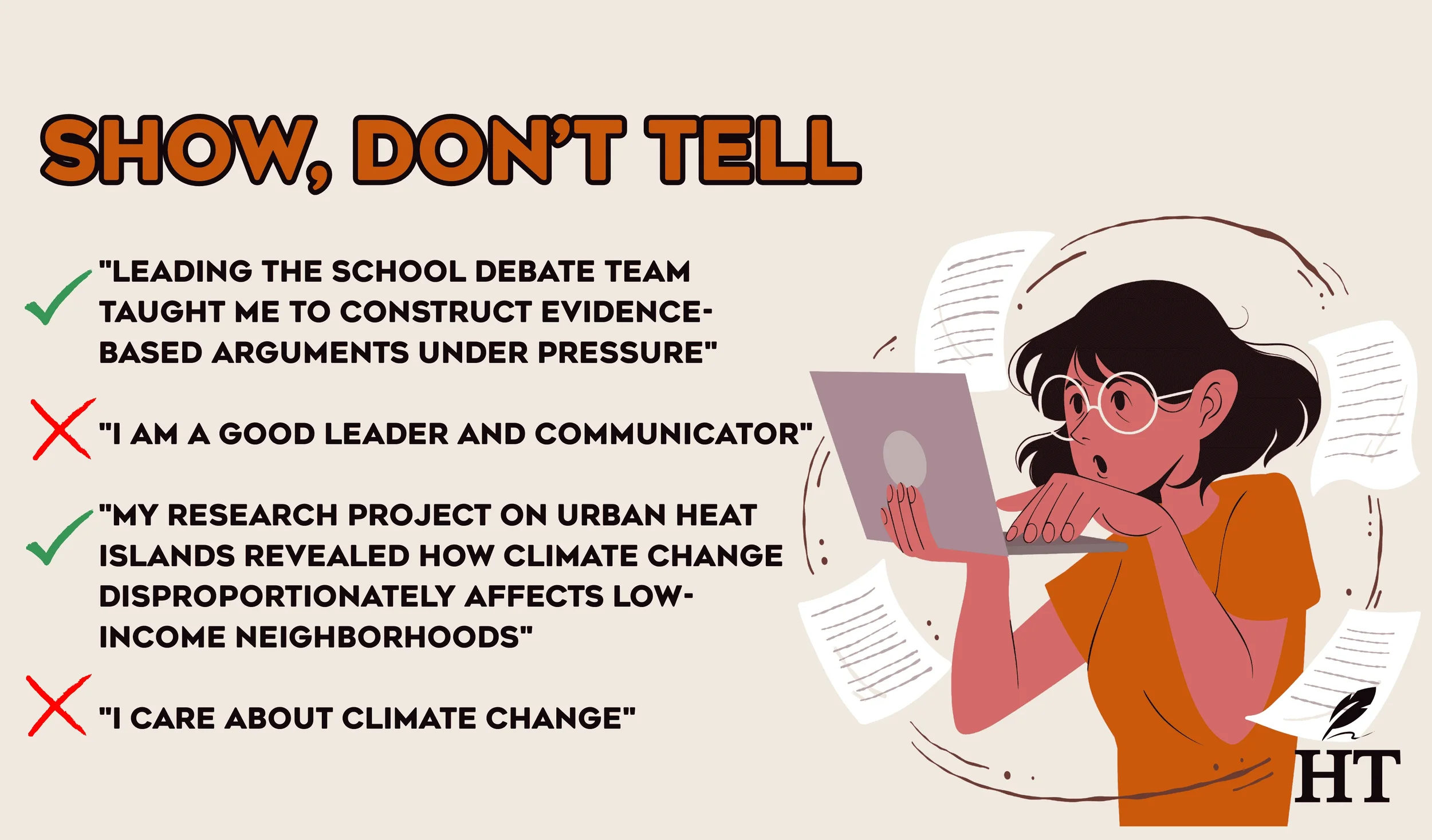
11. Telling Instead of Showing
❌ "I am a hard worker and good leader"
✅ Share specific moments that demonstrate these qualities
Tone Mistakes
12. The Apology Essay
❌ Making excuses for weaknesses in your application
✅ Address challenges with confidence about your growth
13. The Arrogance Essay
❌ Bragging about achievements without humility
✅ Show confidence while remaining authentic and relatable
14. The Oversharing Essay
❌ Inappropriate personal details or TMI moments
✅ Vulnerable but appropriate disclosure
15. The Forced Humor Essay
❌ Trying too hard to be funny or quirky
✅ Let your natural personality emerge
Personal Statement Checklist
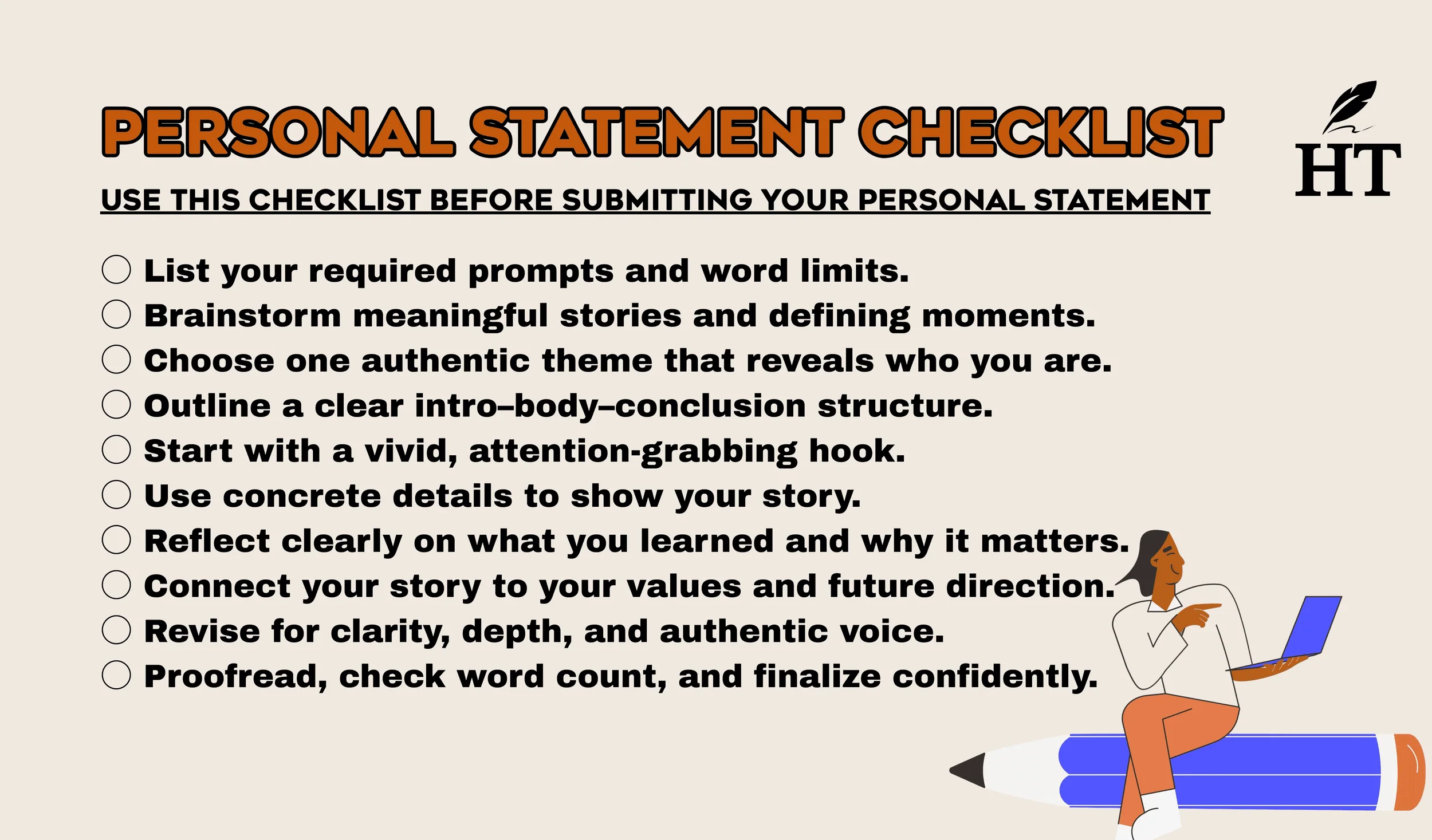
Use this checklist to ensure your essay is ready for submission:
Content Quality
[ ] Opens with a compelling, specific hook (not a cliché)
[ ] Tells a focused story (not trying to cover everything)
[ ] Includes specific, concrete details and examples
[ ] Shows reflection and self-awareness
[ ] Demonstrates growth or changed perspective
[ ] Reveals something meaningful about who you are
[ ] Connects experiences to values or future goals
[ ] Ends with a strong, forward-looking conclusion
[ ] Written in my authentic voice
[ ] Shows rather than tells my qualities
Structure and Clarity
[ ] Has a clear narrative arc or thematic structure
[ ] Paragraphs flow logically from one to another
[ ] Stays focused on one main theme or story
[ ] Balances storytelling with reflection
[ ] Introduction and conclusion work together
[ ] Transitions are smooth and natural
[ ] Every paragraph serves a clear purpose
Technical Excellence
[ ] Within word count limits (check each application)
[ ] Free of spelling and grammatical errors
[ ] Punctuation is correct throughout
[ ] Sentence structure varies (not all sentences same length)
[ ] Active voice used more than passive voice
[ ] No unnecessary words or redundancy
[ ] Proper formatting and spacing
Application Fit
[ ] Answers the specific prompt asked
[ ] Appropriate for the application type (Common App, UC, transfer, etc.)
[ ] Avoids mentioning other schools (unless specific supplement)
[ ] Includes school-specific details (for supplements only)
[ ] Tone matches institutional culture
[ ] Shows understanding of what school values
Authenticity Check
[ ] Sounds like me, not like an admissions officer or parent
[ ] Honest about experiences (no exaggeration)
[ ] Reveals vulnerability appropriately
[ ] Avoids clichés and overused phrases
[ ] Shows my unique perspective
[ ] Not trying too hard to impress
[ ] Would be proud to share this with others
Final Review
[ ] Read aloud to check flow and naturalness
[ ] Had at least two trusted people review it
[ ] Received feedback from teacher, counselor, or mentor
[ ] Made revisions based on feedback
[ ] Checked it's saved with correct filename
[ ] Copied into application correctly (check formatting)
[ ] Did one final proofread before submitting
FAQs
How long should my personal statement be?
Common App: 650 words maximum, though 550-650 is ideal. Quality matters more than hitting the maximum—a tight 500-word essay beats a padded 650-word one.
UC PIQs: Exactly 350 words maximum per question, and you should use close to the full count for each.
Supplements: Follow each school's specific requirements, which typically range from 150-400 words.
Can I use the same essay for multiple applications?
Common App schools: Yes, your personal statement goes to all Common App schools you apply to.
Supplemental essays: No, these must be tailored to each specific school. Generic "Why This College" essays are immediately obvious.
UC PIQs: These go to all UC campuses you apply to, so don't mention specific campuses.
Should I mention specific universities in my Common App essay?
No—your Common App personal statement goes to all schools you apply to, so keep it general. Save school-specific details for supplemental "Why This College" essays.
What if I don't have impressive achievements or experiences?
Strong personal statements aren't about impressive résumés—they're about authentic reflection and unique perspective. Focus on everyday experiences that shaped you, challenges you've overcome, or how you think about the world. Admissions officers value genuine insight over impressive activities.
Can I write about mental health or personal struggles?
Yes, but approach carefully. Focus on resilience, growth, and what you learned rather than dwelling on the struggle itself. Show you've developed coping strategies and are ready for college-level work. Avoid graphic details or anything that raises concerns about your readiness for college.
Should I write about my volunteer trip abroad?
Only if you can avoid the "savior" narrative and demonstrate genuine learning, humility, and mutual exchange. Many students write poorly about service trips by focusing on how they "helped" others rather than what they learned. If you can't show deep reflection and avoid common pitfalls, choose a different topic.
How personal is too personal?
Avoid sharing anything you wouldn't be comfortable with hundreds of strangers reading. Topics like sexual experiences, illegal activities (beyond minor youthful mistakes), extremely personal medical details, or anything that could raise safety concerns are generally too personal.
Can I use humor in my essay?
Yes, if it's natural to your voice, but be careful. Humor is subjective and doesn't always translate in writing. If you use humor, make sure it serves your narrative and doesn't come across as trying too hard or being inappropriate.
Do I need to mention my intended major or career?
Not necessarily in your Common App essay, though you can if it's central to your story. For "Why This College" supplements, you should definitely connect your interests to specific programs. It's okay to be undecided—show intellectual curiosity instead.
Should I have someone edit my essay?
Yes—get feedback from teachers, counselors, parents, or trusted mentors. However, the final essay should still sound like you. If someone rewrites your essay or it no longer sounds like your voice, you've gone too far.
What if English isn't my first language?
This can actually be an advantage—bilingual students often have unique perspectives. Focus on clarity and strong ideas. Have someone help with grammar and syntax, but keep your authentic voice. Admissions officers understand that non-native speakers may write differently.
Can I submit the same essay I wrote for another purpose?
Only if it genuinely answers the prompt and meets requirements. School essays, competition entries, or other work can be adapted, but make sure it's appropriate for college applications and addresses what admissions officers want to see.
Conclusion
Writing a personal statement for U.S. universities is challenging, but it's also your opportunity to ensure admissions officers see you as a complete person—not just grades and test scores. The key to success is authenticity, specificity, and reflection.
Remember these core principles:
Be authentic: Write in your real voice about experiences that genuinely matter to you. Admissions officers read thousands of essays—they can spot insincerity immediately.
Be specific: Concrete details and particular moments always beat generic statements. Show them your story through specific scenes, not abstract claims.
Reflect deeply: The best essays don't just describe what happened—they explore what it meant, how you grew, and how experiences shaped your values and perspective.
Revise extensively: First drafts are never final drafts. Expect to write multiple versions, get feedback, and refine until every sentence serves your narrative.
Stay focused: One story told deeply is more powerful than five stories told superficially. Resist the urge to cover everything.
Your personal statement is where you control the narrative. This is your chance to help admissions committees understand not just what you've accomplished, but who you are, what you value, and what you'll contribute to their community.
The students who succeed aren't always those with the most impressive résumés—they're the ones who most effectively communicate their authentic selves. Your unique experiences, perspective, and voice are your greatest assets. Trust them, refine them through revision, and let them shine through your writing.
Now it's time to start writing. Begin with brainstorming, don't worry about perfection in your first draft, and remember that every strong essay starts with that first imperfect sentence. You've got this.
Ready to start your application journey? Save this guide, work through the steps systematically, and give yourself plenty of time for revision. Your story matters—tell it well.