

How to Solve the Pythagorean Theorem: A Step-by-Step Guide for Students

If you've ever stared at a right triangle and wondered, "How do I actually solve the Pythagorean theorem?" — you're not alone. This is one of the most common questions students ask in geometry, and the great news is: once you learn the steps, it's one of the most predictable formulas in all of math.
In this guide from HYE Tutors, we'll walk you through how to solve the Pythagorean theorem from scratch. You'll learn the formula, follow a repeatable system, see worked examples, and avoid the mistakes most students make. Whether you're in middle school or early high school, by the end of this page you'll feel completely confident.
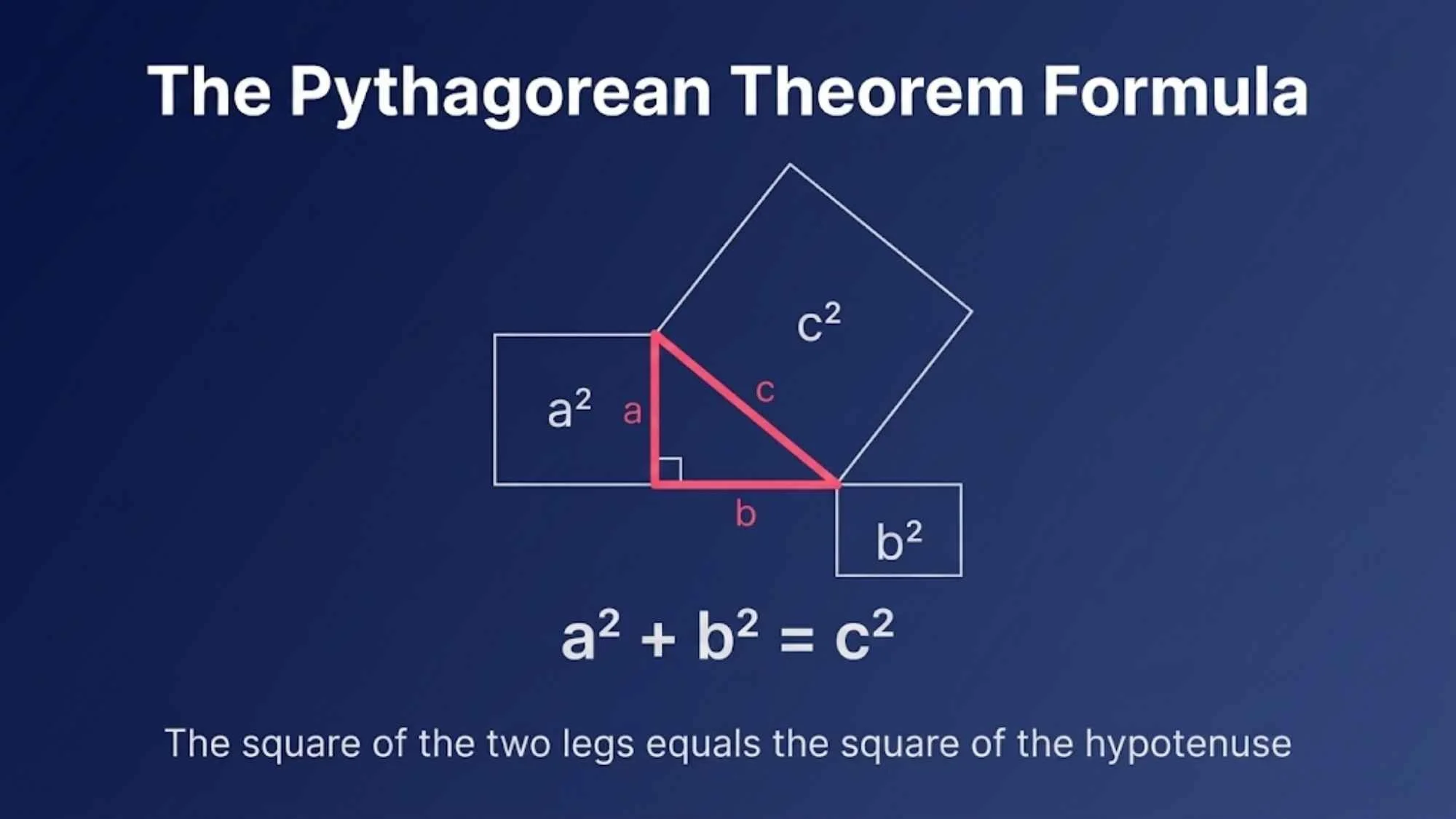
Formula: a² + b² = c² | Used for: right triangles only
The Pythagorean theorem states that in any right triangle, the square of the hypotenuse equals the sum of the squares of the two legs. To use it: identify your known sides, square them, add (or subtract), and take the square root of the result.
a and b = the two shorter sides (legs)
c = the longest side (hypotenuse), opposite the 90° angle
Steps: square the known values → add → take the square root
What Is the Pythagorean Theorem?
Before jumping into solving, let's make sure you actually understand what this theorem is describing — not just memorizing a formula.
A right triangle is a triangle that has one angle equal to exactly 90° (a right angle). The Pythagorean theorem describes the relationship between the three sides of that triangle.
Think of it this way: if you build a square on each side of the triangle, the area of the two smaller squares added together will always equal the area of the largest square. That's the geometric intuition behind the formula.
This relationship is captured in the Pythagorean theorem formula: a² + b² = c². It is one of the most important formulas in geometry and is used everywhere — from construction and navigation to video game design and architecture.
Want to go deeper on triangles before solving? Check out this right triangle reference guide from Khan Academy.
How to Solve the Pythagorean Theorem
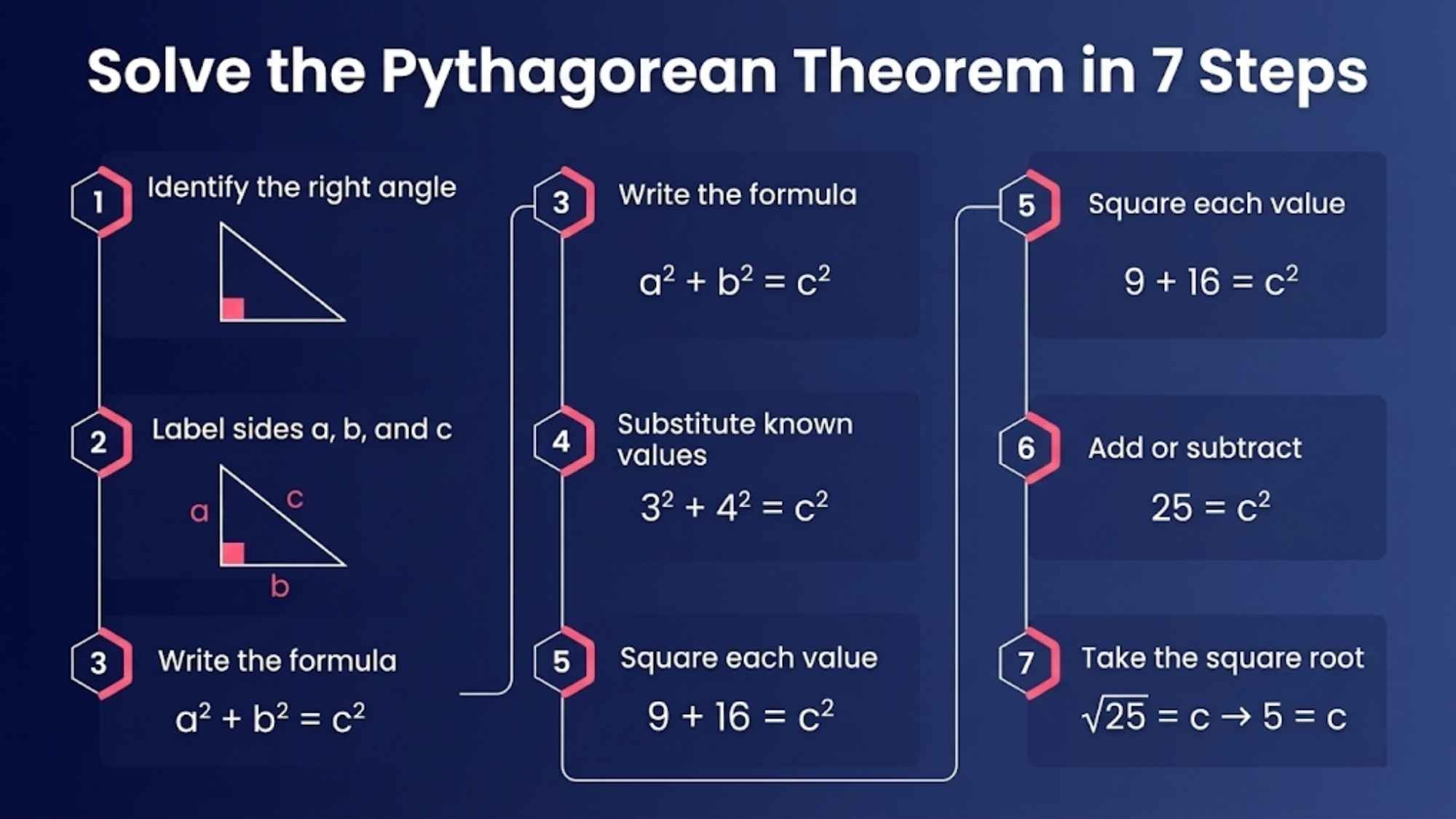
This is the core of what you came for. We're going to move step by step: understand the formula → learn the system → work through examples. Take it slow. There is no rush.
Understand the Formula
Let's start by making sure the formula doesn't intimidate you. Here it is again:
a² + b² = c²
Here's what each part means:
a and b are the two legs — the shorter sides that form the right angle
c is the hypotenuse — always the longest side, always opposite the right angle
² (squared) means multiplying the number by itself (e.g., 3² = 3 × 3 = 9)
One thing to remember forever: c is always the hypotenuse. It is always the longest side. The formula never changes. That predictability is your best friend in an exam.
Solve the Pythagorean Theorem: A Repeatable 7-Step System
Use this system every single time — whether it's a quiz, a test, or a homework problem. It works.
Identify the right angle: Look for the small square symbol (□) at one corner of the triangle. That marks the 90° angle.
Label the sides: The side directly opposite the right angle is c (hypotenuse). The other two sides are a and b.
Write out the formula: a² + b² = c² — writing it out keeps you from making substitution errors.
Substitute the known values: Plug the numbers you know into the correct positions in the formula.
Square each known value: Multiply each known number by itself before doing anything else.
Add or subtract: If finding c: add a² + b². If finding a leg: subtract the known leg squared from c².
Take the square root: This gives you the missing side length. Round if needed, and double-check your answer is reasonable.
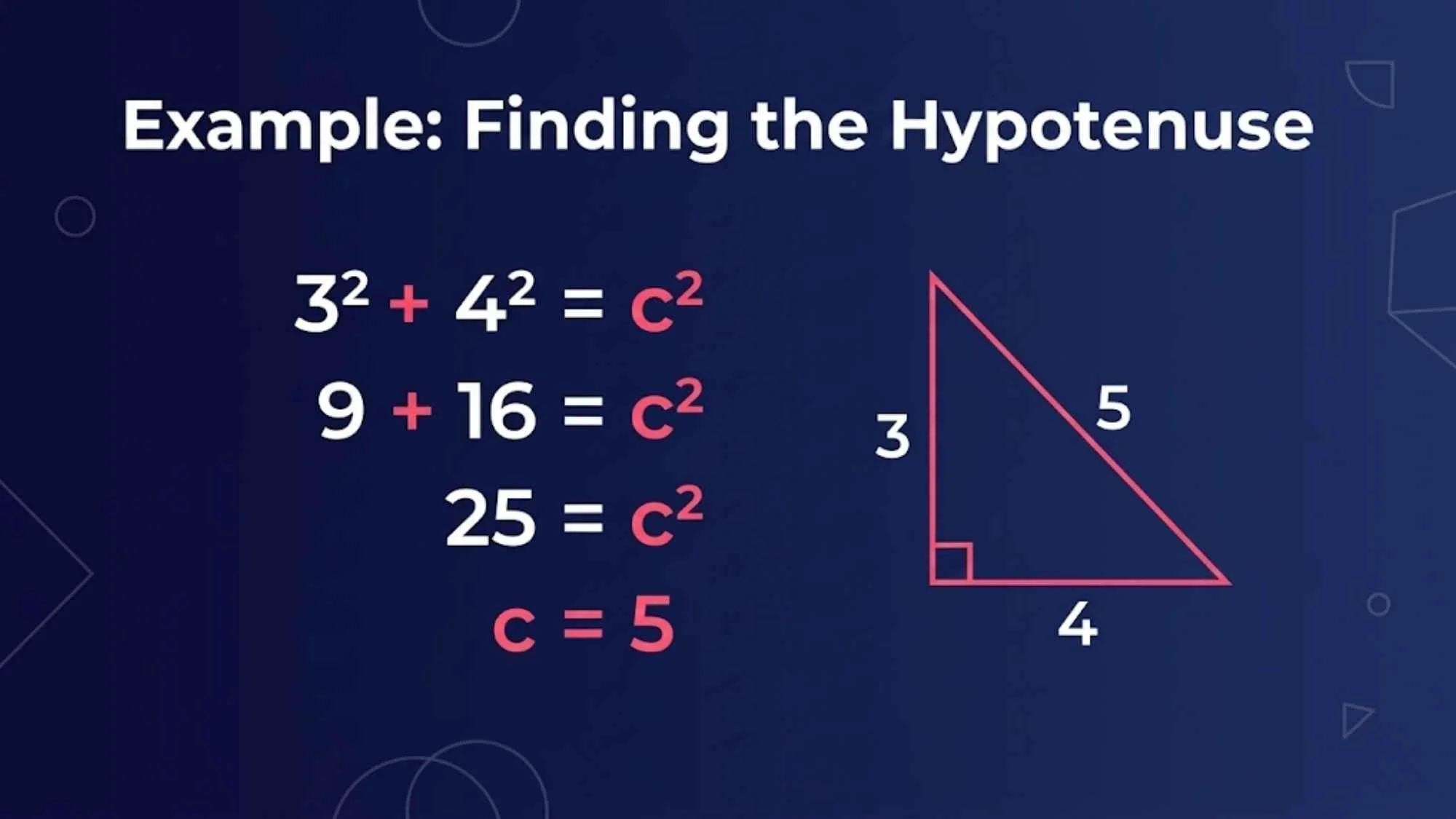
Example — Finding the Hypotenuse
Let's say a right triangle has legs a = 3 and b = 4. We need to find c (the hypotenuse).
a² + b² = c²
3² + 4² = c²
9 + 16 = c²
25 = c²
c = √25 = 5
The missing hypotenuse is c = 5.
See? The process is completely predictable. You followed the steps and the answer appeared.
This is exactly what happens every time.
Example — Finding a Missing Leg
Now let's find a missing leg instead. This trips students up more often — but the logic is simple once you see it.
Say you know c = 13 and a = 5. Find b.
When you're solving for a leg, rearrange the formula:
b² = c² − a²
b² = 13² − 5²
b² = 169 − 25
b² = 144
b = √144 = 12
The missing leg is b = 12. Why subtraction? Because you're working backwards — you already know the total (c²) and one part (a²), so you subtract to find the other part.
For more practice problems like these, try Math is Fun's Pythagorean Theorem exercises.
Common Mistakes Students Make When Solving It
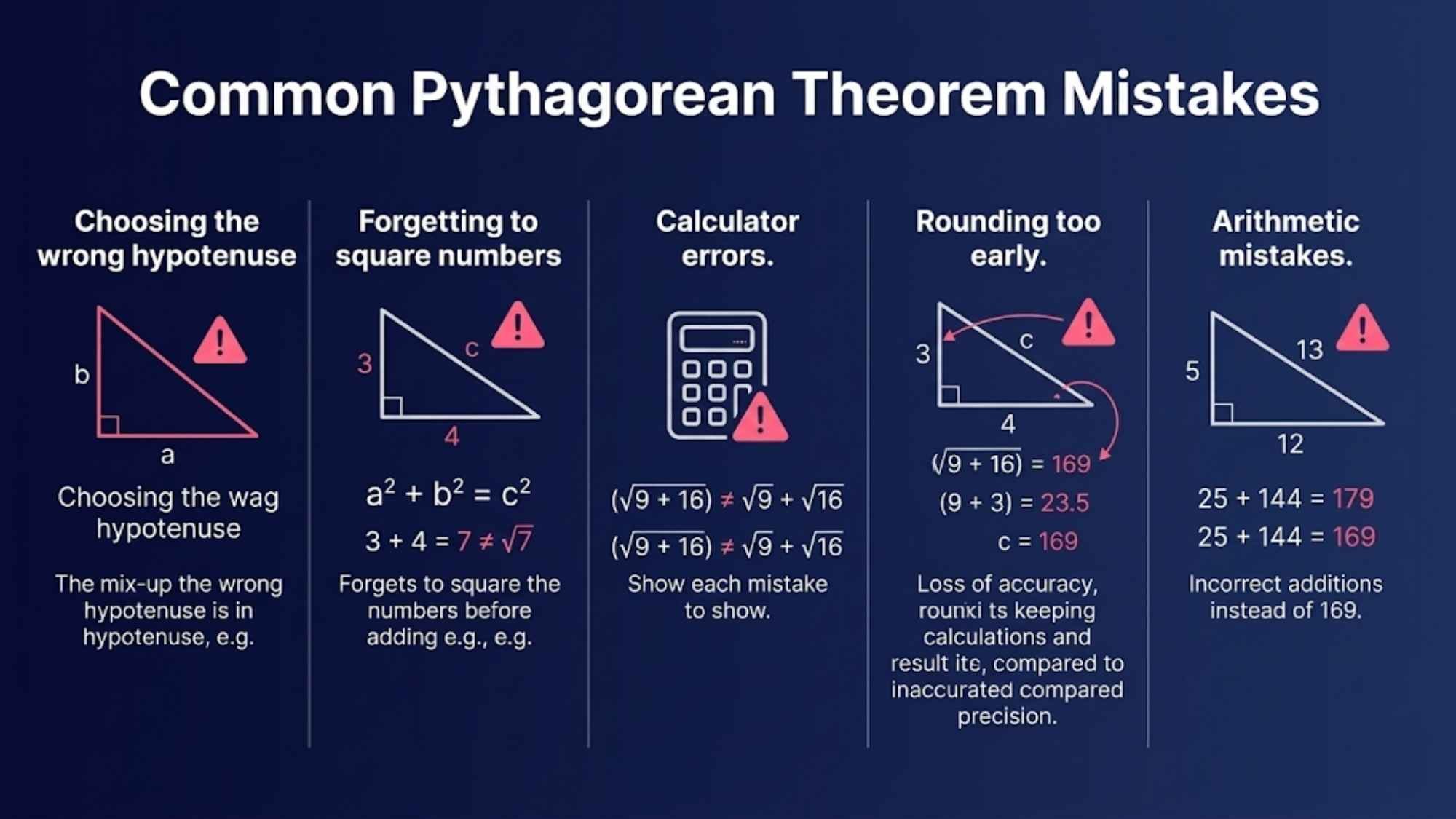
Even students who understand the formula can lose marks over small errors. Here are the most common ones — knowing them in advance puts you ahead.
Choosing the wrong hypotenuse. Always confirm: c is opposite the right angle, not just the longest-looking side you see.
Forgetting to square the values. Never write 3 + 4 = c. You must square first: 9 + 16 = c².
Calculator errors. When finding the square root, make sure you're rooting the final sum — not one of the individual terms.
Rounding too early. Keep full decimal values through the whole calculation. Only round in your final answer.
Arithmetic slips. Even 5² = 10 is a common mistake under pressure. Write it out: 5 × 5 = 25.
Accuracy improves quickly with practice. Don't be hard on yourself for making these mistakes — awareness of them is already the first step to avoiding them.
FAQs
1. What is the easiest way to solve the Pythagorean theorem?
The easiest approach is to follow a consistent step-by-step system every time. Label your sides (a, b, c), write out the formula, substitute values, square them, then add or subtract, and take the square root. The formula never changes — the steps never change. Repetition builds speed.
2. How do you know which side is the hypotenuse?
The hypotenuse is always the side directly opposite the 90° angle — the right angle. Look for the small square symbol in the corner of the triangle. Whatever side faces away from that corner is your hypotenuse (c). It is also always the longest side of a right triangle.
3. Can the Pythagorean theorem be used for all triangles?
No — it only works for right triangles (triangles with a 90° angle). For triangles without a right angle, you'll need different tools like the Law of Cosines. Applying the Pythagorean theorem to a non-right triangle will give you a wrong answer every time.
4. Do you always take the square root at the end?
Yes — whenever you're solving for a side length. The formula gives you the side squared (a², b², or c²), so you must take the square root to get the actual length. The only exception is if the question asks for the squared value specifically, which is rare.
5. Why do we square the sides?
Squaring the sides connects to geometry: each squared value represents the area of a square built on that side of the triangle. The theorem is really saying the two smaller squares' areas add up to the largest square's area. Squaring converts lengths into areas so the relationship holds true.
Quick Summary — How to Solve It Fast
Label a, b, and c on your triangle first
Write the formula: a² + b² = c²
Substitute your known values
Square each value individually
Add (for hypotenuse) or subtract (for a leg)
Take the square root for the final answer
Check: the hypotenuse must be the longest side
Conclusion
Understanding how to solve the Pythagorean theorem isn't about raw math talent — it's about following a system. With the seven steps above, you have a reliable, repeatable method you can use on any problem.
Confusion at first is completely normal. Every student goes through it. The more you practice, the more natural each step becomes until eventually it feels automatic.
If you'd like extra help building that confidence, our tutors at HYE Tutors specialize in making geometry click for middle and high school students. Explore our math tutoring programs and get started today.
