

How To Find the Hypotenuse of a Triangle?

If you've ever stared at a right triangle and wondered where to even start, you're not alone. Many students struggle with geometry — not because the math is impossible, but because no one has shown them the right entry point. The good news?
Learning how to find the hypotenuse of a triangle is one of the most satisfying breakthroughs in middle and high school math. Once you understand the relationship between the three sides of a right triangle, the calculation becomes fast, reliable, and even enjoyable.
In this guide, you'll learn what the hypotenuse is, how to identify it, which formula to use, how to apply it step by step, where students commonly go wrong, and how geometry connects to the real world. Whether you're a student preparing for a test or a parent helping with homework, this breakdown will make the concept click.
“The hypotenuse of a right triangle is the longest side, always located opposite the 90-degree angle. To find it, use the Pythagorean theorem: c² = a² + b², where c is the hypotenuse and a and b are the two shorter sides (called legs). Simply square both legs, add the results, and take the square root. The answer is the hypotenuse.”
How to Find the Hypotenuse of a Triangle
Before reaching for a formula, it helps to build a mental picture. A right triangle has three sides and one special angle — the right angle, which measures exactly 90 degrees. Each of those three sides plays a specific role, and knowing which role each side plays is the foundation of everything that follows.
What Is the Hypotenuse in a Right Triangle?
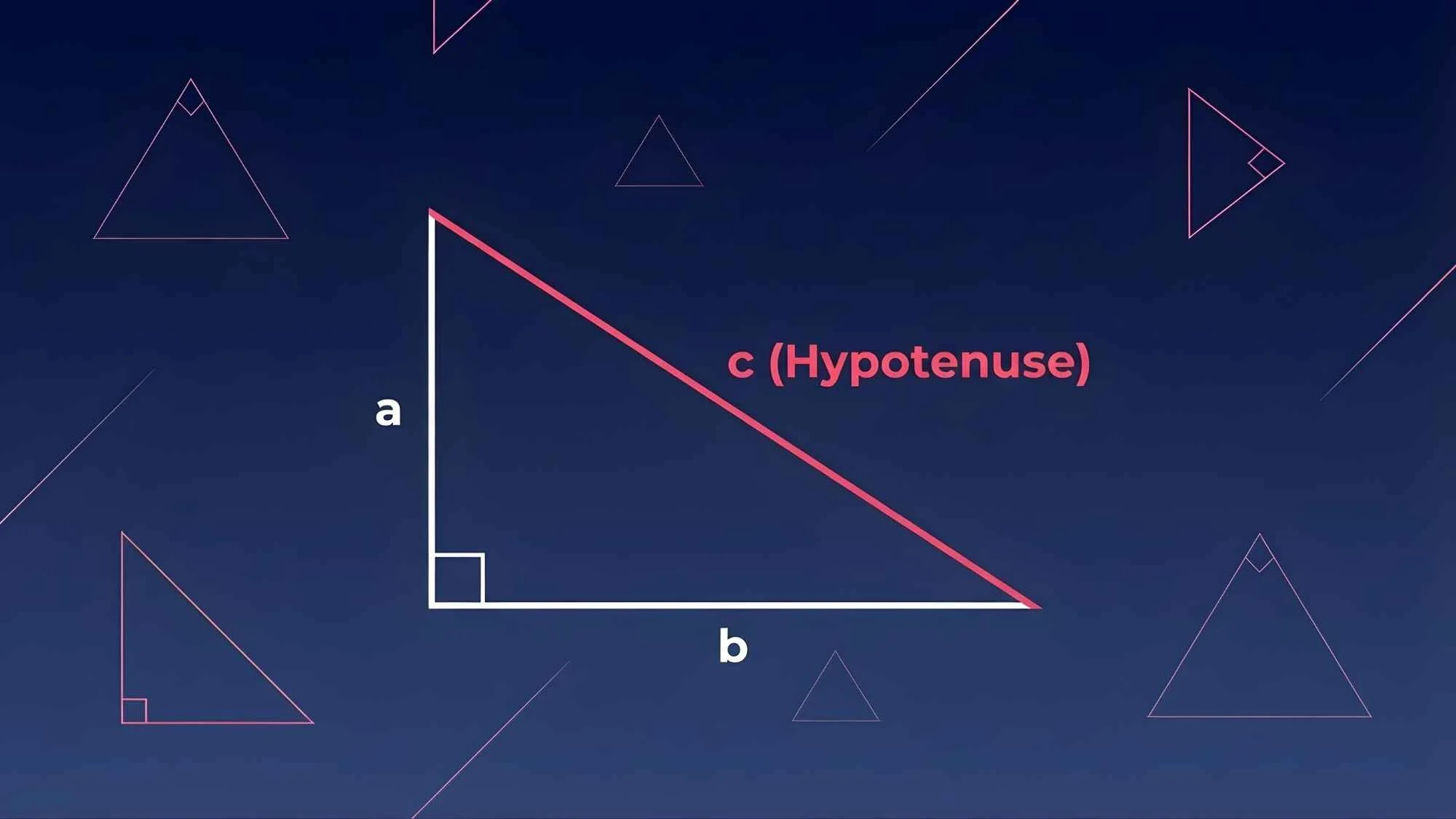
A right triangle contains exactly one 90-degree angle. The side that sits directly across from that right angle — not touching it, but facing it — is the hypotenuse. It is always the longest of the three sides, and it has a unique mathematical relationship with the other two sides.
The two shorter sides are called legs. Students often confuse the legs with the hypotenuse, especially when a triangle is drawn at an unusual angle on the page. The safest approach is to always locate the right angle first (look for the small square symbol in the corner), then find the side that is directly opposite it. That side is your hypotenuse — every single time.
Hypotenuse Formula Using the Pythagorean Theorem
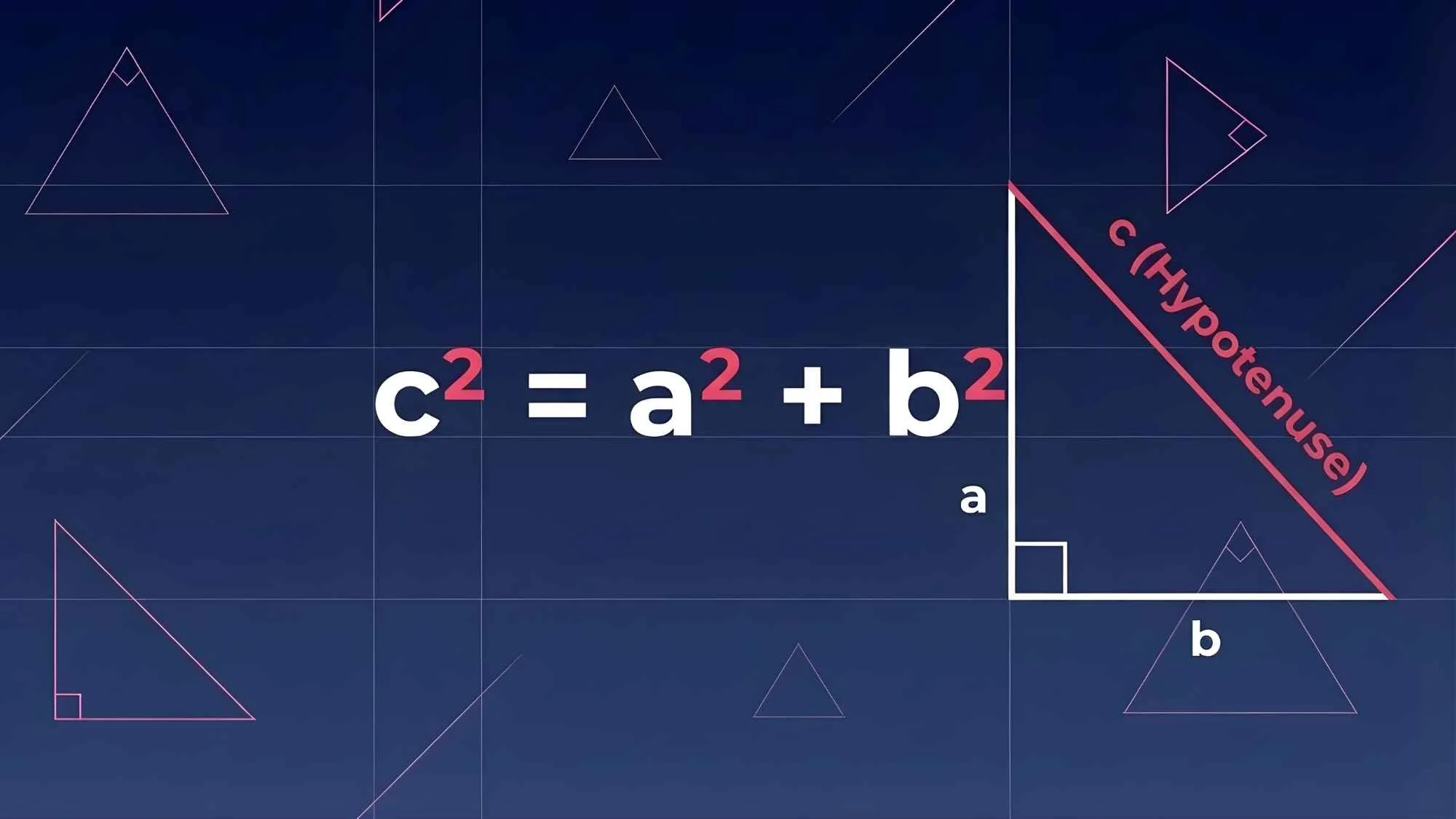
The Pythagorean theorem describes the exact mathematical relationship between the three sides of any right triangle. It was formalized by the ancient Greek mathematician Pythagoras, but its logic is completely accessible to any student willing to follow three steps.
The formula is:
c² = a² + b²
Where:
c = the hypotenuse (the side you are solving for)
a = the first leg
b = the second leg
To isolate c, take the square root of both sides: c = √(a² + b²). You square both shorter sides, add those values together, and then take the square root of the total. The result is your hypotenuse.
Step-by-Step Method to Calculate the Hypotenuse
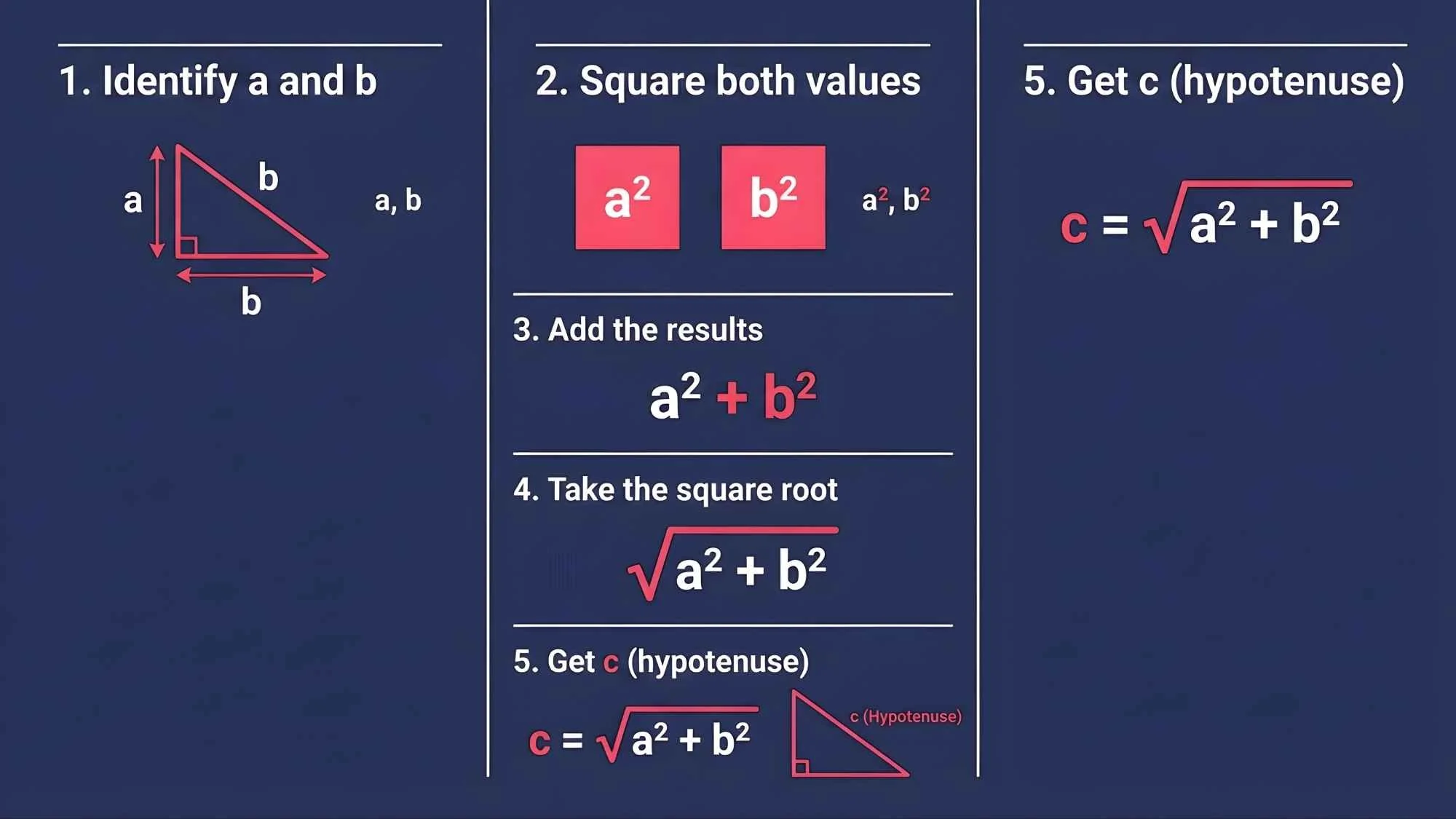
Follow these five steps every time you need to find the hypotenuse. Repeating this process builds reliable problem-solving instincts.
Identify the two known sides (the legs, labeled a and b).
Square both numbers (multiply each by itself).
Add the two squared values together.
Take the square root of that sum.
The result is your hypotenuse (c).
Quick example: if a = 6 and b = 8, then 6² + 8² = 36 + 64 = 100, and √100 = 10. The hypotenuse is 10 units.
Example — Finding the Hypotenuse of a Triangle
The most famous example in all of geometry involves a triangle with sides of 3, 4, and 5. Here is the full calculation:
Given: a = 3, b = 4
3² = 9
4² = 16
9 + 16 = 25
√25 = 5
The hypotenuse is 5 units.
The 3-4-5 triangle is called a Pythagorean triple because all three sides are whole numbers. It appears constantly in math class, on standardized tests, and in real construction work because it reliably produces a perfect right angle. Recognizing it instantly is a great time-saving habit.
💡 Still confused about finding the hypotenuse? Our math tutors at HYE Tutors help students master geometry step by step — with personalized support from Harvard, UC Berkeley, UCLA, and USC graduates.
How to Identify the Hypotenuse in Any Triangle
Not every triangle has a hypotenuse. Only right triangles — those containing a 90-degree angle — have one. Equilateral and isosceles triangles without a right angle follow different geometric rules entirely. Before assuming a triangle has a hypotenuse, confirm it is a right triangle.
To locate the hypotenuse in any right triangle, use this three-step visual strategy:
Find the right angle — look for the small square symbol or confirm which angle is 90 degrees.
Locate the side directly across from that angle — it will not share either of the right angle's two endpoint corners.
Confirm it is the longest side — the hypotenuse is always longer than either leg individually.
This strategy works even when triangles are drawn at unusual angles, tilted, or embedded within more complex diagrams. Always orient yourself by finding the right angle first, then trace across to the opposite side.
Real-Life Uses of Finding the Hypotenuse
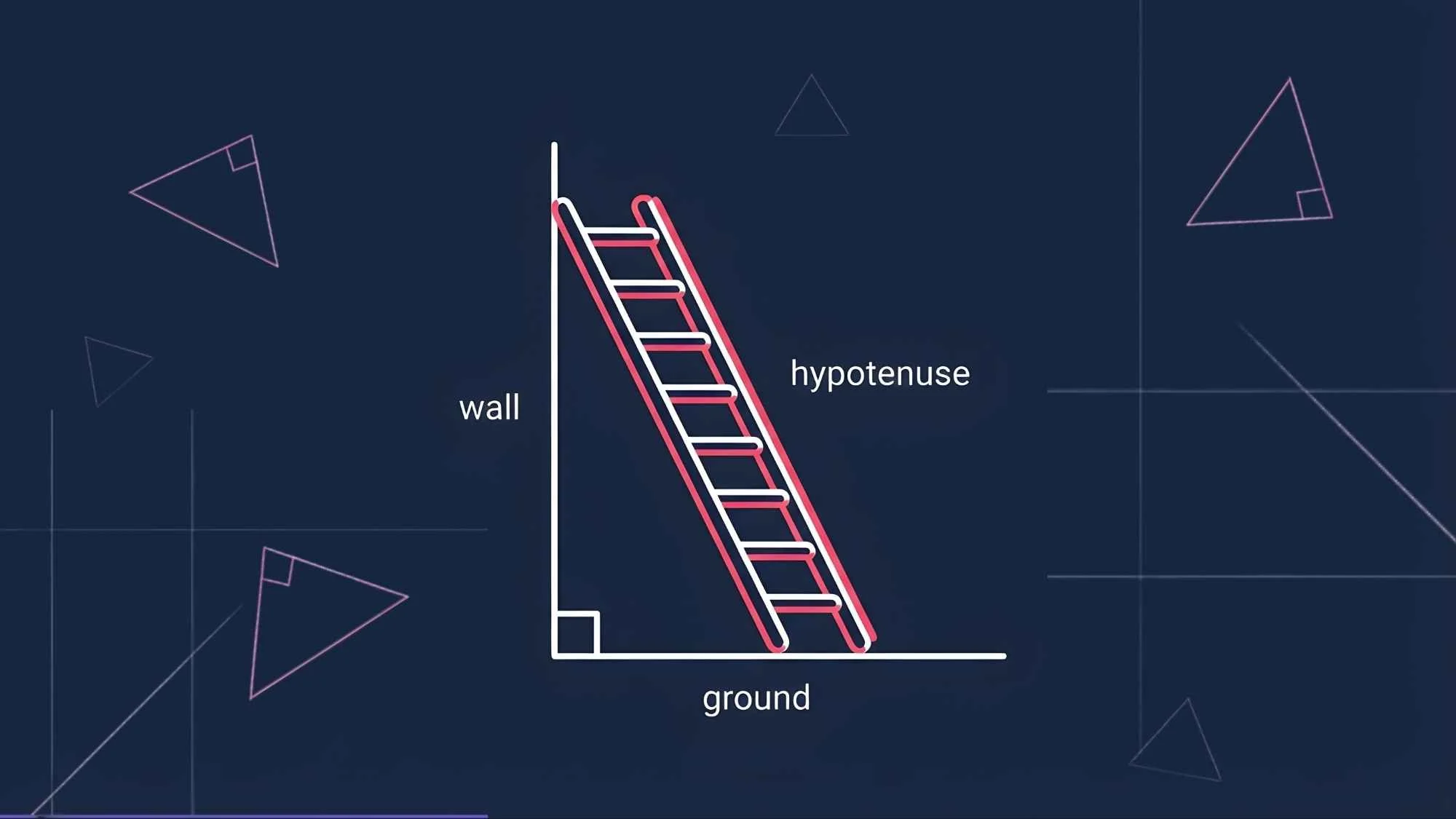
The Pythagorean theorem is not just a classroom formula. It appears constantly in fields that shape the physical and digital world. Understanding how to calculate the hypotenuse gives students a practical tool they will use throughout their careers.
Construction and architecture: Builders use right triangles to ensure walls are perfectly vertical and roofs are correctly angled.
Ladder safety: Knowing how far to position a ladder from a wall — and how tall a ladder you need — uses the hypotenuse formula directly.
Navigation and surveying: Calculating straight-line distances across uneven terrain relies on right triangle geometry.
Computer graphics and gaming: Every time a 3D environment renders a diagonal line or calculates a distance between two points, it is using the Pythagorean theorem.
Physics and engineering: Calculating resultant forces, velocity vectors, and structural loads all depend on right triangle principles.
When students see how the hypotenuse connects classroom math to the real world, abstract formulas start to feel purposeful.
Practice Problems to Find the Hypotenuse
Try solving these problems before checking the answers. Working through them step by step — squaring the legs, adding, and finding the square root — builds confidence quickly.
Problem 1: a = 5, b = 12
Problem 2: a = 8, b = 15
Problem 3: a = 7, b = 24
Answers: Problem 1 = 13 | Problem 2 = 17 | Problem 3 = 25
Each of these is a Pythagorean triple — sets of three whole numbers that satisfy the Pythagorean theorem perfectly. They are favorites on standardized tests, so recognizing them with fluency pays off.
📋 Want guided practice and personal help solving triangles? Book a one-on-one tutoring session with a HYE Tutors math specialist. BOOK NOW
Common Mistakes Students Make When Finding the Hypotenuse
Even students who understand the concept sometimes lose points due to avoidable errors. Here are the most common ones — and how to prevent them.
Confusing the hypotenuse with a leg: Always locate the right angle first, then find the side opposite to it.
Forgetting to take the square root: The formula gives c², not c. Students must complete the final step and take the square root of the sum.
Applying the formula to non-right triangles: The Pythagorean theorem only works for right triangles. For other triangles, different laws apply.
Squaring incorrectly: Make sure to square each leg (multiply it by itself) — do not simply double the value.
Rounding too early: Complete the full calculation before rounding to avoid compounding errors.
Practicing the step-by-step method consistently is the most reliable way to eliminate these errors. Repetition builds both accuracy and speed.
FAQs
What is the hypotenuse of a triangle?
The hypotenuse is the longest side of a right triangle. It is always located directly opposite the 90-degree angle. It is the side you solve for when using the Pythagorean theorem, and it is always longer than either of the two legs.
What formula is used to find the hypotenuse?
The standard formula is c² = a² + b², derived from the Pythagorean theorem. Solving for c gives c = √(a² + b²). Square both legs, add the results, and take the square root to calculate the hypotenuse.
Can you find the hypotenuse without the Pythagorean theorem?
Yes — using trigonometry. If you know one leg and one acute angle, you can use sine or cosine ratios to find the hypotenuse. However, for most geometry courses, the Pythagorean theorem is the primary method and the most straightforward approach.
Does every triangle have a hypotenuse?
No. Only right triangles have a hypotenuse. A triangle must contain exactly one 90-degree angle for the concept to apply. Equilateral, isosceles, and scalene triangles without a right angle do not have a hypotenuse.
Conclusion
Understanding how to find the hypotenuse of a triangle starts with one clear insight: in every right triangle, the sides follow a precise, predictable relationship. Once students internalize c² = a² + b² and practice the five-step process, the calculation becomes second nature.
If math feels challenging right now, that is completely normal. Every student hits difficult concepts. The key is not to rush, but to slow down, follow the steps, and practice consistently. Mastering the hypotenuse builds the foundation for trigonometry, geometry proofs, and advanced coursework — so the time invested here pays dividends throughout your education.
Keep practicing, ask questions, and trust the process. You have everything you need to succeed.
🎓 Struggling with geometry concepts like the Pythagorean theorem? A dedicated HYE Tutors math specialist can make geometry clear, logical, and even enjoyable. Our tutors are graduates of Harvard, UC Berkeley, UCLA, and USC — and they have helped hundreds of students go from confused to confident.