

What Is Mean in Math? Your Complete Guide to Score Higher on Every Test
You're sitting in class or halfway through a practice exam. The question reads: "Find the mean of the following data set." You stare at the numbers — 78, 85, 92, 67, 88 — and suddenly the word mean feels slippery. Is it the middle number? The most common one? If that moment feels familiar, you're in exactly the right place. Understanding what is mean in math is one of the highest-leverage topics you can master before any standardized test. In my five years of tutoring students from grade five through high school, mean questions appear on the SAT, ACT, state assessments, and Common Core exams without exception — and they're almost always worth easy marks once you know the process.
In this guide, you'll get the clear definition, the formula, worked examples you can learn from immediately, common mistakes to avoid, and memory tricks that stick. By the end, you'll have a tutor-approved, exam-ready understanding of mean — and we'll also show you how it connects to median, mode, and range, since those four concepts almost always appear together on tests.
What Is Mean in Math?
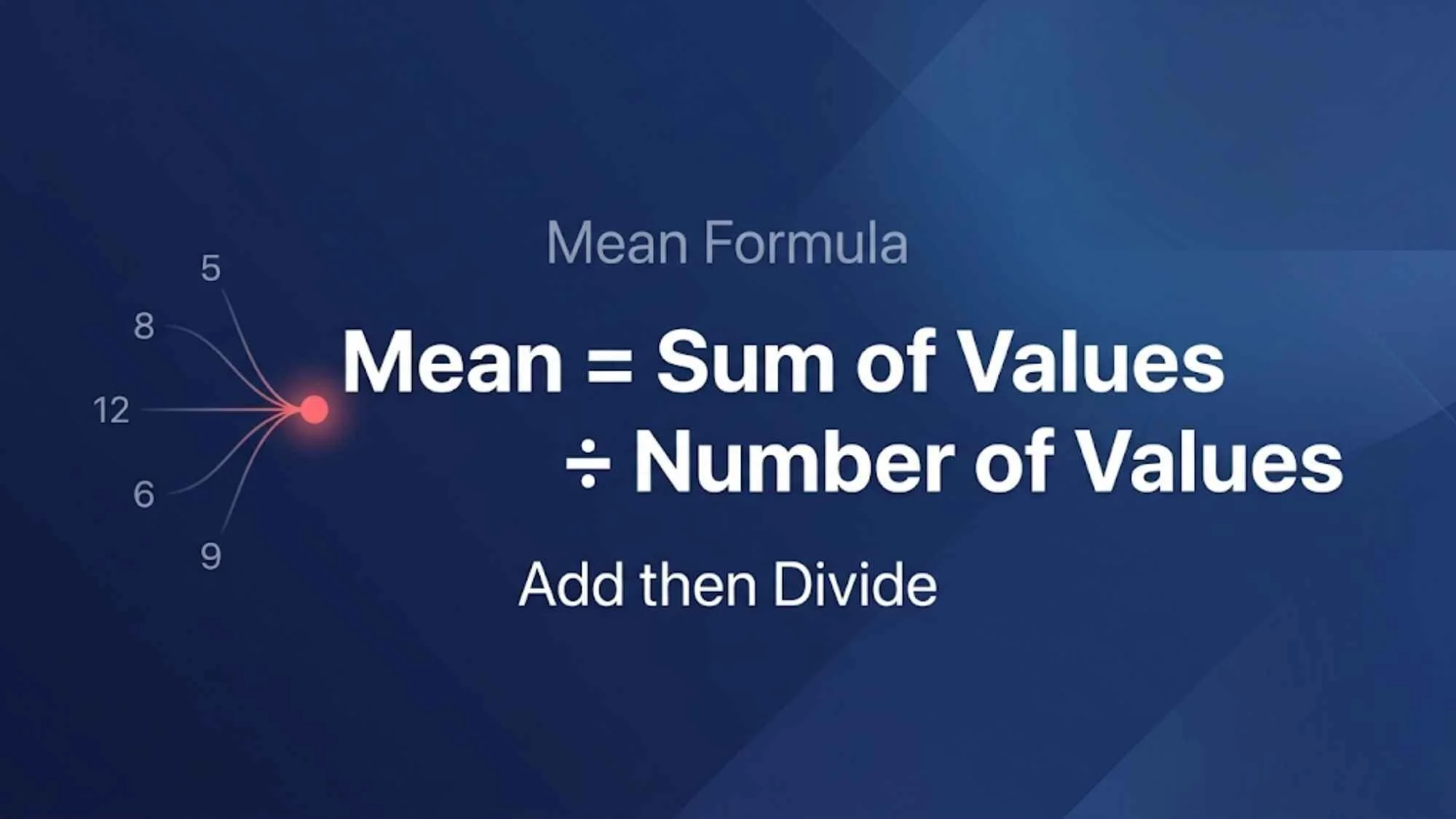
In math, the mean is the average of a set of numbers. To find the mean, add all the values in the data set together, then divide by how many values there are.
Formula: Mean = Sum of All Values ÷ Number of Values
Example: In {4, 8, 6, 2, 10}, the mean is (4 + 8 + 6 + 2 + 10) ÷ 5 = 30 ÷ 5 = 6.
What Is Mean in Math?
In five years of tutoring, mean is one of those topics that students either fly through or stumble on — and the stumbling almost always happens in the addition step, not the division. Let me walk you through it layer by layer so that doesn't happen to you.
Mean in Math — Definition
Let's start with plain English before we bring in any formulas. The mean is simply the average of a group of numbers. Most students already have an intuitive sense of what an average is — they just haven't connected it to the mathematical word mean yet.
Here's the most natural way to think about it: imagine five friends each contribute a different amount of money toward a group birthday gift — one puts in $5, another $20, another $10, and so on. The mean tells you what each person contributed on average. It's the single number that fairly represents the whole group's contribution.
A few things worth noting from the start:
Mean is one of the three measures of central tendency — alongside median (the middle value) and mode (the most frequent value). All three summarize a data set with a single number, just in different ways.
In everyday language, mean and average mean the same thing. In more advanced statistics, there are multiple types of averages — but in school math through Grade 10, mean almost always refers to the arithmetic mean.
The mean is the most commonly used average in daily life, in the news, and on standardized tests — which is exactly why it's worth mastering first.
Mean Formula in Math
The formula is straightforward. There are two ways to write it — a word version and a symbolic version. Both say exactly the same thing:
| Word Formula | Symbolic Formula |
|---|---|
| Mean = Sum of All Values ÷ Number of Values | x̅ = Σx ÷ n |
| Add everything up, then divide by how many numbers you have. | x̅ = mean | Σx = sum of all values | n = count of values |
Don't be intimidated by the symbolic version. The x̅ (read: "x-bar") simply means "the mean." The Σ (Greek letter sigma) means "the sum of." And n is just how many values you have. Put together: add all your values, divide by how many there are.
Teacher Tip: Write out your addition before you divide. Every time. Students who rush this step are the ones who get the wrong mean — even when they know the formula perfectly. A small addition mistake ruins the entire answer.
How to Find the Mean in Math — Step-by-Step
Here is the five-step method I use with every student from their very first lesson on mean:
Write out all the values in the data set.
Add all the values together to get the sum.
Count the total number of values. This is your n.
Divide the sum by n. If you need a refresher on dividing cleanly, our long division step-by-step guide has you covered.
Write your answer. Include decimal places if the division doesn't come out evenly — a decimal mean is completely correct.
Worked Example 1 — Clean result: {5, 10, 15, 20, 25}
Sum = 5 + 10 + 15 + 20 + 25 = 75
n = 5
Mean = 75 ÷ 5
Mean = 15
Worked Example 2 — Decimal result: {7, 14, 9, 22, 8}
Sum = 7 + 14 + 9 + 22 + 8 = 60
n = 5
Mean = 60 ÷ 5
Mean = 12
Worked Example 2b — Non-whole answer: {7, 14, 9, 22, 3}
Sum = 7 + 14 + 9 + 22 + 3 = 55
n = 5
Mean = 55 ÷ 5
Mean = 11
Now swap the 3 for a 4: {7, 14, 9, 22, 4} → Sum = 56 ÷ 5 = 11.2. A decimal answer is fine — write it exactly as it comes out.
At HYE Tutors, we've worked with students who assumed a decimal answer meant they'd made a mistake. They hadn't. The mean doesn't have to be a whole number, and it doesn't have to be a value in the original data set.
Types of Mean in Math — Arithmetic, Geometric, and Weighted
If you're in middle school, here's the short version: arithmetic mean is all you need right now. Master that first, then come back to this section when your curriculum requires it.
For Grade 9–10 students, here's the overview:
Arithmetic mean — the standard average. Sum ÷ count. This is what 'mean' means in school math unless the question says otherwise.
Weighted mean — used when some values count more than others. Your GPA is a weighted mean: a final exam worth 50% of your grade counts far more than a homework assignment worth 5%. Formula: multiply each value by its weight, sum the results, divide by the total weight.
Geometric mean — used in growth rates and financial calculations. You multiply all values together and take the nth root. This is typically Grade 10+ content and won't appear on most middle school assessments.
Exam Tip: On standardized tests up to Grade 10, 'mean' always refers to the arithmetic mean unless the question explicitly states otherwise. If it says 'find the average,' calculate sum ÷ count. That's the safe move in 99% of cases.
How to Find the Mean of a Frequency Table
Frequency tables are a format that appears regularly on state assessments — and they trip students up more often than they should. Here's the approach, step by step.
A frequency table has two columns: the value, and how many times it appears (its frequency). To find the mean from a frequency table, add a third column:
| Value (x) | Frequency (f) | x × f |
|---|---|---|
| 2 | 3 | 6 |
| 4 | 5 | 20 |
| 6 | 2 | 12 |
| Totals | 10 | 38 |
Exam Tip: Frequency table mean questions appear on almost every state assessment I've helped students prepare for. Don't skip this format in your revision — it's a reliable exam item.
Memory Tricks to Remember Mean in Math
Here are the three memory aids I use most often in sessions:
"Add then Divide" — two words, two steps, in order. Say it out loud before you start any mean problem. This single verbal cue prevents the most common sequencing error I see: students who divide first, then try to add.
The party trick — imagine everyone at a party pools their money and splits it equally. That equal share is the mean. If you can picture the party, you'll never forget what mean represents.
The seesaw — the mean is the balancing point of a data set. If you plotted all your values on a number line and balanced it like a seesaw, the mean is exactly where it tips level. I draw this on the whiteboard in every first lesson on mean — students who visualize it almost never forget the concept.
Mean Examples in Math — Practice Problems
Theory becomes confidence through practice. Here are five problems, building from straightforward to exam-level, including a word problem and a frequency table — the two formats you're most likely to encounter on a real test.
Problem 1 — Basic: {3, 6, 9, 12, 15}
Sum = 3 + 6 + 9 + 12 + 15 = 45
n = 5
Mean = 45 ÷ 5 = 9
Problem 2 — Decimals: {4.5, 7.0, 2.5, 9.0, 2.0}
Sum = 4.5 + 7.0 + 2.5 + 9.0 + 2.0 = 25.0
n = 5
Mean = 25.0 ÷ 5 = 5.0
Problem 3 — Non-whole result: {11, 17, 8, 14}
Sum = 11 + 17 + 8 + 14 = 50
n = 4
Mean = 50 ÷ 4 = 12.5 — a decimal result is correct; write it as-is.
Problem 4 — Word problem: A student scored 78, 85, 92, 67, and 88 on five math tests. What is their mean score?
Values: {78, 85, 92, 67, 88}
Sum = 78 + 85 + 92 + 67 + 88 = 410
n = 5
Mean score = 410 ÷ 5 = 82
Problem 5 — Frequency table challenge:
| Score | Frequency |
|---|---|
| 60 | 4 |
| 80 | 6 |
60 × 4 = 240 | 80 × 6 = 480 | Total x×f = 720 | Total f = 10
Mean = 720 ÷ 10 = 72
Teaching Note: Word problems about mean appear on almost every standardized test. The numbers are dressed up in a story, but the process is identical every time: spot the values, add them, divide by how many. That’s it. We’ve worked with students at HYE Tutors who initially found word problems intimidating — within a session or two of recognizing this pattern, they were the ones finishing the statistics section first.
Want more practice? Our team at HYE Tutors is ready to help you work through problems like these with expert guidance. Book a free session today and build your confidence before your next exam.
Mean vs. Median vs. Mode — Key Differences Explained
Mean, median, mode, and range almost always appear together on standardized tests. In our experience at HYE Tutors, if your exam covers one, it covers all four. Here’s the comparison you need:
| Measure | What It Finds | How to Calculate | Best Used When |
|---|---|---|---|
| Mean | Average value | Sum ÷ Count | Data has no extreme outliers |
| Median | Middle value | Order values; find center | Data has outliers |
| Mode | Most frequent value | Find what repeats most | Finding the most common value |
| Range | Spread of data | Maximum − Minimum | Measuring how spread out data is |
The critical insight here: mean works best when data has no extreme outliers. One unusually high or low value pulls the mean away from center, but it barely moves the median. This is why economists report median household income rather than the mean — a small number of billionaires would make the mean look unrealistically high for the average family.
For a full side-by-side treatment of all four measures, our guide on what is mean, median, mode, and range in math is the ideal next read. If you want a dedicated deep-dive into the median specifically, our article on what is the median in math pairs perfectly with this one. And for mode, see our guide on what is mode in math.
Exam Tip: Every year I've tutored, the question 'which measure best represents this data set?' appears on state math exams. If the data contains a clear outlier, the answer is almost always median — not mean. That's a pattern worth memorizing.
Arithmetic Mean vs. Average — Are They the Same Thing?
Students and parents often use the words mean and average interchangeably — and in most school contexts, they are exactly right to do so. But there's a distinction worth understanding, especially for exam purposes.
Technically, "average" is a broader term that can refer to the mean, the median, or even the mode — all three are valid types of averages. In school math through Grade 10, however, whenever a question says "find the average," it almost always means the arithmetic mean: sum ÷ count. That’s the safe interpretation in 99% of cases we’ve seen across SAT, ACT, and state exams.
When exam questions specify "arithmetic mean," they want exactly that: add all values, divide by count. They’re not asking for the median or mode.
One extension worth knowing for Grades 8–10: the weighted average. This is where some values count more than others. Your GPA is a weighted average: a final exam worth 50% of your grade is weighted far more heavily than a homework assignment worth 5%. The arithmetic mean treats every value equally; the weighted mean does not.
Exam Tip: If a question ever says 'find the average' without specifying which type, calculate arithmetic mean. Add all values, divide by n. That’s the right answer in the overwhelming majority of standardized test questions.
Common Mistakes Students Make When Finding the Mean
These are the errors I correct most frequently across five years of tutoring. Read this section like a checklist — each one is avoidable.
❌ Mistake 1: Adding incorrectly before dividing
This is the most frequent error, week after week. A small addition mistake cascades into a wrong final answer. The fix: write out your addition in full, line by line. Don’t add in your head.
❌ Mistake 2: Dividing by the wrong n
Students miscount the number of values, especially when some are repeated. {6, 6, 3, 9} has four values — not three. Count each occurrence separately.
❌ Mistake 3: Forgetting to include all values
In longer data sets, students skip a number mid-addition. Work left to right, check off each value as you go.
❌ Mistake 4: Confusing mean with median
Finding the middle value of an ordered list and calling it the mean. Remember: mean = add then divide. Median = middle value after ordering. They are different operations.
❌ Mistake 5: Rounding too early
Rounding mid-calculation instead of at the final step. Carry full decimal values through the calculation, then round only the final answer if the question asks you to.
❌ Mistake 6: Dropping zero values
Zero is a real value and must be included in both the sum and the count. In {0, 5, 10, 15}, n = 4, not 3. A zero in the data set pulls the mean downward — leaving it out inflates the answer.
Check Your Work Checklist:
Did I include every value?
Did I count n correctly — including repeated values and zeros?
Did I add before dividing, not the other way around?
Did I round only at the final step?
Where Is Mean Used in Real Life?
Math is most memorable when you can see it working in the world outside the classroom. Here’s where you’ll encounter the mean in real life:
Report cards and — a student’s GPA is a weighted mean of their grades across subjects. This is the example I lead with for every high school student I work with, because it affects them directly.
Weather reporting — the mean daily temperature across a month or season is the standard metric used in climate data from NOAA. When meteorologists report that a month was warmer or cooler than average, they’re comparing means.
Sports statistics — a basketball player’s points-per-game average is the mean of their score across all games played. Every batting average, points-per-game figure, and ERA in professional sports is a form of mean.
Finance and investing — mean stock price over a given period helps investors identify trends and smooth out day-to-day volatility. A moving average, for instance, is calculated from consecutive means.
Medicine and public health — mean blood pressure, mean recovery time, and mean dosage across a population are all standard metrics in clinical research and health guidelines.
Classroom performance — teachers use mean test scores to assess how a class performed overall and identify whether a lesson needs revisiting.
For a broader look at how mathematics applies to the world outside the classroom, Khan Academy’s statistics and probability section is an outstanding free resource that pairs well with this guide.
FAQs
Q1: What is mean in math for kids?
The mean is the fair share number. If four friends have 2, 4, 6, and 8 candies and they share them equally, each person gets 5 — that’s the mean. Add all the numbers together, then divide by how many people (or values) there are.
Q2: What is the difference between mean and average?
In most school math, they’re the same thing. Technically, 'average' is a broad term that can refer to mean, median, or mode. But when a test question says 'find the average,' it almost always means the arithmetic mean — add the values and divide by the count.
Q3: Can the mean be a decimal?
Yes — and it frequently is. If the sum doesn’t divide evenly by n, the mean will be a decimal. For example, the mean of {3, 5, 8} is 16 ÷ 3 = 5.33. A decimal answer is completely correct; don’t round unless the question specifically asks you to.
Q4: What happens to the mean if you add an outlier?
The mean gets pulled significantly toward the outlier. For example, the mean of {60, 65, 68, 70} is 65.75. Add one outlier of 150: the mean jumps to 82.6 — far above where most values sit. This is exactly why the median is sometimes a more representative measure when outliers are present.
Q5: How do you find the mean of a large data set?
The steps are identical regardless of size: add all values, divide by n. For very large data sets, tools like Excel’s =AVERAGE() function or Google Sheets handle the calculation automatically. For exams, Math Is Fun’s statistics tools offer useful practice with different data formats.
Q6: What is the weighted mean?
A weighted mean is used when some values count more than others. Multiply each value by its weight, sum the results, then divide by the total weight. Your GPA is a classic example: a final exam worth 50% of your grade is weighted five times more than a homework assignment worth 10%.
Conclusion
Understanding what is mean in math comes down to two steps: add all values, then divide by how many there are. That’s the arithmetic mean — the most commonly tested measure of central tendency in middle and high school math, and the foundation for understanding weighted means, frequency tables, and beyond.
Keep the "Add then Divide" cue handy, write your addition out in full, and double-check your count of n before you divide. Those three habits alone will eliminate the most common mean errors we see in tutoring sessions.
Mean is one of four key measures of central tendency. To complete the picture before your next exam, pair this article with our guides on what is the median in math and what is mode in math — both are worth reading in the same sitting. You now have a tutor-approved, exam-ready command of what is mean in math. Go use it with confidence.
Ready to go further? If you’d like to work through more problems with a dedicated tutor, our team at HYE Tutors is here to help. Book your free session today — let’s make sure you walk into your next exam fully prepared.
