

What Is a Constant in Math? Beginner-Friendly Guide
You’re working through an algebra problem. The equation in front of you reads x + 5 = 12, and your teacher asks: “What is the constant?” The x you understand — it’s the thing you’re solving for. But what about the 5? Or the 12? Are those constants? And what even is a constant, exactly? If you’ve stared at a question like that and felt unsure, you’re far from alone. Understanding what is a constant in math is one of those foundational concepts that appears in Grade 5 arithmetic, again in Grade 7 pre-algebra, and all the way through the SAT, ACT, and state assessments. As someone who has worked with hundreds of students across middle and high school math over the past five years, I can tell you: the students who get this distinction right early on have a noticeably easier time with everything that follows in algebra.
By the end of this guide, you’ll have a clear, memorable definition of a constant, a reliable method for identifying one in any expression, and the confidence to distinguish it from variables and coefficients — the two concepts students most often confuse it with. Let’s build that understanding right now.
Constant in Math
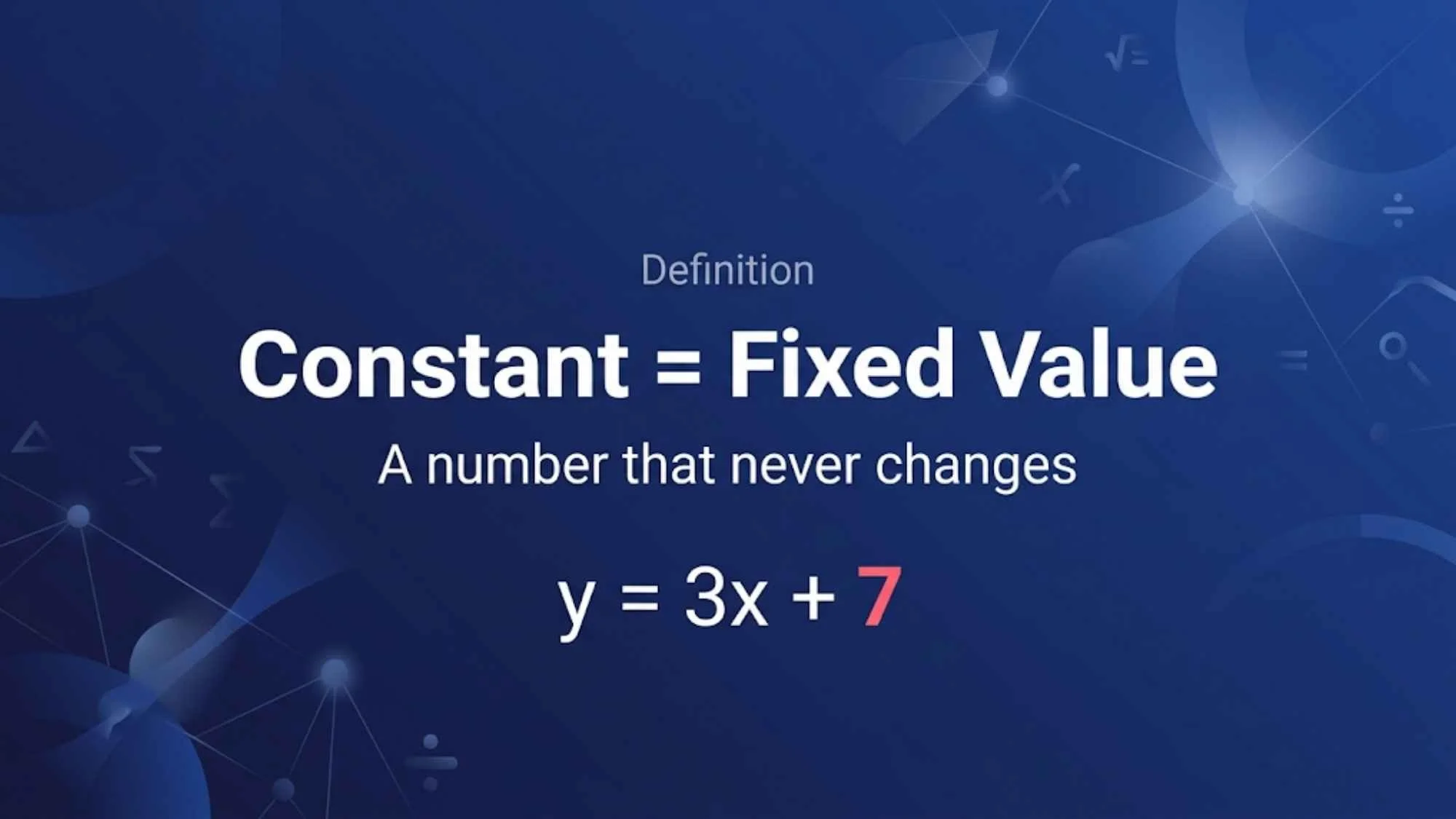
A constant in math is a fixed value that does not change. Unlike a variable, which can take different values, a constant always stays the same. Constants can be numbers (like 5, −3, or ½) or special symbols (like π ≈ 3.14159). In an equation like y = 3x + 7, the number 7 is the constant because it never changes regardless of x.
What Is a Constant in Math?
In my five years of tutoring, I’ve noticed that students who struggle with algebra almost always have one thing in common: no one clearly separated constants from variables for them early on. That single gap creates confusion that ripples across equation-solving, graphing, and word problems for years afterward. Let’s fix that right now, layer by layer.
Constant in Math — Definition
Start with plain English: a constant is a value in a mathematical expression or equation that does not change. No matter what else happens in the problem — no matter what value the variable takes — the constant stays exactly as it is.
The contrast with a variable is the most useful thing to lock in immediately:
Variable = a letter (like x, y, or n) that represents a value that can change from problem to problem or within a problem
Constant = a fixed number (like 5, −3, or ½) or a named symbol (like π) whose value never changes
Constants can be whole numbers, fractions, decimals, or negative numbers. They can also be famous mathematical symbols — more on those in a moment. The defining characteristic is always the same: a constant’s value is known and fixed before the problem begins, and it stays fixed throughout.
A real-life analogy that lands with every student I’ve taught: the number of days in a week is 7. That never changes — it’s a constant. The number of hours you sleep each night? That varies. That’s a variable. Same logic applies inside any math equation.
Teacher Tip: I tell every student: if the value wears a nametag that never changes, it’s a constant. If it wears a question mark, it’s a variable.
Constant vs. Variable — What’s the Difference?
Let’s put the comparison side by side. I draw something like this on the whiteboard in every first algebra session:
| Constant | Variable |
|---|---|
|
Value Fixed — never changes |
Value Changes depending on the problem |
|
Symbol Usually a number (5, −2, ½) or named symbol (π) |
Symbol Usually a letter (x, y, n) |
|
In 2x + 9 9 is the constant |
In 2x + 9 x is the variable |
|
In y = 5x − 2 −2 is the constant |
In y = 5x − 2 x and y are the variables |
One source of confusion worth addressing immediately: coefficients. In the expression 2x + 9, the 2 is the coefficient — it’s a number, but it’s attached directly to the variable x. A coefficient is not a constant. The 9, which stands alone with no variable attached, is the constant.
Exam Tip: Every year without fail, I see students circle the coefficient instead of the constant on multiple-choice tests. Make this rule stick: a coefficient is always glued to a variable. A constant stands alone. On time-pressured exams, spotting this difference quickly saves valuable minutes.
Examples of Constants in Math
Let’s look at constants in a range of contexts — from basic arithmetic all the way to algebra — so you can recognize them in any format your exam might use.
Simple arithmetic: In 4 + 3 = 7, every number is a constant. There are no variables anywhere in the equation — all values are fixed.
Algebraic expression: In y = 5x − 2, the constant is −2. This is the value that shifts the line up or down on a graph, regardless of what x is.
Named constant — π: In the circumference formula C = 2πr, the symbol π (pi) is a constant with a fixed value of approximately 3.14159. Even though it looks like a letter, it never changes.
Real-world formula: In d = 60t (distance = speed × time), if the speed is fixed at 60 mph, then 60 is a constant. The time t is the variable.
Negative constant: In x − 8 = 0, the constant is −8. The negative sign is part of the constant — students frequently miss this and say there’s no constant in the equation.
Teaching Tip: I always ask students: ‘Which number in this equation would still be there even if x disappeared entirely?’ That number is your constant. Try it on any expression — it works every time.
Types of Constants in Math
Students are sometimes surprised to learn that constants come in several forms. Here’s a clear breakdown:
Numeric constants — plain numbers like 3, −7, ½, or 0.5. These are the most common type in middle and high school math. Any number standing alone in an expression, with no variable attached, is a numeric constant.
Mathematical constants — special named values used universally across mathematics:
π (pi) ≈ 3.14159 — appears in every circle formula; circumference, area, volume
e (Euler’s number) ≈ 2.71828 — the base of natural logarithms; used in calculus and finance
√2 ≈ 1.41421 — the exact length of the diagonal of a unit square; appears in geometry and trigonometry
Physical constants (brief mention) — values like the speed of light (c = 299,792,458 m/s) that appear in physics formulas. For students studying both math and science, knowing that some constants have physical meaning deepens the concept considerably.
Exam Tip: For most tests through Grade 10, you’ll mainly deal with numeric constants. Know π by name and value (≈3.14159) — it appears consistently in geometry sections of the SAT, ACT, and Common Core assessments.
How to Identify a Constant in Any Math Expression
Here is the step-by-step method I use with every student when they’re learning to read algebraic expressions for the first time. Follow these six steps and you’ll find the constant in any expression, every time:
Write out or look at the full expression carefully.
Identify any letters — those are your variables (and possibly named constants like π — which you’ll recognize by name).
Look at what’s left: numbers standing alone, not attached to any letter, are your constants.
Critical step: if a number is multiplied directly next to a letter (like 4x or −3y), that number is a coefficient, not a constant. It belongs to the variable.
If a named symbol like π or e appears, recognize it immediately as a mathematical constant with a fixed value.
Double-check: ask yourself, “Would this number change if the variable changed?” If no — it’s a constant.
Quick Check — Try It Yourself: Look at this expression: 6x² − 4x + 11 Which term is the constant? (Answer below.) → The constant is 11. It stands alone with no variable attached. The 6 is the coefficient of x²; the 4 is the coefficient of x.
Teacher’s Note: Step 4 is where I pause longest with every student. Coefficient vs. constant is the most common error in algebra. Write it on a sticky note if it helps: constant = alone; coefficient = with a variable. That two-word rule fixes the confusion instantly.
Constants in Algebra — Why They Matter
Once you can identify a constant, the next step is understanding what it actually does inside an equation. This is where the concept stops being just vocabulary and starts becoming genuinely useful.
In a linear equation written in slope-intercept form — y = mx + b — the constant is b, the y-intercept. This is the value that tells you exactly where the line crosses the y-axis. It’s the “starting point” of the line before x has any influence.
Here’s something I love showing students: take two equations, y = 2x + 3 and y = 2x + 7. They have the same slope (2), so they are perfectly parallel lines. The only thing separating them is the constant — 3 versus 7. That single number shifts the entire line upward by 4 units on the graph. That’s how significant one constant can be.
In word problems, constants almost always represent fixed costs, starting amounts, or known baseline values — the flat taxi fare, the initial temperature, the base subscription price.
Changing the constant shifts the graph vertically without altering its shape or slope — a concept central to understanding function transformations in Grades 9–10.
If you’re building your algebra foundations alongside this guide, our article on what are the factors in math is an excellent companion read — factors and constants often appear together in factored expressions.
What Is a Constant in Math vs. Coefficient vs. Variable?
This three-way comparison is the most tested distinction in introductory algebra — and the one I drill hardest in every Grade 6–9 tutoring session. Here’s the full side-by-side breakdown using the expression 4x² + 3x − 7:
| Term | Definition | Example in 4x² + 3x − 7 |
|---|---|---|
| Variable | A letter representing an unknown or changing value | x (appears throughout) |
| Coefficient | A number multiplied directly by a variable | 4 (in 4x²) and 3 (in 3x) |
| Constant | A fixed number standing alone — no variable attached | −7 |
The Key Rule: A constant has no variable attached to it — ever. If a number is next to a letter, it’s a coefficient. If it stands completely alone, it’s a constant.
Why this matters for exams: the most common multiple-choice trap I’ve seen across five years of tutoring is a question that asks “What is the constant term?” and lists the coefficient as one of the wrong answer choices. The question is specifically checking whether you know the difference. Students who haven’t drilled this distinction pick the coefficient and lose the mark — even though they understand the rest of the problem perfectly.
We’ve worked with students at HYE Tutors who arrived at their first session scoring below 60% on algebra quizzes, where a significant portion of the lost marks came down to mislabeling coefficients as constants. Within two sessions of focused practice on this distinction, those same students were catching the trap questions reliably. The concept is simple once it’s clearly explained — which is exactly why we made this guide.
If you’re also building your understanding of related algebra terms, our guide on what is mean in math covers another foundational concept that appears alongside constants in statistics and data problems. And for broader algebra vocabulary, our what are the factors in math article is an excellent companion.
Exam Tip: In my experience, a multiple-choice question asking ‘what is the constant term?’ almost always lists the coefficient as one of the wrong answer options. Expect this. Know the rule. Never lose this mark.
Common Mistakes Students Make with Constants in Math
These are the exact errors I correct most frequently in tutoring sessions. Read this as a checklist before your next algebra test.
❌ Mistake 1: Confusing a coefficient with a constant
Calling the 4 in 4x a constant because “it’s just a number.” It’s not — it’s multiplied by x, so it’s a coefficient. The fix: always check whether the number is attached to a variable before labeling it.
❌ Mistake 2: Missing a negative constant
In x − 5, students frequently say “there’s no constant” because they see a minus sign rather than a number. The constant is −5 — the negative sign is an integral part of it. Always read the sign that comes directly before the number.
❌ Mistake 3: Thinking π is a variable
Because π looks like a letter, students sometimes treat it as a variable. It isn’t. π is a mathematical constant with a fixed value of approximately 3.14159. It belongs with constants, not variables.
❌ Mistake 4: Calling every number in the equation a constant
Numbers are not automatically constants. A number attached to a variable is a coefficient. Only numbers standing completely alone, with no variable, are constants.
❌ Mistake 5: Missing the constant in a word problem
In real-world problems, the constant is usually described as the fixed fee, starting value, flat charge, or initial amount. When you see those words, your constant is right there.
Before You Label — Ask This:
Is this number attached to a variable? YES → coefficient. NO → constant. That two-second check eliminates the most common error in this entire topic.
Where Are Constants Used in Real Life and Other Subjects?
One of the most effective things a tutor can do is show students that the math they’re learning isn’t confined to a textbook. Constants are everywhere — and recognizing them in context makes the concept stick far more deeply than any definition alone.
Science — The speed of light (c = 299,792,458 m/s) is one of the most famous physical constants, appearing in Einstein’s equation E = mc². NASA’s science resources offer excellent real-world examples of constants in physics formulas.
Business and finance — A monthly subscription fee is a constant cost — it doesn’t change based on how many times you log in. Fixed costs in business — rent, insurance, software licenses — are all constants in financial models.
Geometry — π appears as a constant in every formula involving circles and spheres: circumference (C = 2πr), area (A = πr²), and volume of a cylinder (V = πr²h). It is arguably the most commonly encountered mathematical constant in school math.
Economics and real estate — A fixed mortgage rate operates like a constant in a monthly payment formula. The rate doesn’t change month to month (for a fixed-rate mortgage), while the remaining balance is the variable.
Programming and gaming — In game design and software development, constants define values that should never change during a program’s execution — a character’s starting health, the value of gravity in a physics engine, or the maximum score in a level.
I always use the subscription fee example in sessions — every student gets it immediately because it connects to something they see in real life. “You pay the same $12.99 every month no matter what. That fixed amount? That’s your constant.” Once the concept clicks in a real-world frame, students start seeing constants everywhere.
For another fascinating example of a mathematical constant appearing in the natural world, our article on the golden ratio in math and nature is an excellent read — the golden ratio (φ ≈ 1.618) is one of the most beautiful constants in all of mathematics, and it shows up everywhere from architecture to biology.
FAQs
Q1: What is a constant in math for kids?
A constant is just a number that stays the same and doesn’t have a letter next to it. In x + 5 = 12, the numbers 5 and 12 are constants because they’re always 5 and 12 — they never change. The x is the variable because it’s the mystery number you’re looking for.
Q2: What is the difference between a constant and a variable?
A constant never changes — it’s a fixed number like 7 or −3. A variable can take different values — it’s represented by a letter like x or y. In 4x + 9, x is the variable (it changes) and 9 is the constant (it stays).
Q3: Is π a constant in math?
Yes. π (pi) is a mathematical constant with a fixed value of approximately 3.14159. Even though it looks like a letter, it never changes — it appears in every formula involving circles, from circumference (C = 2πr) to area (A = πr²). Math Is Fun’s page on pi is a great resource for exploring its properties further.
Q4: Can a constant be negative?
Absolutely. In x − 8 = 0, the constant is −8. The negative sign is part of the constant — don’t separate them. A constant can be any fixed number: positive, negative, a fraction, or a decimal.
Q5: What is a constant in a linear equation?
In the slope-intercept form y = mx + b, the constant is b — the y-intercept. It’s the value that tells you where the line crosses the y-axis. It stays the same regardless of what x is. The m is the coefficient (slope), and x and y are the variables.
Q6: What is a constant function in math?
A constant function is one where the output is always the same number, no matter what input you give it. For example, f(x) = 5 always outputs 5, whether x is 1, 100, or −50. The graph is a flat horizontal line. This is a Grade 9+ concept and isn’t expected in most middle school exams.
Q7: What is the difference between a constant and a coefficient?
A coefficient is a number multiplied directly by a variable — like the 3 in 3x or the 4 in 4x². A constant stands completely alone with no variable attached — like the 7 in 3x + 7. In short: coefficient = with a variable; constant = by itself. That distinction is the one most commonly tested on algebra exams.
Constants in Math — What to Expect on Exams
I can say this with confidence after five years of reviewing student results: I have never seen a Grade 7–10 algebra test that didn’t have at least one question testing the difference between constants, coefficients, and variables. This is a topic you cannot skip.
Here’s what to expect across major exam formats:
Common Core (Grades 6–9): Expressions and equations standards explicitly require students to identify and distinguish constants, coefficients, and variables. This appears in both constructed-response and multiple-choice formats.
SAT Math: Constants appear frequently in algebra and advanced math sections — often embedded in linear and quadratic expressions where students must interpret each term’s meaning within a real-world context.
ACT Math: Similar to the SAT, with added emphasis on interpreting expressions in function notation — which often involves identifying constant terms.
State assessments: Virtually every state algebra exam includes at least one direct question on identifying the constant term in an expression — often with the coefficient presented as a deliberate distractor in multiple-choice options.
Question types you should be prepared for:
“Identify the constant in the expression 5x² − 3x + 8.” → Answer: 8
“Which term is a constant?” (multiple-choice, with the coefficient listed as a wrong answer)
“Write an expression for the following word problem and label each term.” → Requires identifying the constant within a story
“What is f(0) for f(x) = 4x + 9?” → f(0) = 9 — the constant term reveals itself when x = 0
Want targeted exam prep?
Our tutors at HYE Tutors know exactly which question types appear on your specific exam. Book a session today and walk into your test fully prepared.
Conclusion
Let’s lock in the essentials. Understanding what is a constant in math comes down to one defining rule: a constant is a fixed value that never changes, and it always stands alone in an expression — no variable attached. A number next to a variable is a coefficient. A letter representing an unknown is a variable. Once those three definitions are clear and separate in your mind, an enormous amount of algebra becomes much easier to navigate.
Remember the key distinction that saves marks on exams: constant = alone; coefficient = with a variable. And when you’re reading a word problem, look for the fixed fee, the starting amount, the baseline value — that’s your constant, hiding in plain sight inside a sentence.
Constants are everywhere: in the π of every circle formula, in the flat fee of every service, in the starting health of every game character. Now that you know what to look for, you’ll spot them instantly. If you’re continuing to build your algebra vocabulary, our guides on what are the factors in math and what is mean in math are the natural next steps in your math fundamentals series.
Ready for personalized help? If you’d like to master algebra concepts like this one with a dedicated tutor, our team at HYE Tutors is here for you. Book your free session today — and let’s make algebra feel exactly as manageable as it should.
