
Top 10 Best Education Systems in the World
Education is the core of human progress. The things we learn shape how we navigate the world, how economies function, and how nations adapt to change over time. It is not a mystery, then, why parents, students, policymakers, and educators seek to understand which country has the best education system in the world: because education is the foundation for long-term progress, stability, and opportunity.
However, singling out the “best” education system is not so simple. Global rankings vary widely, with different evaluation frameworks emphasizing different outcomes and priorities. This article clarifies what the “best education system in the world” means by presenting a Top 10 ranking with clear explanations and explaining why no single education system is universally the best for every country, student, or academic goal.
“No single country has the best education system in the world, but Finland, Singapore, Japan, South Korea, and Canada are widely recognized among the strongest due to high academic standards, effective teaching, equitable access, and a focus on student well-being. What defines the “best” system ultimately depends on priorities such as access, innovation, and learning outcomes.”
Best Education System in the World — How It’s Defined
Defining the best education system in the world requires specific criteria, because no system can be meaningfully evaluated without first agreeing on what education is meant to accomplish. Education systems perform differently depending on which outcomes are measured, and global rankings reflect those specific choices rather than a single objective truth. Organizations that evaluate education systems rely on distinct frameworks and indicators, which helps explain why countries may rank highly in one assessment and less prominently in another.
One of the most widely cited international benchmarks is the Programme for International Student Assessment (PISA), administered by the Organisation for Economic Co-operation and Development (OECD). PISA measures how well 15-year-old students use their reading, mathematics, and science knowledge and skills to address real-life problems rather than just memorizing curriculum content and covers many economies worldwide. The OECD also publishes Education at a Glance, an annual report offering comprehensive data on access, participation, attainment, equity, and education spending across member and partner countries.
Other global institutions approach education quality more broadly. The World Bank provides a range of internationally comparable education indicators, including enrollment, completion rates, learning outcomes, and resource distribution, with a focus on how education contributes to economic development and human capital formation. UNESCO, through the UNESCO Institute for Statistics (UIS), serves as a central source for cross-national education data, focusing on access, literacy, attainment, and structural system indicators that inform policy planning and global comparisons.
Because these organizations prioritize different indicators and weigh outcomes differently, their rankings often differ. A system that performs well on standardized academic assessments may rank lower on measures of equity or access, while systems that prioritize inclusion and broad participation may not always lead in test performance. As a result, the concept of the “best” education system is not absolute but depends on what the focus is: academic achievement, equity of opportunity, long-term societal outcomes, or overall system effectiveness.
According to the OECD, education quality cannot be captured by a single metric. Academic performance remains important, but it represents only one dimension of learning. The World Economic Forum states that Real-world skills such as critical thinking, adaptability, and problem-solving are harder to measure but increasingly valued in modern economies. World Bank research shows that equitable access to education is closely linked to economic growth and social mobility.
Teacher preparation and professional status are also consistently linked to education quality. Research across OECD countries shows that systems investing in teacher training, ongoing professional development, and instructional autonomy tend to achieve stronger and more equitable learning outcomes. How relevant curriculum is to modern society shapes system effectiveness, as education systems must balance foundational knowledge with skills aligned to evolving labor markets and civic life.
Arguably the most critical component of education quality, however, is student well-being. OECD and UNESCO research shows that student well-being is strongly associated with academic engagement and long-term life outcomes. Taken together, these dimensions explain why education systems are evaluated differently — and why defining “best” requires clarity about goals rather than reliance on rankings alone.
What Makes an Education System the Best in the World?
What Makes an Education System the Best?
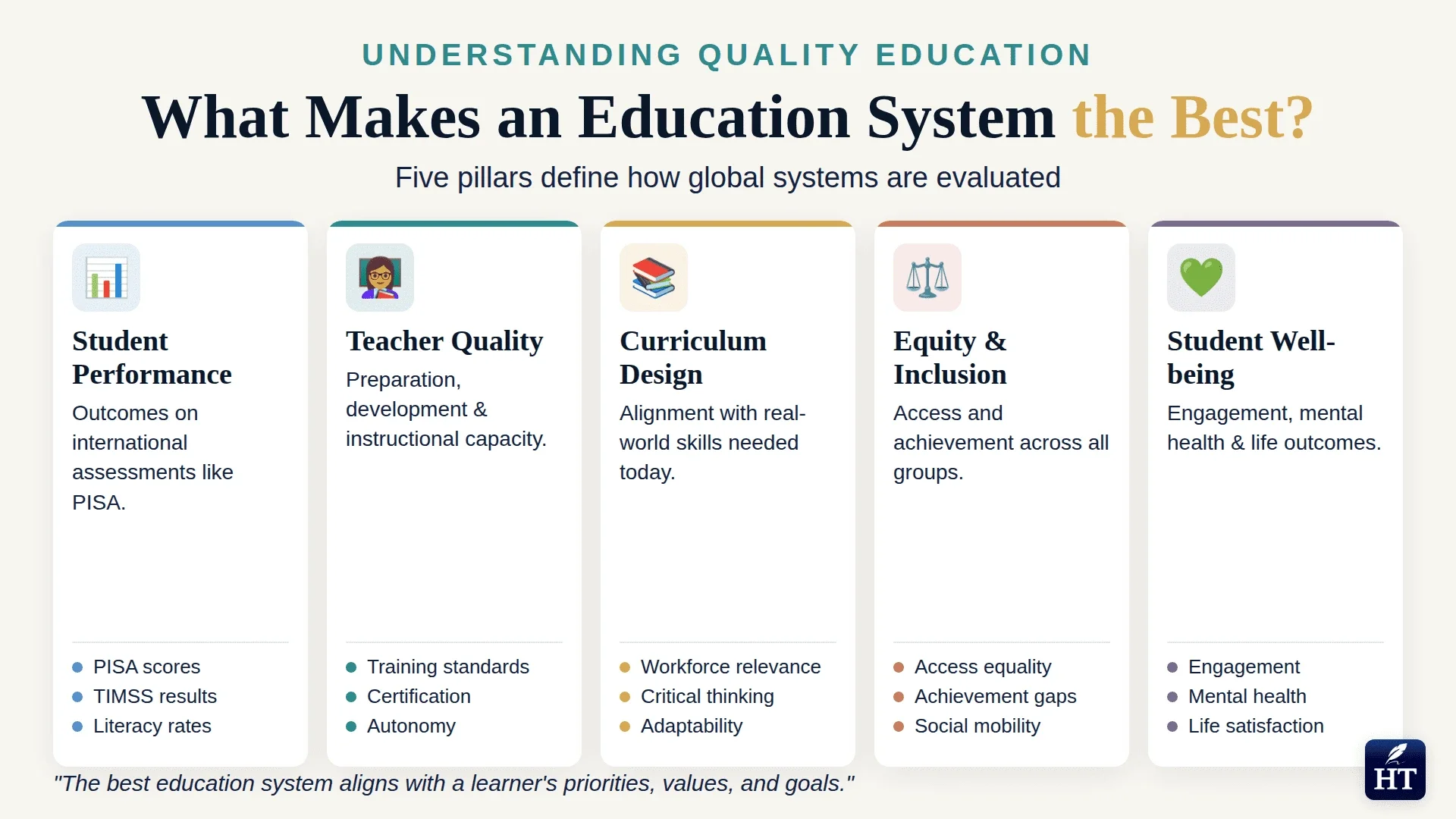
Rather than searching for a single ideal education model, researchers and policymakers around the world rely on a combination of academic, structural, and outcome-based criteria to understand why certain systems are effective across multiple dimensions. Commonly cited criteria include:
Student Performance: Outcomes on international assessments such as PISA and TIMSS
Teacher quality and training: Preparation, professional development, and instructional capacity
Curriculum flexibility: Alignment with foundational knowledge and real-world skills
Equity and inclusion: Access and achievement across socio-economic groups
Long-term outcomes: Educational attainment, employment, and economic participation.
Global Ranking Systems Used to Measure Education Quality
Several international organizations provide widely used education benchmarks, each emphasizing different tiers of quality:
OECD / PISA: Measures applied literacy, math, and science skills at age 15
World Bank education indicators: Tracks access, completion, learning, and system inputs
UNESCO education data: Global participation, literacy, and attainment statistics
QS education system strength: Focuses on higher education and workforce readiness
National assessments: Country-specific exams used for domestic evaluation
Why There Is No Single “Perfect” Education System
Education systems operate within cultural, economic, and political factors that shape priorities and outcomes. Differences in learning styles, population diversity, workforce needs, and public investment influence how these systems are designed and evaluated.
Key factors include:
Cultural expectations around learning and assessment
National economic conditions and funding capacity
Population size, diversity, and migration patterns
Policy priorities such as equity, innovation, or vocational training
Alignment with labor market demands
These factors make universal comparisons inherently limited and explain why no single education system can be considered perfect for all contexts.
Top 10 Best Education Systems in the World (Ranked)
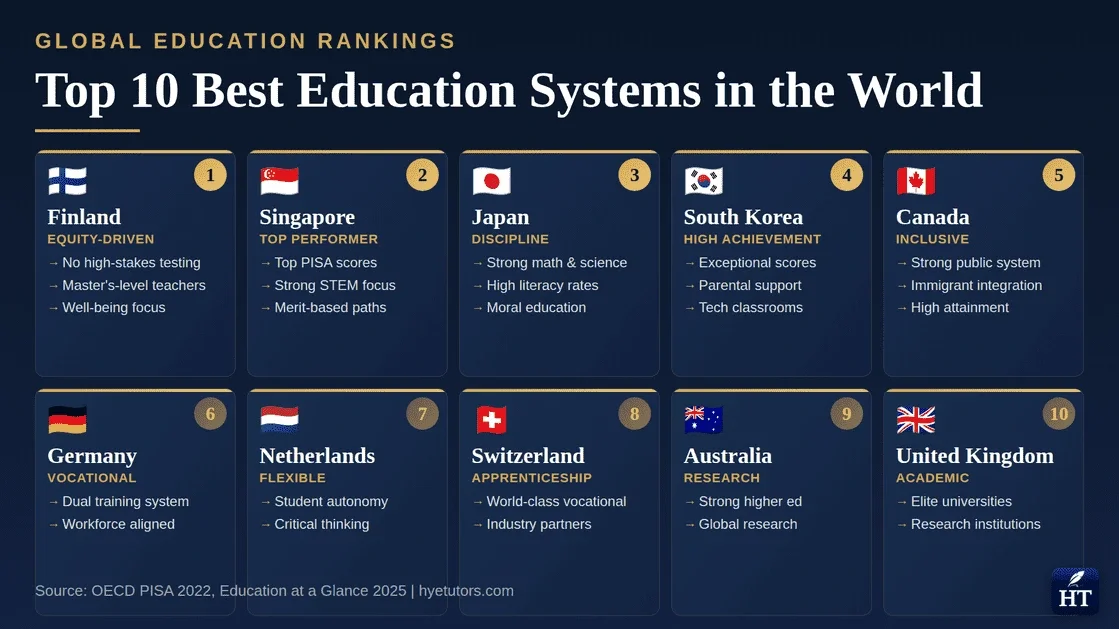
The following ranking reflects a comprehensive measure of education system performance, including academic outcomes, teacher quality, student well-being, and standardized test results. This list prioritizes overall balance rather than test scores alone.
1. Finland — Equity-Driven Excellence
Finland’s education philosophy prioritizes quality, trust, and student support over competition, relying on highly trained teachers and minimizing high-stakes standardized testing to promote equitable outcomes.
No high stakes standardized testing
Highly trained teachers (master’s-level preparation)
Strong public education system
Emphasis on student well-being
2. Singapore — Global Leader in Academic Performance
Singapore’s education system is built on structured rigor and clear performance standards, with strong alignment between curriculum, teacher evaluation, and national economic goals. OECD PISA results consistently place Singapore at the top globally in mathematics, science, and reading.
Top PISA performance
Strong STEM focus
Structured teacher evaluation
Merit-based academic pathways
3. Japan — Discipline, Consistency, and Results
Japan’s education system emphasizes discipline, consistency, and collective responsibility, combining strong academic standards with moral and civic education embedded in daily school routines. OECD data show Japan as a high performer in mathematics and science with consistently high literacy rates.
Strong math and science outcomes
Cultural emphasis on education
High literacy rates
Integrated moral education
4. South Korea — High Achievement, High Pressure
South Korea’s education system is characterized by exceptionally high academic expectations and strong parental involvement, contributing to top-tier standardized test performance. OECD assessments consistently rank South Korea among the highest-performing systems, though researchers also note elevated academic pressure.
Exceptional standardized test performance
Intense academic culture
Strong parental involvement
Technology-driven classrooms
5. Canada — Balanced and Inclusive Education
Canada’s education system emphasizes inclusivity, accessibility, and balance, with strong public schooling and relatively equitable outcomes across socio-economic groups. OECD data highlight Canada’s strong average performance and high post-secondary attainment, particularly among immigrant populations.
Strong public education system
Effective immigrant integration
High post-secondary attainment
Provincial autonomy
6 - 10 Strong Global Educations Systems
The following countries consistently perform well across international benchmarks and are recognized for distinct structural strengths within their education systems.
Germany: Dual vocational training system closely aligned with workforce needs
Netherlands: Flexible curriculum emphasizing student autonomy and critical thinking
Switzerland: World-class apprenticeship and vocational education pathways
Australia: Strong higher education sector and global research output
United Kingdom: Internationally recognized universities and research institutions
Which Country Has the Best Education System for Different Needs
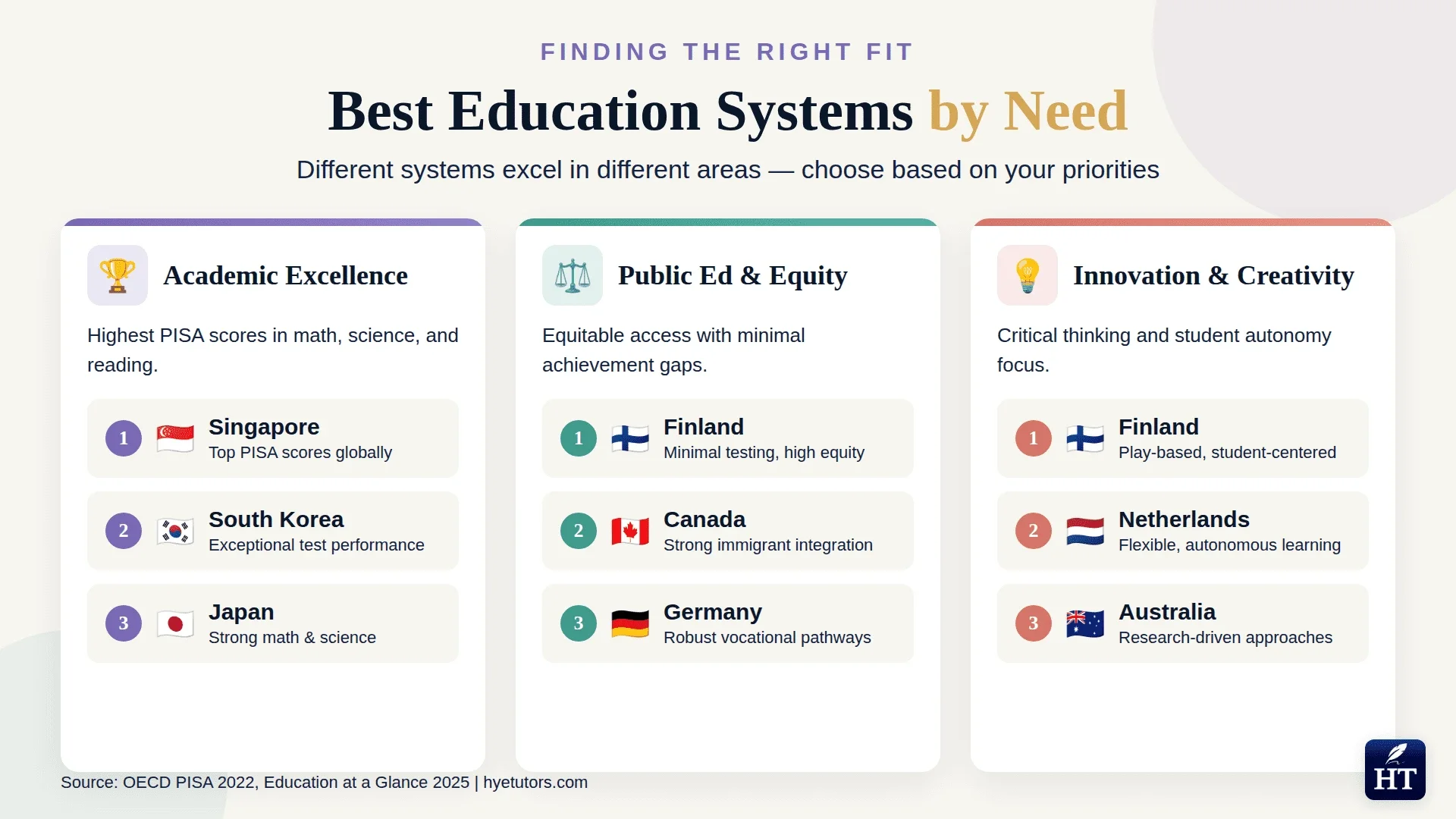
There is no single education system that works best for every student, family, or national priority. Instead, education systems tend to excel in different areas depending on how success is defined. To help readers navigate these differences, the groupings below reflect patterns identified in the most recent international assessments and education policy research referenced in 2025. Each category highlights countries that consistently perform well according to specific goals rather than across all possible measures.
Best Education System for Academic Excellence
Academic excellence is most commonly measured through international assessments such PISA, which evaluates student performance in mathematics, science, and reading. According to the OECD’s PISA 2022 results, which remain the most current global benchmark used in 2025 education comparison the following countries rank among the highest-performing education systems worldwide:
Singapore
South Korea
Japan
Best Public Education Systems in the World
Strong public education systems prioritize equitable access, consistent quality across schools, and relatively small performance gaps between students. The OECD’s Education at a Glance 2025 report highlights the following countries for combining strong public investment with policies that support inclusion, system-wide coherence, and stable outcomes across diverse student populations:
Finland
Canada
Germany
Best Education System for Innovation & Creativity
Education systems that support innovation tend to emphasize curriculum flexibility, student autonomy, and the development of transferable skills such as critical thinking and adaptability. The OECD’s Future of Education and Skills 2030 framework, which continues to inform education policy discussions in 2025, identifies the following countries as having systems aligned with these principles, particularly in preparing students for evolving social and economic conditions:
Finland
Netherlands
Australia
Ultimately, the best education system is the one that aligns most closely with a learner’s priorities, values, and long-term goals.
Best Education System in the World vs United States
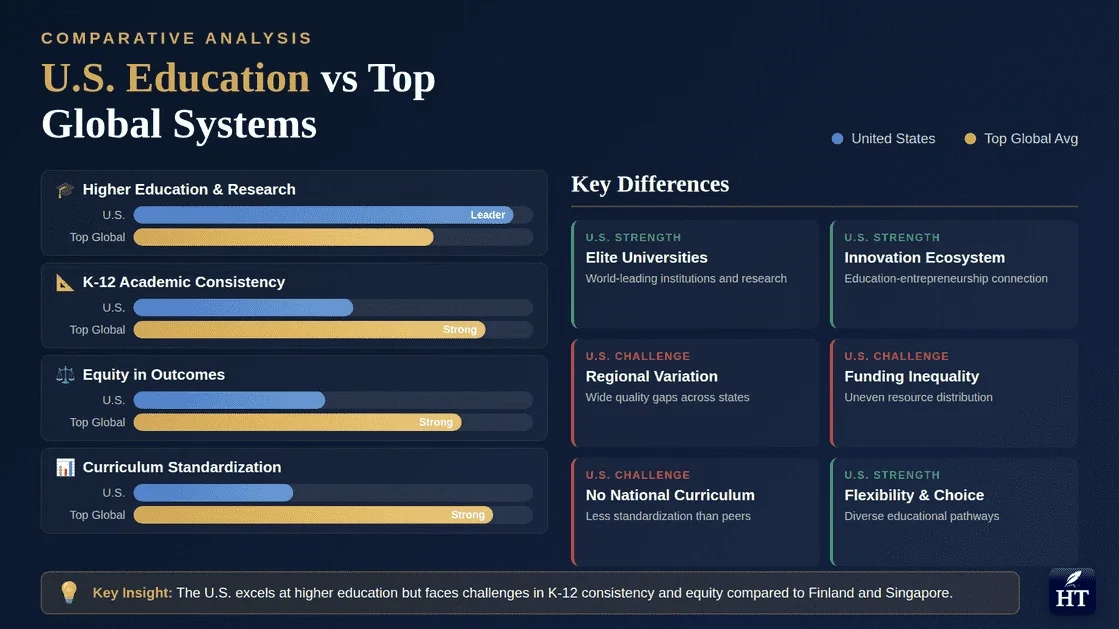
The United States education system is characterized by decentralization, institutional variety, and global leadership in higher education and research. Education policy, funding, and curriculum decisions are largely determined at the state and local level rather than by a single national authority. This structure allows systems to respond to regional needs and supports flexibility and innovation.
Compared with top-performing global systems, the U.S. excels in higher education, research output, and elite university performance. At the same time, decentralization contributes to wide variation in K–12 education quality across regions. The absence of a standardized national curriculum and uneven funding structures has led to persistent disparities in educational outcomes. As a result, while the U.S. performs strongly at the highest levels, it faces challenges in consistency and equity when compared with more centralized education systems.
Key differences include:
Strong higher education and research output
Greater variation in K–12 quality across regions
Less standardized national curriculum
Higher inequality in educational outcomes
FAQs
What is the best education system in the world?
There is no single best education system globally. Countries such as Finland, Singapore, and Canada perform well across multiple indicators, but what qualifies as “best” depends on priorities such as academic outcomes, equity, innovation, and student well-being.
Which country has the best education system in the world?
The answer depends on how education quality is measured. Singapore often ranks highest for academic performance, while Finland is widely recognized for equity, teacher quality, and student well-being. Different systems lead depending on the criteria used.
Who has the best education system in the world?
No country leads across all measures of education quality. Systems vary in strengths related to academic performance, access, consistency, and long-term outcomes, making the “best” education system dependent on national goals and societal priorities.
What are the top 10 best education systems in the world?
Rankings vary, but countries frequently cited among the top include Finland, Singapore, Japan, South Korea, Canada, Germany, the Netherlands, Switzerland, Australia, and the United Kingdom. These systems balance strong academic outcomes with broader educational objectives.
Does the best education system mean highest test scores?
No. While test scores measure specific academic skills, they do not capture equity, curriculum relevance, student well-being, or long-term outcomes. High-quality education systems balance academic performance with broader measures of success.
Which country has the best public education system?
Finland and Canada are often cited for strong public education systems due to their emphasis on equity, access, and consistent quality. Both invest heavily in teacher preparation, public funding, and policies designed to reduce educational disparities.
Is Finland still the best education system in the world?
Finland remains among the strongest education systems, particularly for equity, teacher preparation, and student well-being. However, it does not lead every ranking, and its position varies depending on the criteria used.
Conclusion
There is no single best education system in the world, but there are systems that perform best for specific goals. Evidence from countries with leading education systems shows that strong outcomes can arise from different approaches shaped by culture, policy, and priorities. Because education underpins human progress, understanding how systems are defined and measured helps move the conversation beyond rankings. For families, educators, and policymakers, the most valuable lessons come from identifying principles that support long-term learning, equity, and opportunity. Explore related education guides at hyetutors.com to continue learning.