

How To Use Pythagorean Theorem?
How do you actually use the Pythagorean theorem to solve a triangle? If you've been staring at the formula wondering where to even begin, you're not alone. Many students understand what a² + b² = c² looks like — but freeze when it's time to apply it. The good news? Once you know the steps, knowing how to use the Pythagorean theorem becomes second nature.
In this guide, you'll learn exactly when and how to use it, walk through fully solved examples, and discover the most common mistakes to avoid. By the end, you'll be ready to tackle any right triangle problem with confidence.
“The Pythagorean theorem lets you find a missing side in a right triangle using the formula: a² + b² = c², where c is the hypotenuse (the longest side, opposite the 90° angle) and a and b are the two legs. You can only use this theorem when the triangle has a right angle (90°). It does not apply to other triangle types.”
How to Use the Pythagorean Theorem
This is the core skill you'll use in class, on tests, and in real life. Let's break it down into clear, manageable pieces so you always know exactly what to do.
When Can You Use the Pythagorean Theorem?
Before doing any calculation, you need to verify the triangle is eligible. The Pythagorean theorem works only under these conditions:
The triangle must have a 90° (right) angle
You know the length of two sides and need to find the third
You are solving for a side length — not an angle
You are NOT working with a non-right (oblique) triangle
For working with the angles of a right triangle, you'll need trigonometry — but that's a separate tool.
Understand the Formula Before Using It
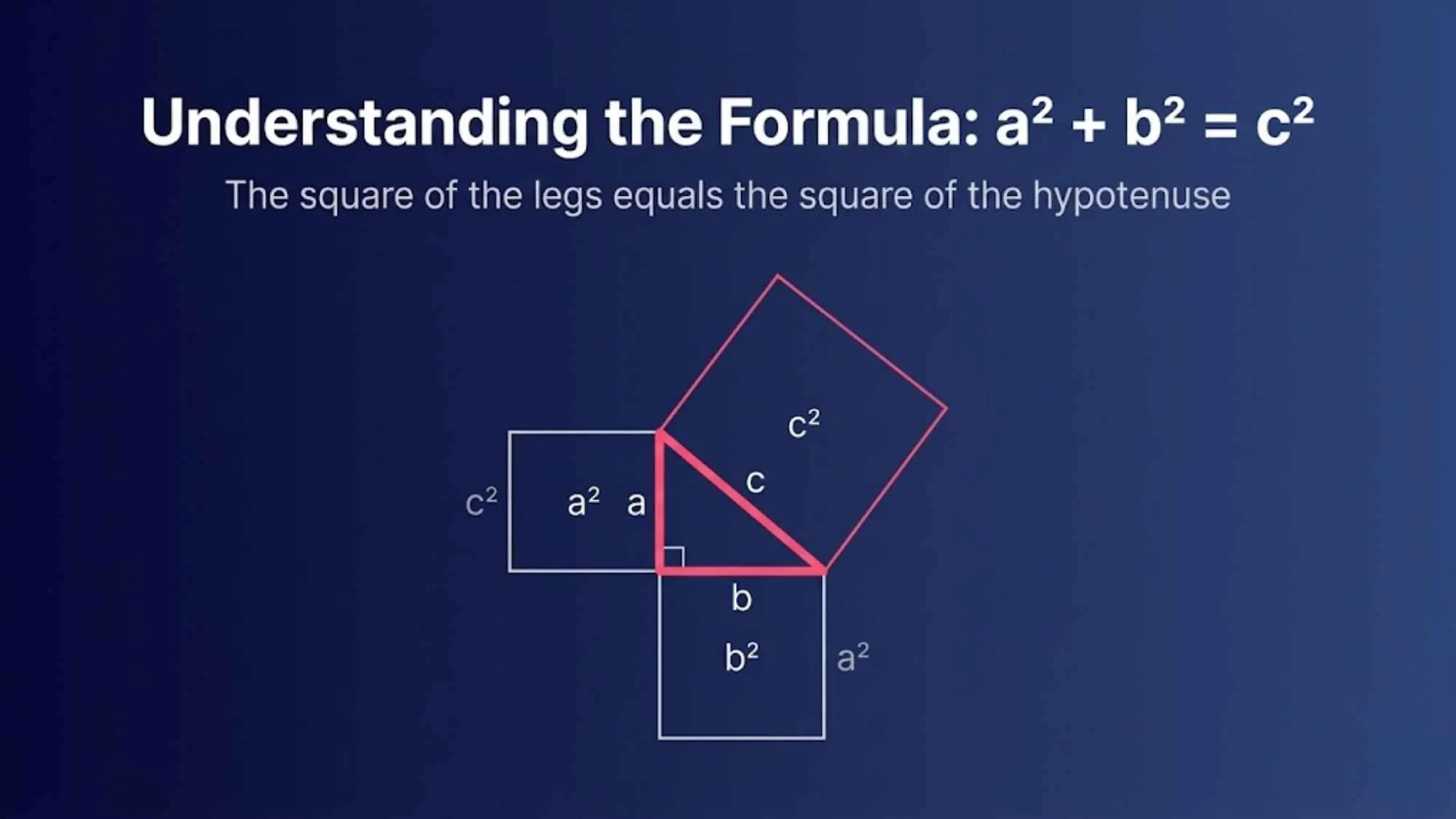
The formula looks like this: a² + b² = c²
In plain English: the square of the two shorter sides, added together, equals the square of the longest side. Here's what each part means:
"Squared" simply means you multiply the number by itself (e.g., 3² = 9)
c is always the hypotenuse — the side directly opposite the right angle
The hypotenuse is always the longest side of the triangle
a and b are the two legs — their order doesn't matter
Don't let the exponents intimidate you. Once you see the pattern, it clicks fast.
Step-by-Step: How to Use the Pythagorean Theorem
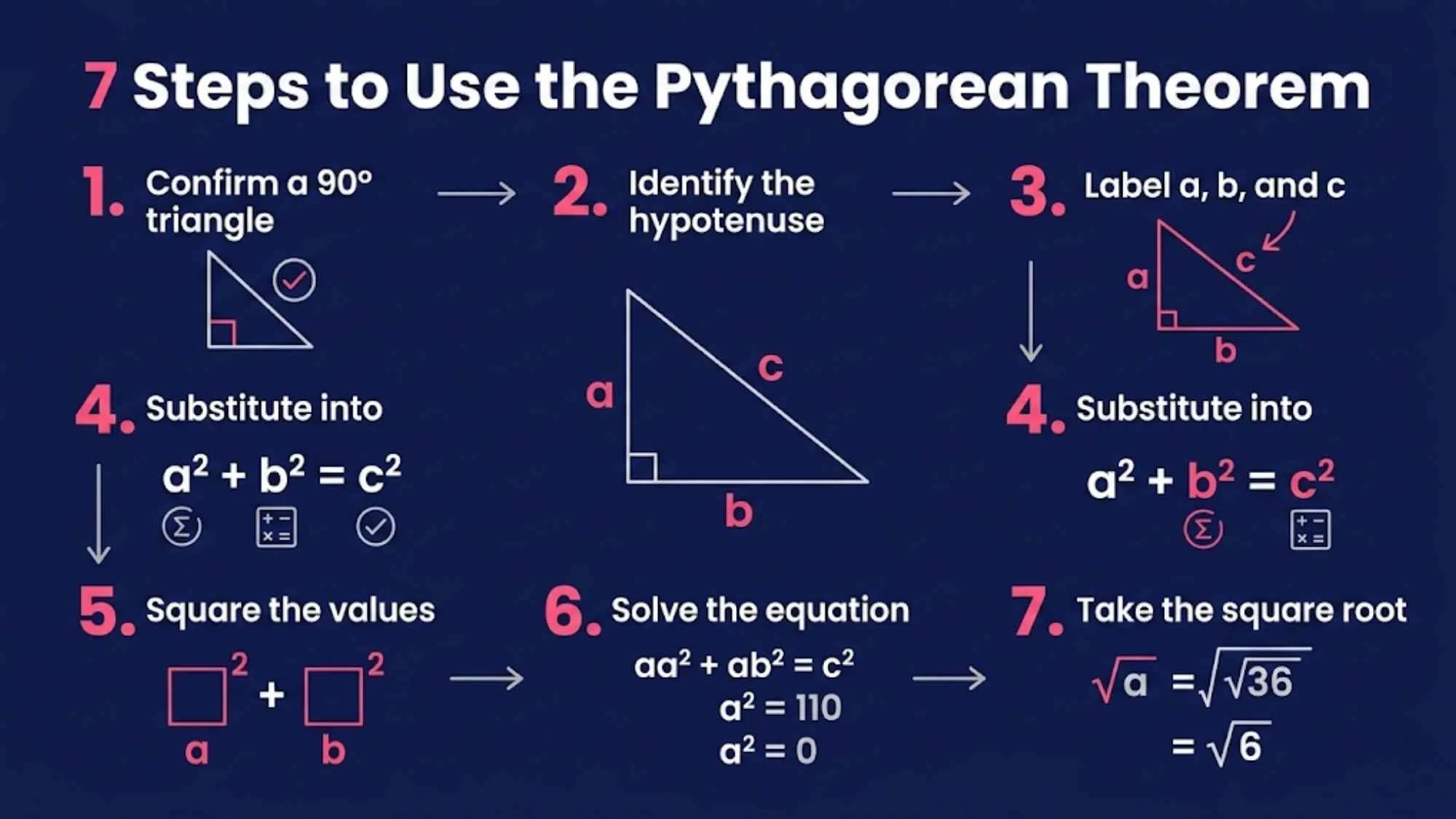
Follow these seven steps every time — no guesswork required:
Confirm the triangle has a 90° angle
Identify the hypotenuse (the side opposite the right angle)
Label the known sides as a, b, and c
Substitute the known values into a² + b² = c²
Square each known number
Add or subtract to isolate the unknown side
Take the square root to find the missing length — and include units!
Keep each step on its own line when working on paper. This makes it easy to catch errors and follow your own logic.
Solved Example: Finding a Missing Side
Problem: A right triangle has legs of length 3 and 4. What is the length of the hypotenuse?
Step 1: Confirm the triangle is a right triangle. ✓
Step 2: Identify the hypotenuse (c) — it's what we're solving for.
Step 3: We know a = 3 and b = 4.
Step 4: Substitute into the formula: 3² + 4² = c²
Step 5: Square the values: 9 + 16 = c²
Step 6: Add: 25 = c²
Step 7: Take the square root: c = √25 = 5
✅ Answer: The hypotenuse is 5 units.
Real-Life Examples of Using the Pythagorean Theorem
The Pythagorean theorem isn't just for exams — it shows up everywhere. Here are a few everyday situations where it's used to calculate triangle side lengths:
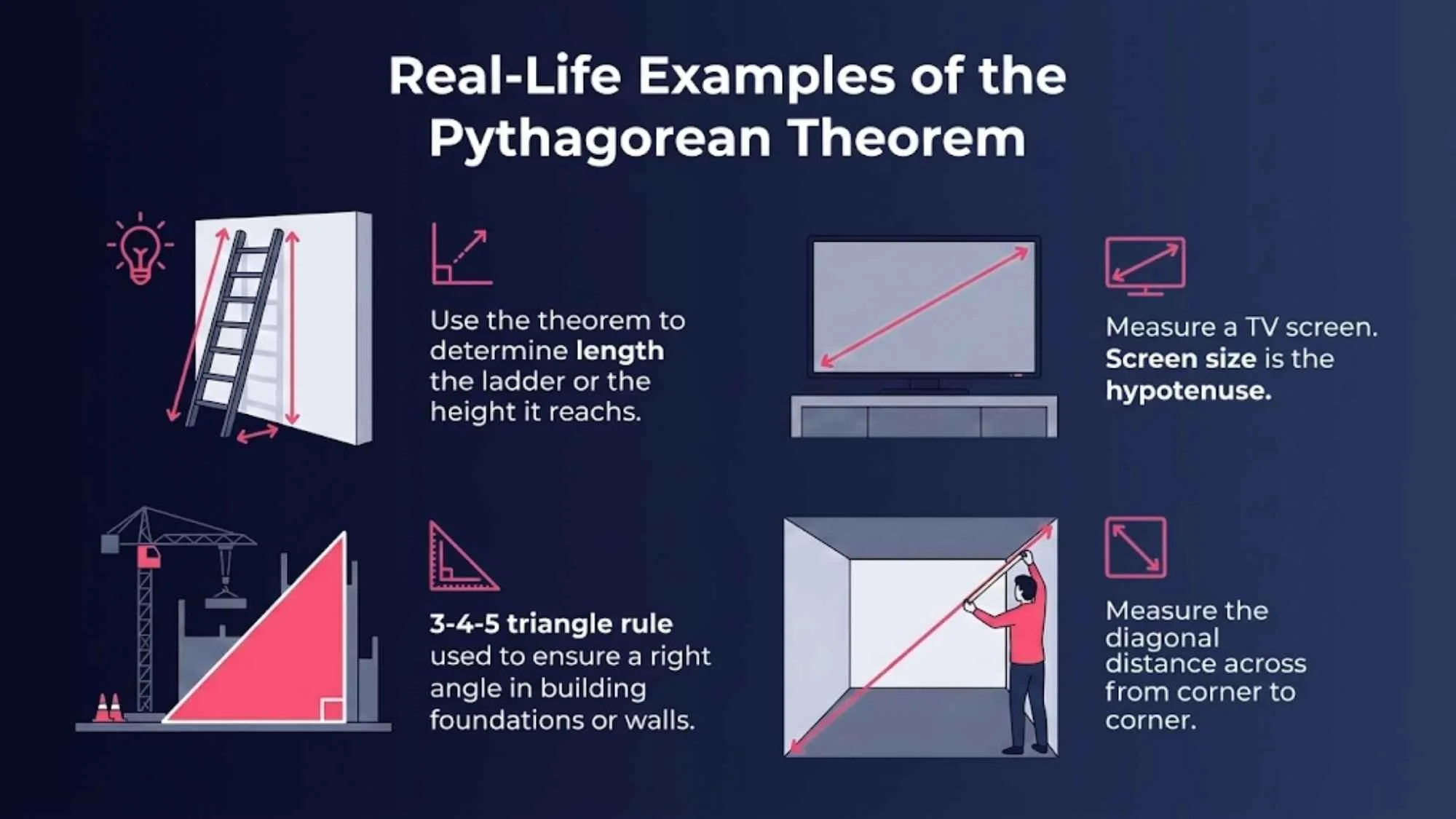
🪜 Ladder against a wall — If a 10-foot ladder leans against a wall and the base is 6 feet from the wall, you can find exactly how high up the wall it reaches.
📺 TV screen size — Screen sizes are measured diagonally. Knowing the width and height lets you verify the advertised size.
🏗️ Construction and carpentry — Builders use it constantly to check if corners are perfectly square (the "3-4-5 rule").
🗺️ Navigation and distance — GPS systems use the theorem to calculate straight-line distances between coordinates.
🏠 Room diagonals — Finding the diagonal of a rectangular room helps with planning furniture placement or running cable.
Want to explore how geometry is used in the real world? Math Is Fun's visual guide has great interactive tools to see it in action.
Common Mistakes Students Make
Even students who know the formula well can slip up in the same predictable ways. Here's what to watch for — and how to avoid each one:
❌ Forgetting to square — Write a², not just a. Skipping this step throws off the entire calculation.
❌ Misidentifying the hypotenuse — The hypotenuse is ALWAYS opposite the right angle. If you label it wrong, your setup is wrong from the start.
❌ Using it on non-right triangles — This formula only works for right triangles. For other types, you'd use the Law of Cosines.
❌ Arithmetic slips — Double-check your multiplication when squaring and your addition when combining terms.
❌ Rounding too early — Hold off on rounding until the very last step. Rounding mid-calculation compounds errors.
For additional practice identifying these errors, the Khan Academy Pythagorean theorem exercises are an excellent free resource.
Quick Practice Problems
Try these on your own before checking any answers. Apply the seven steps above and write each step out clearly.
Beginner: A right triangle has legs a = 6 and b = 8. Find the hypotenuse.
Beginner: The hypotenuse of a right triangle is 13 and one leg is 5. Find the missing leg.
Intermediate: A ladder 15 feet long leans against a building. The foot of the ladder is 9 feet from the base of the building. How high up the building does the ladder reach?
Challenge yourself before looking for help — working through difficulty is where real learning happens.
Conclusion
The Pythagorean theorem is one of the most reliable tools in all of mathematics. Once you understand when and how to use the Pythagorean theorem — identify the right angle, label your sides, substitute, and solve — it becomes a skill you can apply quickly and confidently every time.
If it takes a few tries before it feels natural, that's completely normal. Every student goes through it. The key is to write out each step, check your work, and practice consistently. You'll get there.
Need more support? Explore our full library of math guides at HYE Tutors — and connect with a tutor who makes math click. You can also review foundational geometry concepts at Khan Academy's Geometry section to build the bigger picture.
