

Law of Sines and Cosines Explained with Worksheet and Uses
If you have ever stared at a triangle and wondered how to find a missing side or angle without a right angle in sight, you are not alone. This is exactly the problem that the law of sines and cosines were designed to solve. At first glance the formulas might look intimidating — but do not worry. Once you understand when and why to use each one, the process becomes surprisingly predictable.
The law of sines and cosines are two essential trigonometry rules taught in high school precalculus and used on exams worldwide. In this guide you will learn what each law means, when to use each one, how to solve problems step by step, and how to avoid the mistakes that trip most students up. By the end, you will feel confident picking up any triangle problem and knowing exactly where to start.
“The law of sines and the law of cosines are trigonometric formulas used to find missing sides and angles in any triangle — especially non-right triangles where the Pythagorean theorem does not apply. The Law of Sines compares ratios of each side to the sine of its opposite angle, creating a set of equal fractions. The Law of Cosines relates all three sides of a triangle to one of its angles, acting as a generalised version of the Pythagorean theorem. Together, they give you everything you need to solve any triangle.”
What Is the Law of Sines and Cosines?
If you want to solve any triangle with confidence, the Law of Sines and Cosines give you two powerful formulas that work together to find missing sides and angles—even when right triangles aren’t involved.
Definition of the Law of Sines
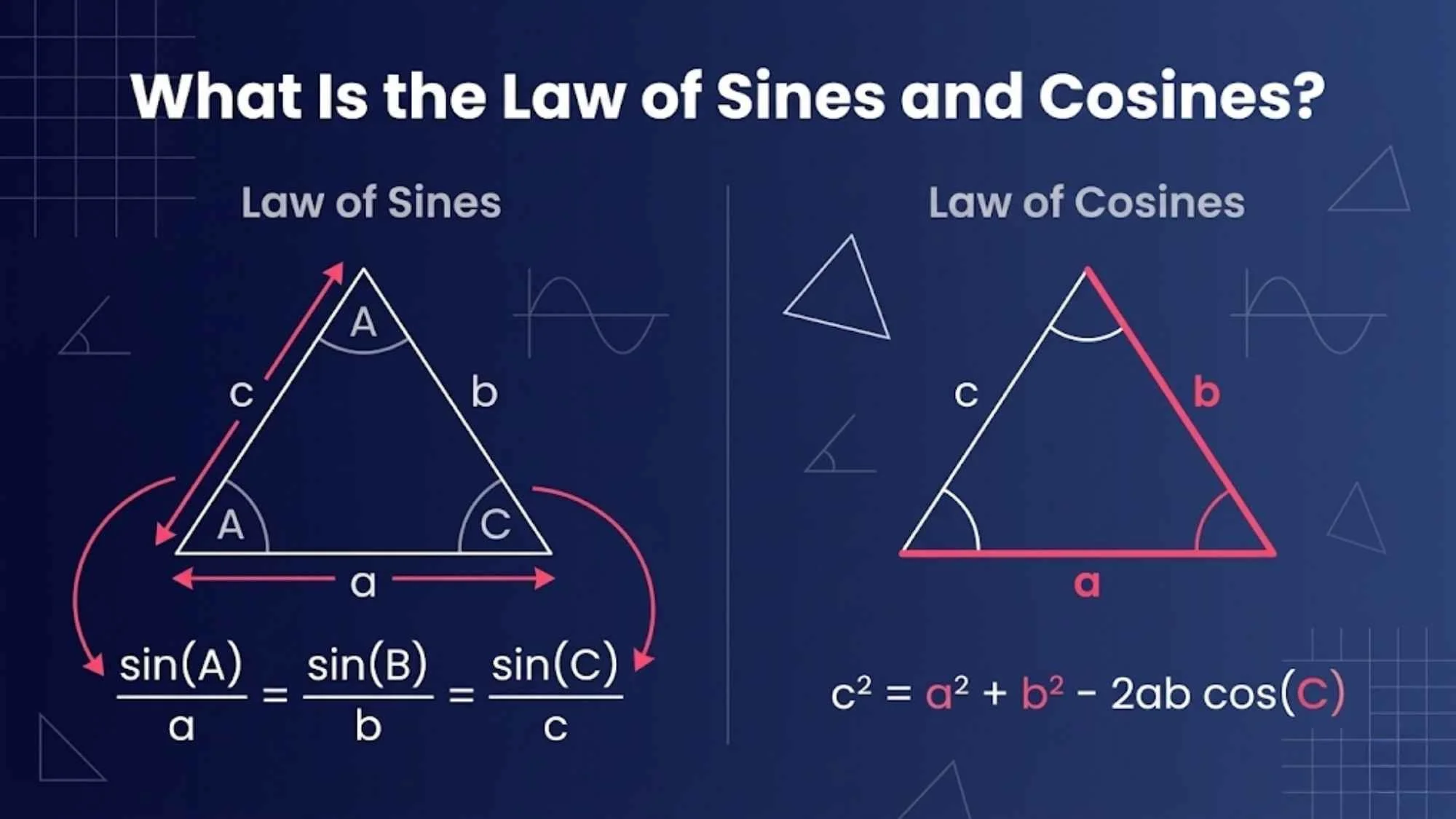
The law of sines is a rule that connects each side of a triangle with the sine of the angle directly opposite to it. In plain language: if you divide any side length by the sine of its opposite angle, you get the same number for every side in that triangle. This ratio stays constant no matter the size of the triangle.
Works for all non-right triangles — and right triangles too
Uses opposite angle–side pairs (each side is paired with the angle across from it)
Creates equal ratios you can cross-multiply to solve
Helps find unknown sides or angles when you have at least one complete pair
The formula is written as:
a / sin(A) = b / sin(B) = c / sin(C)
Here, a, b, and c are the side lengths and A, B, C are the angles opposite those sides. You only ever need two of these three fractions at a time to set up an equation and solve.
Definition of the Law of Cosines
Think of the law of cosines as an upgrade to the Pythagorean theorem. The Pythagorean theorem (a² + b² = c²) only works for right triangles. The law of cosines extends that idea so it works for any triangle — including ones with obtuse angles.
Connects all three sides with just one angle
Useful when no opposite pair is available to use the Law of Sines
Works for both acute and obtuse triangles equally well
Ideal for finding a missing side first, then using other methods to find remaining angles
The formula is:
c² = a² + b² − 2ab · cos(C)
The same formula can be rearranged for side a or side b. Do not let the algebra intimidate you — your calculator does the heavy lifting. The main skill is setting up the equation correctly.
Key Difference Between the Law of Sines and Cosines
Students often mix these up at the worst moment — during an exam. Here is a clear comparison:
Law of Sines vs Law of Cosines
| Feature | Law of Sines | Law of Cosines |
|---|---|---|
| Info needed | Two angles + one side (AAS/ASA) or opposite pair (SSA) | Three sides (SSS) or two sides + included angle (SAS) |
| Best use case | Finding unknown angles or sides when you have an angle–side pair | Finding a missing side or starting angle with no opposite pair |
| Difficulty | Moderate — straightforward ratio setup | Slightly harder — requires squaring and square roots |
| Exam scenario | AAS, ASA, SSA triangle types | SSS, SAS triangle types |
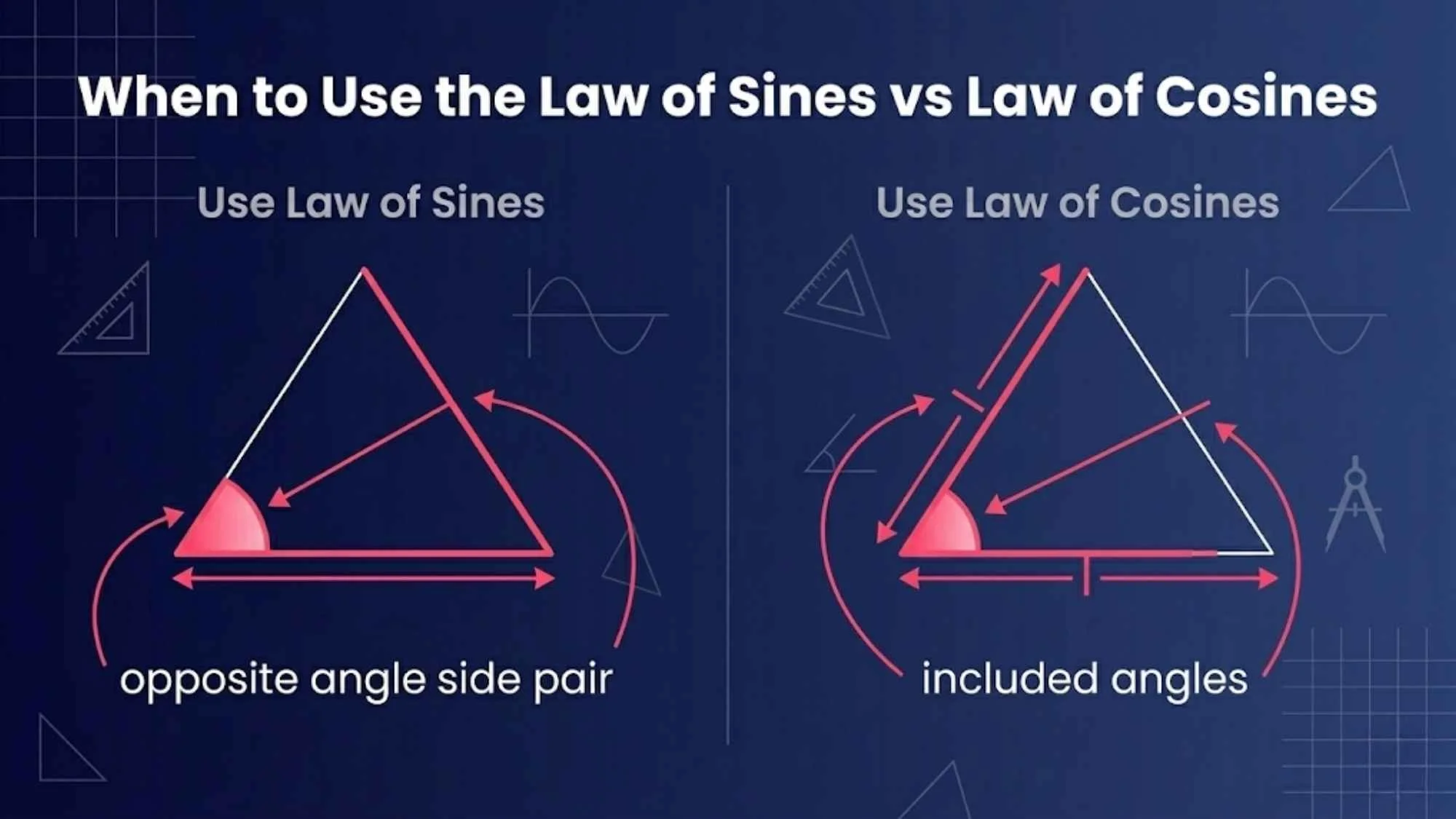
The simplest decision rule: if you have a matching angle–side pair, start with the Law of Sines. If you do not, use the Law of Cosines.
Download law of sines and cosines Worksheets (PDF) from, here
When to Use the Law of Sines vs Law of Cosines
Choosing the right formula is the part students find hardest. Many students know both laws perfectly but freeze at the start of a problem because they are not sure which to apply. Here is a simple decision guide you can memorise in two minutes.
Use the Law of Sines when:
You know two angles and one side (ASA or AAS configuration)
You have at least one complete opposite pair (a side and the angle directly facing it)
You are solving for another angle and already know one side–angle pair
You have two sides and a non-included angle (SSA — watch for the ambiguous case)
Use the Law of Cosines when:
You know all three sides (SSS) and need to find an angle
You know two sides and the angle between them (SAS)
No complete opposite pair exists in the information given
You want to find a missing side before switching to the Law of Sines
Pro tip: Draw and label your triangle before picking a formula. A quick sketch takes ten seconds and prevents a lot of costly mistakes. For a deeper look at triangle types and configurations, Khan Academy's trigonometry section is an excellent free resource.
Law of Sines Formula and Law of Cosines Formula
Here are both formulas laid out clearly. Read them once through before diving into worked examples.
Law of Sines — Full Formula
a / sin(A) = b / sin(B) = c / sin(C)
a, b, c = side lengths of the triangle
A, B, C = angles opposite to sides a, b, c respectively
Triangles can be scaled up or down, but these ratios always stay equal
Important: make sure your calculator is set to degree mode unless the problem specifies radians
Law of Cosines — Full Formula
c² = a² + b² − 2ab · cos(C)
a² = b² + c² − 2bc · cos(A) b² = a² + c² − 2ac · cos(B)
Choose the version that isolates the side or angle you are solving for
Each letter represents the same thing: a side and its opposite angle share the same letter
When solving for an angle, rearrange to: cos(C) = (a² + b² − c²) / 2ab
For a printable formula sheet and further formula explanations, the Math is Fun guide to the Law of Cosines is a student-friendly reference.
Once you have a system, triangle solving stops feeling like guesswork. Follow this method every time and you will rarely go wrong.
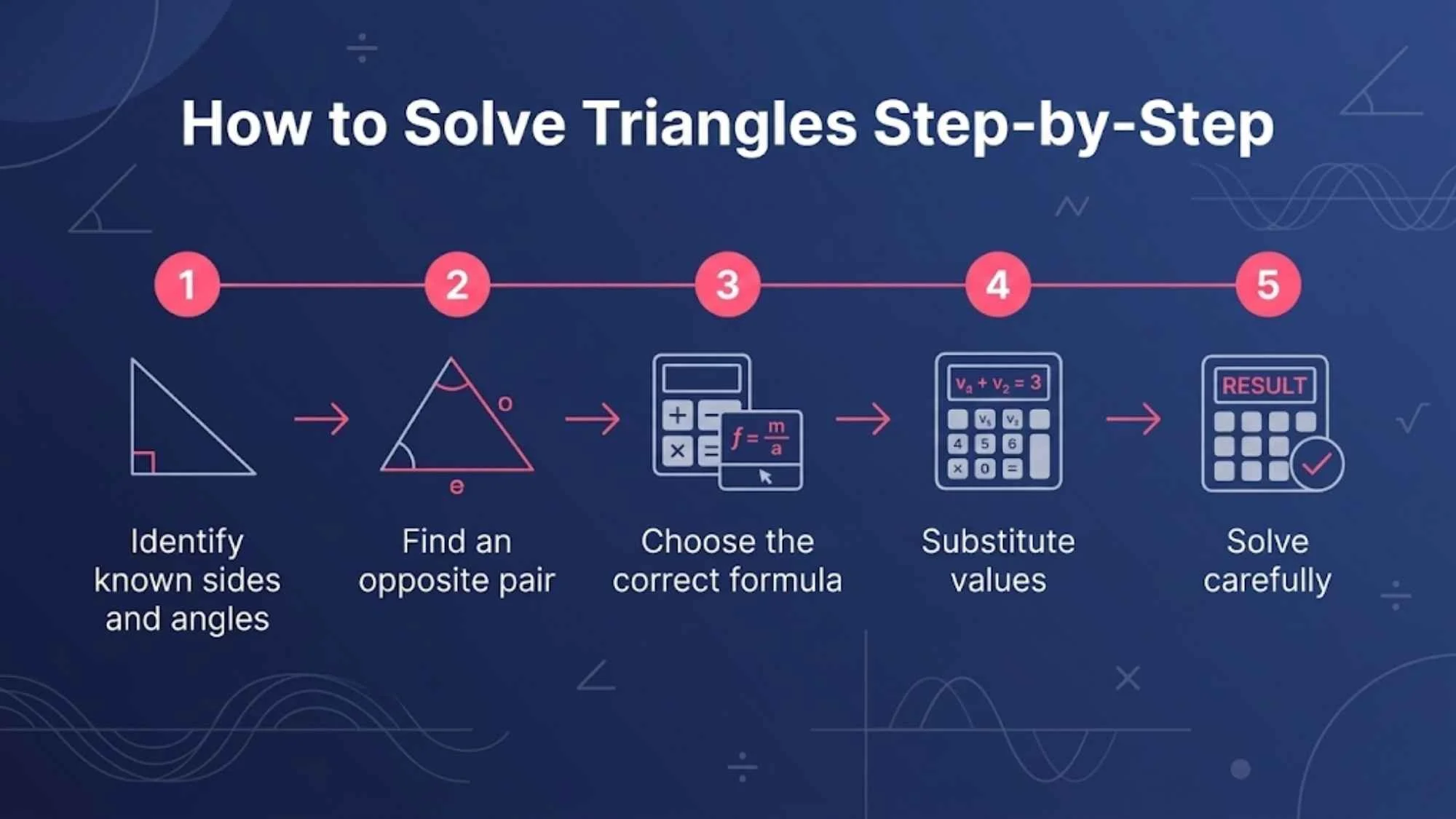
Step-by-Step Method
Identify what you know: label all given sides and angles on a diagram
Find an opposite pair: locate any angle and its directly opposite side
Choose your formula: Law of Sines if a pair exists, Law of Cosines if not
Substitute your known values carefully into the formula
Solve the equation — cross-multiply for sines, use algebra for cosines
Check reasonableness: angles must add to 180°; longer sides face larger angles
Solved Example — Beginner (AAS)
Problem: In triangle ABC, angle A = 40°, angle B = 75°, and side a = 12. Find side b.
Step 1: Find angle C: C = 180° − 40° − 75° = 65°
Step 2: Set up the ratio: a / sin(A) = b / sin(B)
Step 3: Substitute: 12 / sin(40°) = b / sin(75°)
Step 4: Solve for b: b = 12 × sin(75°) / sin(40°)
Step 5: Calculate: b = 12 × 0.9659 / 0.6428 ≈ 18.03
Answer: b ≈ 18.03
The Ambiguous Case (SSA)
When you know two sides and an angle that is not between them (SSA), something unusual can happen: two different triangles might fit the same measurements. This is called the ambiguous case.
Two triangles exist when the given angle is acute and the side opposite it is shorter than the other known side but still long enough to reach
One triangle exists when the angle is obtuse, or the triangle closes perfectly with only one solution
No triangle exists when the opposite side is too short to connect — the triangle simply cannot be drawn
For exam purposes, always check: after finding your first angle using the Law of Sines, consider whether (180° − that angle) also produces a valid triangle. If the angles still add up to less than 180°, you have two solutions.
How to Solve Triangles Using the Law of Cosines
The Law of Cosines is your go-to when there is no opposite pair to work with. The setup is slightly more involved than the Law of Sines, but the steps are consistent every time.
Step-by-Step Approach
Identify your known values and label the triangle clearly
Choose the correct version of the formula based on what you want to find
Substitute values carefully — double-check each number before proceeding
Perform the arithmetic in order: square the sides, then subtract or add
Take the square root only at the very final step to avoid rounding errors
Solved Example — Find a Missing Side (SAS)
Problem: In triangle ABC, side a = 8, side b = 11, and angle C = 60°. Find side c.
Step 1: Write the formula: c² = a² + b² − 2ab · cos(C)
Step 2: Substitute: c² = 8² + 11² − 2(8)(11) · cos(60°)
Step 3: Simplify: c² = 64 + 121 − 176 × 0.5
Step 4: Continue: c² = 185 − 88 = 97
Step 5: Take the square root: c = √97 ≈ 9.85
Answer: c ≈ 9.85
Solved Example — Find a Missing Angle (SSS)
Problem: Triangle with sides a = 7, b = 9, c = 12. Find angle C.
Step 1: Rearrange the formula: cos(C) = (a² + b² − c²) / 2ab
Step 2: Substitute: cos(C) = (49 + 81 − 144) / (2 × 7 × 9)
Step 3: Simplify: cos(C) = −14 / 126 ≈ −0.1111
Step 4: Use inverse cosine: C = cos⁻¹(−0.1111)
Answer: C ≈ 96.4°
Note: A negative cosine value simply means the angle is obtuse (greater than 90°). Your calculator handles this automatically — just press cos⁻¹ and trust the result.
Practice Worksheet — Law of Sines and Cosines
The best way to build confidence is to solve problems yourself before checking answers. Below is a short worksheet covering a range of difficulty levels. Attempt each one before looking at the solution.
Practice Problems
(Law of Sines — AAS) In triangle ABC: A = 35°, B = 85°, a = 10. Find b.
(Law of Cosines — SAS) In triangle ABC: a = 6, b = 8, C = 50°. Find c.
(Law of Cosines — SSS) Sides: a = 5, b = 7, c = 10. Find angle A.
(Ambiguous Case — SSA) A = 30°, a = 5, b = 8. How many triangles are possible?
(Word Problem) Two rangers stand 4 km apart. They both spot a fire. Ranger 1 measures the angle to the fire as 61°. Ranger 2 measures it as 48°. The angle at the fire between the two rangers is 71°. How far is the fire from Ranger 1?
Need more practice problems? Corbettmaths has a free Law of Sines and Cosines worksheet PDF with questions and answers ideal for exam preparation.
Real-Life Uses of the Law of Sines and Cosines
These formulas are not just for passing exams — they appear in the real world constantly:
Surveying: land surveyors use triangulation with the Law of Sines to measure plots of land without physically crossing difficult terrain
Architecture: engineers use the Law of Cosines to calculate roof angles, structural supports, and diagonal measurements in non-rectangular buildings
Navigation: sailors and pilots use these laws to calculate their position and bearing when GPS is unavailable or unreliable
Astronomy: scientists use triangulation based on these trigonometric laws to calculate the distance to nearby stars — a technique called stellar parallax
Forensics and accident reconstruction: investigators use triangle geometry to determine distances and angles from limited measurements
To explore more real-world applications of trigonometry, see this overview from Maths Careers which connects school maths to professional fields.
Common Mistakes Students Make
Even well-prepared students lose marks on triangle problems due to the same avoidable errors. Here is what to watch for:
Choosing the wrong formula: always check whether you have an opposite pair before deciding which law to use
Pairing incorrect sides and angles: side a must be paired with angle A, side b with B, and so on — mixing these up ruins the ratio
Calculator left in radian mode: always verify your calculator is in degree mode at the start of every problem unless told otherwise
Rounding too early: carry at least four decimal places through your working and only round at the very final answer
Skipping the diagram: even a rough sketch of the triangle prevents misidentifying which angle is opposite which side
When you get an unexpected answer, the fastest fix is to go back to your diagram and check your pairings. Most errors trace back to labelling.
Quick Summary — Law of Sines vs Law of Cosines
Before your next test, keep these rules in mind:
Opposite pair available → use the Law of Sines
No opposite pair → use the Law of Cosines
Three sides given (SSS) → Law of Cosines to find an angle
Two angles given (AAS or ASA) → Law of Sines straightaway
Two sides and included angle (SAS) → Law of Cosines for the missing side
SSA → Law of Sines, but check for the ambiguous case
Conclusion
Yes, the formulas have more moving parts than basic trigonometry — but that is exactly why having a clear process matters. Confusion at the start is completely normal. Every student goes through it, and every student can move past it with a little structured practice.
Use the examples in this guide as models. Work through the worksheet problems before peeking at the answers. And if you find yourself stuck, revisit the decision guide: opposite pair means Law of Sines; no pair means Law of Cosines. That one rule will carry you through the majority of problems you will ever encounter.
The law of sines and cosines are tools you now have in your kit. With practice, reaching for the right one will become second nature.The law of sines and cosines give you a reliable, repeatable system for solving any triangle.
Need help preparing for your next maths exam?
HYE Tutors offers personalised one-to-one tutoring for high school and precalculus students. Our tutors are experienced, patient, and results-focused.
