

What Is A Simple Sentence? Definition and Example
If you've ever asked "what is a simple sentence," you're starting at exactly the right place. Simple sentences are the foundation of English grammar — the building blocks from which all other sentence types are constructed. Understanding them clearly makes everything else easier to learn.
Many learners confuse simple sentences with compound and complex sentences, or they mistakenly think "simple" means "short." In reality, a simple sentence can be quite long — what makes it simple is its structure, not its length.
This guide will give you a clear definition, show you how simple sentences are built, provide real-life examples, and explain how they differ from other sentence types. By the end, you'll recognize and write simple sentences with confidence.
“A simple sentence is a sentence that contains one independent clause with a subject and a verb, and it expresses a complete thought. It may include objects, modifiers, or phrases, but it has only one main clause. Example: The dog barked loudly.
”
What Is a Simple Sentence
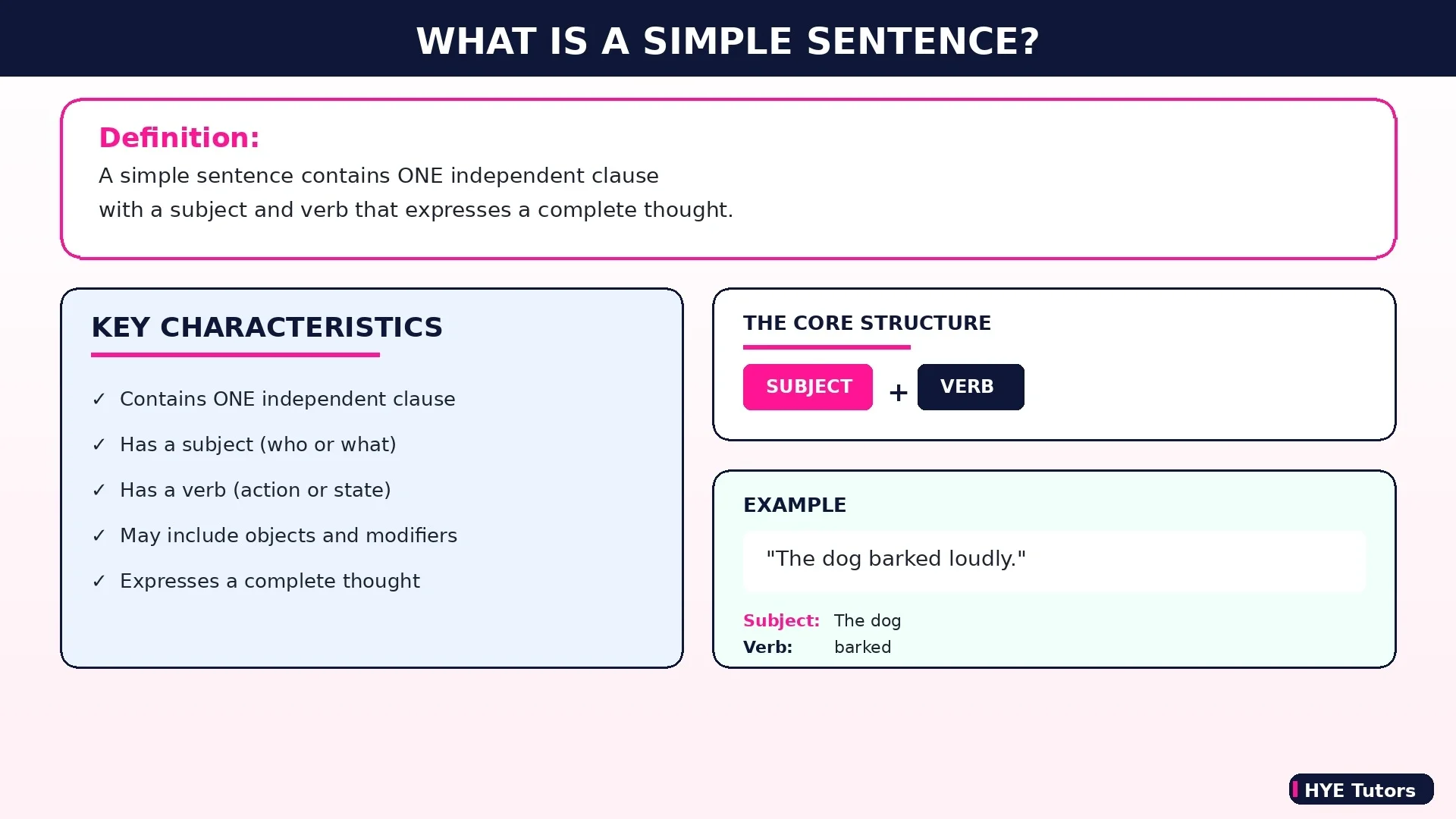
A simple sentence is the most basic complete sentence in English. It contains just one independent clause — a group of words with a subject and verb that expresses a complete thought. Despite its name, a simple sentence isn't necessarily short or basic in meaning; it's "simple" because it has a single clause structure.
Simple sentences are powerful tools for clear communication. They deliver one idea at a time, making them easy to understand. Professional writers often use simple sentences strategically for emphasis, clarity, and impact — especially when they want a point to land with force.
Definition
In plain English, a simple sentence contains one independent clause that includes a subject and a verb and expresses a complete thought. That's it. No dependent clauses, no second independent clause — just one complete idea standing on its own.
The Purdue Online Writing Lab emphasizes that understanding simple sentences is essential for building clear, effective writing skills.
Key characteristics of simple sentences:
• Contains one independent clause
• Includes a subject (who or what) and a verb (action or state)
• May include objects, adjectives, adverbs, or phrases
• Always expresses a complete idea that can stand alone
Structure
Every simple sentence has a core structure: a subject and a verb. The subject tells us who or what the sentence is about, and the verb tells us what the subject does or is. Everything else — objects, modifiers, phrases — adds detail but doesn't change the sentence from simple to compound or complex.
The basic structure includes:
• Subject: Who or what the sentence is about ("The cat," "My teacher," "Running")
• Verb: The action or state of being ("sleeps," "explained," "is")
• Optional elements: Objects, adjectives, adverbs, prepositional phrases
• One clause only: No matter how many details you add, it remains one clause
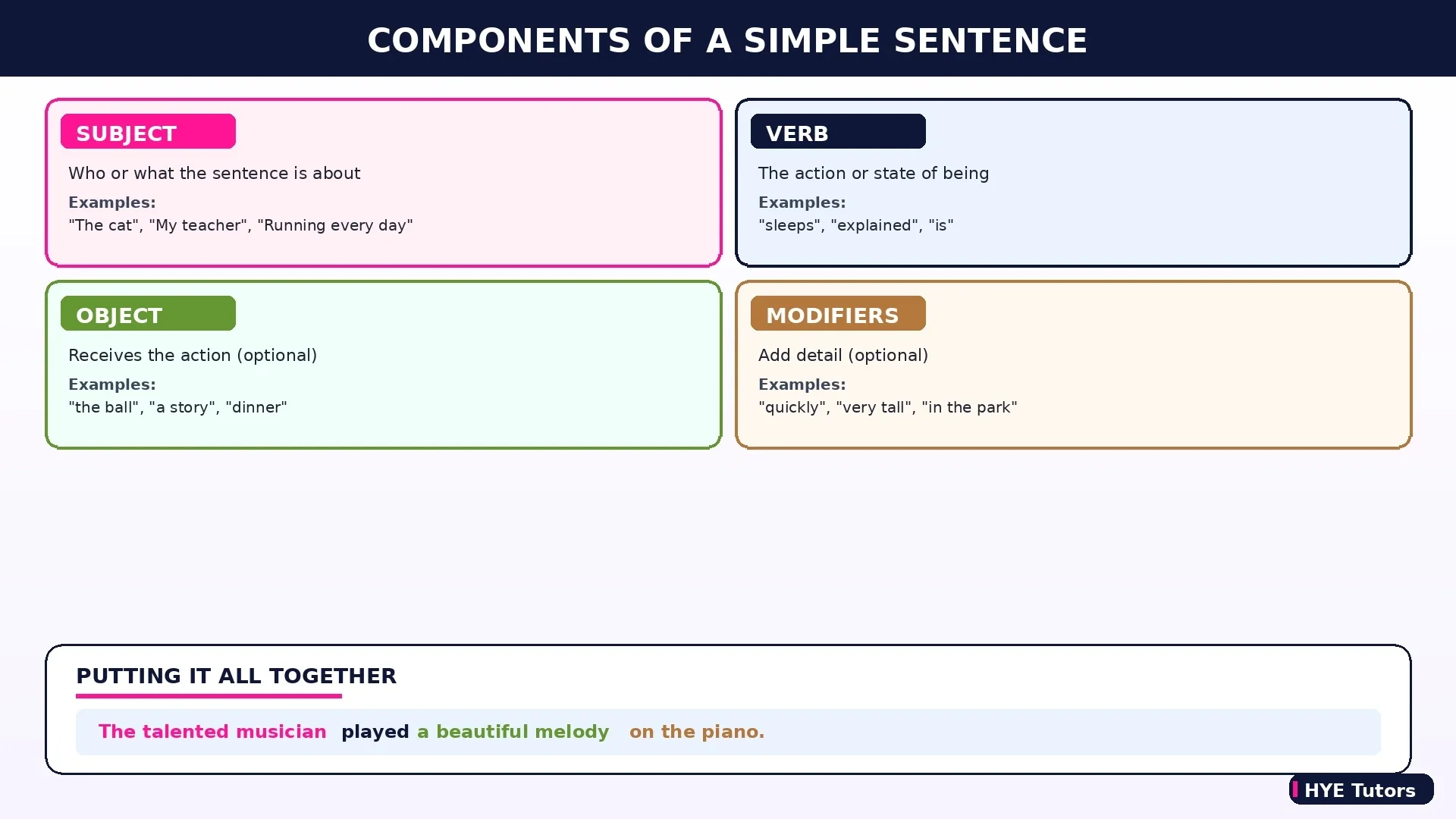
Example: "The talented young musician played a beautiful melody on her grandmother's antique piano." This is still a simple sentence — one subject (musician), one verb (played), one complete thought.
Types of Simple Sentences
Simple sentences can take several forms depending on how you structure the subject and verb. Understanding these variations helps you see that "simple" refers to clause structure, not sentence length or complexity of ideas.
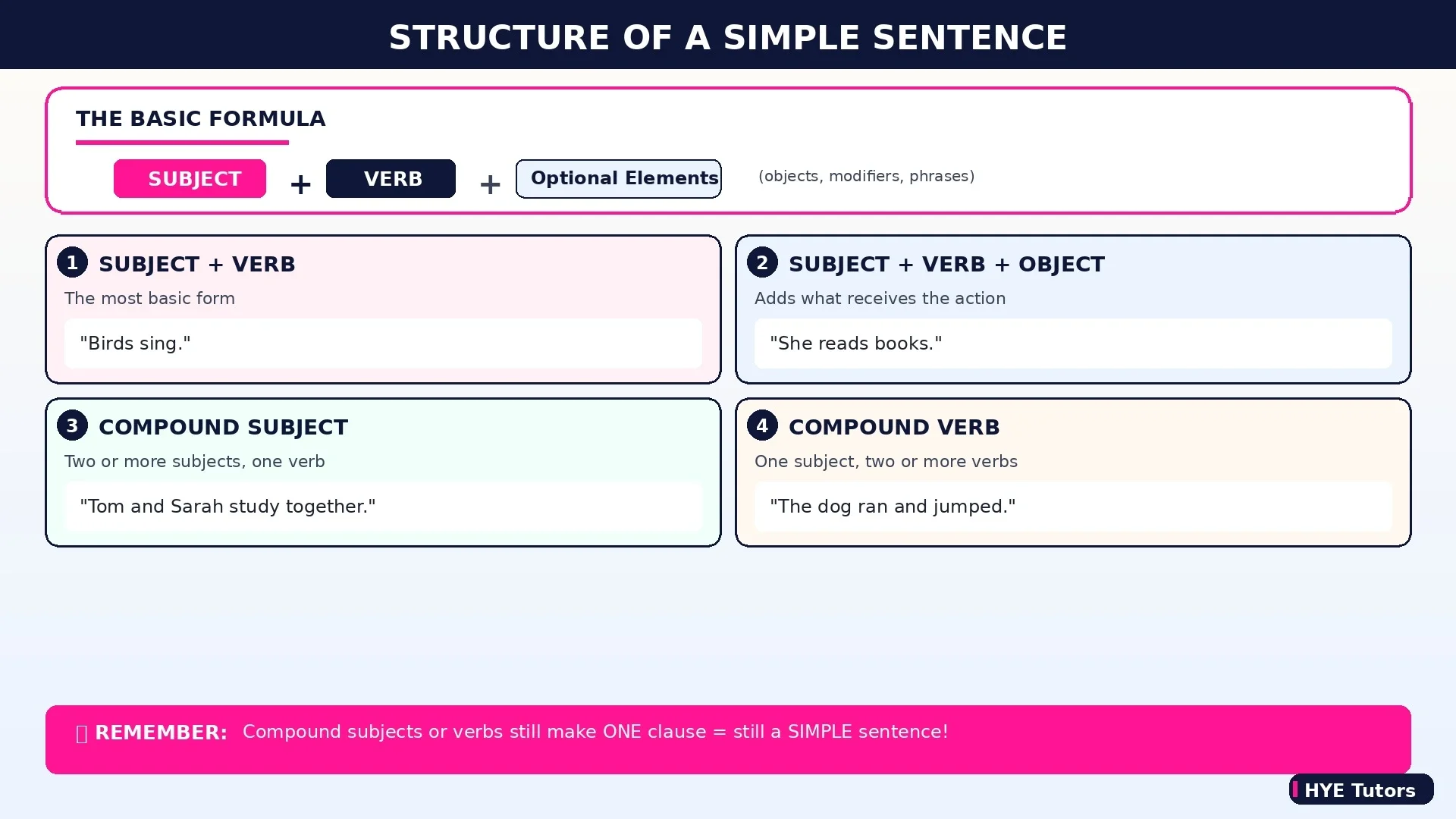
• Subject + Verb: The most basic form. Example: "Birds sing."
• Subject + Verb + Object: Adds what receives the action. Example: "She reads books."
• Compound Subject: Two or more subjects sharing one verb. Example: "Tom and Sarah study together."
• Compound Verb: One subject with two or more verbs. Example: "The dog ran and jumped."
Punctuation & Grammar Tips
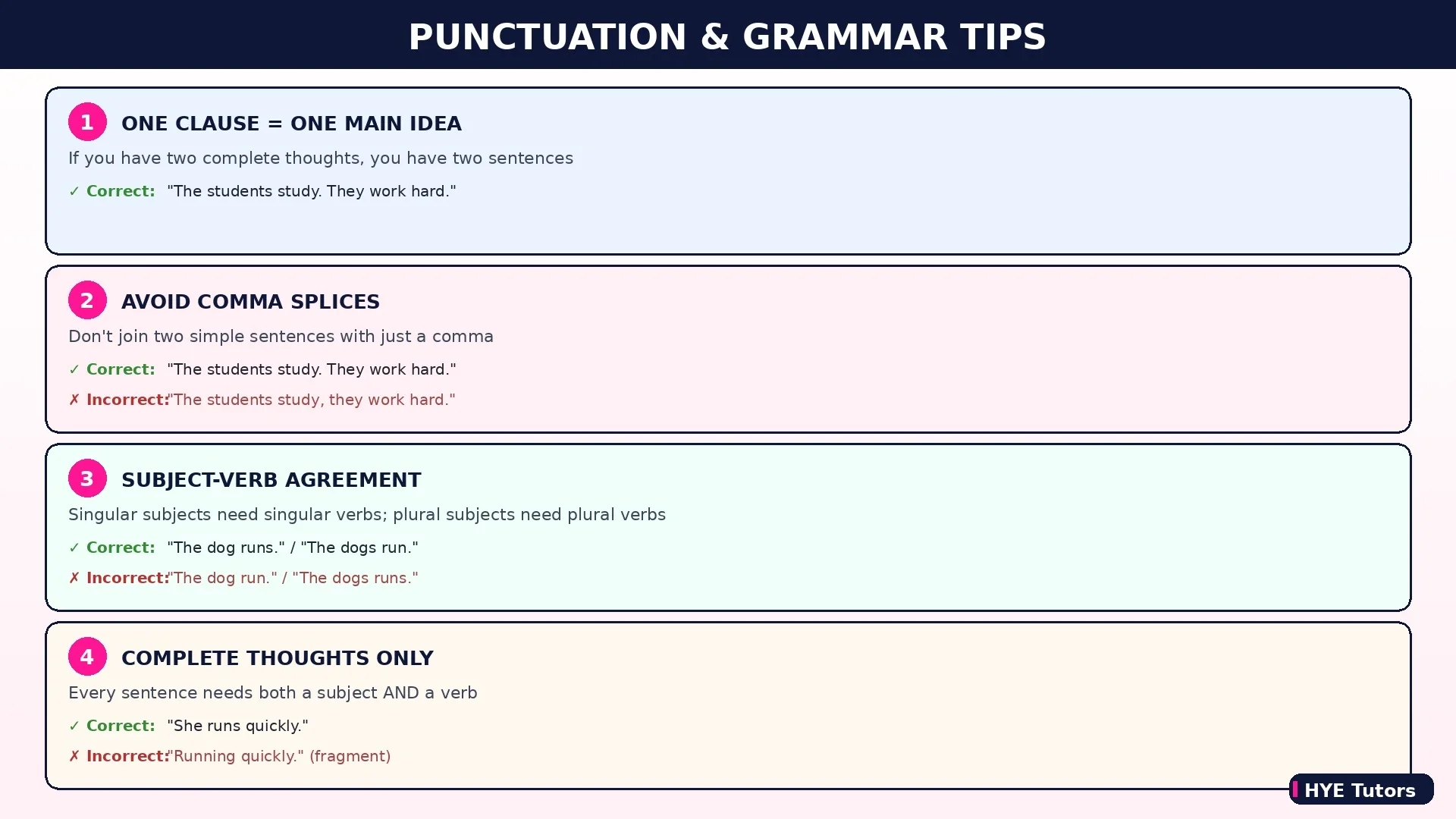
Simple sentences follow straightforward punctuation rules, but there are a few common traps to avoid. These tips will help you write clear, correct simple sentences every time.
• One clause = one main idea: If you have two complete thoughts, you have two sentences (or a compound sentence)
• Avoid comma splices: Don't join two simple sentences with just a comma
• No joining independent clauses: Two independent clauses need a conjunction or become separate sentences
• Subject-verb agreement: Make sure singular subjects have singular verbs, and plural subjects have plural verbs
Correct: "The students study. They work hard." Incorrect: "The students study, they work hard." (comma splice)
Examples
The best way to understand simple sentences is to see them in everyday contexts. Here are examples from school, home, and daily life:
1. "The bell rang."
2. "My sister loves chocolate ice cream."
3. "The teacher explained the lesson clearly."
4. "Rain fell steadily throughout the afternoon."
5. "My parents and grandparents came to the recital."
6. "The excited puppy wagged its tail and barked happily."
7. "She finished her homework before dinner."
Common Mistakes and How to Avoid Them
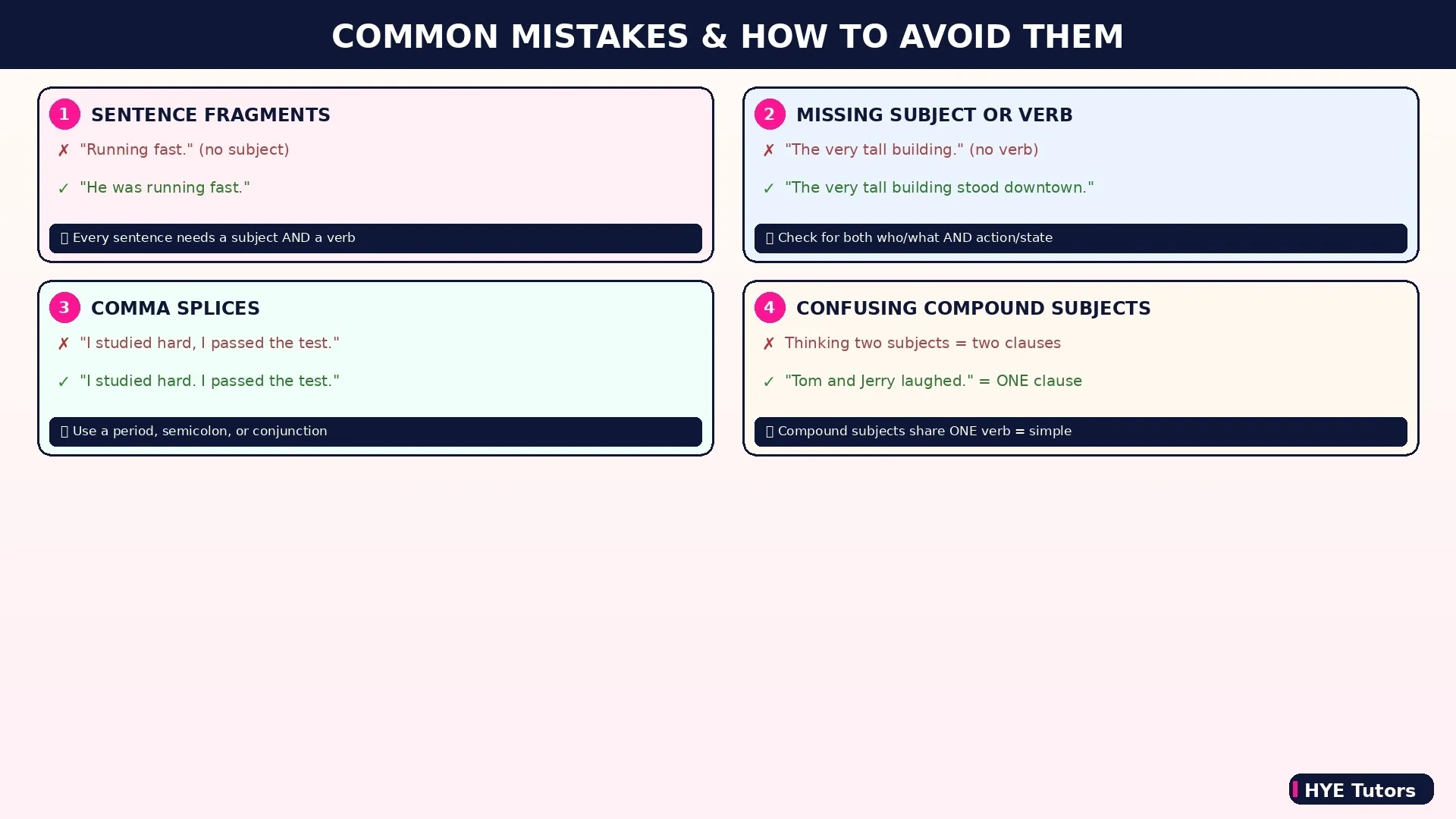
Even confident writers sometimes stumble with simple sentences. Here are the most common errors and friendly tips to avoid them:
• Confusing short sentences with fragments: A fragment lacks a subject or verb. "Running fast" is a fragment; "He was running fast" is a sentence.
• Missing subject or verb: Every sentence needs both. Check that you have a clear "who" and "what they did."
• Joining two clauses incorrectly: If you have two complete thoughts, use a period, semicolon, or conjunction — not just a comma.
• Overusing conjunctions: Adding "and" between two independent clauses creates a compound sentence, not a simple one.
What Is a Compound Sentence vs Simple Sentence?
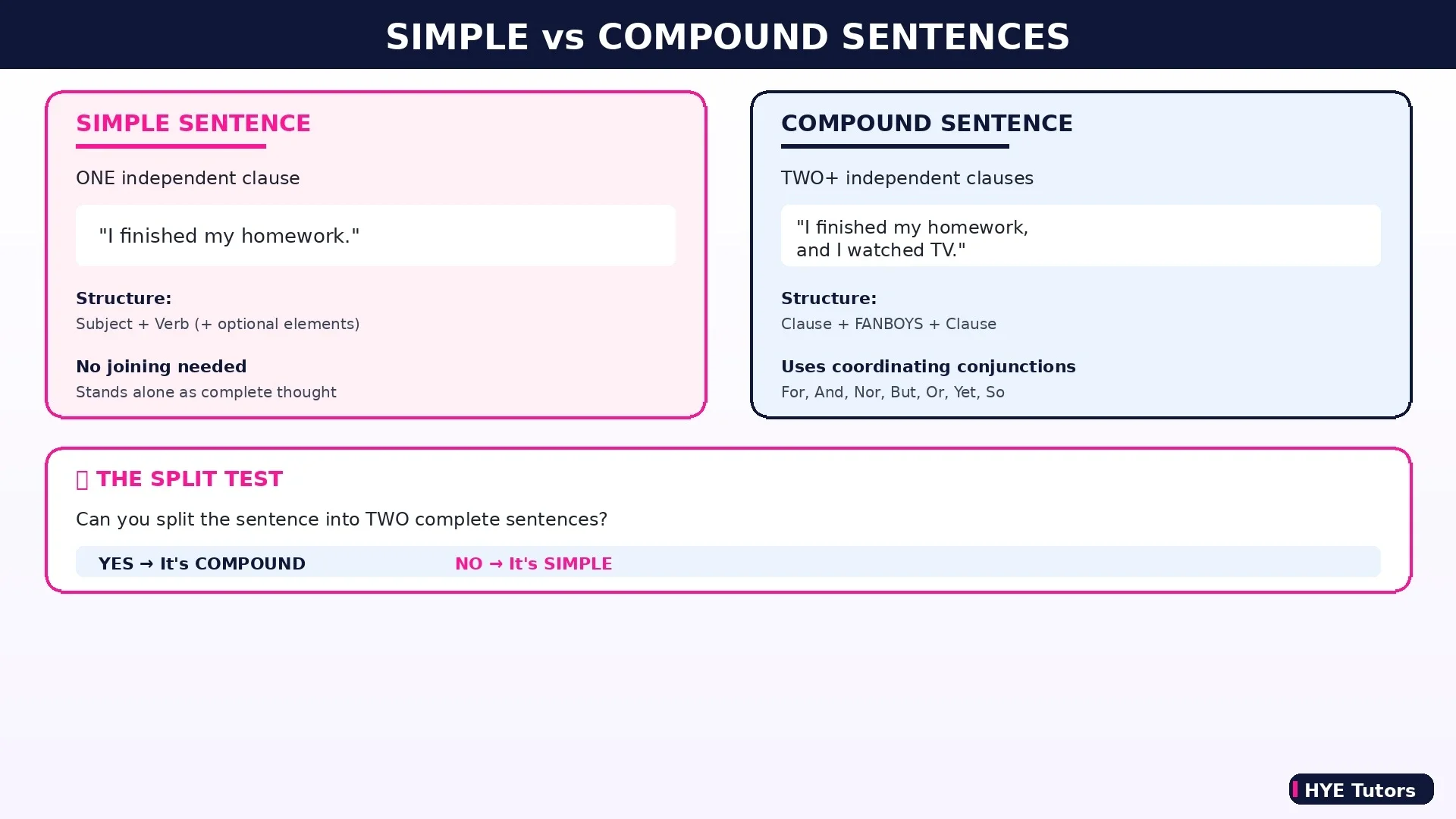
One of the most common questions students ask is how simple sentences differ from compound sentences. The distinction is straightforward once you understand clauses. According to Grammarly's sentence guide, the key difference lies in how many independent clauses the sentence contains.
• Simple sentence: One independent clause. Example: "I finished my homework."
• Compound sentence: Two or more independent clauses joined by a coordinating conjunction (FANBOYS) or semicolon. Example: "I finished my homework, and I watched TV."
• Different connectors: Simple sentences don't join clauses; compound sentences use "and," "but," "or," "so," etc.
• Test it: Can you split the sentence into two complete sentences? If yes, it's compound, not simple.
Remember: A simple sentence with a compound subject ("Tom and Jerry laughed") or compound verb ("She sang and danced") is still simple — it has only one independent clause.
Simple vs Complex vs Compound - Complex Sentences
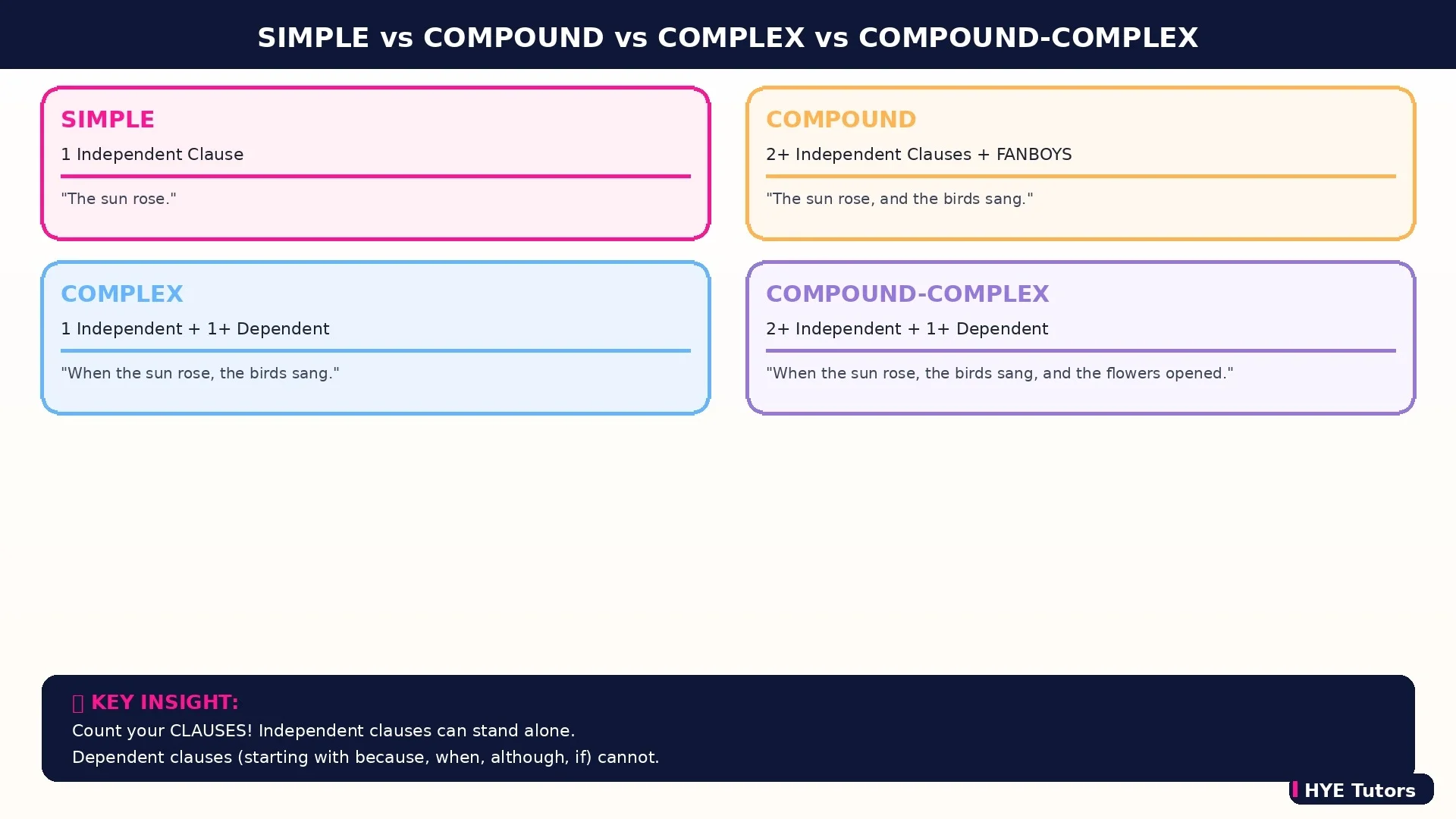
Understanding all four sentence types helps you write with variety and precision. Here's a clear side-by-side comparison of simple, compound, complex, and compound-complex sentences:
• Simple sentence: One independent clause. Example: "The sun rose."
• Compound sentence: Two or more independent clauses. Example: "The sun rose, and the birds started singing."
• Complex sentence: One independent clause + one or more dependent clauses. Example: "When the sun rose, the birds started singing."
• Compound-complex sentence: Two or more independent clauses + one or more dependent clauses. Example: "When the sun rose, the birds started singing, and the flowers began to open."
The key difference between a simple sentence and a complex sentence is the presence of dependent clauses. Simple sentences have none; complex sentences have at least one. Dependent clauses begin with subordinating conjunctions like "when," "because," "although," or "if."
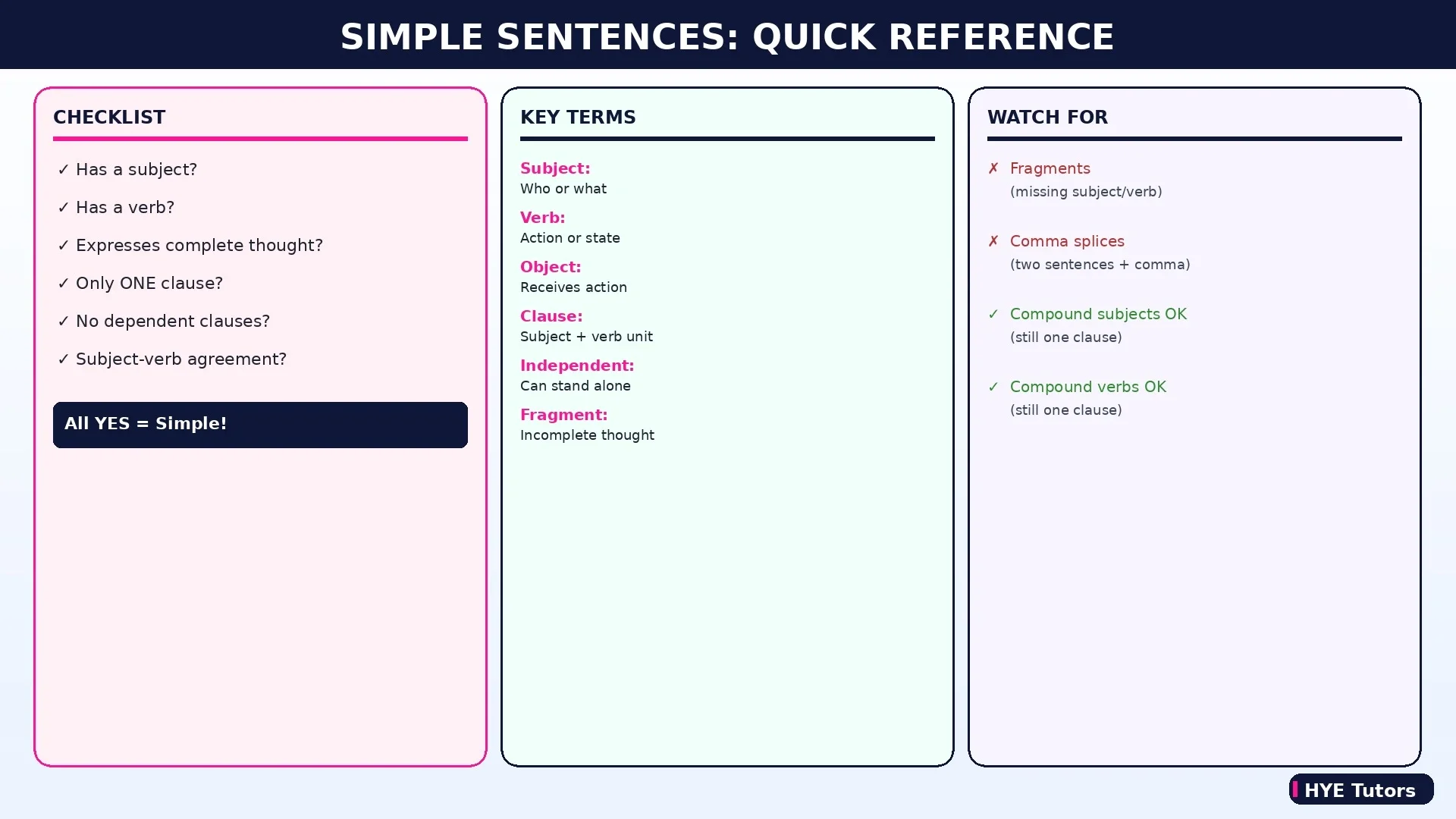
Quick tip: Count your clauses. One independent clause with no dependent clauses = simple. Add a dependent clause = complex. Add another independent clause = compound or compound-complex.
Conclusion
Now you have a complete answer to "what is a simple sentence" — it's a sentence containing one independent clause with a subject and verb that expresses a complete thought. Despite its name, a simple sentence can include multiple words, phrases, and even compound subjects or verbs, as long as it maintains that single-clause structure.
Simple sentences are the foundation of clear writing. Master them, and you'll have the building blocks for understanding compound, complex, and compound-complex sentences. Every great writer knows when to use a simple sentence for impact and clarity.
Keep practicing, and remember: good grammar is a skill that improves with use. You've got this!