

Where Does the Us Rank in Education Worldwide?
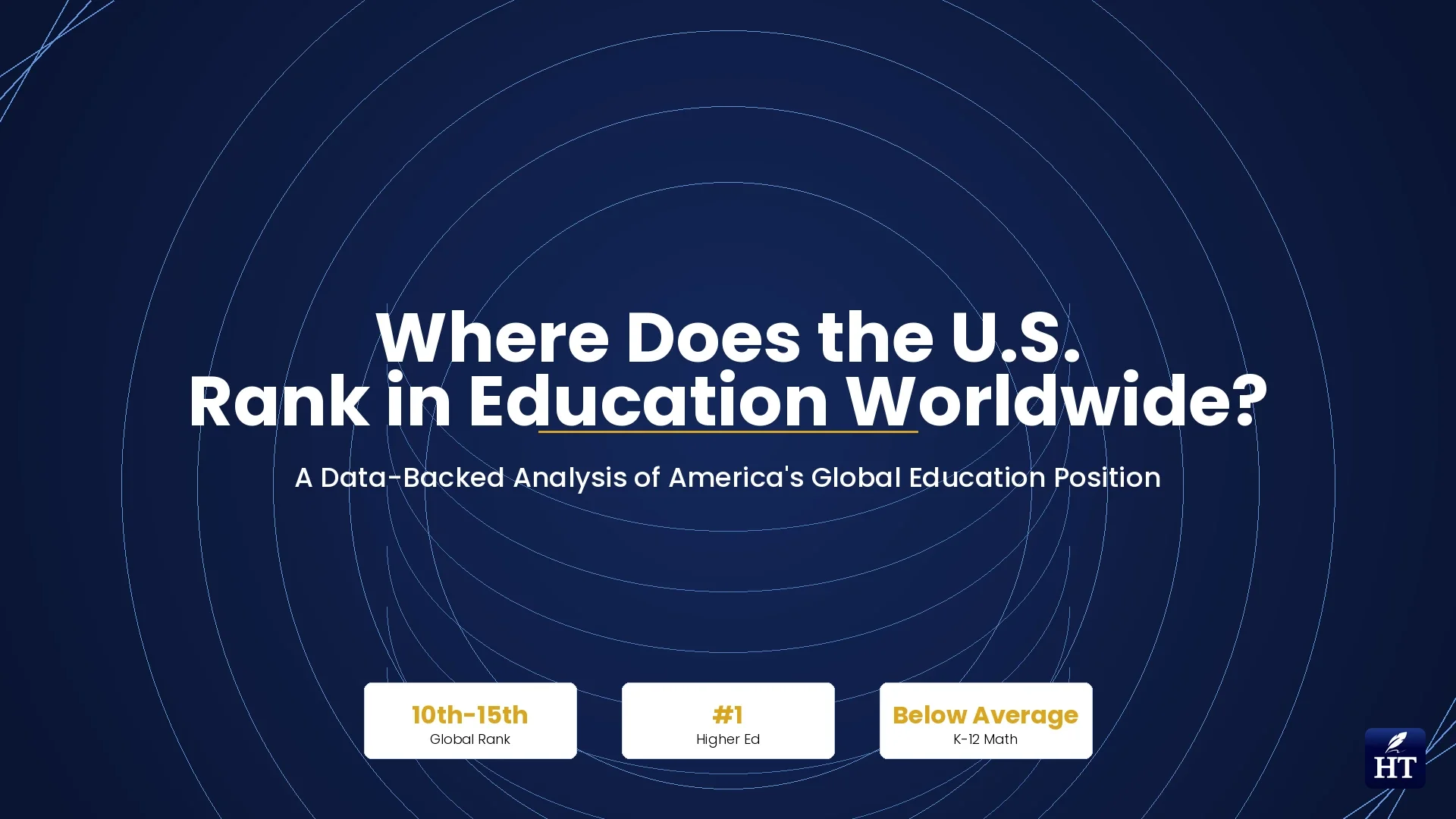
Questions about where the United States ranks in education worldwide often create confusion. Depending on the source, the U.S. may appear among global leaders or positioned behind other developed nations. International organizations such as the OECD, PISA, UNESCO, World Population Review, and U.S. News rely on different evaluation frameworks, leading to mixed conclusions about whether American education is “top tier” or falling behind.
According to the OECD’s Education at a Glance report, the U.S. does rank globally but does not consistently place among the top five education systems across comparative benchmarks. Rankings vary depending on what is measured, including student test performance, access to education, higher education quality, education spending, or long-term outcomes.
This guide explains where the U.S. ranks in education worldwide, breaks down global rankings versus public education, compares the U.S. with top-performing countries, and clarifies why education rankings differ across systems.
“The United States typically ranks between 10th and 15th globally in education, depending on the ranking framework used. While the U.S. performs strongly in higher education and university quality, it ranks lower in K–12 outcomes, particularly in mathematics and science compared to countries such as Finland, South Korea, and Canada. Public education rankings generally place the U.S. lower than overall system rankings due to structural variation and inequality.
”
Where Does the U.S. Rank in Education Worldwide?
There is no single global ranking that definitively answers where the U.S. ranks in education worldwide, as international comparisons depend on different datasets and indicators. Some rankings evaluate education systems broadly, while others focus on student learning outcomes, leading to different conclusions across reports.
Global organizations such as the OECD, UNESCO, and the World Bank assess education systems using indicators including enrollment rates, literacy levels, attainment, access to schooling, and system-wide outcomes. These measures provide insight into how education systems function structurally and how broadly education is accessible, but they do not always capture academic performance at the student level.
In contrast, international assessments such as the Programme for International Student Assessment (PISA) focus specifically on student outcomes. Administered by the OECD, PISA evaluates how 15-year-old students apply reading, mathematics, and science knowledge to real-world problems rather than measuring curriculum coverage alone. Rankings based on PISA results often place the U.S. lower than rankings that emphasize access or higher education quality.
Rankings that incorporate higher education tend to place the U.S. higher due to the global strength of American universities. The U.S. consistently leads in research output, institutional prestige, and the number of universities represented in top global rankings. As a result, combined education rankings may present a more favorable view of the U.S. system overall.
Understanding where the U.S. ranks accurately requires examining overall education system rankings, K–12 outcomes, subject-level performance, higher education strength, and public education performance separately.
Overall Global Education Rankings (U.S. Position)
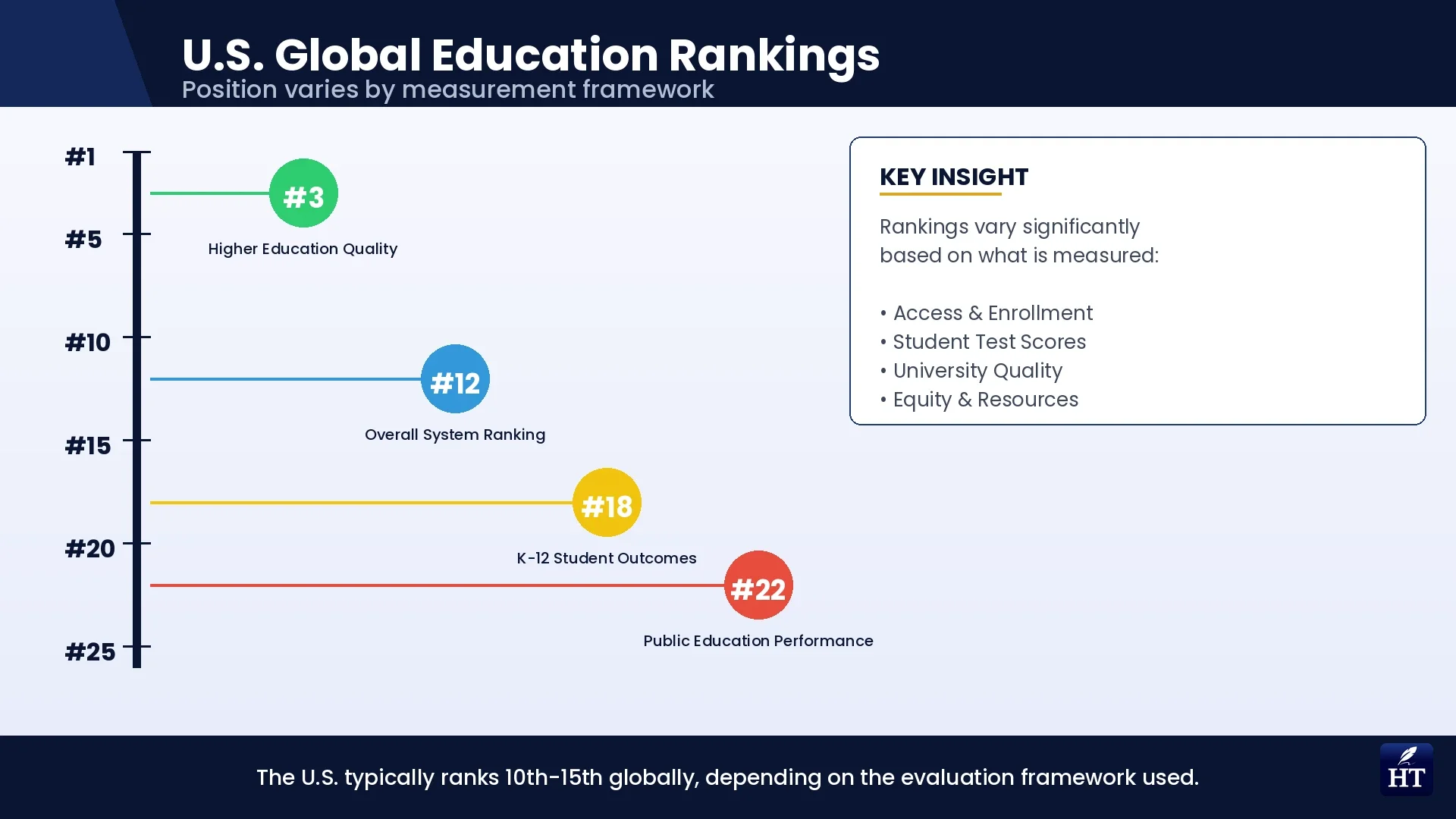
When education systems are evaluated across access, literacy, attainment, and institutional quality, the U.S. typically ranks outside the top 10 but within the top 15 to 20 globally.
Across global comparisons, common patterns include:
Average global rank
Strong performance in higher education
Moderate performance in primary and secondary education
Rankings vary by methodology and year
Since organizations prioritize different indicators, overall rankings should be interpreted as comparative rather than definitive measures of education quality.
Where Does the U.S. Rank in K–12 Education Globally?
K–12 education rankings rely more heavily on international assessments such as PISA, which measure student learning outcomes directly. In these comparisons, the U.S. typically ranks lower than peer nations with more standardized national education systems.
International assessment data from the OECD PISA 2022 report and NCES 2023 show:
Reading: above the OECD average
Math: below many developed countries
Science: middle-tier performance
Performance gaps: vary by state and income level
U.S. Education Ranking in Math, Science, and Reading
Much of the U.S.’s uneven ranking can be attributed to differences in subject-level performance. According to data from the OECD PISA 2022 report, reading is a relative strength, while mathematics consistently ranks as the U.S.’s weakest subject area. Below is a breakdown of how the U.S. performs internationally based on this assessment.
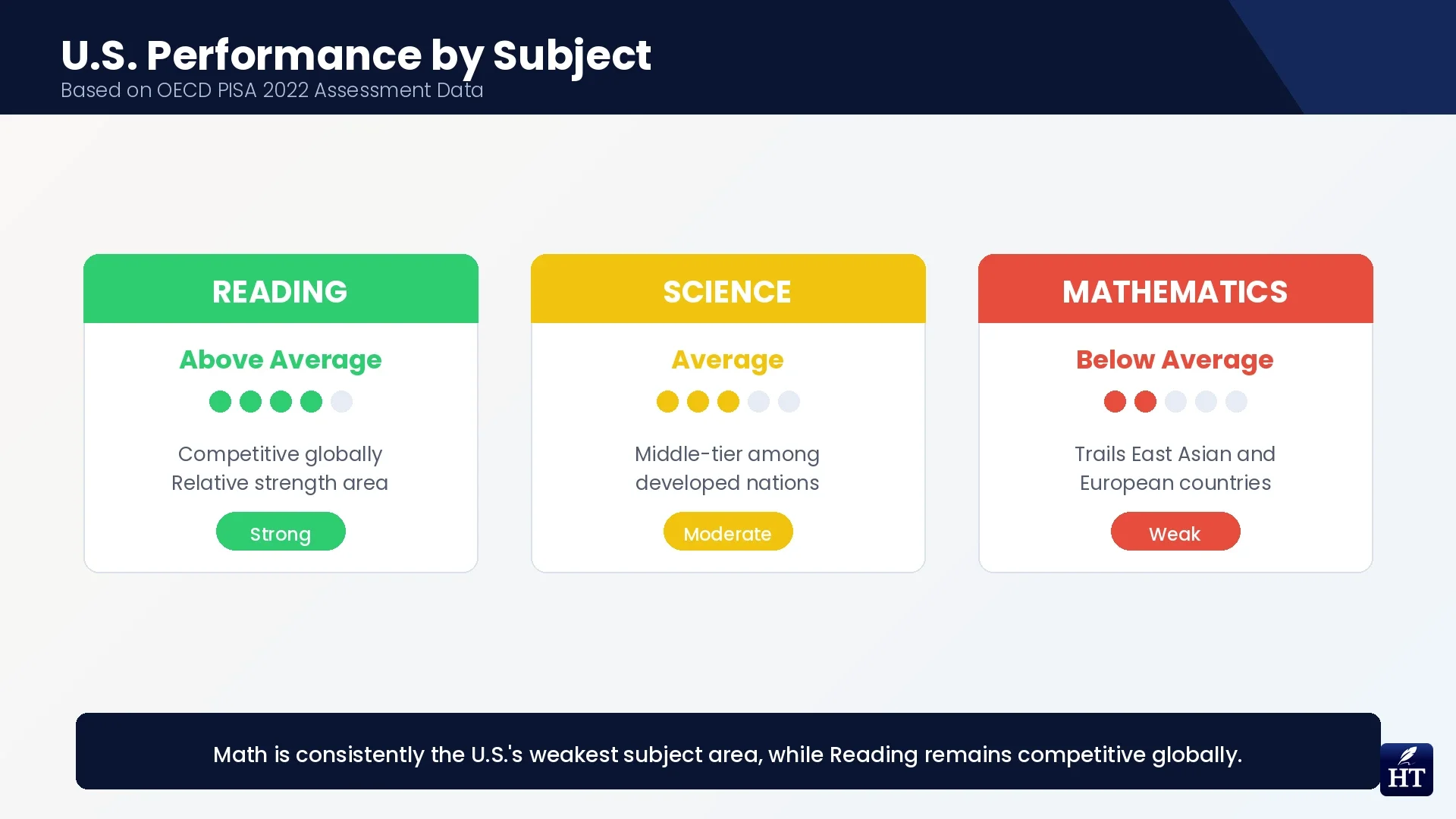
Reading: competitive globally
Science: average among developed nations
Math: trails East Asian and European countries
Performance gaps are influenced by curriculum consistency and variation across states and income levels.
Higher Education vs School Education — Why Rankings Differ
Higher education significantly influences perception of U.S. education quality. International university rankings consistently show that American universities dominate global rankings and account for a disproportionate share of top-ranked universities worldwide, reflecting strong institutional prestige and global influence. Various international reports indicate that key factors contributing to higher overall education rankings include:
U.S. leadership in top global universities
World-class research output
Broad access to higher education
K–12 outcomes lag behind higher education prestige
This divide explains why combined education rankings often present a more favorable view of the U.S. system overall than rankings focused exclusively on K–12 student outcomes.
Where Does the U.S. Rank in Public Education Worldwide?
Public education rankings typically place the U.S. lower than overall education rankings due to persistent inequality, funding differences, and significant variation across states and districts. International comparisons show that when rankings focus specifically on public K–12 systems, the U.S. tends to fall outside the top tier globally.
Common conclusions across global and national datasets include:
Public education rank: typically 20th or lower
Variation by state: outcomes differ significantly across regions
Funding: higher spending does not consistently yield stronger outcomes
Socioeconomic gaps: disparities across states and school districts impact results
How the U.S. Compares to Top-Ranked Countries
Countries that consistently rank above the United States tend to have education systems designed for consistency and fairness across schools. International comparisons show that top-performing education systems rely on clear national standards, strong teacher preparation, and shared expectations for what students should learn, which help reduce differences in outcomes between schools and regions. These systems also invest in early learning and maintain coherent curricula, making student success less dependent on where a child lives or their family’s income.
Countries That Rank Higher Than the U.S.
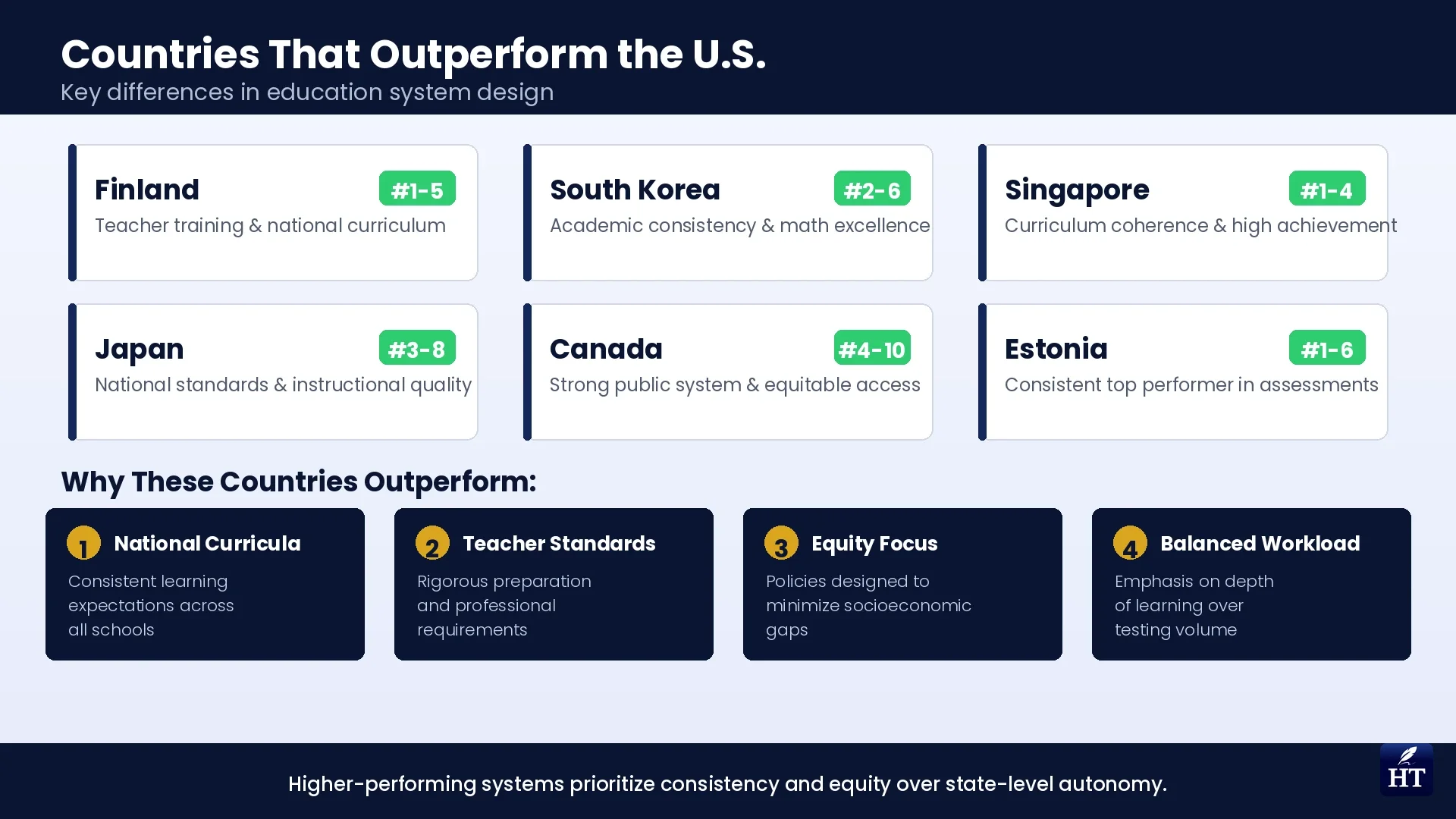
Education systems that frequently outperform the U.S. include:
Finland, known for highly trained teachers and a nationally aligned curriculum.
South Korea, which emphasizes academic consistency and strong performance in mathematics
Singapore, recognized for curriculum coherence and high achievement across multiple subjects
Japan, where national standards and instructional quality contribute to stable outcomes
Canada, which combines strong public education systems with relatively equitable access
Estonia, a smaller system that consistently ranks near the top in international assessments
Key Differences Between the U.S. and Top Education Systems
According to international education reports, the key differences between the U.S. education system and top-ranked education systems lie in how standards, teaching, and equity are structured across schools. Global comparisons consistently show that higher-performing countries rely on centralized standards, stronger teacher preparation, and policies designed to reduce inequality, rather than allowing outcomes to vary widely by region or income level.
Key systemic differences include:
National curricula, which ensure consistent learning expectations across schools, compared to the U.S.’s state-controlled system
Higher teacher training standards, with more rigorous preparation and professional requirements
Balanced student workload, emphasizing depth of learning over excessive testing
Equity-focused access policies, aimed at minimizing socioeconomic gaps in educational outcomes
Why the U.S. Education Ranking Varies So Much
Confusion around U.S. education rankings is common, largely because different ranking systems measure different aspects of education quality. International comparisons show that shifts in the U.S. education ranking are driven primarily by differences in measurement frameworks—such as whether rankings emphasize student outcomes, access, equity, or higher education—rather than sudden declines or improvements in system performance.
As a result, the U.S. may appear stronger in rankings that prioritize university quality or educational access, and weaker in those focused on K–12 learning outcomes or equity. Understanding this variation helps explain why rankings change across reports and years without signaling dramatic changes in education quality.
Key contributors to ranking variation include:
Different ranking criteria, including outcomes, access, and attainment
State-level autonomy, which leads to uneven implementation and results
Public vs. private performance, which can skew system-wide comparisons
Socioeconomic diversity, affecting aggregate outcomes
Immigration and language diversity, influencing assessment results
FAQs
Where does the U.S. rank in education worldwide?
The United States typically ranks between 10th and 15th worldwide, depending on the ranking system used. Rankings that emphasize higher education quality, research output, or access tend to place the U.S. higher, while those focused on K–12 student outcomes usually position it lower.
Where does the U.S. rank in education in the world?
In most international comparisons, the U.S. ranks outside the top 10 but within the top 20 education systems globally. This placement reflects strong performance in higher education alongside weaker and more uneven outcomes in primary and secondary education.
Where does the U.S. rank globally in education?
Globally, the U.S. is considered a mid-to-high performing education system among developed countries. Its ranking varies by methodology, with strengths in tertiary education and access offset by comparatively lower K–12 performance, particularly in math and science.
Where does the U.S. rank in public education?
Public education rankings often place the U.S. around 20th or lower internationally. Persistent inequality, differences in state-level governance, and uneven resource distribution contribute to wide variation in outcomes across public K–12 systems.
Why is the U.S. not ranked in the top 5 for education?
The U.S. is rarely ranked in the top five due to lower K–12 student performance, inconsistent curriculum standards across states, and persistent achievement gaps. These factors limit overall outcomes despite strong investment and higher education excellence.
Does the U.S. rank higher in higher education than K–12?
Yes. The U.S. consistently ranks among global leaders in higher education because of university quality, research output, and institutional prestige. In contrast, K–12 outcomes—especially in mathematics and science—rank lower relative to peer nations.
Has the U.S. education ranking improved or declined?
Overall U.S. education performance has remained relatively stable over time. Changes in rankings typically reflect shifts in methodology or measurement priorities rather than major system-wide improvements or declines in education quality.
Conclusion
Where the U.S. ranks in education worldwide depends largely on how education quality is defined and measured. Across multiple indicators, the United States consistently places in the mid-to-high global range. Higher education remains a clear global strength, driven by university quality and research output, while differences in K–12 performance explain most international ranking gaps. Understanding where the U.S. ranks in education worldwide requires looking beyond headlines and recognizing how ranking methodologies shape outcomes. Explore related education guides at hyetutors.com to continue learning.