

How Many Elements Are on the Periodic Table?
Picture this: you walk into your chemistry exam and glance up at the periodic table poster on the wall. You know you have seen it hundreds of times. But a multiple-choice question asks you how many elements are currently confirmed - and for a second, your mind goes blank. Is it 116? 117? You have a vague sense the answer is somewhere in that range, but you are not certain.
Knowing exactly how many elements are on the periodic table - and understanding what that number actually means - is the kind of foundational knowledge that pays dividends across chemistry exams from middle school through AP Chemistry, SAT Subject Tests, O-Levels, and A-Levels. At HYE Tutors, we have guided students through general chemistry and AP Chem for over a decade, and questions about the periodic table structure appear on virtually every major science assessment we have helped students prepare for.
In this guide, you will get the precise answer, a breakdown of how the 118 elements are organized, which ones matter most for your exams, and exam-day strategies from tutors who have reviewed hundreds of chemistry papers. Let's start with the number.
How many elements are on the periodic table?
There are 118 confirmed elements on the periodic table as of 2024, organized by increasing atomic number from Hydrogen (1) to Oganesson (118). Of these, 94 occur naturally on Earth and 24 are synthetic - created in laboratories. The periodic table is officially maintained and updated by the International Union of Pure and Applied Chemistry (IUPAC).
How Many Elements Are on the Periodic Table?
In our work at HYE Tutors, we have found that most students can memorise '118' in about five minutes. But the students who consistently score higher on AP Chemistry and standardised science exams are the ones who understand the structure behind that number - what the elements are, how they are organised, which ones matter for reactions, and why the table looks the way it does. That is what this section is going to build.
The Current Number of Elements - And Why It Is 118
The answer is 118 confirmed elements as of the most recent update from IUPAC (the International Union of Pure and Applied Chemistry) - the international body responsible for officially verifying and naming new elements. The table runs from atomic number 1 (Hydrogen, the lightest element) to atomic number 118 (Oganesson, the heaviest confirmed element).
Each element is a unique substance that cannot be broken down into simpler substances by any ordinary chemical reaction. What makes each element unique is its atomic number - the number of protons in the nucleus of its atoms. Hydrogen has 1 proton. Carbon has 6. Gold has 79. No two elements share the same atomic number.
It is worth noting: the periodic table is not permanently closed. Scientists are actively attempting to synthesise element 119. IUPAC only adds an element to the official table after rigorous, independently verified confirmation - a process that can take years from initial synthesis to official naming.
How Are the 118 Elements Organized on the Periodic Table?
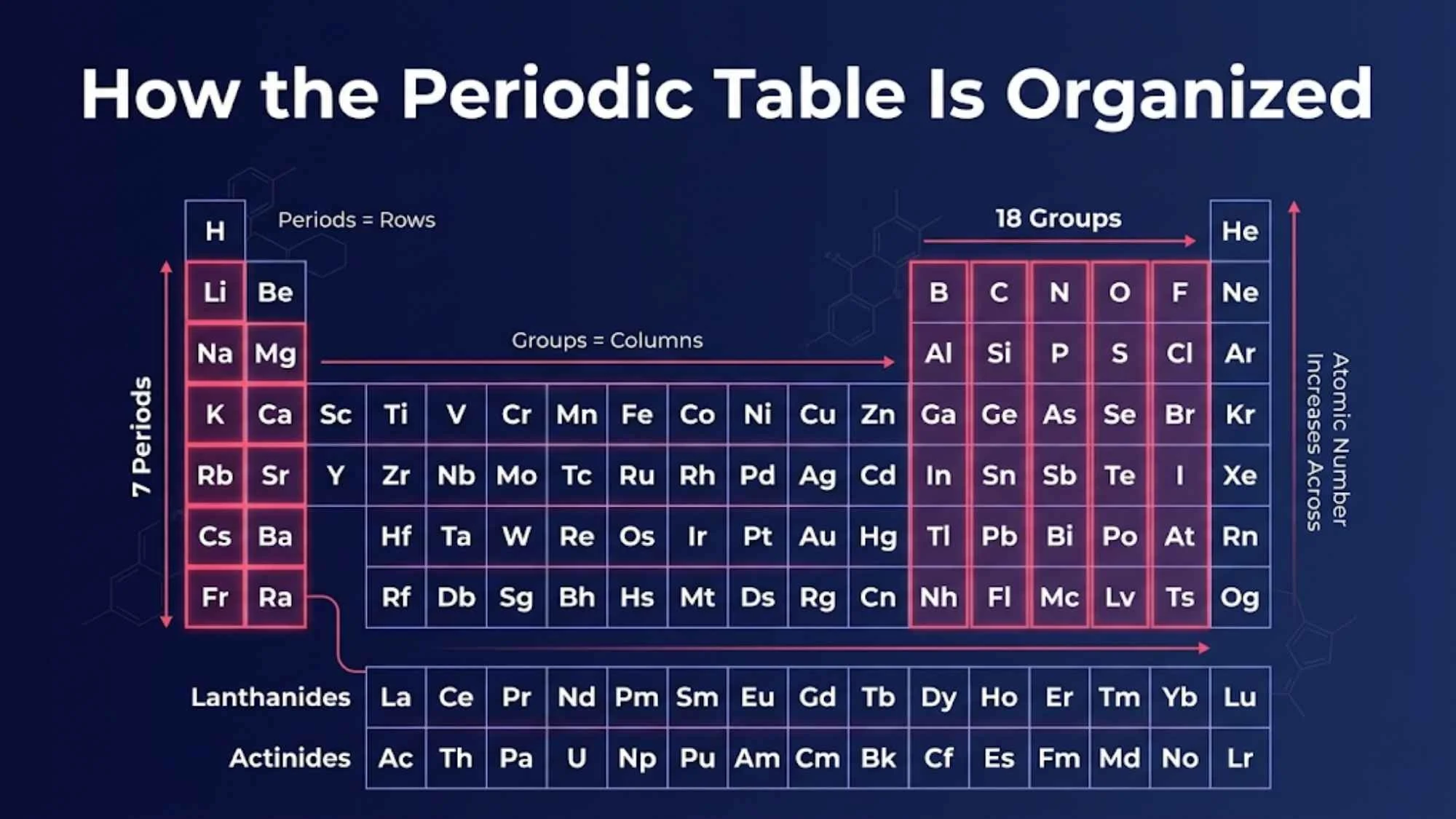
The periodic table is not a random list - every position is deliberate. Think of it like a carefully designed seating chart where each element's seat tells you something fundamental about its chemistry.
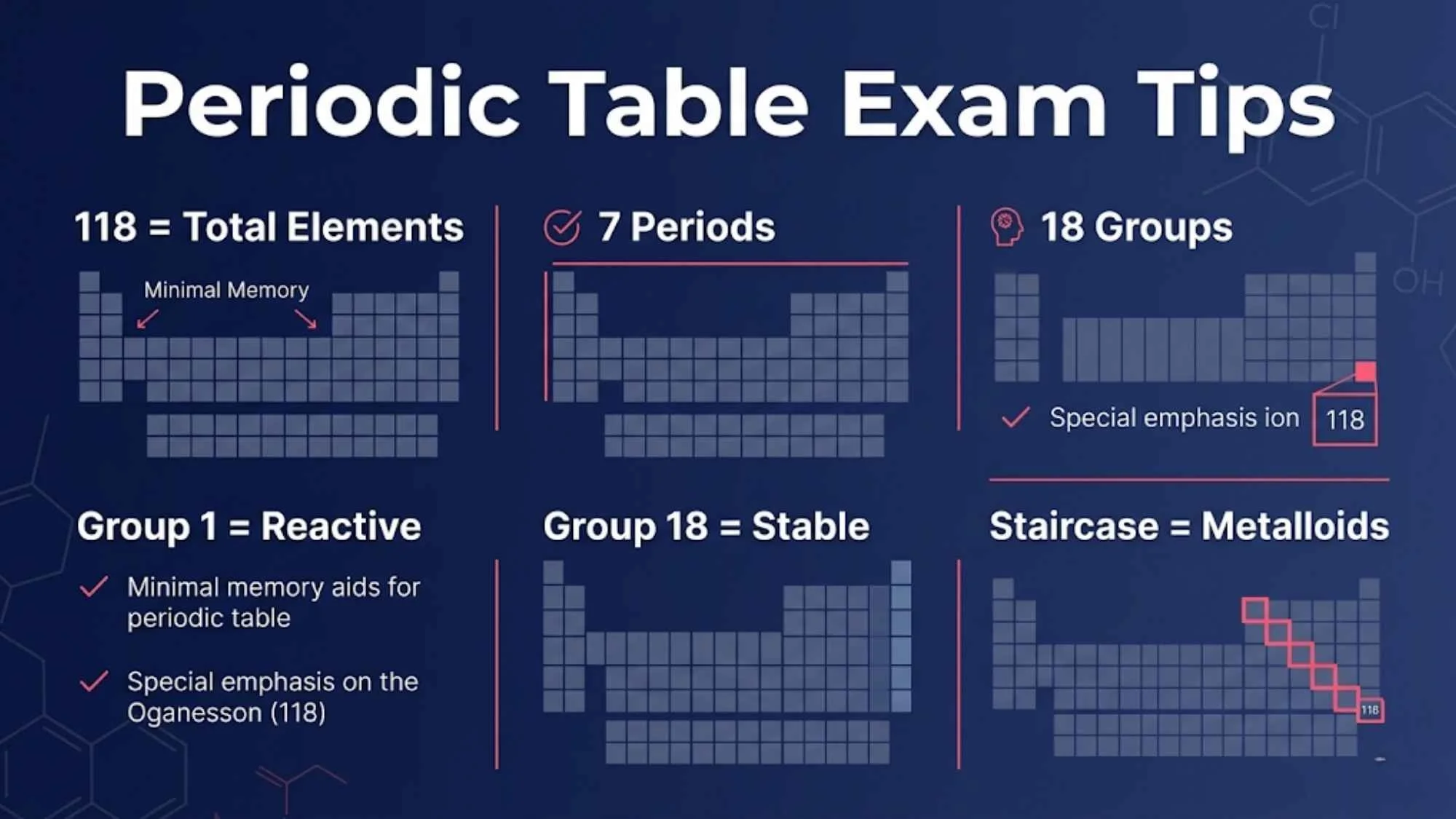
Periods (rows): There are 7 horizontal rows, each called a period. As you move left to right across a period, the atomic number increases by exactly 1 at each step. Elements shift in character across a period - from reactive metals on the left to nonmetals and noble gases on the right.
Groups (columns): There are 18 vertical columns, each called a group (or family). Elements in the same group have the same number of valence electrons - electrons in the outermost energy level - which gives them similar chemical behaviour. This is the single most powerful insight the table offers.
The two detached rows at the bottom: The Lanthanides (elements 57-71) and Actinides (elements 89-103) are pulled out and displayed below the main table purely for visual convenience - if they were placed in their correct positions, the table would be impractically wide. They belong to Periods 6 and 7 respectively.
"We always tell our students: the periodic table is not something you memorise in isolation - it is a map you learn to read. Once you understand that position predicts behaviour, every element question becomes significantly easier to approach."
Natural vs. Synthetic Elements - Breaking Down the 118
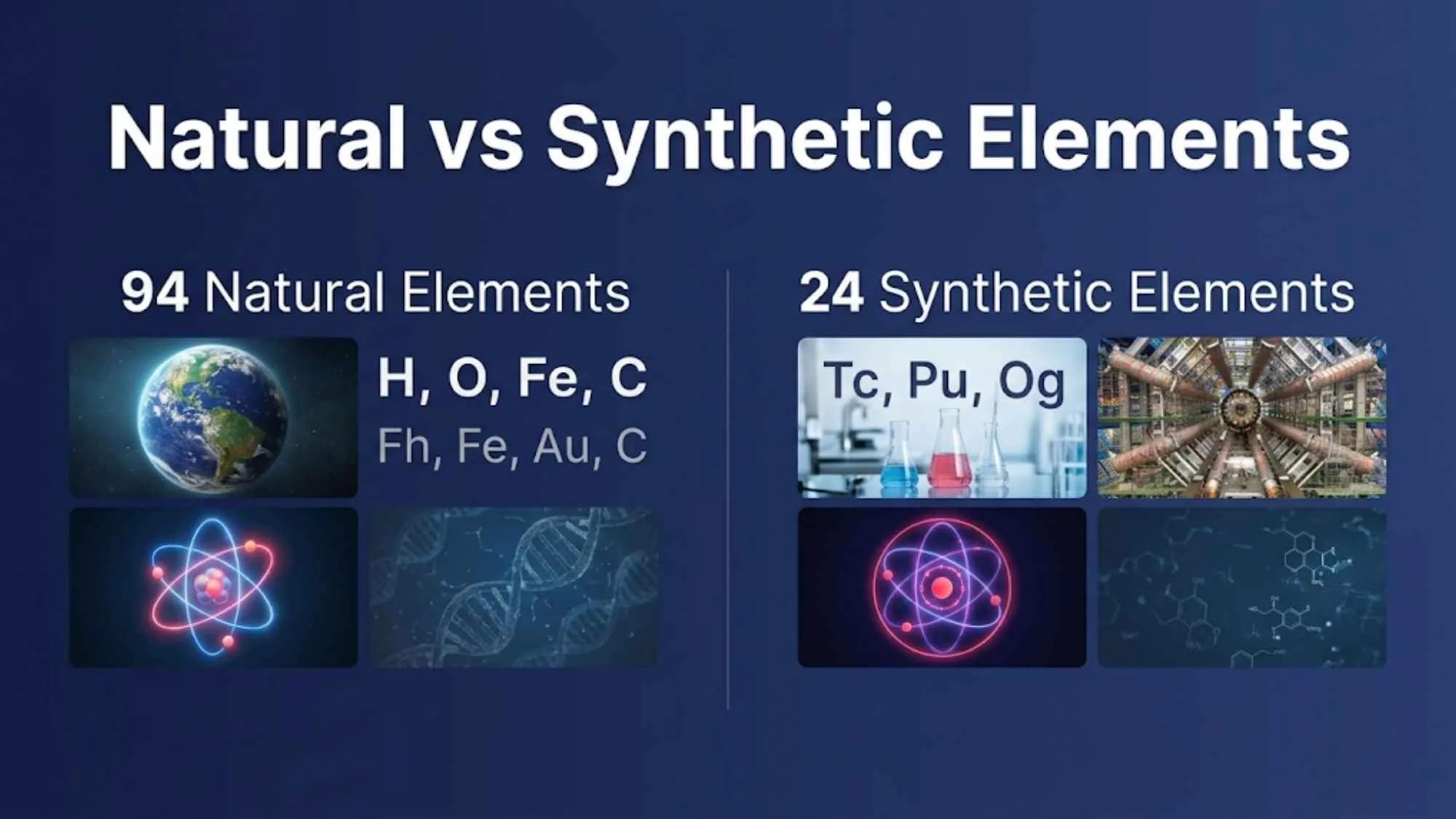
Not all 118 elements are found in the ground, the ocean, or the air around us. The 118 break down into two distinct categories:
| Natural Elements | Synthetic Elements | |
|---|---|---|
| Count | 94 | 24 |
| Origin |
Found in Earth's crust, oceans, atmosphere |
Created in nuclear reactors or particle accelerators |
| Stability |
Range from stable to mildly radioactive |
Typically unstable; very short half-lives |
| Examples | H, O, Fe, Au, Ca, C | Tc (43), Np (93), Pu (94), Og (118) |
The boundary between natural and synthetic elements is not perfectly sharp - some technically 'natural' elements are so rare that they exist in only trace amounts and are largely produced synthetically for practical use. But the 94/24 split is the standard figure used in chemistry education and on exams.
Synthetic elements are not just scientific curiosities. Plutonium (element 94) powers nuclear reactors and has been used in spacecraft propulsion systems. Technetium (element 43) is the first element ever produced artificially and is used in medical imaging. Students sometimes ask us whether it is worth knowing about synthetic elements - the answer is yes, particularly for AP Chemistry and A-Level, where nuclear chemistry questions appear regularly.
The 118 Elements Grouped by Category -Know Your Element Types
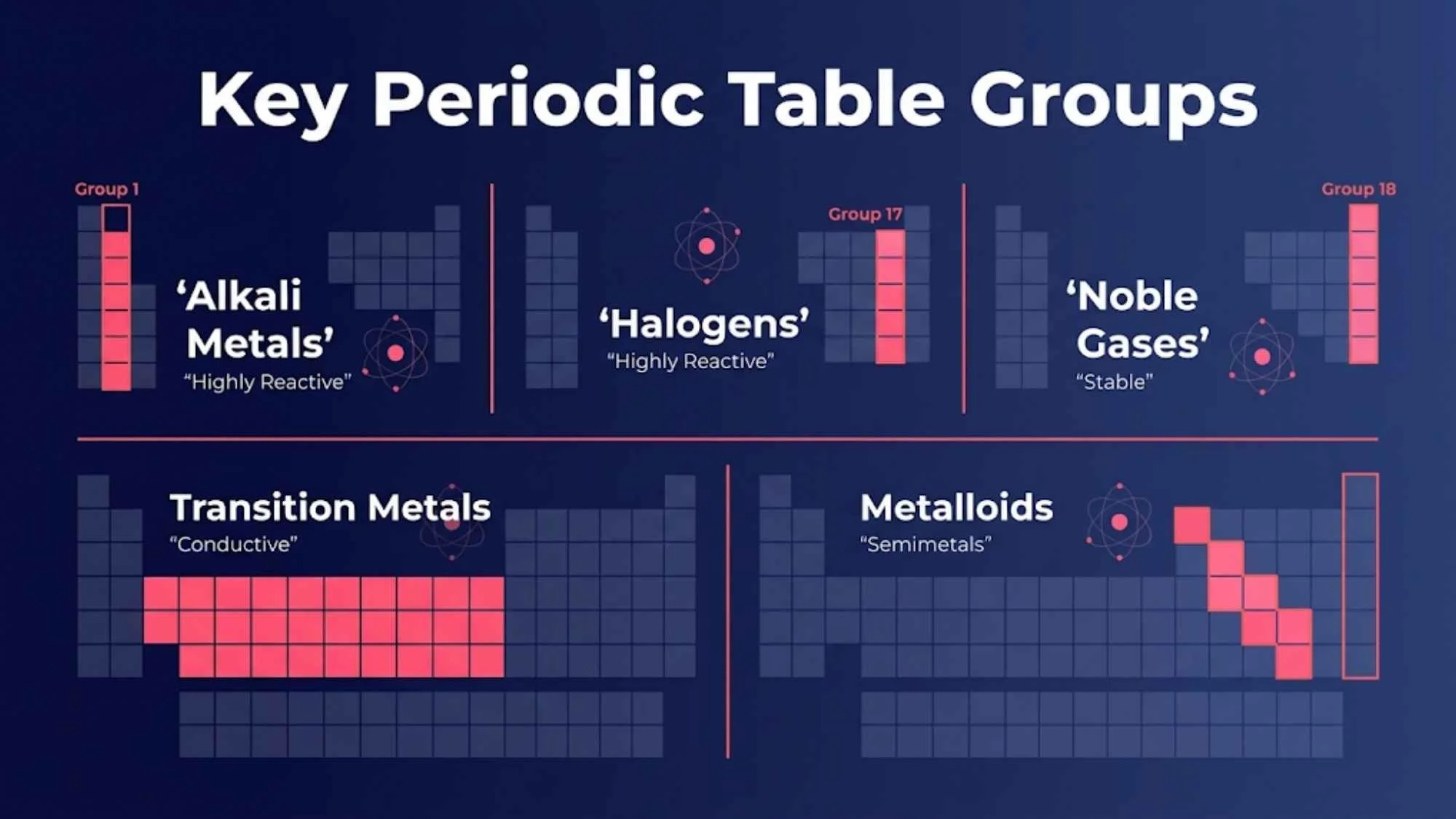
The 118 elements are not just organised by number - they are categorised by their physical and chemical properties. Understanding these categories is one of the highest-yield skills for chemistry exams at every level.
| Category | Count | Location on Table | Examples |
|---|---|---|---|
| Alkali Metals | 6 | Group 1 | Li, Na, K, Rb, Cs, Fr |
| Alkaline Earth Metals | 6 | Group 2 | Be, Mg, Ca, Sr, Ba, Ra |
| Transition Metals | ~40 | Groups 3-12 | Fe, Cu, Zn, Ni, Au, Ag |
| Lanthanides | 15 | Period 6 (bottom row) | Ce, Nd, Eu, Gd |
| Actinides | 15 | Period 7 (bottom row) | U, Pu, Th, Np |
| Post-Transition Metals | ~7 | Groups 13-16 | Al, Ga, In, Sn, Pb |
| Metalloids | ~8 | Staircase border | B, Si, Ge, As, Te |
| Nonmetals | ~7 | Upper right | H, C, N, O, P, S, Se |
| Halogens | 5 | Group 17 | F, Cl, Br, I, At |
| Noble Gases | 6 | Group 18 (far right) | He, Ne, Ar, Kr, Xe, Rn |
The broad three-way split to know first: approximately 91 metals, 17 nonmetals, and 8 metalloids. Metals conduct electricity and heat, are malleable, and tend to lose electrons in reactions. Nonmetals are diverse in form but tend to gain electrons. Metalloids - also called semimetals - sit along the staircase-shaped boundary on the right side of the table and share properties of both.
Two groups that deserve special attention for exams: Noble Gases (Group 18) are famously unreactive because their outer electron shells are completely full - they have no need to gain or lose electrons. Halogens (Group 17) are the opposite: with 7 valence electrons, they are just one electron short of a full shell and are among the most reactive elements on the table.
The Most Important Elements Students Should Know by Name and Symbol
In over a decade of tutoring chemistry students, we have reviewed hundreds of exam papers. The same 20 to 30 elements appear again and again. You do not need to memorize all 118 -you need to know the right ones well. Here is exactly what to prioritize.
The first 20 elements -most curricula require these memorized:
| # | Symbol | Name | # | Sym bol |
Name |
|---|---|---|---|---|---|
| 1 | H | Hydrogen | 11 | Na | Sodium |
| 2 | He | Helium | 12 | Mg | Magnesium |
| 3 | Li | Lithium | 13 | Al | Aluminum |
| 4 | Be | Beryllium | 14 | Si | Silicon |
| 5 | B | Boron | 15 | P | Phosphorus |
| 6 | C | Carbon | 16 | S | Sulfur |
| 7 | N | Nitrogen | 17 | Cl | Chlorine |
| 8 | O | Oxygen | 18 | Ar | Argon |
| 9 | F | Fluorine | 19 | K | Potassium |
| 10 | Ne | Neon | 20 | Ca | Calcium |
A widely used classroom mnemonic for the first 10 elements:
Additional high-priority elements for exam success:
Common metals: Fe (Iron), Cu (Copper), Zn (Zinc), Pb (Lead), Au (Gold), Ag (Silver), Al (Aluminium)
Biology crossover elements: C, H, O, N, P, S - the six building blocks of all living molecules
Everyday chemistry: Na (table salt component), Ca (bones and teeth), Cl (bleach/disinfectants), Fe (blood haemoglobin)
Noble gases to know: He, Ne, Ar, Kr, Xe, Rn
Halogens to know: F, Cl, Br, I, At
Memory Tricks to Remember the Number of Elements and Table Structure
Here are the specific techniques we use in our tutoring sessions - practical, memorable, and built for exam conditions.
118 - One, One, Eight: Say it as a three-beat rhythm: One-One-Eight. Students who verbalise the number - rather than just reading it - retain it significantly better under pressure. Say it three times before your exam morning.
Periods = Floors, Groups = Columns: Picture the periodic table as a seven-storey building with 18 columns per floor. 7 floors (periods). 18 columns (groups). Every element has an address: its floor and column number.
Oganesson = The Last Stop: Oganesson (Og, element 118) sits at the far right of Period 7. When you need to recall the total element count, picture Oganesson at the very last position. It is the last stop on the table. 118.
Staircase = The Border: The boundary between metals and nonmetals is a staircase-shaped line on the right side of the main table. Left of the staircase = metal. Right = nonmetal. Straddling it = metalloid. Once you can picture the staircase, you can classify any element by position alone.
A Brief History of the Periodic Table - From 63 to 118 Elements
The periodic table was not discovered all at once - it was built, revised, and expanded over more than 150 years. Understanding how it developed helps students answer the history questions that appear on AP Chemistry and A-Level exams, and it makes the structure feel less arbitrary.
1869 - Mendeleev's table: Russian chemist Dmitri Mendeleev published the first widely recognised periodic table, organising 63 known elements by atomic mass. His genius was not just arranging the elements he knew - it was deliberately leaving blank spaces for elements he predicted must exist but had not yet been discovered. He even described the properties of these missing elements in detail. When Gallium (1875) and Germanium (1886) were later discovered and matched his predictions almost exactly, the scientific community fully accepted his system.
Early 20th century - Moseley's revision: British physicist Henry Moseley discovered in 1913 that elements should be ordered by atomic number (number of protons) rather than atomic mass. This resolved several inconsistencies in Mendeleev's original table and gave the periodic law its modern, precise foundation.
Mid-20th century onwards - the synthetic era: Beginning with Technetium in 1937, scientists began creating elements in nuclear reactors and particle accelerators that do not exist naturally on Earth. Each new synthetic element extended the table further into the superheavy region.
2016 - the four newest names: IUPAC officially named elements 113, 115, 117, and 118 as Nihonium (Nh), Moscovium (Mc), Tennessine (Ts), and Oganesson (Og) - completing Period 7 and bringing the confirmed total to 118. According to the Royal Society of Chemistry's periodic table resources, the naming process for a new element typically takes several years after initial synthesis, requiring independent verification by multiple international research groups.
"I always ask my students: what is more impressive - building the table from the elements you have, or leaving blank spaces for elements you know must exist but have not found yet? Mendeleev did the latter. That is what made him extraordinary - and it is exactly the kind of insight that earns full marks on history-of-chemistry essay questions."
Periods and Groups on the Periodic Table - What the Structure Tells You
The most powerful thing about the periodic table is not what it lists - it is what it predicts. Once a student understands how position determines behaviour, the table stops being a chart to memorise and becomes a tool to reason with. This is exactly the shift we work to create in our HYE Tutors chemistry sessions.
Periods (horizontal rows):
There are 7 periods in total. As you move left to right across any period, the atomic number increases by 1 at each step. The character of elements shifts systematically: metals dominate the left side, metalloids appear near the middle-right, and nonmetals and noble gases occupy the far right. Period 1 contains only two elements (H and He). Period 7 is the longest, housing the heaviest elements including the Actinides and Oganesson.
Groups (vertical columns):
There are 18 groups. The key insight: elements in the same group have the same number of valence electrons -- and valence electrons determine almost everything about how an element reacts.
Group 1 (Alkali Metals): 1 valence electron - lose it easily - highly reactive. React violently with water.
Group 2 (Alkaline Earth Metals): 2 valence electrons - reactive, but less so than Group 1.
Groups 3-12 (Transition Metals): Complex electron configurations - many form coloured compounds and serve as catalysts.
Group 17 (Halogens): 7 valence electrons - one short of a full shell - extremely reactive, seeking to gain that final electron.
Group 18 (Noble Gases): Full outer shell (8 electrons, or 2 for Helium) - essentially unreactive under normal conditions.
Periodic Table Elements - The Ones That Appear Most on Exams
After reviewing hundreds of chemistry exam papers at HYE Tutors - AP Chemistry, SAT Chemistry, GCSE, O-Level, A-Level - a clear pattern emerges. The same 20 to 30 elements carry the majority of exam questions. You do not need all 118. You need the right elements, known well.
Highest-frequency exam elements across all levels:
Oxygen (O, 8): Appears in virtually every chemistry topic - combustion, respiration, oxides, acids.
Hydrogen (H, 1): Acids, water, organic chemistry, electrochemistry.
Carbon (C, 6): Organic chemistry, carbon dioxide, combustion, life molecules.
Nitrogen (N, 7): Atmospheric chemistry, fertilisers, the nitrogen cycle.
Sodium (Na, 11): Table salt (NaCl), reactivity with water, electrolysis.
Chlorine (Cl, 17): Halogens, bleaching, hydrochloric acid, electrolysis.
Iron (Fe, 26): Rusting, the blast furnace, transition metal properties.
Calcium (Ca, 20): Limestone, hard water, bones, Group 2 reactions.
Magnesium (Mg, 12): Combustion in air, extraction, Group 2 reactions.
Potassium (K, 19): Group 1 reactivity, fertilisers, flame tests.
For AP Chemistry specifically: extend your focus through the first 36 elements and ensure you know the transition metals (particularly Fe, Cu, Zn, Ni, Mn) and their common oxidation states. According to Khan Academy's AP Chemistry curriculum, periodic trends - including atomic radius, ionisation energy, and electronegativity - are tested extensively, and all three require confident knowledge of element positions.
Biology crossover - the six elements of life: Carbon (C), Hydrogen (H), Oxygen (O), Nitrogen (N), Phosphorus (P), and Sulfur (S) form the backbone of all biological molecules. If you are studying both biology and chemistry, these six are your starting point for both subjects.
New Elements - Could the Periodic Table Grow Beyond 118?
One of the most common questions we hear from curious students - and from parents supporting their children through chemistry - is whether the periodic table is finished. The short answer: almost certainly not.
Scientists are currently attempting to synthesise element 119, which would be named Ununennium as a placeholder. If confirmed, it would begin Period 8 of the periodic table - a new row beneath the current seven. Research groups in Russia, Japan, Germany, and the United States are all working on this. The challenge is extraordinary: creating a superheavy element requires accelerating particles to near-relativistic speeds and colliding them with a target nucleus - a process that may produce only a handful of atoms that exist for mere milliseconds before decaying.
Even if element 119 is synthesised, official recognition requires independent verification of the discovery, which is then reviewed by IUPAC before the element receives an official name. This process took several years for elements 113 to 118.
An intriguing theoretical question in nuclear physics is the "island of stability" - the hypothesis that certain superheavy elements with specific numbers of protons and neutrons might be significantly more stable than their neighbours, surviving long enough to study in detail. Whether any element in the region of 119 to 126 lies on this island is an active area of research.
"When I tell students that elements 113-118 were officially confirmed and named the same year some of them were in primary school, the room changes. This is not ancient history - this is live science. The periodic table you are studying today may genuinely add new entries in your lifetime."
How to Use the Periodic Table on Exams - Practical Strategies from a Tutor
Here is one of the most valuable things we tell every student at the start of chemistry exam prep: on most major exams, the periodic table is provided. AP Chemistry, A-Level, O-Level, and most state standardised tests all give you the table. This means your job is not to memorise 118 entries -- it is to know how to read and use the table fluently and quickly.
What each element's box contains:
Position-based exam strategies:
Metal or nonmetal? Left of the staircase line = metal. Right = nonmetal. On the staircase = metalloid.
Reactive or stable? Group 18 = stable. Group 1 and 17 = highly reactive.
How many valence electrons? For main group elements: Group number (for Groups 1-2) or Group number minus 10 (for Groups 13-18). Group 1 = 1, Group 17 = 7, Group 18 = 8.
Predicting reactions: Elements in the same group react similarly. If you know how Sodium behaves with water, you can predict how Potassium (same group, lower) will behave -- and it will be more vigorous.
Identifying isotopes: Two atoms of the same element have the same atomic number but can have different atomic masses (different numbers of neutrons). These are isotopes.
FAQs
How many elements are on the periodic table in 2024?
There are 118 confirmed elements on the periodic table. The four most recently named elements - Nihonium (113), Moscovium (115), Tennessine (117), and Oganesson (118) - were officially confirmed by IUPAC in 2016. Element 119 has not yet been confirmed.
How many elements occur naturally?
94 elements occur naturally on Earth. The remaining 24 are synthetic - produced in nuclear reactors or particle accelerators and typically very short-lived. Natural examples include Oxygen, Iron, and Gold. Synthetic examples include Technetium (43), Plutonium (94), and Oganesson (118).
Who created the periodic table?
Russian chemist Dmitri Mendeleev published the first widely accepted periodic table in 1869, organising 63 known elements and leaving gaps for undiscovered ones. British physicist Henry Moseley later improved the table by reordering elements according to atomic number (protons) rather than atomic mass, giving the table its modern form.
What is the last element on the periodic table?
The last element is Oganesson (Og), atomic number 118. It is synthetic, highly radioactive, and was officially named in 2016. It sits at the far right of Period 7, Group 18 (the noble gas group), though it does not behave like a typical noble gas due to relativistic effects at such a high atomic number.
How many periods and groups does the periodic table have?
The periodic table has 7 periods (horizontal rows) and 18 groups (vertical columns). Elements in the same period have the same number of electron shells. Elements in the same group have the same number of valence electrons and similar chemical behaviour.
Do students need to memorise all 118 elements?
No - and most exams do not require it. AP Chemistry, A-Level, O-Level, and most standardised tests provide the periodic table. Focus your memorisation on the first 20 elements and the high-frequency exam elements (Fe, Cu, Na, Cl, Ca, Mg, K). Understanding the table's structure matters more than memorising every entry.
What are the newest elements on the periodic table?
The four newest officially named elements are Nihonium (Nh, 113), Moscovium (Mc, 115), Tennessine (Ts, 117), and Oganesson (Og, 118) - all confirmed and named by IUPAC in 2016. They complete Period 7 of the periodic table. Scientists are currently working to synthesise element 119.
Conclusion
The answer to how many elements are on the periodic table is 118 - from Hydrogen (1) to Oganesson (118), organised across 7 periods and 18 groups, with 94 occurring naturally and 24 created in laboratories. That is the number to know confidently for any chemistry exam.
But the number alone is only the starting point. The students who perform best on chemistry assessments at every level are the ones who understand the structure behind the number: how position predicts reactivity, why the staircase divides metals from nonmetals, which groups carry which electron counts, and which elements appear most often in real exam questions. That structural understanding is what this guide has built.
You now have a clear, complete answer to how many elements are on the periodic table - and more importantly, you understand what that number means and how to use the table strategically. If you are building your full chemistry foundation, the next step is working through atomic structure, chemical bonding, and periodic trends - all of which flow directly from what you have learned here.
Keep Reading - Related Guides from HYE Tutors
What Is Euler's Number? - the mathematical constant that underpins growth models in chemistry and biology
What Is the Pythagorean Theorem? - another foundational formula for science and engineering
What Is Volume in Math? - molar volume and gas calculations connect math and chemistry
What Is Mean, Median, Mode and Range? - statistics skills you will need for data analysis in science